Hefei has a very strong industrial sector, but why has its business sector failed to keep pace?
On July 27, 2026, Changxin Technology was listed on the Sci-Tech Innovation Board, with its market value exceeding 3.2 trillion yuan on the first trading day. Ten years ago, Hefei continuously invested in strategic industries such as integrated circuits, with a total planned investment of about 150 billion yuan for the Changxin project. Ten years later, the four major industrial clusters of "core, screen, automobile, and integration" have gradually taken shape, and the output value of Hefei's integrated circuit industry reached 151.4 billion yuan in 2025.
However, the commercial narrative has not unfolded simultaneously with the industrial boom. Up to now, there is still no shopping mall in Hefei with annual sales exceeding 10 billion yuan, and there is still a clear gap between the top-tier commercial entities in Hefei and those in Hangzhou, Nanjing, Chengdu and Shenzhen. On one hand, the industrial level is rising rapidly, on the other hand, the commercial ceiling has not been broken through. Behind this lies a question worthy of in-depth research by the commercial real estate industry: Why can a city have a trillion-yuan-level industry first, but fail to develop city-level commercial facilities matching it for a long time? What exactly separates industrial prosperity from commercial breakthrough?
From the perspective of RET, industrial growth will not automatically "convert" into commercial prosperity. Between the two, there is a hidden transmission mechanism, which we can call the "industrial underlying tone". It is not the total GDP, not the number of listed companies, nor the contracted amount of investment attraction. It is the part of "effective energy" that finally precipitates at the consumption end after the industrial characteristics of a city are filtered layer by layer. It determines why for the same trillion-yuan output value, some cities can develop shopping malls with annual sales of 10 billion yuan, while others can only develop clustered stores of chain brands.
In the era of urban renewal and REITs, what commercial investors need to study is no longer just "whether the city's economy is good", but more specific questions: How much consumer capital has the industry created, where will this consumer capital precipitate, what kind of commerce can capture it, and whether this capture can eventually be transformed into stable NOI and asset value. To understand the industrial underlying tone is essentially to understand these things.
The Four-Level Transmission Chain of Industrial Underlying Tone
We define "industrial underlying tone" as the effective potential energy possessed by the leading industries of a city, which is transformed into commercial space demand after the dual conversion of population structure and consumption behavior. The key to this definition lies in the word "effective" — not all industrial potential energy is effective, and it is constantly leaking, discounted and dissipating in the transmission process. RET has extracted a "four-level transmission chain" through long-term research: industrial level → population structure → consumption capacity → commercial breakthrough.
Each level is a filter. If the industrial level is very high but the employment density is low, the population end will be discounted; if the scale of population inflow is very large but the absolute main force is assembly line workers, the consumption structure will be relatively basic; if the willingness to consume is very strong but the consumption scenarios continue to flow out — to Shanghai, to Beijing, to Tokyo — the commercial end will suffer losses. It can be said that industry is the "fuel" of a city, but commerce is not the scene of fuel combustion, but the "useful work" of fuel after a complex thermodynamic cycle. Not all heat can be converted into kinetic energy, and not all output value can be converted into the sales per square foot of shopping malls.
This means that understanding the industrial underlying tone is essentially understanding the "conversion rate" and "conversion cycle". The former answers "how much can be converted", and the latter answers "how long it takes to convert". Below, we will expand along these two dimensions.
Industrial Type Determines Commercial Transformation and Breakthrough
Industries are not homogeneous. Different types of industries have huge differences in their conversion rate to commercial space demand, just like the "exchange rate" gap between different currencies. RET divides them into four tiers.
Tier 1: Platform Economy and Headquarters Economy — the "Hard Currency" of Commerce
Representative cities: Seattle, Munich, Hangzhou
In 1994, Amazon was only a sketch in Bezos' garage in the South Lake Union (SLU) area of Seattle. Thirty years later, Amazon's headquarters covers 17 million square feet and directly employs more than 55,000 people. These positions are not assembly line operators, but software engineers, product managers and data scientists with an annual salary of more than 150,000 US dollars.
The story of Munich is equally clear. Its per capita purchasing power is 38,364 euros, 35% higher than the national average of Germany. The headquarters economy gathers not only enterprises, but also decision-making layers — and the consumption radius of the decision-making layer naturally takes the city core as the center.
Hangzhou is the most convincing sample in the Chinese narrative. The superposition of the digital economy and e-commerce ecosystem has driven the annual sales of MixC to 13.5 billion yuan, and the city has three 10-billion-yuan-level shopping malls. The job creation effect of the platform economy is essentially the dual superposition of "high salary density × local consumption willingness".
Shenzhen is built on ICT and hard technology, and behind its total retail sales of consumer goods of 1.06 trillion yuan is the trinity of "R&D + manufacturing + consumption". The MixC in Shenzhen Bay is steadily moving towards the 10-billion-yuan annual sales mark, which means that when a city's industry climbs from the manufacturing layer to the platform layer and decision-making layer, the commercial ceiling will rise accordingly — not linearly, but in a step-by-step breakthrough.
Tier 2: Hard Technology R&D Layer — the Soil of Lifestyle Complexes
Representative projects: The Domain in Austin, one-north in Singapore, Hefei High-tech Zone
The story of The Domain in Austin is the most dramatic. It used to be an abandoned IBM park. After Apple settled in, it brought a 6,500-person R&D park, and the occupancy rate soared to 94%. But The Domain is not a "park supporting facility" in the traditional sense, but a redefined "second city center" — with open blocks, experiential retail, and night economy scenarios, all available.
The 400 enterprises and 800 start-ups in one-north, Singapore, bring together 50,000 knowledge workers, giving rise to the prosperity of Fusionopolis and The Star Vista. Different from the compact business district in the main urban area of Singapore, the commercial space in one-north is characterized by low density, openness and socialization, which is a consumption scenario tailored for the "researcher lifestyle".
Taking Hefei High-tech Zone as an example, its 550,000 population is currently in the early window of this tier. The commercial proposition here is not "how to copy the MixC in Hangzhou", but "how to create an irreplaceable lifestyle destination within the consumption radius of R&D personnel".
Tier 3: Heavy Asset Mass Production Manufacturing Layer — the Ceiling of Community Commerce
Representative areas: Suzhou Industrial Park, the periphery of Bangalore, Changxin Xinqiao
Bangalore is the IT capital of India, but if we look at its stock of shopping malls — the area has doubled from 9 million square feet to 18.2 million square feet in ten years — the increment is concentrated in the core areas where R&D and outsourcing service practitioners gather. In the suburban areas where the heavy asset manufacturing links are located, commerce is still dominated by community supporting facilities.
Suzhou's total retail sales of consumer goods exceeded 1 trillion yuan in 2024, but there is no shopping mall with annual sales of 10 billion yuan. The single-store ceiling of Suzhou Center is about 4 billion yuan. This is closely related to the industrial structure of Suzhou characterized by "strong manufacturing, weak consumer-oriented headquarters". Suzhou's total industrial output value ranks among the top in the country, but a large number of output value comes from the mass production links of foreign-funded factories, the decision-making layers and R&D centers are not located locally, and the "local precipitation rate" of high-paying jobs is low.
Bangalore provides another reference. The stock of shopping malls in India's IT capital has doubled in ten years, but the increment is highly concentrated in the gathering areas of R&D outsourcing practitioners such as Whitefield and Electronic City. In the suburbs where heavy asset manufacturing links are located, commerce is still dominated by community supporting facilities, there are almost no regional-level business districts, let alone city-level landmarks.
Therefore, if the trillion-yuan output value is locked in wafer fabs, it is a blessing for local finance; only when it is transformed into 500,000 high-paying jobs, will it be the spring for shopping mall operators.
Tier 4: Traditional Labor-Intensive Industry — Almost No Direct Promotion
This tier does not need further elaboration. Its commercial transformation path is not directly generated, but indirectly affected through slow secondary distribution and intergenerational accumulation. The time scale is measured in decades or even longer.
The essential difference between the four tiers is not the size of the output value, but the three-dimensional product of "job salary structure × local consumption tendency × consumption scenario stay time". As long as one dimension collapses, the industrial potential energy will be greatly attenuated in the transmission chain.
Four-Tier Industrial Conversion Rate Model
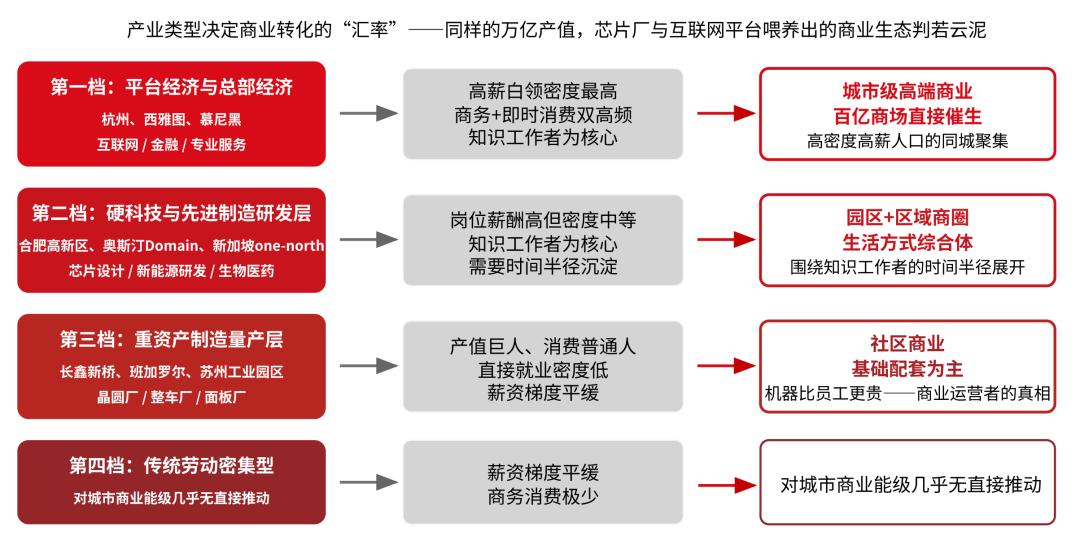
The Commercial Ceiling Depends on the Consumer Capital Behind the Industry
The transmission of industrial potential energy to commercial space requires not only the difference of "quality", but also the accumulation of "quantity". Enrico Moretti, an economist at UC Berkeley, put forward a groundbreaking view in his book *The New Geography of Jobs*: every new high-tech job can create 5 jobs in the long run — 1 direct job drives 2 local service jobs and 2 indirect jobs.
The 13,000 employees of Apple in Cupertino eventually gave rise to 70,000 indirect jobs in the entire core area of Silicon Valley. This number is not addition, but multiplication. However, the establishment of Moretti multiplier has an implicit premise: the density of high-tech jobs must reach a critical value. Through cross-analysis of global cases, RET has identified three key thresholds.
Threshold 1: About 500,000 high-quality employed population → regional-level business district
The permanent resident population of Hefei High-tech Zone is about 550,000, the radiation circle of The Domain in Austin covers about 500,000 knowledge workers, and the 50,000 people in one-north, Singapore may not be large at the scale of the whole city, but it forms an extremely high consumption density within a 2-kilometer walking circle. The threshold of 500,000 is not an arbitrary estimate, but the basic consumption chassis required for a medium-sized city to support a "regional lifestyle center".
Threshold 2: Permanent resident population of ten million level + young age structure → systematic expansion of urban commercial entities
Shenzhen is the most representative sample. With an average age of 32.5 years old, among its 14 million permanent residents, the proportion of people with bachelor's degree or above exceeds 30%. Youthfulness means strong consumption willingness, sufficient willingness to try new things, and high brand acceptance. The Shenzhen Bay MixC is steadily moving towards the 10-billion-yuan annual sales club, which is not accidental, but the natural spillover of the 10-million-level young population structure.
Threshold 3: More than about 200,000 high-income households → one 10-billion-yuan-level shopping mall
The project approval basis of Santana Row in San Jose is very precise: there are 200,000 households with an annual income of more than 100,000 US dollars within a 10-mile radius. Santana Row is not a simple shopping mall, but a complex of "open blocks + high-end retail + lifestyle experience", whose annual sales have long been among the top in California.
It is worth noting that in the population weighting model of these three thresholds, the order of importance is income level > age structure > educational composition > total population. The commercial conversion capacity of 10 million low-salary people may be far lower than that of 3 million high-salary people. That's why we call it "consumer capital" — it is the effective stock obtained by weighting the population from the consumption dimension, rather than the statistical number of permanent residents. Demographics is the household register of a city, while consumer capital is the balance sheet of a shopping mall. The two use the same set of numbers, but tell completely different stories.
The "Industrial Lag" of Commercial Development
If the four-tier conversion rate answers "how much can be converted" and the three thresholds answer "how much is needed", then there is another crucial question: "How long does it take?" The answer is that commerce never develops synchronously with industry. There is a systematic time lag between the "first thunder" of industry and the "first fallen leaf" of commerce. RET summarizes it into three stages:
Stage 1 (0-5 years): Spontaneous complementation of park commerce
In the first few years after the industry lands, the population inflow is employment-oriented, and the living radius spreads around the park. The commercial forms are dominated by spontaneous supplement of canteens, convenience stores, express hotels and chain brands. During the early expansion stage of Amazon in SLU, Seattle, lunch scenarios were long solved by food trucks. This is not backward, but a typical feature of the time lag period.
Stage 2 (5-10 years): Accelerated formation of regional business districts
When the population size breaks through the first threshold and "separation of workplace and residence" begins to appear — engineers are willing to accept a 30-minute commute for a better living environment — the soil for the formation of regional business districts comes into being. It took about 8 years for The Domain in Austin to be recognized as the "second city center" after Apple settled in. Hefei High-tech Zone is currently in the middle of this stage.
Stage 3 (10-15 years+): City-level commercial landmarks and high-end commerce break through the ceiling
Only when the industrial potential energy completes the leap from "park-level" to "city-level", and only when high-income families complete the identity transformation from "temporary residents from other places" to "local rooted residents", can city-level commercial landmarks be born. It took Seattle more than 20 years from the founding of Amazon in 1994 to the stable prosperity of city-level commercial flagships such as Nordstrom and Macy's.
Chengdu provides an interesting comparison. The "two-wheel drive" of the electronic information industry and consumer service industry allows the city to breed two 10-billion-yuan landmarks, IFS and Taikoo Li, before its industry reaches the level of Shenzhen and Hangzhou. This reveals an important supplementary proposition: the underlying tone of a consumer-oriented city can exist independently of the industrial underlying tone to a certain extent — but that requires the support of unique humanistic genes, consumption culture and tourist flow. Hefei does not have such innate conditions, so it must follow the transmission law of "industrial underlying tone determines the commercial ceiling" more strictly.
Observing Hefei in this time lag framework: Changxin Xinqiao started construction in 2016, which is less than ten years ago. Taking its listing in 2026 as a landmark node for the leap of industrial level, in accordance with the industrial transmission law, the breakthrough window of Hefei's city-level commerce will fall between 2030 and 2035.
Conclusion
Observing the commercial evolution of global cities, we will find that prosperous commerce never appears out of thin air, but is the result of long-term accumulation of the city. The city determines the boundary of growth, the industry changes the conditions of growth, and commerce is the shape left by time in the end. Commerce cannot be separated from the growth logic of the city itself. Trying to bypass the industrial underlying tone and directly copy Shanghai IFC or Beijing SKP is like only transplanting the canopy of a tree while ignoring the different soil under your feet. Architecture and brands can be copied, but what really determines whether they can grow is whether the city has formed matching wealth, people and lifestyles.
In the new stage when urban development shifts from expansion to reconstruction, professional operators and investors need to understand not only where the prosperity is, but also where the prosperity comes from and where it will grow. A good investment never chases the flowers that have already bloomed, but understands the soil before the flowers bloom.