Tencent can be as strong as it wants, NetEase just intends to firmly guard its own established business turf.
According to the 2026 Global Mobile Game Industry White Paper, the revenue scale of China's mobile game market in 2025 was about 285.92 billion yuan, with a slight increase of 0.56%. It is expected that the domestic mobile game revenue in 2026 will reach 293.99 billion yuan, representing a year-on-year increase of 2.82%.
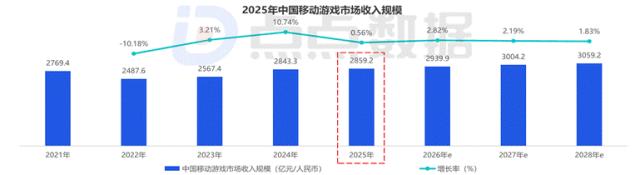
Data source: 2026 Global Mobile Game Industry White Paper by Diandian Data
Against the backdrop of a stock competition market and low-speed growth, the financial results NetEase delivered in the second quarter showed "counter-cyclical" characteristics.
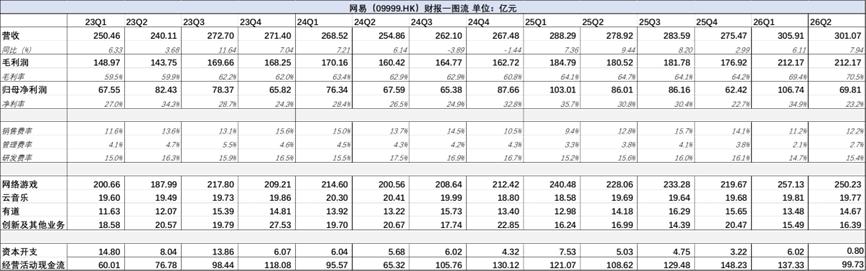
In the second quarter of 2026, NetEase recorded a total revenue of 30.107 billion yuan, representing a year-on-year increase of 7.9%, which exceeded market expectations of 29.45 billion yuan. Its gross profit reached 21.217 billion yuan, up 17.5% year on year; the gross margin was about 70.5%, representing a year-on-year increase of about 5.8 percentage points.
Differentiation emerged on the profit side. Under the Non-GAAP standard, the adjusted net profit was 7.75 billion yuan, down 18.7% year on year; the net profit attributable to shareholders was 6.981 billion yuan, with a net profit margin of about 23.2%. The earnings per share (on ADR basis) was 12.02 yuan, lower than the market expectation of 15.54 yuan.
The better-than-expected revenue mainly benefited from the resilience of the core business of key games such as Fantasy Westward Journey and Where Winds Meet; the pressure on the profit side almost entirely came from non-book items: investment losses of 2.953 billion yuan, exchange losses of 436 million yuan, coupled with an actual tax rate of 25.5%.
(The one-page financial report chart is as follows, all data are from Wind and corporate financial reports, the unit is 100 million yuan, the same below)
Our core views are as follows:
Overall, against the backdrop of peers' pressure resistance, NetEase's Q2 financial report delivered a high-quality performance. The market prices this financial report based on net profit, while we prefer to price it based on operating profit and cash flow. The essence of short-term valuation divergence is the dispute over weight: which one can better represent NetEase, the 3.4 billion yuan non-operating loss or the 33% operating profit growth rate? The long-term answer still lies in new products: whether Infinity and Return to Tang can take over the baton of long-established IPs determines whether this quarter's "undervaluation" is an opportunity or a trap.
The specific analysis is as follows.
01
Revenue exceeded expectations, NetEase focuses on its core game business
In the second quarter of 2026, NetEase achieved a revenue of 30.107 billion yuan, a year-on-year increase of 7.94%, exceeding the market expectation of 29.45 billion yuan. Against the background that the overall market growth is almost zero, this growth rate is of high gold content.
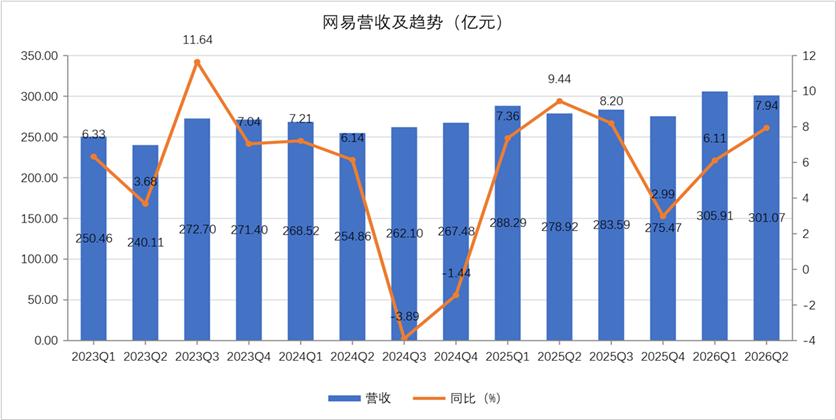
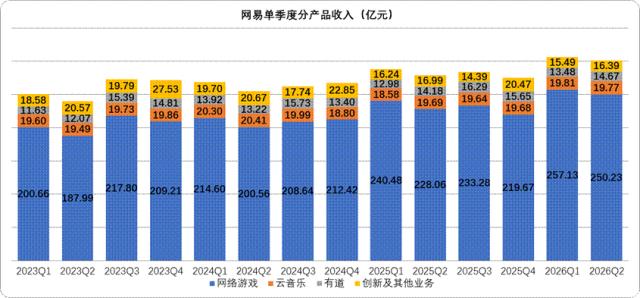
By product segment, the revenue from online games and related value-added services contributed the most to the growth. In Q2 2026, NetEase's online game revenue reached 25.023 billion yuan, up 9.7% year on year, accounting for 83.1% of the total revenue. On the supply side, NetEase only launched one lightweight new game Star Paint Sunny Day in the second quarter (the PC early access version was released at the end of April, and the mobile version was launched at the end of June), which is particularly low-key compared with the intensive promotion and new launch pace of large peer manufacturers.
The revenue of Youdao and NetEase Cloud Music increased slightly with mediocre performance. For the specific financial analysis of NetEase Cloud Music's Q2 financial report, please refer to the previous article NetEase Cloud Music Doesn't Want Soda Music to Take Its Last Note, and we won't elaborate too much here.
So in the window period without intensive new game launches, where do the revenue growth points of the online game sector come from?
Judging from the Q2 data, the core of growth comes from the resilience of long-established IPs and new flagship products. Series such as Fantasy Westward Journey, Identity V, Eggboy Party, the mobile version of Justice Online and Where Winds Meet still performed strongly. The mobile version of Justice Online launched its "New World" anniversary version in June, with the number of active players exceeding 10 million on the first day, and the online number hit a new high in two years; the registered users of Eggboy Party exceeded 700 million, and the monthly active users remained stable at more than 100 million.
Net revenue from online games accounted for about 97.7% of the segment's net revenue, compared with 97.5% in the previous quarter and 97.1% in the same period last year. Looking at online games alone, the net revenue in the second quarter was about 24.5 billion yuan, up 10% year on year and down 2% quarter on quarter.
Different from Tencent's game product path that relies on large DAU and scale effect, NetEase often takes a different approach: asymmetric competition, quirky SOC, UGC party, urban open world, relying on strong self-development capabilities combined with mechanism micro-innovation to achieve vertical breakthroughs.
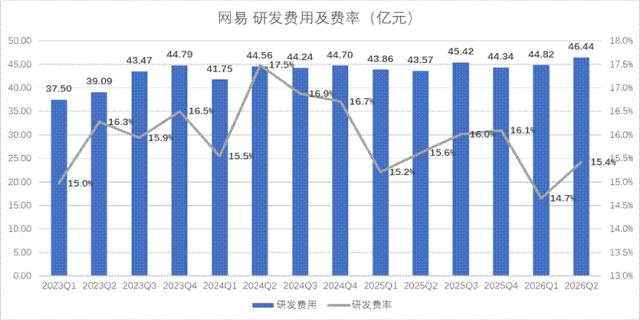
This differentiated product strategy is directly reflected in high R&D investment. In the second quarter of 2026, NetEase's R&D expenses reached 4.644 billion yuan, hitting a new all-time high for a single quarter; the R&D expense ratio was 15.4%, a slight decrease of 0.2 percentage points year on year. The absolute amount has hit a new high while the ratio is converging, indicating that the investment intensity is not out of control.
We have counted the R&D data comparison between NetEase and major peer game and internet companies in the second quarter of 2026.
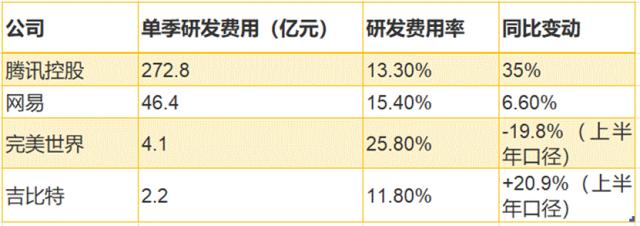
Note: The single-quarter data of Perfect World and Gbits are calculated by subtracting the first-quarter report from the semi-annual report, and the year-on-year change is based on the half-year caliber; Tencent's R&D expenses include large model and AI-related investment. Data source: financial reports of various companies, Wind.
Putting peers in the same table, NetEase's R&D coordinate system can be clearly seen. Tencent's R&D expenditure in the second quarter was 27.28 billion yuan, up 35% year on year, which is 5.9 times that of NetEase; the single-quarter R&D expenses of Perfect World and Gbits were about 410 million yuan and 220 million yuan respectively, NetEase's 4.644 billion yuan single-quarter R&D is about 7 times the sum of Perfect World and Gbits, and only one sixth of Tencent's. It is in a unique ecological niche: it has enough funds to support 3A pipelines, and is not kidnapped by the arms race of general large models.
The real difference lies beyond the R&D account. Tencent's capital expenditure in the second quarter was 52.8 billion yuan, a sharp increase of 176% year on year, and the single-quarter free cash flow was negative 13.8 billion yuan, turning negative for the first time since its listing, which is the cost of fully betting on general AI computing power. NetEase's capital expenditure for purchasing and constructing fixed assets in the same quarter was less than 100 million yuan, and the cash flow from operating activities was 9.973 billion yuan.
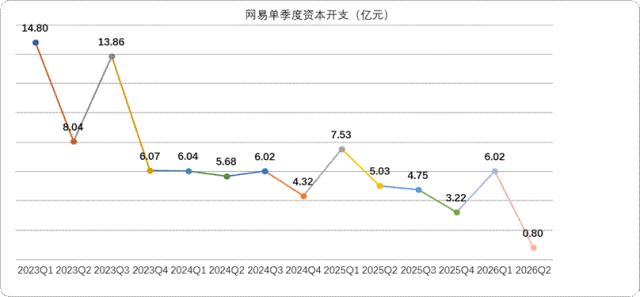
On the one hand, there are big moves in R&D, on the other hand, the game promotion is extremely restrained. Where does NetEase's R&D investment flow to?
Combining public information and financial report disassembly, this huge R&D expenditure is mainly composed of four major sectors:
First, to provide industrial pipeline funds for a number of high-consumption, long-cycle 3A-level blockbuster games under development such as Infinity and Return to Tang;
Second, to cover the regular salary and operating costs of multiple overseas studios located in North America, Europe and Japan;
Third, to continuously iterate the self-developed underlying engine, and deeply integrate AI automation into the whole game production process such as art and motion capture;
Fourth, to take into account the technical iteration of non-game businesses such as NetEase Youdao's AI hardware and Cloud Music algorithm.
Outpost was launched in March 2025, and no longer occupies the funds of the R&D pipeline. The real "money guzzler" in the pipeline is the uncommercialized Infinity and Return to Tang.
In fact, it is not difficult to see from NetEase's R&D investment moves that compared with focusing on the capital expenditure of general large models, NetEase pays more attention to AI assistance in vertical fields. This strategy seems to be "regressive" under the current general AI boom, but it is extremely in line with the capital efficiency logic of content-oriented enterprises: instead of paying the expensive "general AGI capital expenditure tax", it is better to turn computing power into productivity for art, motion capture and AI NPCs.
The 2026 AI Penetration Report of China's Listed Game Companies by Diandian Data draws a very interesting conclusion: it has been more than 3 years since AI appeared and was officially integrated into the business of game enterprises. But judging from the actual performance of financial report data, the addition of AI has not yet enabled enterprises to achieve the result of "widespread cost reduction and efficiency increase". At best, it can only be considered that there are signs of improvement on the cost side. For such large vertical game manufacturers, the actual benefits brought by focusing on AI and large models are not as high as imagined.
For NetEase's capital allocation model of "high R&D investment and long recovery cycle", the essence is to focus limited resources on the core game business. Judging from the financial report, NetEase also has sufficient methodology for the operation of long-established games.
02
Channel dividends drive short-term profits, gross margin is close to the ceiling
Let's look at the profit side.
In the second quarter of 2026, NetEase's gross profit was 21.217 billion yuan, up 17.5% year on year; the gross margin was 70.5%, up 5.8 percentage points year on year and 1.1 percentage points quarter on quarter, reaching the highest level in a single quarter in the past three years.
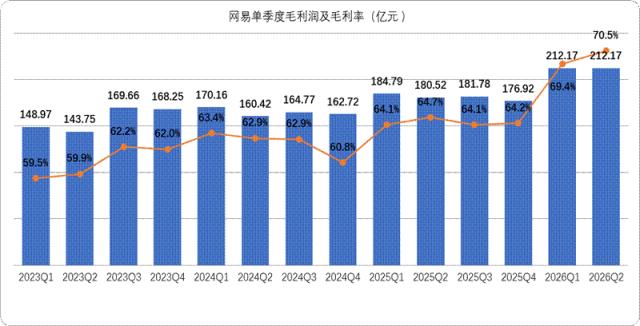
Driven by the growth on the revenue side, the increase of the high gross profit part of online games contributed to the high gross margin growth in this quarter. From the segment perspective, the gross margin of online games in the second quarter was 76.1%, up 1.3 percentage points quarter on quarter and 5.9 percentage points year on year