Five years after the implementation of the double reduction policy, platforms represented by VIPKID have returned with a completely new architecture.
01
How Is This Course Sold Now
On July 24, 2021, the "double reduction" policy was officially implemented, and the rule of "strictly prohibiting the employment of overseas foreign personnel to carry out training activities" was written into the official document. As of today in 2026, more than five years have passed.
In June five years later, two scenarios emerged.
One is in the capital market. On June 12, 51Talk released its 2026 Q1 financial report: revenue reached 31.2 million US dollars, a year-on-year increase of 70.9%, with 132,900 active students, hitting a new quarterly high since the divestment of its mainland China business. Founder Huang Jiajia announced that an integrated "AI + real person" learning product will be launched within the year. One month ago, he also increased his holdings by 73,100 shares in the secondary market, and the company has a repurchase plan at the level of tens of millions of US dollars.
The other is feedback from parents. VIPKID, which has been silent for several years, reappeared with the combination of "overseas site + AI courses": parents pay in RMB, the Singaporean company collects the payment, and children attend classes through accounts registered with Hong Kong area codes.
It turns out that the original course has not disappeared, it just adopted a new structure.
Let's look at a specific transaction. According to the report of Yangtze Evening News, Ms. Qiu from Nanjing spent 25149.03 yuan to buy 144 one-on-one foreign teacher courses on VIPKID in 2024. After taking 87 classes, she applied for a refund on March 4, 2026. The customer service's plan is: refund in US dollars, 645.375 US dollars, plus a handling fee of more than 1000 yuan. The payment record shows that the payee is not a Beijing-based company, but VIPTEACHER PTE.LTD. registered in Singapore, and the payment processor Airwallex is also a Singaporean company.
Classes are attended via the VIPKID Global overseas site account registered with the "+852" Hong Kong area code, and class hours are deducted from the account registered with a Chinese mainland mobile phone number; the account is registered under the name of an adult during enrollment, while the actual learner is a child. The new version of the agreement has deleted the appellations of "child" and "student parent"; the contract with parents is signed by Beijing Rice Technology Co., Ltd., whose paid-in capital is 1 million yuan, with 0 social security contributors in its 2025 annual report, and its business scope does not include "education and training".
Several links are connected: domestic marketing for customer acquisition, overseas entity collecting payment, overseas accounts for class delivery, and domestic company signing contracts. A lawyer pointed out to the media that such operations are suspected of evading domestic approval and supervision, and may involve issues of data security and foreign exchange control.
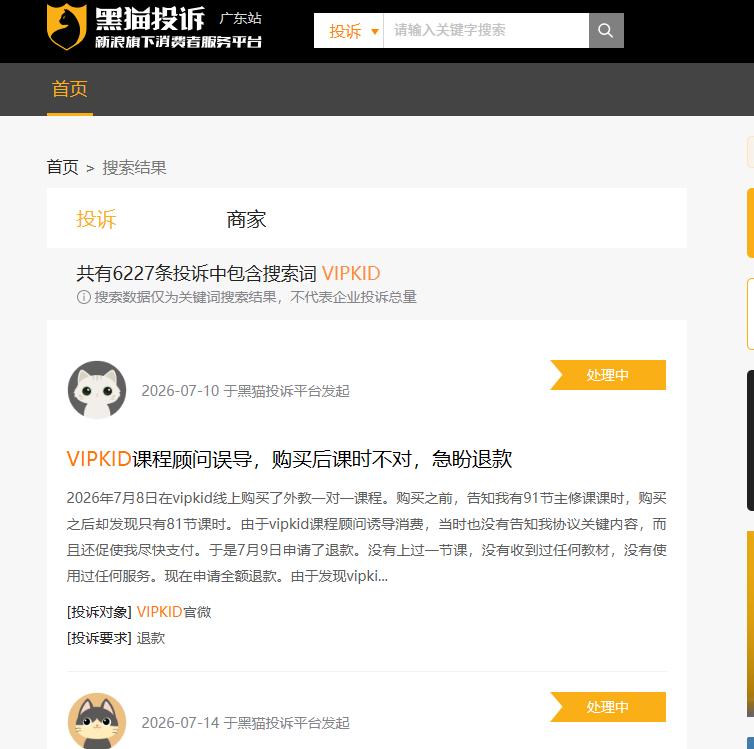
As of the recent date, there are more than 6000 VIPKID-related complaints on the Black Cat Complaint Platform, focusing on "difficulty in refund" and "failure to fulfill promises".
02
How the Policy Stipulates and How the Financial Report Is Written
First, clarify a misunderstanding. The rule that "the fee cannot exceed 5000 yuan" targets non-academic training, while "3 months or 60 class hours" is the general red line. For one-on-one overseas foreign teacher courses targeting domestic primary and secondary school students, the problem is not whether it exceeds the limit, but that it is prohibited for sale.
The "double reduction" guidelines issued in 2021 clearly state: It is strictly prohibited to hire overseas foreign personnel to carry out training activities, and strictly prohibit the provision of overseas education courses. Five years have passed, and this ban has not been loosened. The two provisions are retained as they are in the "Special Reminder" of the latest 2025 version of the "Off-campus Training Service Contract for Primary and Secondary School Students (Model Text)" jointly released by the Ministry of Education and the State Administration for Market Regulation. Documents issued by 12 departments including the General Office of the Ministry of Education in December 2022 require strict investigation of online academic training carried out by overseas online platforms for domestic primary and secondary school students.
In December 2025, the Haidian District Education Commission replied to the complaint in writing: Beijing Rice Technology Co., Ltd. "only operates with a business license, and is not a training institution approved by the Haidian District Education Commission".
The Regulations on the Administration of Off-campus Training was open for public comments in February 2024, and has not been officially implemented so far. In the notices on the investigation of hidden and variant training in various regions, the named targets are offline one-on-one tutoring, after-school care, and live-in tutors, and no online foreign teacher platforms have been mentioned. The National Comprehensive Platform for Off-campus Education Training Supervision and Services has included more than 120,000 compliant institutions (according to the caliber of the Ministry of Education in March 2025), and no records of VIPKID or 51Talk settling in with training qualifications can be found through public channels.
Then look at the financial report. 51Talk is listed on the US stock market, and the following data comes from its Q1 report released on June 12, 2026.
As of March 31, 2026, student prepayments reached 78.9 million US dollars, higher than the 76.6 million US dollars at the end of 2025. These are large course packages prepaid by parents, which are not counted as revenue in accounting, but are class hours to be delivered. At the same point in time, the company's total cash, cash equivalents and time deposits amounted to 35.5 million US dollars, lower than the 39 million US dollars at the end of 2025. Prepayments are already 2.2 times the cash assets, and the gap is expanding.
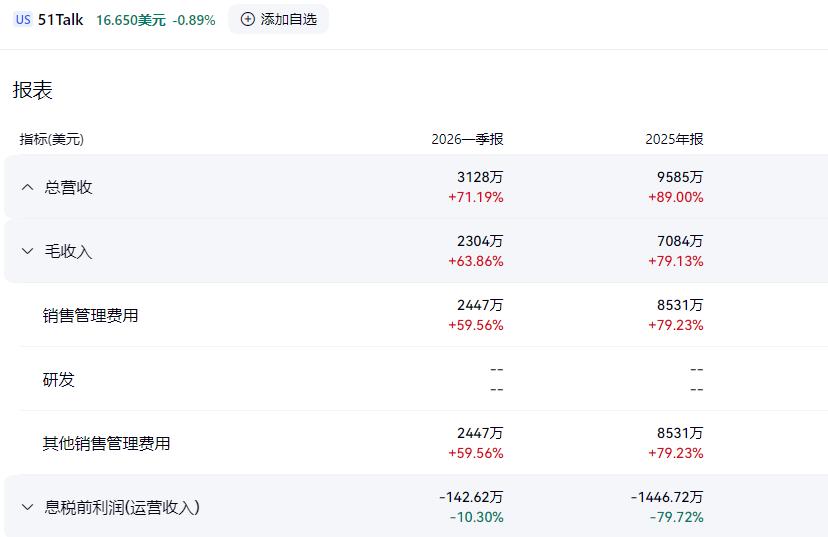
Revenue in the first quarter was 31.2 million US dollars, a year-on-year increase of 70.9%; net cash income was 33.3 million US dollars, a year-on-year increase of 51.9%; net loss was 2.3 million US dollars, compared with a loss of 1.7 million US dollars in the same period last year. Sales and marketing expenses were 17.9 million US dollars, a year-on-year increase of 59%, accounting for nearly 60% of the quarter's revenue. The company needs to continuously sell large course packages, and use new prepayments to deliver old class hours; every refund directly uses existing cash.
The risks fall on the side of the domestic entities. According to the annual report caliber, the company's net assets have been negative for three consecutive years: -8.34 million US dollars in 2023, -15 million US dollars in 2024, and -31.36 million US dollars in 2025. 100% of its revenue comes from overseas, and its headquarters is located in Singapore. The original domestic operating entity, Beijing Dasheng Zhixing Technology Co., Ltd., has a registered capital of 1.166 million yuan, with 0 social security contributors in its 2025 annual report; the current contracting entity, Shenzhen Dasheng Zhixing Education Technology Co., Ltd., has 4 social security contributors.
It should also be noted that the overseas business is indeed growing, but the refund risk under the prepayment model is borne by domestic parents.
03
What Judgments Have the Courts Issued
In the past few years, the courts have formed stable adjudication rules for such disputes.
First, the "double reduction" policy constitutes a change of circumstances, and the court will support parents' requests to terminate the contract and refund the prepaid fees.
Second, AI courses cannot be forcibly substituted. In the case of (2023) Jing 03 Min Zhong No. 2923, VIPKID claimed that the class hours had been converted into AI intelligent learning courses and should continue to be performed. The Beijing Third Intermediate People's Court determined that the intelligent learning courses are education and training services with strong personal attachment attributes, which are not suitable for compulsory performance.
Third, free bonus courses are handled differently. The judgment of (2023) Jing 03 Min Zhong No. 5706 establishes that: free bonus courses for purchase-gift or compensation purposes have monetary consideration and should be refunded; pure activity-based free bonus courses have no paid consideration and are non-refundable.
Fourth, the jurisdiction clause can be challenged. The 51Talk agreement stipulates that "the lawsuit shall be filed with the court at the location of 51Talk", which once transferred a batch of cases of Beijing parents to Shenzhen in 2023; the judicial interpretation on prepaid consumption in 2025 lists "dispute resolution clauses that unreasonably increase consumers' rights protection costs" as invalid circumstances, and in December 2025, Shenzhen courts have already had precedents that determined the invalidity of standard arbitration clauses based on this rule.
The refund is "discretionary" rather than "fully refunded for sure". The court will deduct the costs already invested by the platform, and the refund amount will also be reduced at discretion if the student has his own fault. In a case heard by the Chuxiong Court of Yunnan Province in January 2026, the court ordered a 70% refund because the student had been negligent in attending classes for a long time.
The key lies in enforcement. After parents win the lawsuit, the counterparty they face is the contracting entity with paid-in capital of 1 million yuan, 0 social security contributors, no education and training qualifications, and all assets located overseas. How much of the judgment can be enforced depends on how much enforceable property is left in China.
The model is still evolving: real-person overseas foreign teachers are banned, and AI foreign teachers fill the gap; domestic payment collection is restricted, and overseas payment processing takes over. The supervision is also being improved. The Measures for the Supervision and Administration of Off-campus Online Training Institutions in Guangdong Province has been implemented since September 1, 2025, requiring online institutions to hold complete licenses, pass annual inspections and submit annual reports, and the employment of foreign personnel complies with national regulations.
More critically, the pending Regulations on the Administration of Off-campus Training has already stipulated prepayment supervision and provincial-level approval for online training in the draft for comments. When the regulation is officially implemented will determine how long the structure of "overseas site collecting payment and domestic entity signing contracts" can operate.
How to draw the compliance boundary for education and training enterprises going overseas is still an unsolved mystery.
This article is from the WeChat official account "Qidian Pai", written by Li Yan, and authorized for release by 36Kr.