A well-known brand under LV, its Chinese partner has withdrawn.
On August 19, Shanghai Jahwa released an official announcement that it plans to sell its 19% equity stakes in both Sephora Shanghai and Sephora Beijing to Sephora Asia for 70 million euros (approximately 555 million yuan), ending a 22-year joint venture partnership.
This full divestment has also laid bare the operational difficulties of Sephora China. Financial reports show that Sephora China has accumulated total losses exceeding 1.4 billion yuan since it turned to deficit in 2022.
To restore customer flow, Sephora is incubating its own beauty brands on one hand, and introducing a large number of domestic Chinese brands to its shelves on the other.
Sephora, which once held top international brands and defined the high-end beauty market in China, has ended up in a loss-making predicament. What realistic challenges will Sephora China face next after its local shareholder completely exits the partnership?
How did Sephora slip into this situation?
Sephora was founded in France in 1969 and joined the LVMH Group in 1997.
When it first entered the Chinese market, Shanghai Jahwa and Sephora Asia established a joint venture to operate its online and offline businesses in China.
Sephora Asia is wholly owned by Sephora SAS (France), a subsidiary of the LVMH Group. The two joint ventures Sephora Shanghai and Sephora Beijing are 81% owned by Sephora Asia, and 19% owned by Shanghai Jahwa.
As of March 31, 2026, Sephora has a total of 322 stores across China.
According to data disclosed in Shanghai Jahwa's financial reports over the years, Sephora China once experienced a period of profitable growth. From 2019 to 2021, Sephora Shanghai and Sephora Beijing recorded a combined total profit of nearly 1.5 billion yuan.
2021 marked the peak of Sephora China's performance, with the two companies generating a total operating revenue of 10.876 billion yuan and a net profit of 431 million yuan that year.
Since 2022, its performance has shifted from profit to loss. In 2022, the two companies posted a combined revenue of 8.55 billion yuan with a net loss of 190 million yuan; in 2023, the revenue reached 8.76 billion yuan with a net loss of 140 million yuan; in 2024, the revenue further dropped to 7.14 billion yuan, with the net loss expanding to 646 million yuan; in 2025, the revenue fell again to 6.536 billion yuan, with a net loss of 499 million yuan.
In the first quarter of 2026, Sephora Shanghai achieved a net profit of 26.6081 million yuan, while Sephora Beijing recorded a net loss of 16.8367 million yuan. From 2022 to 2025, the two companies suffered a combined loss of over 1.4 billion yuan.
What are the reasons behind Sephora's loss-making situation?
Dr. Zhou Ting, a luxury industry expert and dean of the VIP Customer Research Institute, told Interesting Report that the difficulties mainly come from three layers of impacts: "First is the impact of channel iteration. International brands have built their own direct sales channels one after another, coupled with diversion from duty-free channels and live streaming e-commerce, the channel value of collection stores featuring 'exclusive product selection + one-stop shopping' has been greatly diluted, and neither the price nor the product categories retain scarcity anymore."
For example, a 100ml bottle of Bvlgari Pour Homme perfume is priced at 1110 yuan on Sephora's official mini-program, the same price as on Bvlgari's official mini-program. But if you purchase it on Bvlgari's official flagship store, you can get free gifts related to Bvlgari fragrances, while the same bottle is only priced at 634 yuan on the China Duty Free Rishang mini-program.
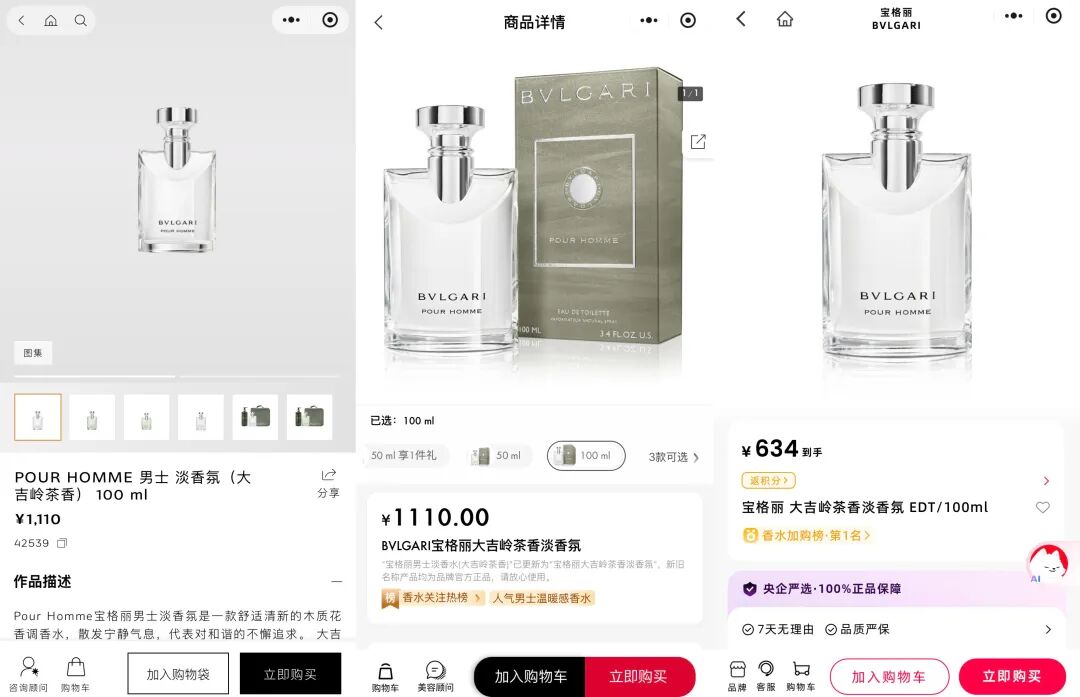
Image source: Bvlgari, Sephora, China Duty Free Rishang mini-programs
"Second, the high-end positioning is self-undermined. To drive customer flow, Sephora has massively introduced mass-market domestic Chinese brands and online viral best-selling products, which has dislocated the perception of its original high-end customer groups," Zhou Ting said.
Around 2020, Sephora had successively introduced high-end lines of local brands such as Mao Geping · Luminous and Inoherb · Tang. In 2022, Sephora China launched the "Shine with Chinese Brands" program, planning to support 5 local brands to become high-end beauty representatives with annual sales exceeding 100 million yuan within 3 years.
In December 2024, skincare brand UNIFREE officially entered 50 Sephora stores across the country. In 2025, Sephora China introduced 9 local brands one after another. The first batch included WEN, East Wind, Comfy; the second batch included SANSAN, Joocyee, GLOWSIS and others.
In 2026, Sephora announced the introduction of 11 more Chinese local beauty brands including Florasis, Perfect Diary, Judydoll, FAN BEAUTY and others. Up to now, more than 20 Chinese brands have settled in Sephora.
These settled brands show obvious stratification. Brands such as WEN, East Wind, Comfy, Mao Geping · Luminous and UNIFREE belong to mid-to-high-end or niche characteristic brands; brands such as SANSAN, Joocyee, Lõhocos, BABI belong to affordable color cosmetic brands, with most single products priced at around 100 yuan, and some even below 50 yuan. Sephora has set up a new "The Next Big Thing" zone for these affordable brands for sales.
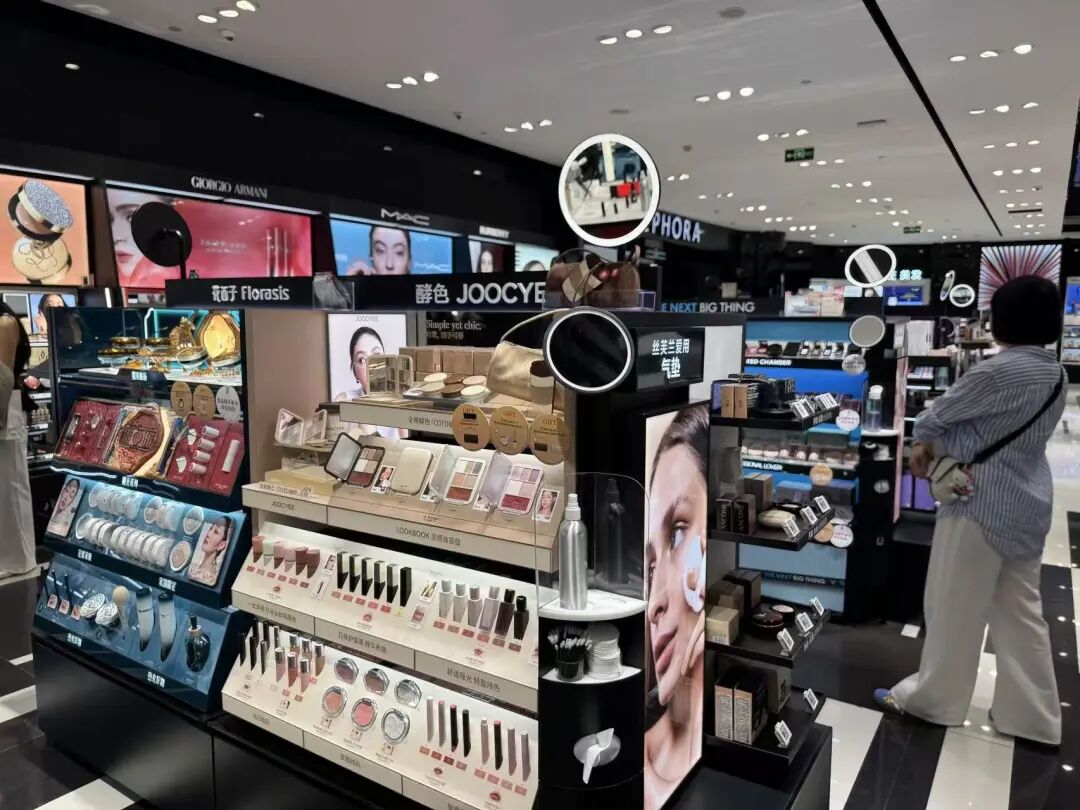
Domestic Chinese brands in Sephora | Photo by Wang Hanyi
Different opinions have emerged on social platforms regarding Sephora's introduction of a large number of domestic Chinese brands. Some consumers believe that the entry of domestic brands enriches choices and is more suitable for Chinese people's skin types; other consumers think that these settled brands have lowered the tonality of the stores. Some netizens described it as "a bit like finding Miniso in SKP", while others joked that Sephora has "turned into a small KKV" and "become a miscellaneous brand collection store".
"Third is the squeeze from local competitors. The competition among local beauty collection stores is fierce, with the rise of local beauty collection stores such as HARMAY, WOW COLOUR and The Colorist, which has diverted Sephora's customer flow," Zhou Ting added.
When consumers have more choices, Sephora, which no longer has the upper hand in price advantage, is destined to no longer be the "only choice" for consumers.
Challenges Remain
After Shanghai Jahwa completes the equity sale, Sephora China will be fully controlled by the foreign shareholder, and the realistic challenges it faces will not disappear along with the divestment.
Bai Yunhu, a management expert in the cosmetics industry, pointed out to Interesting Report: "The beauty collection store industry has bid farewell to the incremental era. In the past, Sephora's model could work smoothly relying on the premium brought by big brands, but now the market logic has changed. Sephora's move to increase investment in domestic Chinese brands has the advantage of making up for its understanding of Chinese consumers' skin types, aesthetic preferences and efficacy demands, as well as filling the gaps in its product portfolio. But the risks are also prominent, as it is extremely difficult to strike a balance between its high-end positioning and the mass-market product portfolio targeted at online traffic."
"Blindly introducing online viral bestsellers without making them exclusive, limited-edition or customized will only turn Sephora's stores into offline makeup trial rooms. Consumers will try the products in store and then place orders online, leaving the stores with no conversion. If Sephora stubbornly sticks to the pure international big brand route, it will face the dilemma of brand owners building their own independent channels and continuously shrinking customer flow," Bai Yunhu added.
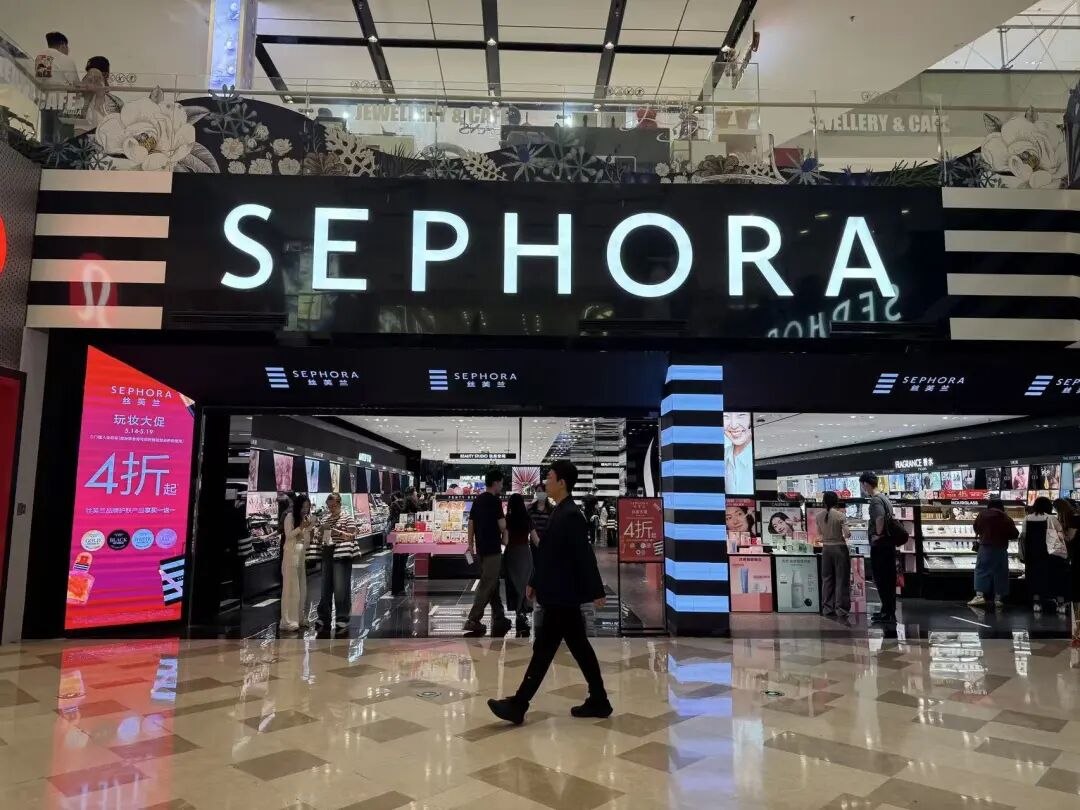
Many consumers are visiting offline Sephora stores | Photo by Wang Hanyi
Zhou Ting also believes that the underlying demand for most people to choose Sephora's services is to get a high-end, curated shopping experience. "It is very difficult to get both traffic and retain the high-end brand essence."
In fact, in addition to the continuous downward adjustment of product selection, Sephora China has launched comprehensive reforms in dimensions including store layout and internal management.
Sephora's stores have expanded from focusing on core business districts in first- and second-tier cities to more third- and fourth-tier cities. At present, Sephora has entered cities such as Yichang, Linyi, Jiujiang, Ganzhou, Yangzhou and Jiangmen.
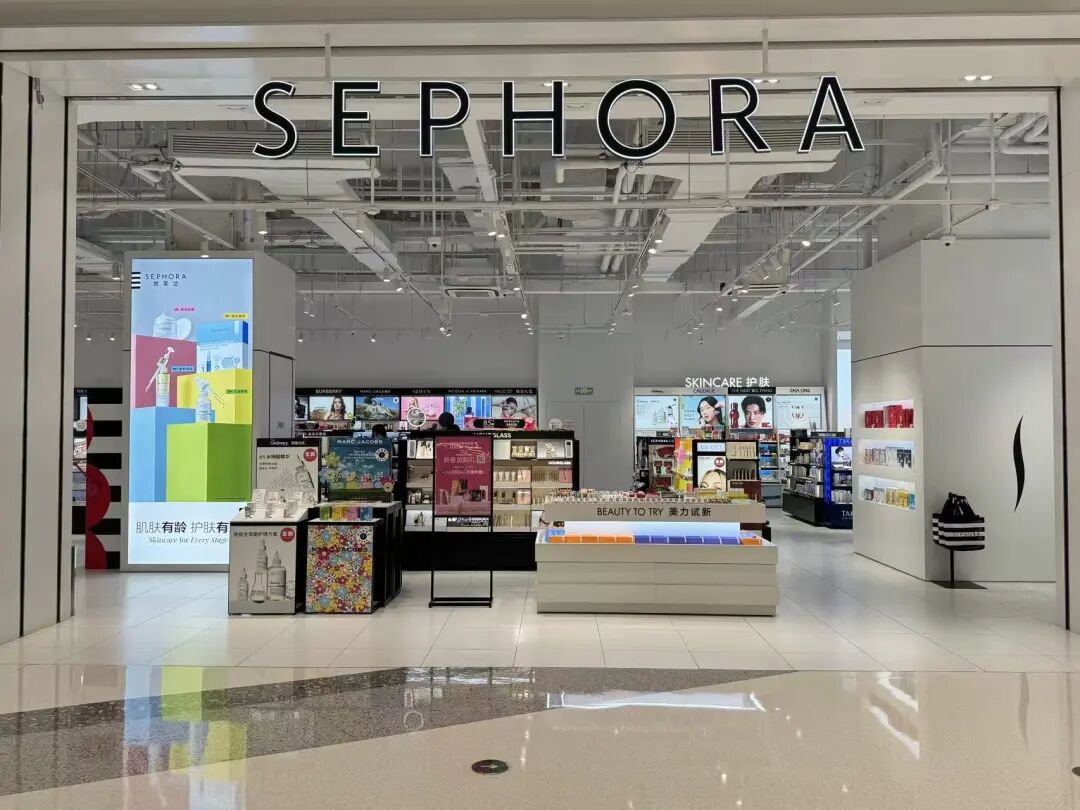
Offline Sephora store | Photo by Wang Hanyi
In the past two years, Sephora China's management has also undergone intensive changes. In January 2024, Chen Bing, the former General Manager of Greater China who had served for five years, left the company; in April of the same year, Ding Xia, former President of JD Fashion who has rich experience in digital operation, took over the position with high expectations for driving digital transformation.
In March 2025, Guillaume Motte, Global CEO of Sephora, directly took over the China region business and took back the local operation authority. During the same period, Zhou Yingyan, Chief Operating Officer of Greater China, stepped down, and many core executives in charge of marketing, retail and other departments left one after another, bringing a full reshuffle of the core team.
From channel sinking, product selection adjustment to senior management reshuffle and direct headquarters management, Sephora China is pushing forward a top-down in-depth transformation. Now, the difficulty level of this transformation has further increased.
This article is from the WeChat official account "Interesting Report", written by Wang Hanyi, edited by Tianna Xi, and authorized for release by 36Kr.