The boom of "one-person companies" in Xiongan: P7-level employees laid off by large tech enterprises are leveraging AI to piece together their own "capital dreams".
"When a single person is a whole company, technological leverage is both honey and arsenic."
In several quiet tech incubators in Xiong'an New Area, a brand-new form of office is spreading quietly. There are no rows of monitors and busy teams on the desks here, usually only a laptop, a few cups of coffee, and an entrepreneur with focused eyes.
A large number of them are mid-to-senior employees of large Internet companies who left their jobs from Beijing's Houcuncun or Hangzhou to start businesses in the past two years — former P7 and P8 level architects and senior product managers. After experiencing the layoff wave and age crisis in the Internet industry, they did not choose to "cut salaries and polish resumes" in the weak recruitment market. Instead, with the systematic business thinking endowed by large enterprises, they came to regions with lower living costs and more intensive policy support, and formed their own OPC (One-Person Company).
Relying on AI capabilities represented by Agents and small expert models, these "solo combat" entrepreneurs are trying to prove the possibility of OPC: in the AI era, a single person can run a listed company.
However, behind this seemingly romantic "solo capital dream", there hides the cruel backlash brought by the popularization of technological leverage.
01
Assembling a "virtual assembly line" with AI
"Previously, to develop a software in a large enterprise, product managers needed to write documents, UI designers draw prototypes, front-end and back-end engineers write codes, QA do testing, and finally operation teams run advertisements. This assembly line required a team of at least 10 people, and the monthly salary expense alone would be 200,000 to 300,000 yuan."
Standing by the floor-to-ceiling window of an incubator in Xiong'an, Zhang Rui (pseudonym), who used to be a senior product expert at a leading Internet company and is now the founder of an OPC, shows his workbench. On his computer desktop, there is no complex development environment, replaced by a set of self-built AI agent orchestration workflows.

Zhang Rui currently operates a data analysis SaaS tool targeting overseas niche markets. In this company with only himself, product requirement analysis is automatically extracted by a large model optimized with specific prompts; the UI interface is built by AI code generation tools to complete front-end development within hours; back-end data cleaning and API docking are automatically run at night by a locally deployed streamlined small model; even promotion copies for overseas social media and customer service email replies are processed by "virtual employees" in different positions at different time periods.
In the past, such a startup idea was financially infeasible. But with the leap in performance of open-source small models and the maturity of Agent frameworks, the technological leverage that a single individual can control has been amplified dozens of times. Zhang Rui defines his company as a "digital factory assembled with small AI models". He no longer needs to pay expensive labor costs, nor does he need to consume energy for team management, and the gross profit margin of the company even remains above 80%.
This "one person as a whole team" model is attracting more and more technical elites to join. The low-cost office spaces and policy conveniences launched in Xiong'an and other places have further become the hotbed of this "one-person company" wave.
02
Vulnerability Under Prosperity: When Technical Barriers Disappear
However, the productivity leverage that AI gives to a single person is an extremely sharp double-edged sword. While endowing individuals with strong development capabilities, it also erases the technical barriers of traditional software development in a devastating way. If you mistake the outbreak of this individual leverage for a reduction in the difficulty of starting a business, you will fall into a "cognitive trap" for OPC competitiveness.
"When you can assemble a product with three Agents in a few days, it means others can also make an identical substitute within 48 hours."
Zhang Rui admitted that he launched a document parsing tool for a specific industry in the first half of this year, which achieved profitability in the first month after launch. But only two weeks later, more than a dozen competitors with completely overlapping functions and even lower prices appeared on the market. Some of the competitors were even directly assembled by interns from large Internet companies using open-source Agent frameworks on weekends.
This is the contradiction of the "one-person company" model: the popularization of technical productivity leads to an exponential increase in the speed of product homogenization and barrier dilution.
In the traditional context of Internet entrepreneurship, team scale, code accumulation and technical expertise themselves form a moat. And when code writing, interface design and even business plan writing degenerate into calls to large model APIs, "technology" is no longer a barrier, but degenerates into the most easily replicated general-purpose infrastructure.
What makes solo entrepreneurs even more suffocated is the relentless squeeze from ecological giants. Many niche scenarios carefully selected by OPCs, once valued by giants such as ByteDance, Alibaba or Tencent, the giants only need to add an Agent plugin to their existing native applications, or directly integrate the function in the next large model version update, and the user traffic accumulated by the one-person company over several months will return to zero in an instant.
03
Shifting From "Writing Code" to "Asymmetric Resources"
If technology is no longer a moat, what ultimately supports the capital dream of "one-person companies"?
After experiencing several setbacks where products were quickly imitated and traffic suddenly stopped, some forward-looking OPC entrepreneurs began to adjust their competition logic. They realized that the core of independent entrepreneurship in the AI era has completely shifted from "technology-driven" to "asymmetric resources and in-depth scenario-driven".
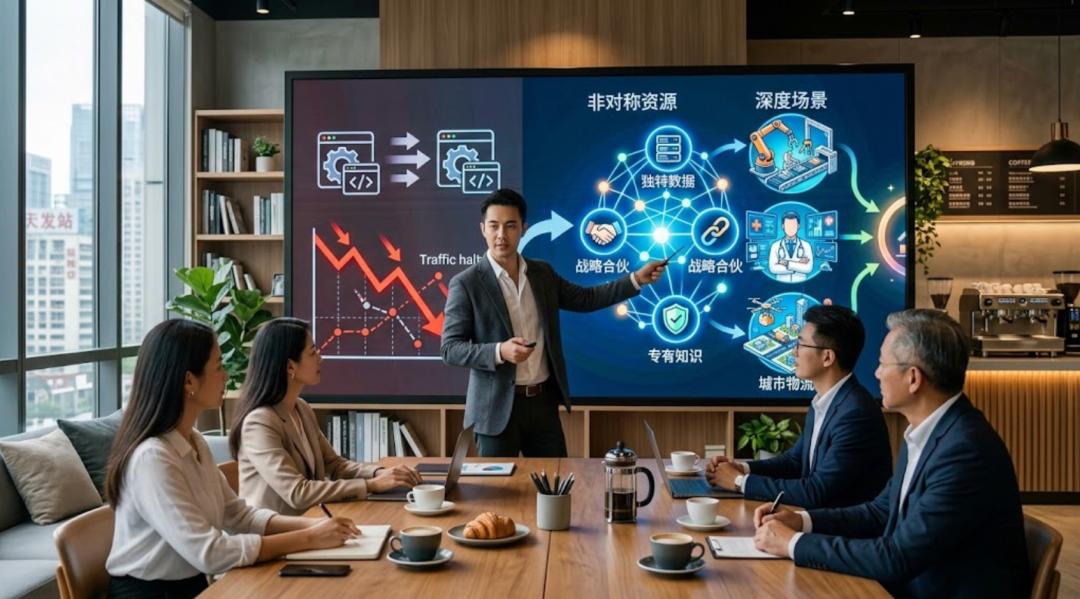
1. Embrace "Heavy Performance" and In-depth Industry Know-how
Pure digital products (such as text generation and simple tools) are extremely easy to replicate, but services deeply bound to offline physical scenarios and specific industry workflows are difficult to be replaced by pure technology. For example, some entrepreneurs use AI Agents to assist supply chain order matching for specific local industries, where AI only undertakes 20% of the efficiency improvement function, while the entrepreneur's own familiarity with the industrial supply chain, offline connections and trust endorsement account for 80% of the barriers. This business closed loop deeply embedded in the physical world cannot be easily invaded by large enterprises and pure technology imitators.
2. Seize the Extremely Marginal Ecological Gaps That Large Giants "Look Down On and Find Too Troublesome"
Giants need big DAU stories with hundreds of millions of users, while the living space of OPCs precisely exists in those marginal fields with annual revenue at the level of several million yuan, extremely segmented market scale, and extremely difficult for large giants to carry out standardized promotion. In these fields, one-person companies can live quite comfortably relying on extremely low operating costs, while giants cannot afford to compete at all due to their huge organizational costs.
3. Build Personal IP and Private Domain Trust
In an era flooded with AI-generated content and severe homogenization, "real trust" has become a scarce resource. Many successful OPC founders are opinion leaders in the industry themselves. What users pay for is ostensibly a set of AI-assisted software tools, but the underlying logic is trust in the founder's personal professional ability and aesthetic taste. This private domain barrier based on interpersonal connection cannot be mirrored and replicated by any algorithm or Agent.
04
Can OPC Remain "Decent" All the Time?
The "one-person company" wave surging in Xiong'an is essentially a product of the interweaving of technological changes and the reshaping of social organization forms.
It is not only a product of mid-to-senior technical talents seeking to deconstruct the traditional employment relationship and achieve self-rescue under the squeeze of large enterprises, but also a bold challenge launched by individual productivity to traditional organizational forms after the maturity of AI computing power infrastructure.
However, this entrepreneurial experiment is destined to be cruel. Most of the one-person companies that try to cash out quickly by "splicing APIs and Agents" will eventually die quietly under extreme homogenization competition and the ecological crushing of giants. Only a very small number of entrepreneurs who can deeply combine AI leverage with their unique industry cognition, offline resources and private domain trust can build a real business closed loop in this wave.
"One-person companies" may not be able to create the next unicorn enterprise with a valuation of tens of billions as in the traditional Internet era; but it provides a brand-new possibility: to enable capable individuals to get rid of the shackles of huge organizations, and survive decently, efficiently and with dignity in this silicon-based era by virtue of the leverage of computing power and Agents.
Note: "Zhang Rui" in the text is a pseudonym.
This article is from the WeChat Official Account "Home of Large Models", author: Lin Xiaobai, published with authorization from 36Kr.