AI-version Moderna's stunning interim report: MistRx takes the center stage of China's AI4S track.
August 2026 is destined to be written into the annals of AI-powered pharmaceutical R&D.
On August 19, across the ocean, Moderna and Merck & Co. jointly announced that intismeran autogene, a personalized mRNA oncology vaccine, has met the primary endpoint in the Phase III clinical trial as adjuvant therapy after surgery for high-risk melanoma. This marks the world's first individualized neoantigen therapy that has demonstrated clinical benefits in a Phase III trial. Right after the news broke, Moderna's stock price skyrocketed by 177% in a single day, and its market value jumped from 25 billion USD to 62 billion USD overnight. This company that had been questioned by Wall Street for 16 years completed the most resounding coronation for its "persistence on platform building" with a valuation quadrupling its original market cap overnight.
Under the same sky, China's AI pharmaceutical industry has also ushered in its own inflection point: On July 9, Insilico Medicine released a positive profit forecast, projecting its H1 revenue to increase by approximately 272.7% to 287.3% year-on-year, and turning net profit from loss to gain; in mid-August, XtalPi released its semi-annual report that swung from profit to loss; on August 25, MedThera Technology released its first semi-annual report after IPO, recording a half-year revenue of 154 million yuan, a year-on-year increase of 13399%, which has exceeded 47% of its full-year revenue last year. Its adjusted net loss narrowed by nearly half, and five commercialization milestones were intensively landed: from the 1.6 billion USD overseas licensing deal to Hengrui's platform procurement, from OpenCGT breaking through 6 billion yuan in potential transaction volume to the MTS-004 advancing to NDA submission.
The first complete semi-annual reporting season after the "Three Little Giants of AI Pharmaceuticals" were all listed on the Hong Kong Stock Exchange. Same track, same inflection point, different routes, completely different growth slopes. The purpose of comparison is not to rank them, but to answer a more fundamental question: What exactly does the realization of AI4S in China's innovative pharmaceutical industry look like? Which path is likely to achieve "large-scale validation" first?
01 Two Semi-Annual Reports, One Inflection Point
1. XtalPi: The Pains of Proactive Transformation
Let's start with XtalPi: it recorded a revenue of 394 million yuan and a net loss of 225 million yuan in H1 2026. Judging only from the total figures, this report card does not look good. But if you only focus on the total numbers, you will miss far more important things.
XtalPi's revenue structure is undergoing drastic changes. Its revenue from drug discovery solutions reached 200 million yuan, compared with 435 million yuan in the same period last year. However, there is a base trap here: a large upfront payment of 51 million USD for pipeline licensing was recognized in the same period last year, which inflated the base. After excluding this impact, the revenue from drug discovery services actually only increased slightly by about 1%. In other words, pure service fee revenue has hit the growth ceiling.
The figure that truly deserves attention is another line: revenue from AI4S smart solutions reached 194 million yuan, a year-on-year increase of 136.4%, and its proportion in total revenue jumped from about 16% in the same period last year to 49%, accounting for nearly half of the total. In the same period, R&D expenditure increased from 222 million yuan to 368 million yuan, a 66% increase.
This means that XtalPi is shifting from "selling projects" to "selling platforms + in-house R&D". This is a strategic choice that requires courage, because the in-house R&D investment period is naturally a profit vacuum, where you have to reinvest all the profits you earned into platform construction and pipeline R&D.
What is truly worth recording in this semi-annual report is the hidden common sense: when revenue is highly dependent on one-time large BD upfront payments rather than reusable platform production capacity, the volatility of performance is written on the surface. This is not a failure of the original route, but an inevitable cost of route switching.
2. MedThera: Concentrated Spillover of Platform Capabilities
If XtalPi's semi-annual report reflects the pains of the transformation period, MedThera Technology's first semi-annual report after IPO presents a completely different picture: commercialization milestones are intensively landed, and the natural spillover of platform capabilities has begun to become explicit.
The financial figures themselves are impressive enough: half-year revenue exceeded 47% of last year's full-year revenue, adjusted net loss narrowed significantly by 56.4%, R&D expenditure increased by 48.1% year-on-year, and the asset-liability ratio was optimized from 19% to 9%. The simultaneous occurrence of revenue growth and loss narrowing is rare among AI4S companies that focus heavily on R&D investment. But what really deserves attention is not the financial figures themselves, but the realization logic behind these numbers.
The starting point of this logic is a capability leap completed by the NanoForge platform during the reporting period.
With the release of the AiProtein platform and the AI Antibody Rational Optimization Network (AARON), MedThera has completed the last puzzle piece of the full Biological AI chain: the full-stack closed loop composed of four modules, AiProtein (protein and antibody design), AiRNA (nucleic acid sequence design), AiLNP (delivery system design), and AiTEM (formulation development and validation) has been officially formed, which can simultaneously answer the three previously separated questions of "what the drug is, how it arrives at the target, and how it becomes a marketable drug"; high-throughput wet experiments and in vivo screening continuously feed real-world data back to the model, allowing data, models, experiments and assets to continuously learn and iterate within the same system.
In other words, NanoForge is no longer a single-point "delivery platform", but a life engineering master machine that can simultaneously design "drugs, paths, and dosage forms". Its strategic coordinate is shifting from "delivering drugs" to "programming life". The intensive landing of the five milestones is essentially the concentrated spillover of the production capacity of this master machine:
First, the exclusive global licensing of MTS-128. Granted to Boulevard Bio, which is backed by Deerfield, with an upfront payment of 20 million USD, total milestones of up to 1.6 billion USD plus tiered sales royalties. This sets a new record for the single overseas licensing deal of preclinical TCE projects by Chinese pharmaceutical companies. More critically, the whole process only took half a year from PCC to the completion of the BD transaction, verifying the closed-loop efficiency of the platform's "design → development → licensing" process. In the traditional pharmaceutical industry, half a year may not even be enough to complete the optimization of a lead compound. MTS-128 itself was developed end-to-end from molecular design to optimization by AiProtein + AARON: this transaction not only prices a single molecule, but also prices "the platform that can continuously produce such molecules".
Second, Hengrui Medicine deploys the AiTEM platform. Leading pharmaceutical companies pay "infrastructure-level" fees for platform capabilities, focusing on the development of poorly soluble drug formulations. Hengrui is one of the Chinese innovative pharmaceutical companies with the largest R&D investment, and its procurement decision is backed by a strict internal evaluation system. The fact that it is willing to pay for MedThera's platform shows that in its view, AiTEM is not a tool, but a complete set of infrastructure. This is also the fourth path for platform commercialization: upgrading from "project output" to "infrastructure output", and embedding the platform's production capacity into other people's laboratories in the form of deployment.
Third, the total potential transaction volume of OpenCGT has exceeded 60 billion yuan. Covering multiple directions including cell therapy, gene therapy, fibrotic cell programming, in vivo immunotherapy and others. A platform that can cover so many cutting-edge directions at the same time obviously has a ceiling far higher than a single indication; this cooperation pool constitutes a reservoir for medium and long-term revenue.
Fourth, MTS-004 advances to NDA submission. It has been licensed out, the licensee has completed the Pre-NDA communication with the regulatory authority, and is advancing the validation production and NDA submission. This is China's first AI-enabled innovative formulation drug that has completed Phase III clinical trials, and is expected to fill the domestic gap in PBA treatment. A pipeline that has reached the doorstep of NDA means that the full chain from AI design to clinical validation has been completed, which is also the first regulatory-level validation of the full capabilities of the AiTEM platform from R&D design to registration transformation.
Fifth, intensive landing of cooperation pipelines. Signed a 15 million yuan exclusive license agreement with Shide Biotechnology (covering up to 10 candidate products), and built an "AI + CDMO" innovation ecosystem with Prolo Pharmaceutical. The industrial penetration of platform capabilities is moving from single points to networking.
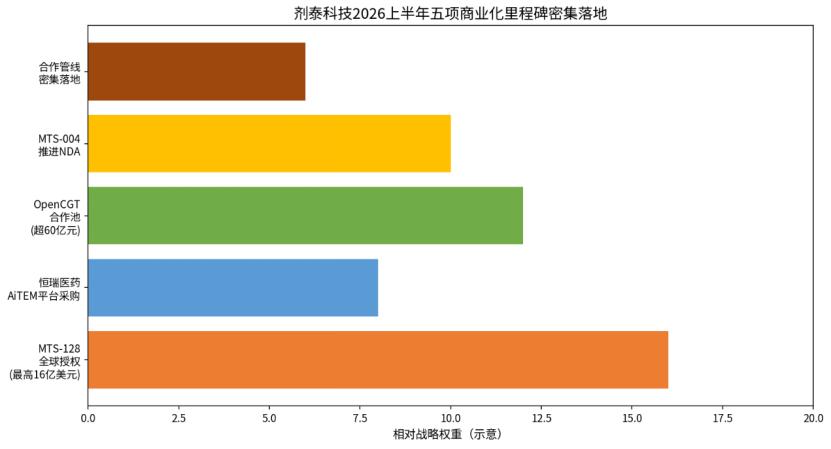
The common feature of the five milestones is that they are not isolated BD events, but the "capacity spillover" of NanoForge in different dimensions. The three lines of asset licensing, platform deployment, and cooperative pipelines are all landed at the same time, each corresponding to a different aspect of platform capabilities — asset licensing verifies that the platform can produce molecules of global value, platform deployment verifies that the capabilities can be directly reused by the industry, and cooperative pipelines verify that the penetration of capabilities can be networked.
What supports these three lines to point to the same end point is a penetrating underlying logic: biological instructions (AiRNA + AiProtein design mRNA and proteins — what procedures the cells will execute) + nano-rockets (AiLNP design delivery vectors — how the procedures enter the body) + precise release (cell targeting technologies such as tLNP — on which cells the procedures run). The three are designed and optimized collaboratively, which is essentially the "reading, writing and editing" of cellular programs.
A number of key breakthroughs on the delivery side in H1 — the cardiomyocyte transfection rate of cardiac-targeted LNP in mouse models exceeds 95%, the CRISPR gene editing rate exceeds 50% with extremely low editing in off-target organs; the in vivo CAR-T active targeted LNP delivery efficiency reaches more than 3 times the industry gold standard; NHP high-throughput DNA Barcoding allows simultaneous assessment of the multi-tissue distribution of dozens of candidate LNPs in a single cynomolgus monkey — are all paving the way for this path to achieve engineering-level precision from organs to cells, from in vitro to in vivo.
When diseases are redefined as "deviations of cell states", the end point of drugs is no longer blocking a certain target, but reprogramming diseased cells into healthy cells — which is exactly the meaning of "programming life". In the words of Dr. Lai Caida, the founder:
"We hope to use AI to upgrade drug R&D from repeated trial and error in individual projects to a life engineering system that can continuously learn, repeatedly verify and output at scale. Shifting from delivering drugs to programming life is the most important strategic leap for MedThera in the next stage."
On one side is the pain of transformation, on the other side is the explosion of milestones. The two semi-annual reports show different performance, but both prove the same thing: the realization period of AI4S is coming.
02 Two Routes, Two Types of Compound Interest
Under the inflection point, the two companies are actually answering two different questions.
1. XtalPi: Industrialization of Scientific Research
The most intuitive way to understand what XtalPi is doing is to imagine an "unmanned pharmaceutical factory", except that the product of this factory is not pills, but experimental data.
XtalPi's route can be condensed into a formula: 200+ AI models (expert brains) + 300+ automated workstations (precise hands) + Multi-Agent (project manager) → data flywheel. Up to now, XtalPi has deployed more than 300 automated workstations around the world, covering more than 20 types of R&D scenarios, and accumulated more than 500,000 real experimental records, about 80% of which are negative failure samples that are rarely seen in public literature.
The essence of this system is to make experiments faster, more accurate and more cost-effective.
2. MedThera: Making Life Systems Computable
MedThera takes a different path. If XtalPi is "accelerating the process of doing experiments", MedThera is trying to "redefine the objects of experiments".
The NanoForge platform allows AI to "learn life systems", not to learn molecular structures, not to learn target sequences, but to learn the interactions between Drug, Material, Cell and Organ. The multiplicative relationship of these four elements is the key to understanding MedThera: traditional drug R&D processes these four dimensions separately, and MedThera's ambition is to reconnect them into a computable whole with AI.
The core assets supporting this route include: the world's largest diverse ionizable lipid library at the ten-million level, about 100,000 experimental data points, and continuous feedback from ALAN and AARON agents. The founder Dr. Lai Caida's original words set the tone for this route: "Explore the scaling laws in life systems, let AI move from learning molecules to learning life systems, and become the basic engine in the era of cell reprogramming."
From "delivering drugs" to "programming life", behind these eight words is a leap of technological paradigm: the former is a postman, the latter is a programmer.
There is an easily overlooked industry background here: the traditional drug delivery field is a "patent minefield". The core patents of LNP delivery technology are monopolized by a few companies, and latecomers either pay patent fees or struggle to move forward in the narrow gaps of patents. MedThera's approach is to redesign ionizable lipids with AI — not to bypass patents, but to open up a brand new design space outside the patent map. When you can generate and evaluate tens of millions of new lipids, the patent wall becomes background noise.
03 AI Version of Moderna: Natural Emergence of MedThera's Platform Capabilities
To understand the underlying logic of MedThera's realization, it is advisable to look back at a classic reference frame — Moderna.
1. Moderna's 16 Years of Persistence
Moderna was founded in 2010. For eight long years, it has been one of the most questioned biotech companies on Wall Street: only platforms, no products; only losses, no revenue. At its IPO in 2018, the issue price was 24 USD, and its stock price fluctuated repeatedly between 15 USD and 30 USD in the following two years. The questioning voices never stopped before 2020.
Then 2020 came. The explosive validation of mRNA vaccines made Moderna's annual revenue soar to 80.3 billion USD, and its stock price once broke through 494 USD from 24 USD — an increase of more than 20 times. Eight years of persistence was realized overnight.
However, the questioning resurfaced after the dividend faded: its revenue in 2025 dropped to 1.944 billion USD, with a net loss of 2.822 billion USD. The market asked: after leaving COVID-19, what is left of Moderna? Moderna did not abandon its platform, but instead announced a new bet on the "multi-modal mRNA platform" at its 2026 Science Day — moving from preventive vaccines to an in vivo immune engineering platform.
Then came August 19. The victory in the Phase III clinical trial made this company, which had persisted for 16 years, skyrocket by 177% in a single day. Moderna's market value increased by an amount equivalent to the total market value of "BioNTech".
2. Structural Similarities Between MedThera and Moderna
The essence of Moderna's success is not "getting one vaccine right", but that "mRNA technology is a life software system that can repeatedly produce drugs".
The similarities between MedThera and Moderna are structural:
First, both take delivery technology as the core barrier. Moderna delivers mRNA through LNP, while MedThera achieves multi-organ targeted delivery through AI-designed LNP.
Second, both follow the platform logic rather than the single-product logic. Any single pipeline is only a one-time proof of platform capabilities, and the platform itself is the master machine.
Third, both point to "programming