What should we really focus on in NVIDIA's earnings report? These six signals from Jensen Huang will determine the development trend of the AI hardware industry chain.
For this NVIDIA earnings report, I will only spend a few minutes skimming through the revenue, gross margin, and next quarter's guidance.
The part truly worth listening to the full earnings call is how Jensen Huang answers the following several more critical questions:
- Whether Blackwell and Rubin can achieve a smooth transition
- Whether Vera CPU can open up new revenue streams
- Whether Groq 3 LPX can keep the low-latency inference budget within NVIDIA's ecosystem
- Whether the gross margin can be maintained after server price hikes
Because the market is no longer questioning whether there is demand for AI right now.
What really needs to be judged is how fast this round of AI infrastructure investment can continue to expand, and where exactly the profits and risks will shift in the next stage.
NVIDIA will release its financial results for the second quarter of fiscal year 2027 after U.S. stock market closes on Wednesday, August 26.
In the last quarter, the company's revenue reached 81.6 billion U.S. dollars, data center revenue hit 75.2 billion U.S. dollars, and non-GAAP gross margin stood at 75%; the company's revenue guidance for this quarter is 91 billion U.S. dollars, with a floating range of ±2%.
Numbers are certainly important, but what truly determines the expectations for the next few quarters, according to analysis from U.S. Stock Investment Network, are the following six signals.
The first signal: Whether orders from the new type of AI cloud can shift from "financing-driven" to "revenue-driven"
In the last quarter, the company even changed the disclosure method for its data center business, classifying large public cloud and internet companies as Hyperscale, and separately grouping AI Cloud, industrial and enterprise customers into ACIE. This change itself already indicates that AI computing power demand is spreading to more customers.
So there is little point in discussing "whether customers are diversified" anymore.
The real question is:
After the rapid expansion of new AI cloud players like CoreWeave and Nebius, can their future procurement be increasingly supported by real revenue and utilization rate, instead of mainly relying on continuous expansion of financing?
This matter has become increasingly important recently.
In March, NVIDIA and Nebius announced a long-term strategic partnership, with Nebius planning to deploy more than 5GW of NVIDIA systems by the end of 2030.
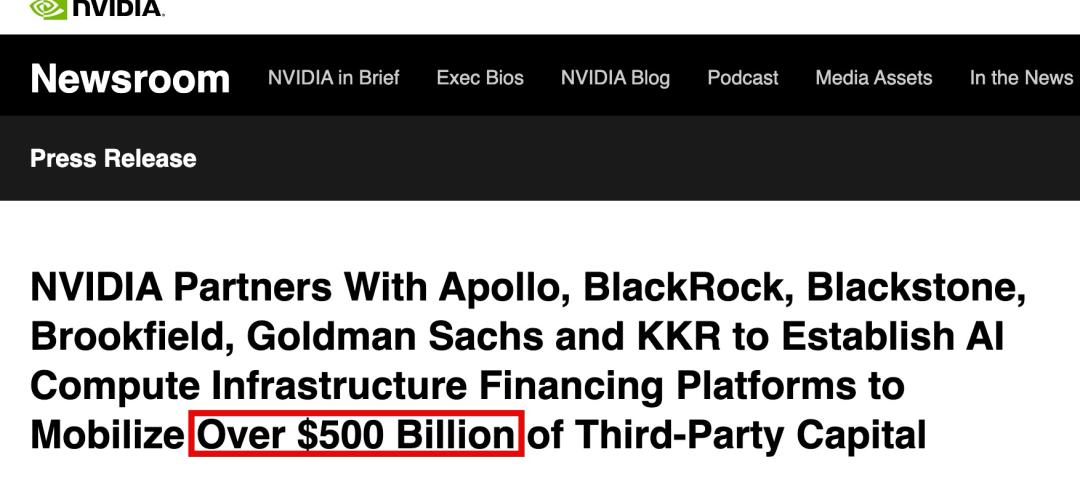
On August 10, NVIDIA joined forces with Apollo, BlackRock, Blackstone, Brookfield, Goldman Sachs and KKR to establish an independent AI computing power financing platform, aiming to mobilize more than 5 trillion U.S. dollars in third-party capital in the long term, to provide larger-scale financing capabilities for AI Cloud, enterprises and other customers.
This shows that what NVIDIA is facing now is no longer "whether there are customers", but another layer of problem:
Customers have demand, but capital expenditure is getting larger and larger, what will ultimately support the orders?
So during this earnings call, I will pay more attention to how the management describes the utilization rate, order term, renewal status and revenue growth of AI Cloud customers.
If the computing power utilization rate and AI revenue of these customers continue to rise, financing will act as an accelerator.
But if the growth rate of capital expenditure outpaces the customers' own revenue and cash flow for a long time, financing will gradually change from a booster to a source of risk.
This determines the quality, not just the quantity, of NVIDIA's new orders.
The second signal: Whether Rubin can seamlessly follow up on Blackwell
Vera Rubin has now entered full mass production, with the entire supply chain covering more than 350 factories across 30 countries. System vendors including Dell, HPE, Lenovo, Supermicro have all joined the mass production system. CoreWeave, Google Cloud, Microsoft Azure, Oracle and Nebius have also started deploying related systems.
What really needs to be observed is:
When Blackwell is still shipping in large volumes, can Rubin immediately take over without any generation transition gap?
In the last quarter, the management has clearly given the ramp-up pace of Rubin in the second half of the year, and stated that the company has already received procurement orders. So the most important thing this time is not to hear "Rubin demand is very strong" once again, but whether there is a clearer delivery rhythm.
If GB300 continues to ship strongly, and Rubin starts to contribute revenue at the same time, the two generations of products can overlap, making the revenue visibility for the next few quarters relatively solid.
Conversely, if the management starts to reduce descriptions of orders and shipments, and emphasizes more on system complexity, customer data center readiness and deployment time, we need to raise our vigilance.
Because Rubin is no longer a single GPU.
It is a complete set of POD-level systems, composed of Vera CPU, Rubin GPU, Groq 3 LPX, BlueField-4 storage and Spectrum-6 network.
The on-time delivery of the GPU itself does not mean that the entire system can recognize revenue on schedule.
If any link slows down, the following situation may occur:
Orders are still there, but revenue is pushed back.
That's also why NVIDIA's inventory, procurement commitments and advance payment scale last quarter are worth keeping tracking of. Where the money is locked in advance can often be used to infer which link will be the real bottleneck in the next stage.
The third signal: Whether Vera CPU can truly open up an independent revenue line
The most noteworthy part of Vera is not its role as the CPU in the Rubin system.
Instead, NVIDIA is trying to sell it independently.
At the end of May this year, NVIDIA officially launched the independent Vera CPU server, and disclosed that customers including Anthropic, OpenAI, SpaceXAI, ByteDance, CoreWeave, Nebius and Oracle are evaluating or planning to adopt it. Dell, HPE, Lenovo and Supermicro will also provide independent Vera servers.
In the last quarter, the management also gave a very important figure:
The company already has close to 20 billion U.S. dollars in revenue visibility for independent Vera CPU for the current year, and this part does not include the revenue from Vera sold as part of the Vera Rubin system.
This means that NVIDIA has officially started to enter the server CPU market that was long dominated by Intel and AMD in the past.
The new progress on August 24 further verified this route.
SpaceXAI announced that it plans to use Vera CPU to undertake orchestration, tool calling, code execution, data processing and simulation in Agent workloads, moving these CPU-intensive tasks away from GPUs to improve GPU utilization.
This is no longer a simple "CPU paired with GPU" scenario.
Instead, Vera has started to get independent workloads.
So there are three things to listen for in this earnings call:
- Whether the revenue visibility of nearly 20 billion U.S. dollars continues to be raised;
- When independent Vera revenue will start to be clearly recognized;
- And how many customers have moved from testing to official deployment now.
If these figures continue to rise, Vera will no longer just be a part of the Rubin system.
It will become a new independent revenue curve for NVIDIA.
The fourth signal: Whether Groq 3 LPX can keep the dedicated inference budget within NVIDIA's ecosystem
This is a new variable that just emerged the day before the earnings report.
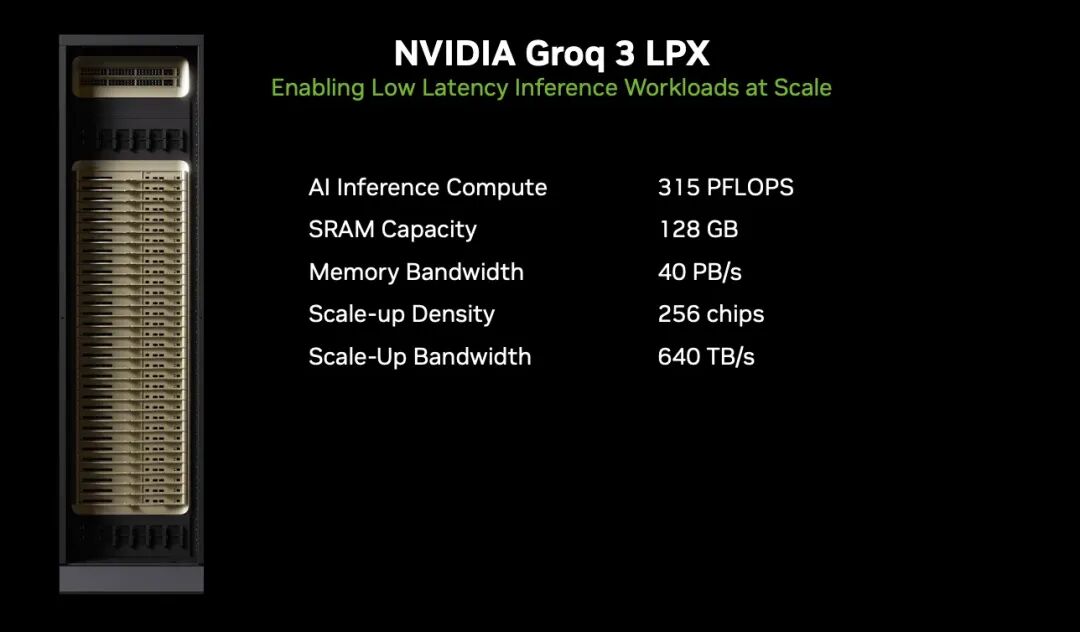
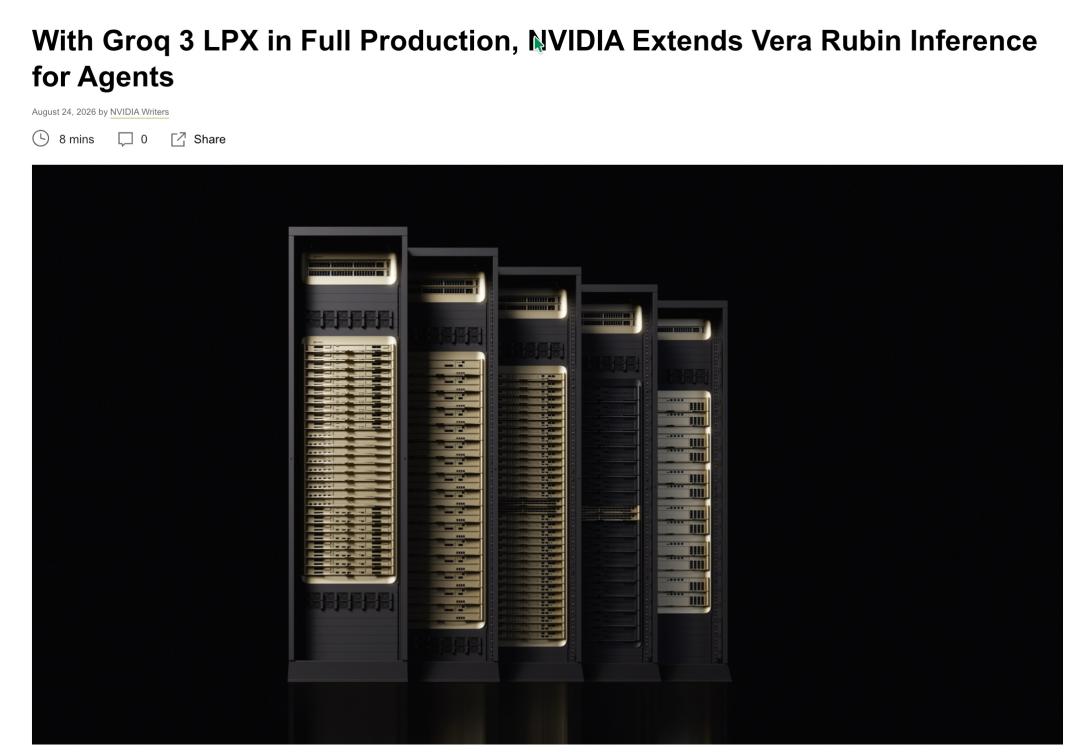
On August 24, NVIDIA announced that Groq 3 LPX has entered full mass production, and is officially used as part of the Vera Rubin platform for low-latency token generation and Agent inference. Nebius has become the first AI Cloud to adopt it.
The significance of this matter is not just that one more chip is added.
In the past, NVIDIA mainly relied on GPUs to cover both training and inference. But as Agent workloads increase, the division of labor in inference has become increasingly obvious.
Prefill, long-context computing and general inference of models are suitable for GPUs, while token-by-token generation, code Agents and real-time interaction are extremely sensitive to latency, leaving room for dedicated inference accelerators.
Groq 3 LPX is NVIDIA's response to this change.
NVIDIA disclosed that in the test of Gemma 4 31B with 100,000 token context, Groq 3 LPX reached about 3400 output tokens per second; and it does not independently replace the Rubin GPU, but works in collaboration with Vera Rubin.
The commercial logic behind this is more important than the performance itself:
If inference becomes increasingly specialized, NVIDIA hopes this part of the budget will still stay on its own platform, instead of flowing to other dedicated accelerators.
So what we really need to follow up on in this earnings call are customers and revenue.
- How many more customers will adopt it after Nebius?
- When will LPX start large-scale shipments?
- What is its matching rate with Vera Rubin?
- Will the management start to discuss this part of revenue separately?
If we only talk about token speed and benchmarks, it is currently just a product advantage. Only when the number of customers and shipments expands rapidly, can it truly become a new incremental revenue source.
The fifth signal: AI servers are getting more and more expensive, can NVIDIA still maintain a gross margin of 75%?
There is another new variable before the earnings report that deserves high attention:
The cost of AI servers continues to rise.
U.S. Stock Investment Network learned that due to rising memory chip prices, the price of some AI servers equipped with Grace Blackwell and Vera Rubin that will be shipped from the beginning of 2027 may rise by more than 15%, and the final increase depends on the specific product generation and memory configuration.
It is very easy to make a misjudgment here:
Seeing the server price hike, people simply interpret it as NVIDIA having stronger pricing power and higher profit margins.
This may not be the case in reality.
An important background for this round of price hikes is that after the prices of HBM, DRAM and enterprise-level storage rise, ODMs have begun to pass higher costs downstream to cloud vendors.
And Vera Rubin is already a highly integrated complete system.
Apart from GPUs, the proportion of costs for memory, storage, network, liquid cooling and power components is getting higher and higher.
So in this earnings report, we must look at "price" and "gross margin" together.
NVIDIA's non-GAAP gross margin in the last quarter was 75%, and the guidance given by the company for this quarter is also about 75%.
If after the server price rises, the gross margin still stays stable at this level, it indicates that NVIDIA still has strong cost transmission capability. But if the price of the whole machine has risen while the gross margin still drops significantly, the meaning is completely different:
The cost of upstream components and complex system integration is starting to erode NVIDIA's own profits.
This matter will also affect the profit distribution of the entire AI hardware chain.
As the importance of components such as HBM, DRAM, and enterprise-level SSDs increases, in the future, the profits of AI servers will not necessarily continue to be highly concentrated on the GPU side.
Whoever controls the scarce production capacity in the upstream will have stronger bargaining power.
So what is really worth listening to this time is how the management describes storage costs, procurement guarantees, system pricing and gross margin.
This is more important than simply discussing "whether a 15% server price hike is good or bad".
The sixth signal: NVIDIA starts to solve land, power and financing on its own
This is the most noteworthy change in this earnings report.
On August 10, NVIDIA joined forces with Apollo, BlackRock, Blackstone, Brookfield, Goldman Sachs and KKR to establish an AI computing power financing platform, aiming to mobilize more than 5 trillion U.S. dollars in third-party capital in the long term.
NVIDIA's positioning for this matter is very clear:
Turn NVIDIA Compute and the entire AI infrastructure into infrastructure assets that can be underwritten and invested in by long-term capital.
A week later, things moved one step further.
On August 17, NVIDIA announced a partnership with SB Energy to develop the PORTS-Pike project in Ohio.
NVIDIA will become the exclusive AI computing power infrastructure supplier for the park, provide credit support for the land, power supply and data center construction of the first phase of 4.25GW, and also hold the option for the remaining 3.75GW.
OpenAI will become the customer of the entire 8GW project, SB Energy is responsible for constructing, owning and operating the data center, and has signed a 20-year lease with OpenAI. NVIDIA will also invest 1.5 billion U.S. dollars in SB Energy.
The significance of this matter far exceeds that of an ordinary investment.
In the past, NVIDIA solved the problem that:
Customers need computing power, and I sell equipment.
Now it starts to solve the problem that:
Customers need computing power, but there is not enough land, power, data centers and financing, so I will participate in solving them together.
Why?
Because the bottleneck of AI infrastructure has obviously moved outward.
Jensen Huang directly referred to land, power and data centers as key basic resources in the AI era in the PORTS-Pike announcement. This project also plans to add at least 10GW of new power supply and invest at least 4.2 billion U.S. dollars in regional power grid construction.
So what is restricting NVIDIA's revenue growth today is no longer just GPU production volume.
Whether an AI Factory can be implemented also depends on whether there is sufficient power supply, data centers, capital, and whether customers can sign long enough contracts.
NVIDIA has taken the initiative to get involved in these links, which of course improves the certainty of future orders in the short term.
But this also means that risks are beginning to change.
In the past, NVIDIA mainly bore product and supply chain risks.
If this kind of credit support and direct investment continue to expand in the future, it will also need to face risks that were not important in the past, including project construction, customer credit, asset utilization rate and long-term computing power prices.
So this earnings call is very worth asking further questions about:
How the 5 trillion U.S. dollars financing platform will be implemented, where is the boundary of NVIDIA's own capital investment and credit support, and whether models like PORTS-Pike will be replicated in more projects.
This may be the deepest step of change in NVIDIA's business model.
Connecting these six things together, the current stage NVIDIA is in is actually very clear.
The earliest AI market rally was trading around:
Whether there are enough GPUs.
Later it became:
Whether there are enough HBM, network and power supply.
Now it has further become:
Whether customers have sufficient revenue, cash flow and capital to keep