I venture to talk about the 800 million yuan belonging to the bosses of Alibaba.
On the evening of August 25, the news that Jack Ma increased his holdings in Alibaba has probably been seen by many people on their feeds.
It is reported that he has been buying shares for several consecutive days, with a total amount exceeding HK$600 million; together with the recent moves of Chairman Joseph Tsai and CEO Wu Yongming in the past two days, they have spent a total of more than HK$800 million.
The timing is very conspicuous: right before this, Alibaba just raised HK$80 billion from the market, its stock price was hit to a low point, and its market value evaporated by HK$200 billion in one day. The company's executives chose this dip to buy shares at a level near the placement price.
August 24 was one of the worst days for Alibaba's stock performance in the past two years.
Four days earlier, the financial report had just been released, showing that the net profit plummeted by more than 70% year on year, and the market had not yet recovered from the shock.
The placement was priced at HK$112.7. As soon as the announcement was released, Alibaba's Hong Kong stock price once fell by more than 10% during the session, closing at HK$112.5. Its market value evaporated by about HK$200 billion in a single day, with a trading volume of HK$40.5 billion, ranking first in the entire market.
All eyes in the market were on this stock that day.
In the afternoon of that day, two new entries appeared on the Hong Kong Stock Exchange's disclosure form: Joseph Tsai bought 720,000 shares at an average price of about HK$112, costing about HK$80 million; Wu Yongming bought 350,000 shares at an average price of about HK$111.6, costing about HK$40 million.
The two bought a total of 1.07 million shares, worth HK$120 million. Several hours passed between the opening of the market and the disclosure, and guess what? The stock price still did not bounce back during that period.
On the worst day for the stock price, the company's executives used their own money to buy shares.
Wu Yongming's purchase is quite notable: his transaction price range was HK$110.7 to HK$112.4. What was the placement price? It was HK$112.7. The institutional investors got the placed shares at the wholesale price of HK$112.7.
The executives bought shares in the secondary market at a price slightly lower than the wholesale price, getting shares below the wholesale price at retail level, which is equivalent to them setting a price anchor for this financing.
The next day, Joseph Tsai bought another 720,000 shares at an average price of HK$113.47, costing about HK$82 million. In just two days, he alone spent HK$160 million on buying shares.
There is a detail that many people have not noticed: the figures you see are only half of the actual scale.
Joseph Tsai is the chairman of the board of directors, and Wu Yongming is the CEO. According to the rules of the Hong Kong Stock Exchange, directors must disclose their transactions of the company's own shares on the day of trading, and no single transaction can be omitted.
The rules are so strict because directors know the most about the company's actual situation, and their trading actions are signals to the market, so transparency is mandatory. Therefore, every purchase they make can be seen by the public, with the average price and number of shares accurately recorded.
What about Jack Ma?
He is not on the board of directors, and his personal shareholding ratio is 1.5%, which does not meet the disclosure threshold of the Hong Kong Stock Exchange. The news that he spent HK$600 million on share increase was reported by multiple media outlets citing people familiar with the matter.
By the way, in terms of shareholding size: Joseph Tsai and Wu Yongming together hold less than 2% of the shares. After this round of increase, the number of shares directly held by Wu Yongming is only more than one million, which is a tiny proportion of Alibaba's total share capital and can hardly cause any noticeable fluctuation.
The amount they bought is not large, but every share is paid with their own money. What the executives are buying is a clear attitude.
Moreover, this is not the first time they have done this.
At the beginning of 2024, Jack Ma and Joseph Tsai jointly increased their holdings once, claiming to be optimistic about the company's development at that time, when Alibaba's stock price had stayed at a low level for a long time.
It was not until a long time after the share increase that the positive results came: Alibaba's stock price did not really rebound until the AI market boom in 2025.
When the executives take action, it is usually when the market is the most pessimistic. The people who placed their bets once more than two years ago have placed their bets again this time.
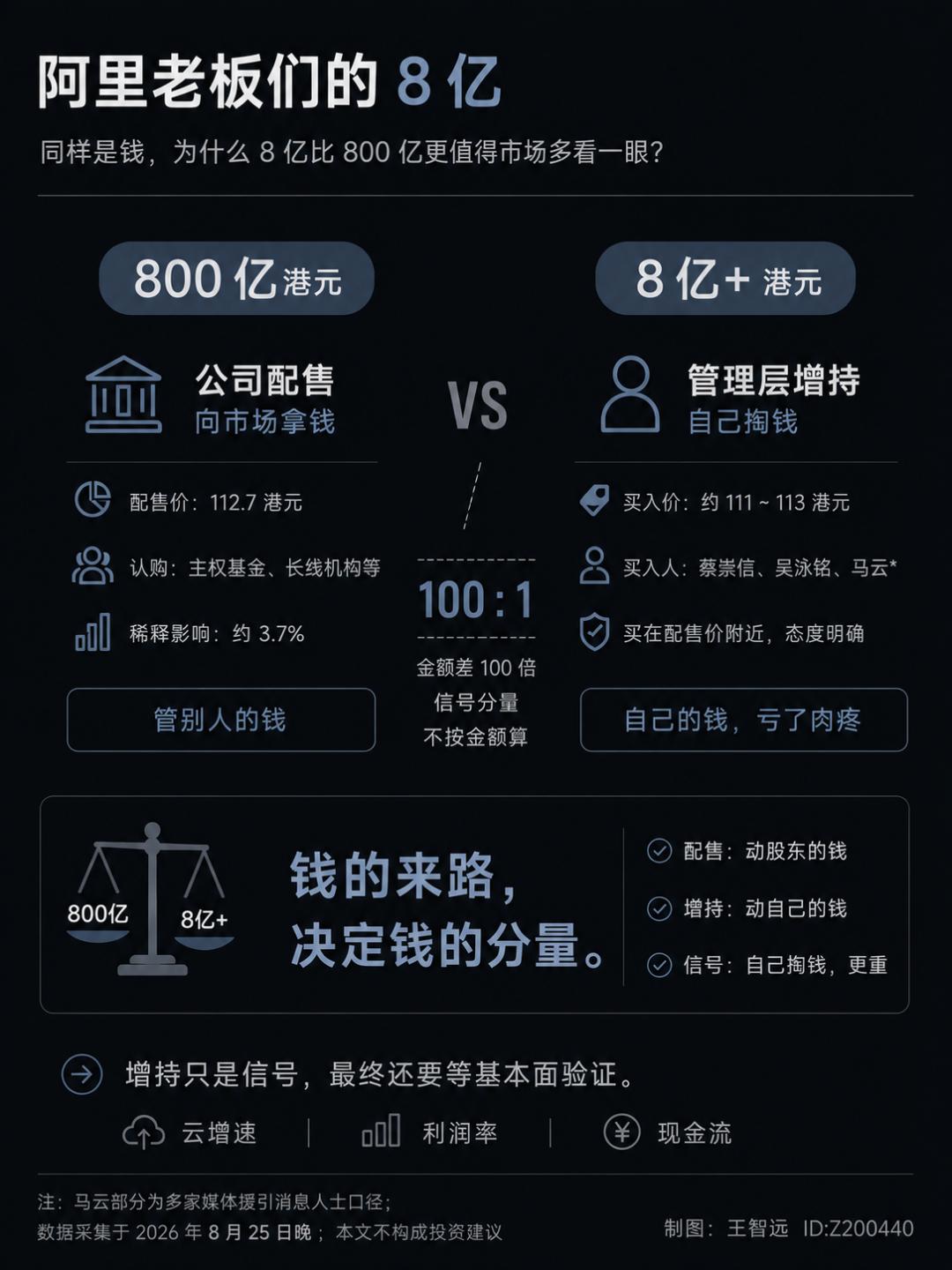
Now let's do the math: the total HK$800 million they spent is exactly 1% of the HK$80 billion financing.
What does 1% mean? To put it this way, the amount of money raised through the one-time placement is equivalent to 100 times the amount the executives spent. The daily trading volume of the market is far larger than this amount.
But this time, the market paid extra attention to this 1% share increase. The market may doubt financial reports and research notes, but it is hard to doubt people who spend their own money to buy shares.
......
Both are buying Alibaba's shares: one transaction is worth 28 billion US dollars, and the other is worth HK$120 million. But their significance does not seem to be measured by the amount of money.
Then what determines their significance?
One is a placement order that sovereign funds and long-term institutional investors are scrambling to sign, using other people's money; the other is the shares bought by Joseph Tsai and Wu Yongming in the secondary market transaction by transaction, using their own money.
The source of the money determines its weight. Let me explain this sentence.
When borrowing money, if someone says "this business is reliable", you can just take it as a casual remark if the speaker is just an ordinary employee; but if the speaker has put his house up as collateral for the business, you need to think twice about what he says. The words are the same, but different speakers make their weight totally different.
Why is the source of money so important?
Because people will not feel distressed when they lose other people's money, but they will feel the real loss when they lose their own money. When a person places a bet with his own money, he is using his own judgment as a guarantee. What the market cares about the share increase is exactly this point.
Alibaba's situation this time is the same: the placement uses shareholders' money, while the share increase uses the executives' own money. The signal comes exactly from whose pocket the money comes out of.
Why do the executives dare to spend their own money? Wu Yongming gave the answer at the earnings call on August 20.
The capital expenditure on AI will be recovered within three years; if the gross profit margin rises, the payback period can be shortened to two and a half years. He also said that in the future, the company is expected to maintain a business growth rate of over 40% while keeping positive cash flow.
I attended the earnings call. These words were spoken to analysts, which sounded very bold, but at that time the market was shocked by the profit decline and had no time to pay attention to these statements.
After making the statements, they followed up with actual money input. The combination of public statements and actual share purchases forms a complete logic that the market needs to understand.
The attitude of institutional investors is also clear:
Bank of America Securities released a report on August 24, maintaining the buy rating, stating that after the placement, Alibaba's net cash rose from about 31 billion US dollars to more than 41 billion US dollars. This is not only growth financing, but also an early strengthening of the balance sheet.
Nomura Securities said on the same day: The dilution of 710 million new shares is only 3.7%, and the actual impact is lower than the market expected. After this financing is completed, the uncertainty hanging over the stock price will be eliminated.
There are also different voices. Jason Chan, an investment strategist from Bank of East Asia, reminded that the fundraising scale and discount rate exceeded the market's expectations, the dilution pressure still exists, and the market needs to re-evaluate how much return the AI business can bring.
Speaking of which, I have to add that share increase is not a panacea.
There are existing lessons in the Hong Kong stock market. The head of Feihe spent nearly HK$300 million to increase his holdings in his own company's stock in 2021, when the stock price was just over HK$14, but later the stock price fell all the way to around HK$5.
In July 2025, the company announced a large-scale share repurchase and dividend commitment, but on the first day after the announcement, the stock price still fell by 17%.
There are also positive examples.
Lei Jun spent HK$100 million to increase his holdings in Xiaomi in November 2025. After that, Xiaomi's stock price rebounded, and its market value returned to the trillion level. The two cases where executives spent their own money to buy shares led to totally different results.
What is the difference between them?
The difference lies in who the money belongs to and what stage the company is in. Feihe's share increase cannot save an industry that is in a downward cycle, while Xiaomi's share increase caught up with the inflection point of its automobile and AI businesses.
Share increase is just a signal. The signal needs to be verified by the fundamentals. If the signal cannot be verified, the market will treat it as if it never existed.
Alibaba's current fundamentals have been stated by the management at the earnings call: The annualized revenue of AI products has reached 49.5 billion yuan, and the target for the next quarter is 10 billion US dollars. The cloud business revenue is still accelerating. Only when the fundamentals are strong enough can the executives be willing to spend this sum of money.
......
On August 25, Alibaba's Hong Kong stock closed up 1.51%. The day before, it had just fallen by 8.54%. Two days, two opposite directions. Who on earth does the market believe in?
First, let's talk about what happened that day. On August 25, Alibaba's Hong Kong stock closed at HK$114.2.
On that day, the disclosure of Joseph Tsai's second share increase and the news of Jack Ma's HK$600 million purchase came out at the same time. Before the US stock market opened, Alibaba's US stock once rose by more than 2%, but this increase cannot be entirely attributed to the share increase.
After the placement price was determined, the biggest suspense was resolved. The stock price fell too sharply the day before, and a rebound was naturally expected.
Several events overlapped, leading to this rising candlestick. The share increase is only part of it, and its real weight can only be seen after detailed breakdown.
After breakdown, you will find that the market is divided.
What about southbound capital? On August 21, it sold HK$1.118 billion of Alibaba's shares. On the Shanghai Stock Exchange that day, the short selling orders for Alibaba's shares accounted for a quarter of the total trading volume of the day, more than double the figure a week earlier.
On August 24, the day when the stock price fell the most sharply, southbound capital bought back HK$2.184 billion. On August 25, when the stock rebounded, it sold HK$183 million again. The largest buyer in the market is doing band trading, buying on dips and selling on rallies.
I checked that Alibaba was not included in the Hong Kong Stock Connect until September 2024. Southbound capital has been buying shares continuously in the past two years, becoming the largest shareholder group of Alibaba's Hong Kong stocks, with a shareholding ratio of more than 10%.
Wall Street holds a different attitude. On August 21, when the US stock market plummeted, among the 40 institutions that track Alibaba, 38 still maintained a buy rating. The bulls remain bullish, the bears continue to sell, and no one can convince anyone.
Some people on the Internet even said sarcastically that Alibaba first launched a HK$80 billion additional issuance to suppress the stock price by 10%, dragging down the Hang Seng Tech Index together, and then turned around to increase their holdings at a low level, calling this a very ugly way of making money.
This statement sounds satisfying, but the logic does not hold up.
The placement price was locked on August 23. No matter how much the stock price falls afterwards, the amount of money the company gets will not increase at all. The decline does no good to the placement.
The share increase of the executives is done through their personal accounts in the secondary market. The total amount is only 1% of the placement size. Such a small volume cannot support a carefully designed scheme.
Besides, the company's placement is the company's account, and the executives' share increase is the personal account. The two are calculated separately. The main force that suppressed the stock price came from the selling pressure brought by the poor financial report, share dilution and arbitrage selling.
In Hong Kong stock placements, institutions that get discounted shares can make a profit by selling them immediately. This kind of arbitrage selling will happen every time, and no one can avoid it. If you attribute all these problems to deliberate manipulation, you get the logic wrong.
Objectively speaking, the market only believes half of the positive signal from the share increase.
The rising candlestick on August 25 is the market's response; but the gap caused by the sharp fall on August 24 has not been filled yet, which means the market has not been fully convinced. The buy ratings are on public display, and the share increase is done with real money.
The remaining half of the market's confidence depends on three key figures: cloud business growth rate, profit margin, and cash flow performance, which will be released quarter by quarter. The market has its own judgment, and the company has its own development rhythm. The two can rarely be fully aligned, especially in the secondary market.
Data Sources:
[1]. Hong Kong Stock Exchange equity disclosure and SEC filings (details of management share increase); Alibaba's first quarter financial report announcement and earnings call for fiscal year 2027, placement announcement; institutional views from Bank of America Securities, Nomura Securities, Jason Chan from Bank of East Asia; analyst tracking data from Securities Times, Zhitong Finance, AASTOCKS, S&P Global
[2]. The amount of Jack Ma's share increase is cited from multiple media reports citing people familiar with the matter; data collected on August 25, 2026; this article does not constitute investment advice
This article is from the WeChat official account "Wang Zhiyuan" (ID: Z201440), author: Wang Zhiyuan, published with authorization from 36Kr.