Next-generation productivity is right in Doubao Work+ and Feishu.
In 2026, airport billboards, elevator screens, social media feed advertisements — ubiquitous promotional content are all selling the same offering: AI-powered office productivity tools.
If you line up the feature lists of products from different players, you will find they are becoming increasingly similar. This means the era of building competitive moats through feature checklists has come to an end.
On August 25, "Doubao Work" was officially launched as a brand new Agent product, and the brand emphasized one core positioning at the same time: deep native integration with Feishu.
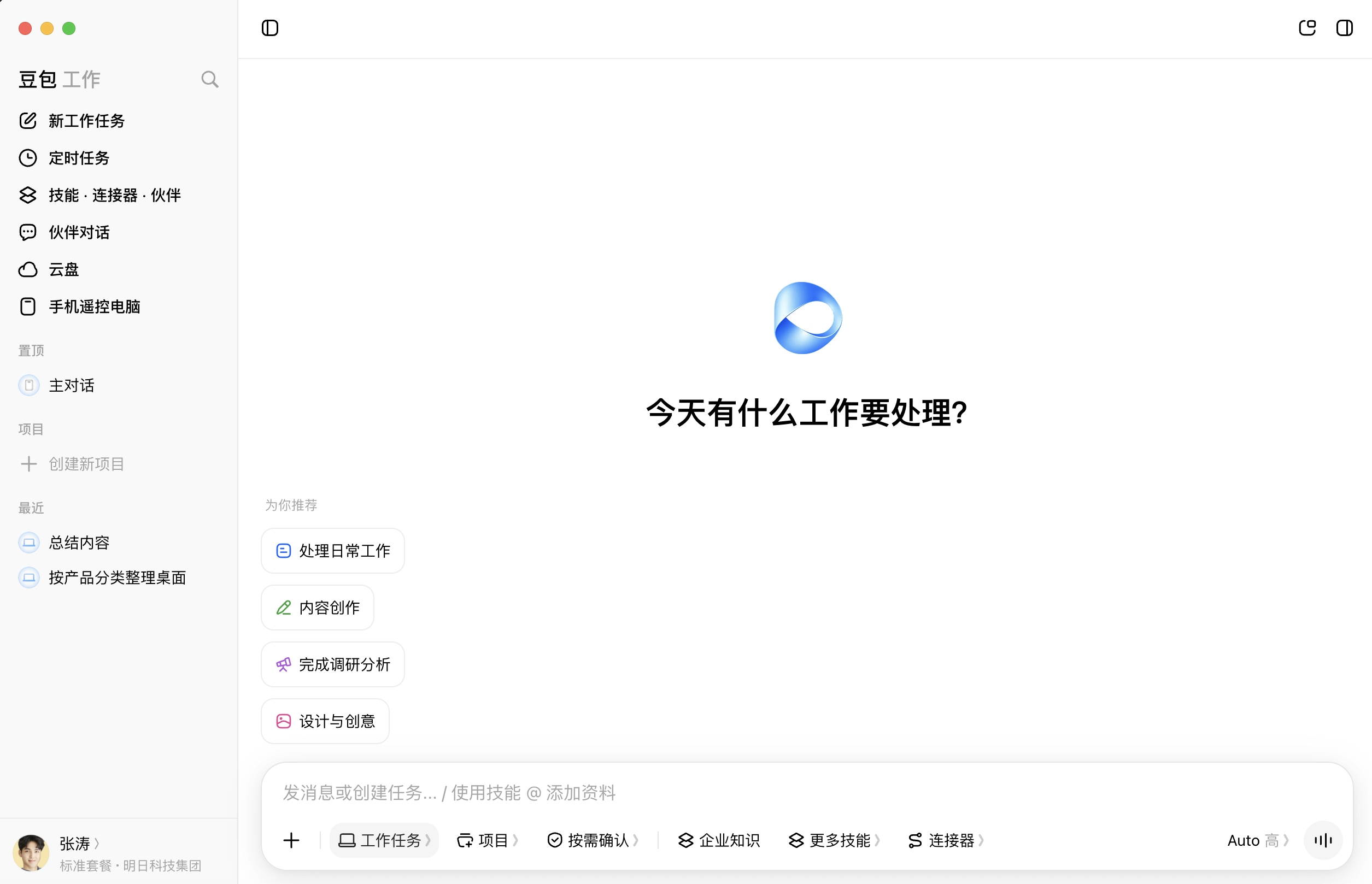
This seemingly trivial announcement has pushed the competition into its second half: the first half was a race to build more capable Agents, while the second half is a race to deliver tangible improvements to organizational productivity.
Agents Are Getting More Powerful, But Enterprises Are Not Speeding Up Accordingly
Let's first look at what happened in the first half of the Agent development cycle.
Since the launch of OpenClaw, the performance gap between large language models has been narrowing, and the engineering capabilities required to turn models into usable Agents are being rapidly standardized. Memory, Skills, MCP, tool calling, Sandbox, Computer Use, long-task execution... The Agent Harness that previously required a dedicated team to build from scratch is now increasingly provided directly by model vendors and open source frameworks.
In April this year, OpenAI updated the Agents SDK to integrate capabilities including memory, sandbox, file system tools, MCP and Skills into a standardized Harness. Lang Chain later even summarized Agent as a simple formula: Agent=Model+Harness. The increasingly mature SDKs and open source Harness allow developers to swap models, connect tools, and reuse proven mature Agent architectures.
This has reshaped the competitive logic of Agent products — capability checklists are no longer a sustainable moat.
After a new feature is launched, the time it takes for competing products to catch up is shrinking; once a Harness is validated, it can quickly become reusable infrastructure for the entire industry.
This has driven the rapid growth of Agent capabilities: they can process longer documents and complete more complex tasks than ever before.
However, the speed at which enterprises convert AI capabilities into real organizational productivity has not kept pace with this growth.
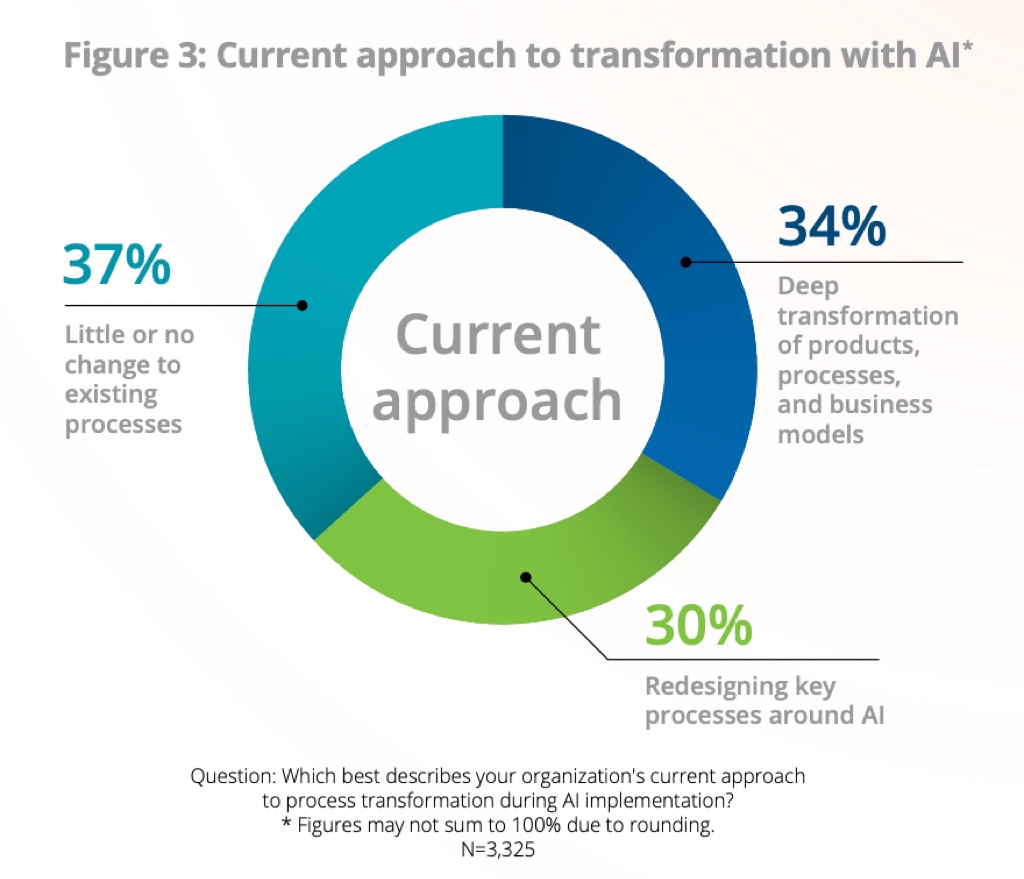
This mismatch is already reflected in third-party research. Deloitte's 2026 survey of 3,235 enterprise executives across 24 countries shows that the adoption rate of AI tools for employees has risen from less than 40% to 60%, but only 34% of enterprises have started to use AI to deeply transform their products, core processes or business models. Another 37% of enterprises remain at the relatively superficial application stage, with almost no changes to their existing business workflows.
This gap translates into very tangible experiences for every employee in the enterprise.
For example, an employee may ask an Agent to "review a project" or "find out why the project is delayed". Even though large language models are highly proficient at summarization and reasoning, the real bottleneck often emerges before the Agent starts working: what new requirements the client just updated, what conclusions were reached in last week's meeting, which version is the latest proposal, who is responsible for driving the progress, and at which approval step the process is stuck — all these information that determines judgment will not naturally appear in the Agent's dialog box.
As a result, employees have to first go through group chat records, find meeting minutes, download spreadsheets and documents, organize information scattered across different locations, and then re-explain all the context to the AI.
It seems that the Agent is working for people, but people have to do the preparatory work for the Agent first.
Work in an enterprise is never a series of isolated tasks. A requirement may start from discussions in a group chat, reach consensus in a meeting, be documented in files and spreadsheets, then enter the project, task and approval workflows, and circulate continuously across different departments and responsible persons. Its antecedents and consequences are scattered across knowledge assets, data, workflows, permission systems, organizational relationships and historical decisions.
Capabilities determine whether an Agent can perform tasks, while context determines whether an Agent can perform tasks well.
Nowadays, the former is no longer a bottleneck, while the latter is.
Doubao Work: Finding Its "Workstation" Inside Feishu
To solve this bottleneck, the most critical move Doubao Work has made is to implement account-level deep integration with Feishu.
After logging in with a Feishu account, the Agent can directly inherit the user's work context in Feishu — it can access chat records, documents, meeting minutes, schedules and other information within the scope of the user's permissions. Instead of requiring employees to manually transfer scattered information, it directly retrieves information, understands relationships and continues to take actions where the work actually happens.
The significance of this move depends on what Feishu already contains.
In most enterprises, data is siloed. For an Agent to complete a cross-system task, it has to connect to each system separately, migrate data, and then process identity and permission configurations across different systems. Each additional connected system adds extra friction.
But Feishu natively unifies all these elements — chats, documents, meetings, knowledge bases, multidimensional spreadsheets, projects and approvals all run under the same set of organizational identities, permissions and collaboration frameworks.
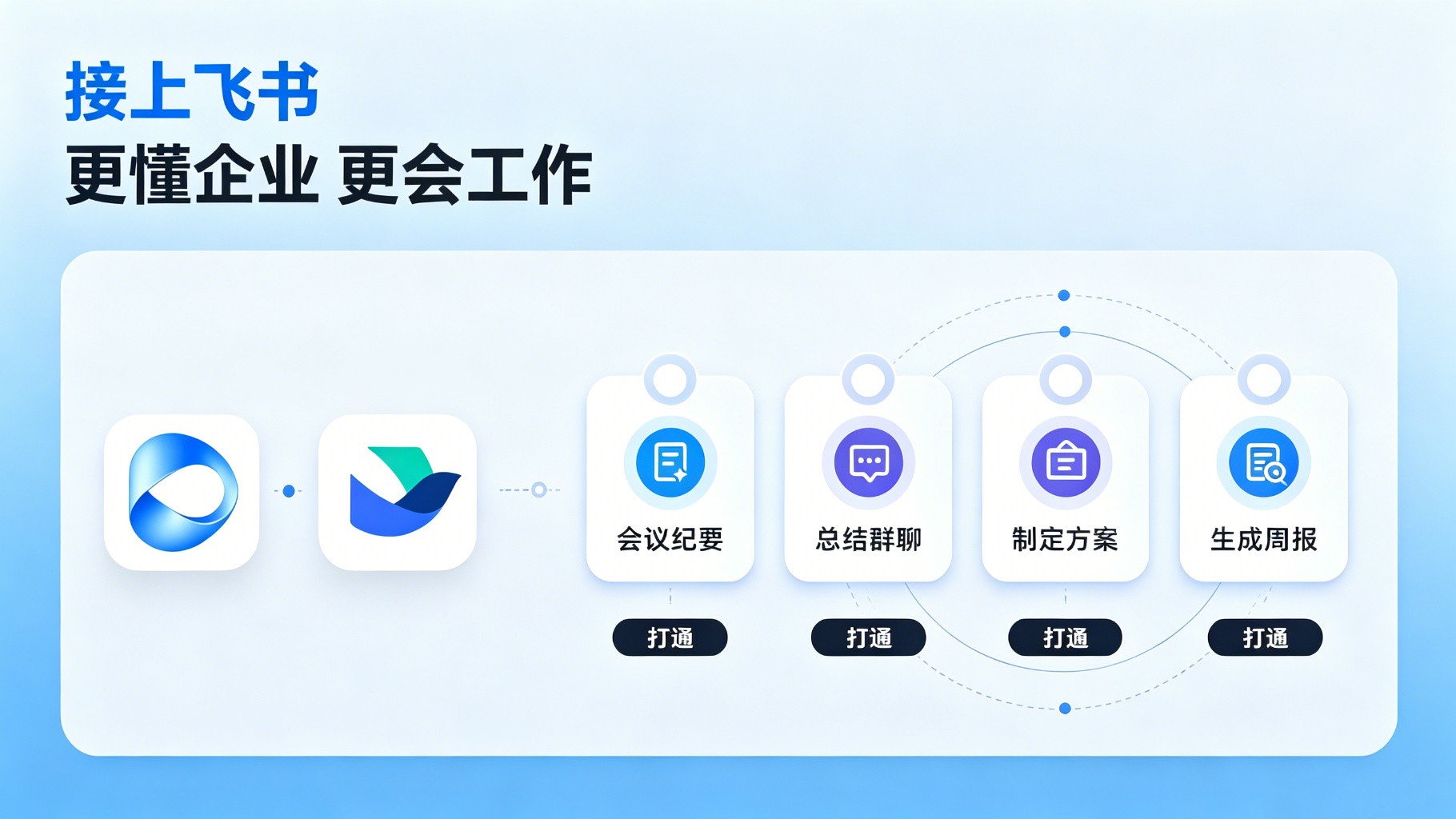
More importantly, Feishu has been building AI-accessible infrastructure over the past few years. Meetings are automatically saved as searchable, quotable Meeting Notes, and documents, knowledge bases, group messages and multidimensional spreadsheets have all been adapted for AI invocation.
Data is not just stored passively, but has been organized into a format that Agents can understand and utilize.
Among mainstream domestic collaboration platforms, Feishu has the highest level of unified organizational information and the most complete adaptation for Agents, making it close to an AI-native organizational operating system. This is why amid the "lobster" Agent wave, Feishu has naturally been identified by developers as the core execution and collaboration entry point for Agents.
When Agents actually run on such a foundation, the efficiency improvement for daily work is immediate.
In the past, the real progress of a cross-departmental project was often scattered in group chats, meeting minutes, tasks and approval records. To confirm whether the project can be launched on schedule, employees had to align status with multiple stakeholders one by one. But now, you only need to ask Doubao Work "Can we still launch this on X date", and the Agent can follow the traces left in Feishu to independently retrieve relevant information and output a full view of progress and risks. For key nodes such as GPU expansion, resource application and version release, it can further trace who submitted the application and when, as well as the impact of approval or rejection on the whole project.
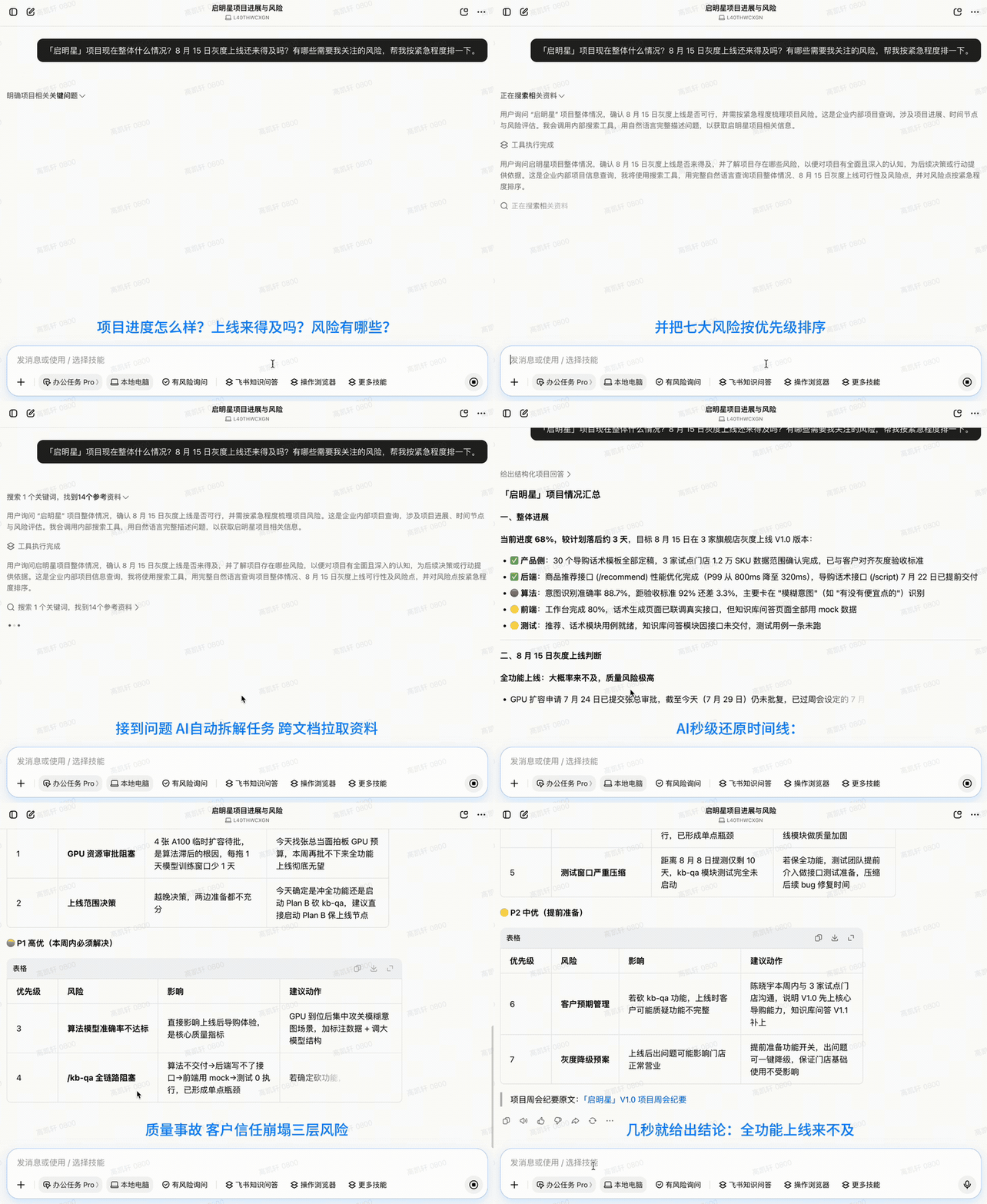
Employees no longer need to spend half an hour supplementing background information for AI. The Agent starts to work like a colleague who has been involved in the project from the very beginning — it finds information on its own, sorts out the antecedents and consequences, and then delivers judgments.
However, simply "knowing what is happening in the company" is not enough. A real digital employee must also be able to push the work forward and leave the output in the organizational system.
Doubao Work can process documents, spreadsheets and PPTs, build web pages and applications, generate images and videos, and operate browsers and local computers. But the real differentiation does not lie in these functions themselves, but in where the outputs go.
If an AI-generated report stays in a personal dialog box, colleagues cannot view or edit it, and the user has to re-explain all the context the next time they need it — the efficiency gain from this single use will disappear in subsequent work.
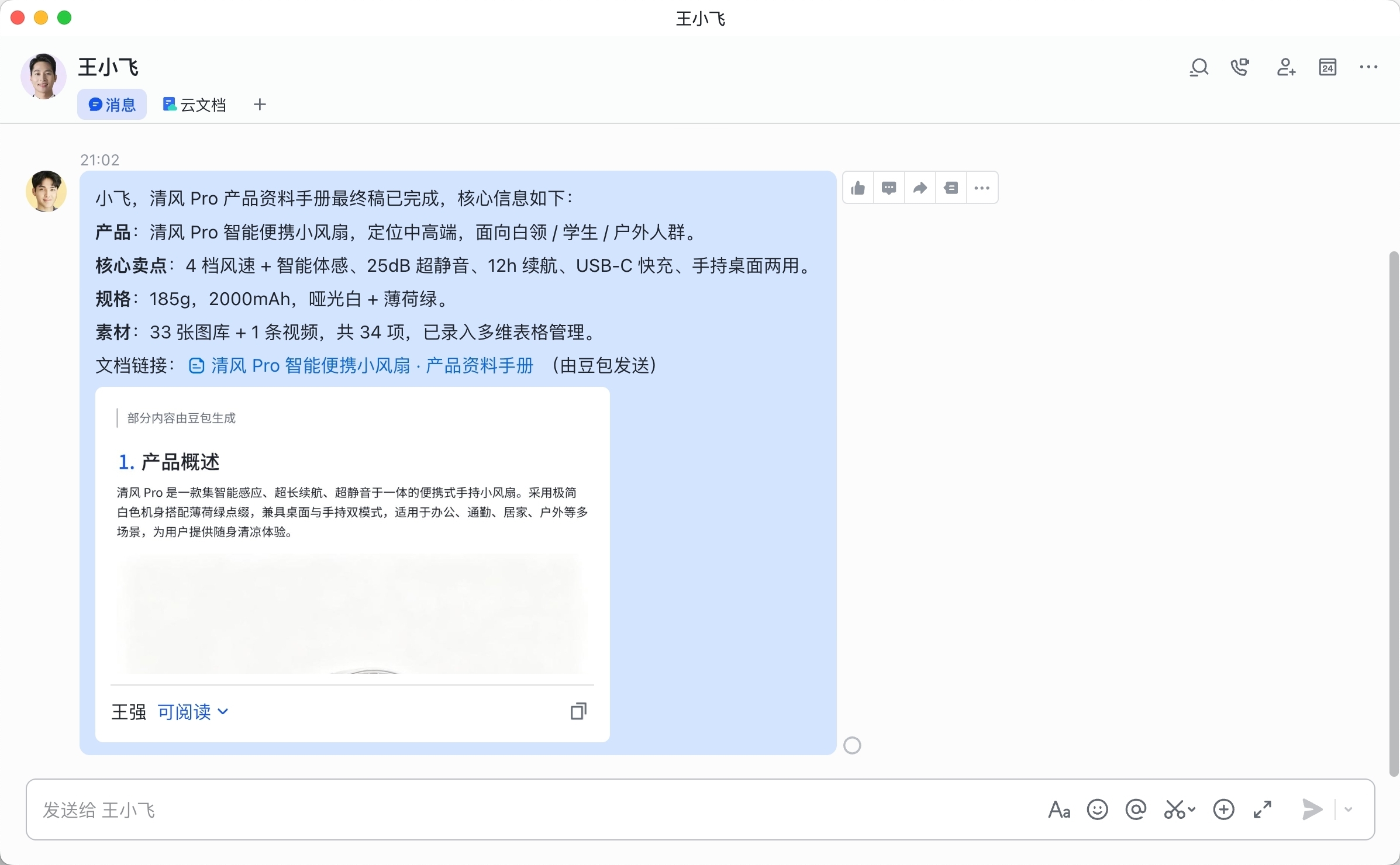
But after connecting to Feishu, the content generated by Doubao Work can be saved directly back to Feishu, where colleagues can share, comment on and edit it. Mature working methods can be precipitated into organization-shared skills that can be directly invoked next time.
This forms a complete closed loop: understanding the organization, executing tasks, participating in collaboration, receiving feedback, and precipitating new organizational experience. The more work the Agent completes, the more outputs will be converted into enterprise assets, which in turn become accessible context for subsequent tasks.
A tool can perform tasks, but only a qualified digital employee that knows what is happening in the company, can push work forward independently, and leave deliverables for the team can be called a real organizational Agent.
ROI of Agents: Shifting from Individual Productivity Gain to Organizational Efficiency
After Agents are embedded into organizations, the criteria for enterprises to measure AI value will also change accordingly.
Compared with how many minutes an individual saves thanks to AI, the more critical question becomes whether AI can reduce the communication, collaboration and process costs across the entire organization.
BCG's global "AI at Work" survey released in June this year published a striking figure: 42% of frontline employees who use AI frequently can save at least 8 hours per week. But BCG also pointed out that most enterprises have not yet figured out how to convert these saved hours into organizational value.
After all, one person working faster does not mean the whole team is working faster.
The majority of efficiency loss in enterprises does not happen within individual tasks, but between tasks and between people: searching for information, checking progress, synchronizing updates, confirming responsible persons, cross-departmental communication, waiting for approvals. These actions are not complex when viewed separately, but they constitute the largest hidden cost in the daily operation of organizations.
AI can reduce the time spent making a PPT from two hours to half an hour, but if the subsequent review, revision and follow-up process of this PPT remains unchanged, the organizational level efficiency will not be improved at all.
This means the value of an Agent does not lie in helping people finish a single piece of material, but in taking over the whole sequence of follow-up actions after the material is produced: to inquire, to follow up, to synchronize status, and to drive progress.
This requires the Agent to truly integrate into the business scenarios of the organization: customer data, operational metrics, meeting content, and approval workflows.
As a result, permission management has become an unavoidable prerequisite.
Customer information that an employee is not authorized to access should not be accessible to the Agent either; operations that an employee is not allowed to perform cannot be bypassed by AI.
Doubao Work inherits Feishu's existing identity and permission system, so Agents can only access data and operate tools within the permission scope of the current user. Meanwhile, Doubao Work has built a full-link Agent security protection system covering device access, permission configuration, quota control, data encryption and operation audit. At present, it has become one of the first batch of office Agents in China to obtain dual certifications of "Office Agent Capability" and "Cloud Benchmark Test" from the China Academy of Information and Communications Technology.
This is not about building a more powerful Agent, but about enabling Agents to operate as organizational members within the existing security governance framework.
In the past, enterprise software was designed to manage what people can do; after Agents are introduced, it also needs to manage what AI can do on behalf of people — "permission management" is becoming a key dividing line between organizational-level Agents and personal AI assistants.
From this perspective, the evaluation system for this round of Agent competition has also changed.
In the first half of the AI office competition, players competed to provide more powerful AI for individual users: smarter models, higher generation quality, and more completed tasks. These capabilities are converging, with the gap between players getting smaller and smaller.
Entering the second half, the real differentiator is who can enable Agents to safely enter the organization, understand ongoing work, participate in real workflows, and convert the output of a single task into reusable experience for the entire organization.
Therefore, the truly notable value of Doubao Work is not that it is just another Agent that can make PPTs, but that ByteDance has tightly integrated its full-stack Agent offering with the most AI-native organizational infrastructure.
The competition of Agents is shifting from individual productivity to organizational productivity.