Laopu Gold: As gold prices slump, has the "Hermès of Gold" narrative been completely shattered?
On the afternoon of August 25, Beijing time, Laopu Gold (6181.HK) released its 2026 H1 performance, with a generally mediocre overall performance whose actual figure fell at the lower bound of the previously issued guidance. The specific key points are as follows:
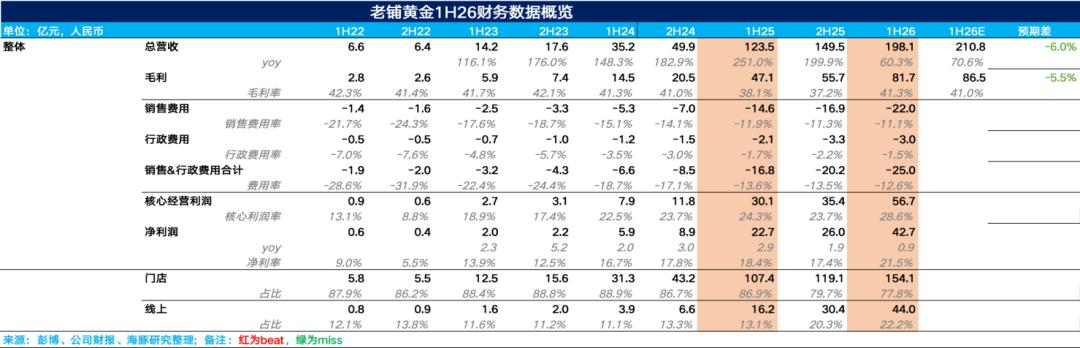
1. Revenue performance is mediocre and falls short of expectations. In 1H26, Laopu recorded a total revenue of RMB 19.8 billion, up 60% year on year, landing at the lower limit of the company's July forecast range (RMB 19.8–20.45 billion), indicating that June performance was weaker than the company's own expectation. By reverse calculation, its Q2 revenue was only RMB 2.3–3.3 billion, down 16% to 42% year on year.
In other words, almost all the performance in the first half of the year was earned from the rush purchase wave before the price hike on February 28, and the company only generated less than RMB 3 billion of business in more than three months after the price hike — which shows that the driving force of "price hike expectation" on consumers is obviously greater than Laopu's own brand power.
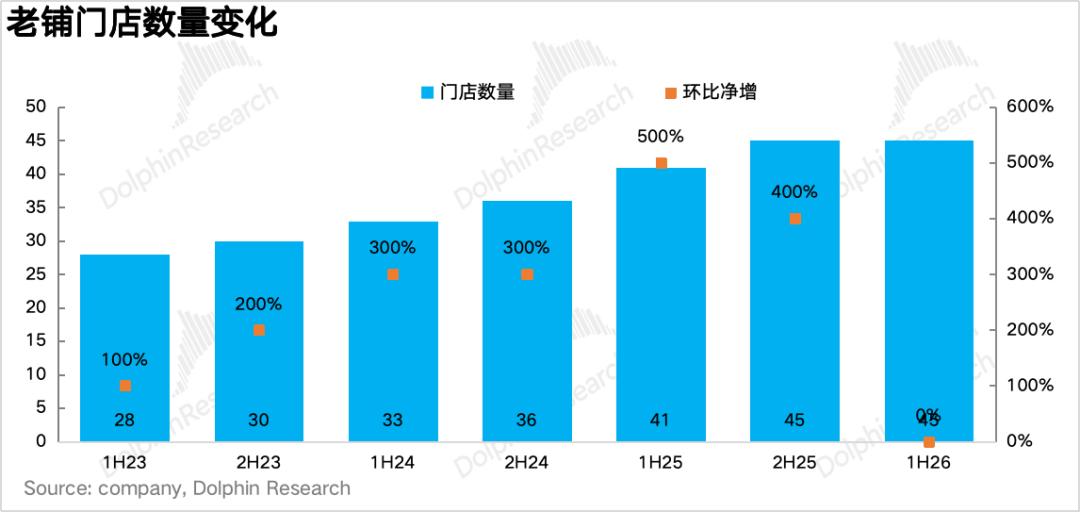
2. Domestic new store expansion is suspended, shifting to store capacity expansion and overseas expansion. In terms of store count, Laopu had 45 stores at the end of the period, with no net new stores. The channel priorities are as follows: first, the expansion and upgrading of existing stores (5 stores in Shanghai will be fully upgraded this year, 10–12 stores are planned to be optimized for the whole year, 6 of which have been completed); second, overseas expansion (the Parisian Macao store opened at the end of May, 4–5 new overseas stores are planned to open in the whole year, mainly in the second half of the year). Overseas expansion is basically the only growth source for Laopu at this stage that "does not depend on the direction of gold price".
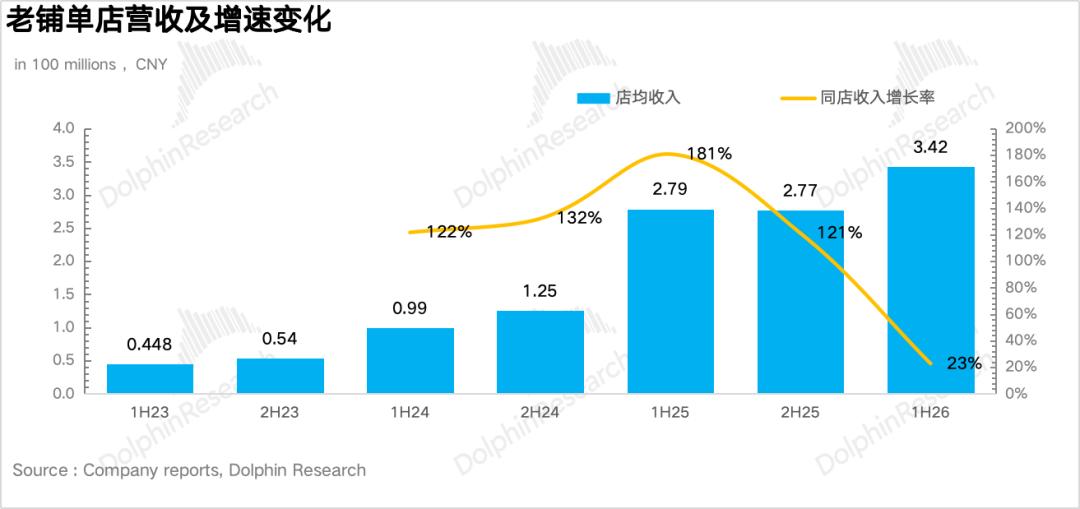
3. Store efficiency is still improving rapidly. By channel breakdown, offline stores generated revenue of RMB 15.4 billion, up 43.5% year on year, Dolphin Research calculates that a single offline store realized a half-year revenue of RMB 340 million, up 23% year on year, indicating that the path of "changing store location + expanding store area" is currently proven feasible.
Online platforms generated revenue of RMB 4.4 billion, surging 172% year on year, and its proportion further increased to 22.2% from 13% in the same period of last year, with a far higher prosperity level than offline channels.
4. The release of operating leverage drives profitability to hit a new high. Benefiting from the low-cost gold inventory hoarded in the second half of last year plus the price hike in February, gross margin increased by 3.2pct year on year to 41.3%, basically returning to the previous high level. The overall expense investment is relatively restrained, the sales and administrative expense ratios both declined slightly compared with the same period of last year, and finally Laopu's core operating profit margin reached 28.6%, hitting a new record high.
5. Inventory level is further raised. Laopu's current inventory has reached RMB 19 billion, indicating that the company replenished a large amount of goods at a higher gold price in the first half of the year, lifting the mixed cost line of inventory by one notch, which means that Laopu's gross margin may face considerable pressure in the second half of the year.
6. Overview of detailed financial data:
Dolphin Research's overall view
Xu Gaoming, chairman of Laopu, once publicly stated that "do not think Laopu can only make money when gold price goes up, and cannot make money when gold price goes down". The past six months is the first long-term downward fluctuation cycle of gold price that Laopu has encountered since its listing. Judging from the actual performance, it is obviously not easy to make money during the gold price downward period.
Combined with survey information, in Q2 when gold price accelerated its decline, the prosperity of Laopu's terminal stores dropped significantly: compared with the grand occasion that customers queued for 2-3 hours at peak hours in core stores before the price hike at the beginning of the year, stores tended to be deserted at non-peak hours such as noon on workdays; mainstream best-selling products generally have sufficient spot goods, and there is no need to frequently transfer goods across stores. In terms of data, the average monthly sales volume of Laopu in Q2 is only about 40% of the monthly sales volume in March.
This is not unexpected for Dolphin Research, we wrote in the previous comment that "once the gold price enters a downward cycle, superimposed with consumers' wait-and-see sentiment of holding back purchases amid falling prices, the decline in inventory turnover will bring a severe impact on Laopu's performance, even leading to same-store sales decline", and Laopu failed to pass the stress test.
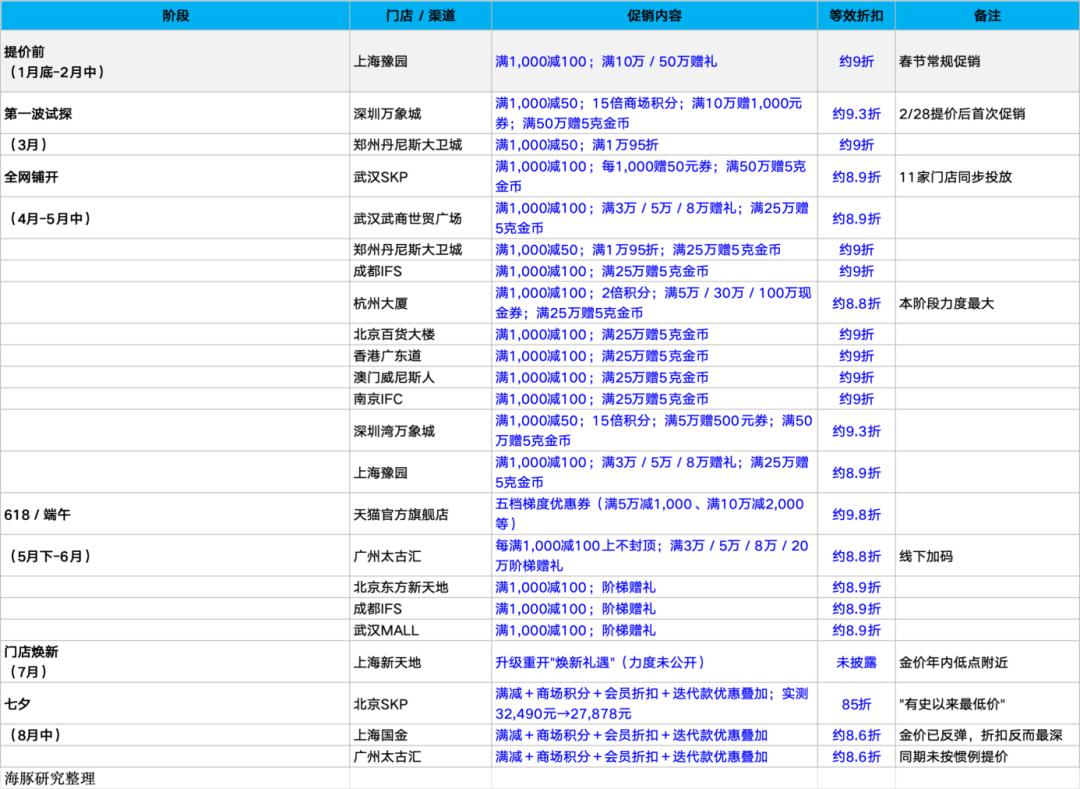
From another dimension, Dolphin Research summarizes the changes in Laopu's promotion intensity from the beginning of the year to date in the following figure. It can be observed that during the process when gold price fell all the way from the high point of USD 5,599 at the beginning of the year to USD 4,000 at the end of June (-29%), Laopu's discount intensity dropped from 10% off to about 11.4% off, which is basically synchronized with the gold price. That is to say, the so-called luxury logic of "Hermès in gold jewelry" has been completely shattered amid the continuous decline of gold price.
But one point to be alert to is that the current gold price has rebounded from the June low to around USD 4,600 in August, but Laopu's discount intensity has further deepened from 11.4% off to 14.1% off, setting the largest discount since its listing, and it also gave up the regular price hike that was implemented in the same period of last year.
Dolphin Research believes that the conclusion that can be drawn here is that — in fact, many price-sensitive customer groups have been directly deterred, so even if the gold price environment has improved, demand cannot recover, and Laopu can only continue to increase discount intensity to retrieve lost demand.
So the awkward situation is that, if no promotions are launched, the actual revenue in Q2 will definitely be lower; but once the discount is started, consumers' reference frame will change from "the price will rise next time" to "the price may be cheaper next time", which means Laopu is currently sacrificing part of its brand assets in exchange for short-term performance.
Dolphin Research mentioned before that, the whole business model of Laopu is essentially a psychological project of "canceling the gram weight reference frame": choosing store locations opposite Hermès, only marking the price per piece instead of per gram, artificially creating scarcity, and raising prices regularly every year with no price cut, so as to make consumers believe that what they buy is "luxury" rather than gold.
However, through this financial report, it can be confirmed again that Laopu is not actually a luxury enterprise (luxury sales will not plummet due to the fall in raw material prices), it is essentially a gold retail enterprise with high operating leverage, only wrapped with a set of Oriental high-end luxury narrative packaging.
Overall, the fundamental reason why Laopu's valuation cannot rise is that under this business model, its final profit has extremely strong uncertainty. As long as Laopu insists on not carrying out any financial hedging, Dolphin Research believes that its valuation will always have a layer of discount, which has little to do with how good the brand is. Therefore, Dolphin Research believes that Laopu is more of a trading opportunity that fluctuates with the gold price range.
The following is the detailed interpretation of the financial report
I. Overall revenue is at the lower bound of the guidance
In 1H26, Laopu recorded a total revenue of RMB 19.8 billion, up 60% year on year, landing at the lower limit of the company's July forecast range (RMB 19.8–20.45 billion). Combined with the Q1 forecast disclosed by the company in March (revenue of RMB 16.5 billion to 17.5 billion, net profit of RMB 3.6 billion to 3.8 billion), it means that Q1 contributed about 86% of the revenue and about 87% of the profit in the first half of the year (calculated at the median of the range), and in the more than three months after the price hike, the company only generated less than RMB 3 billion of business.
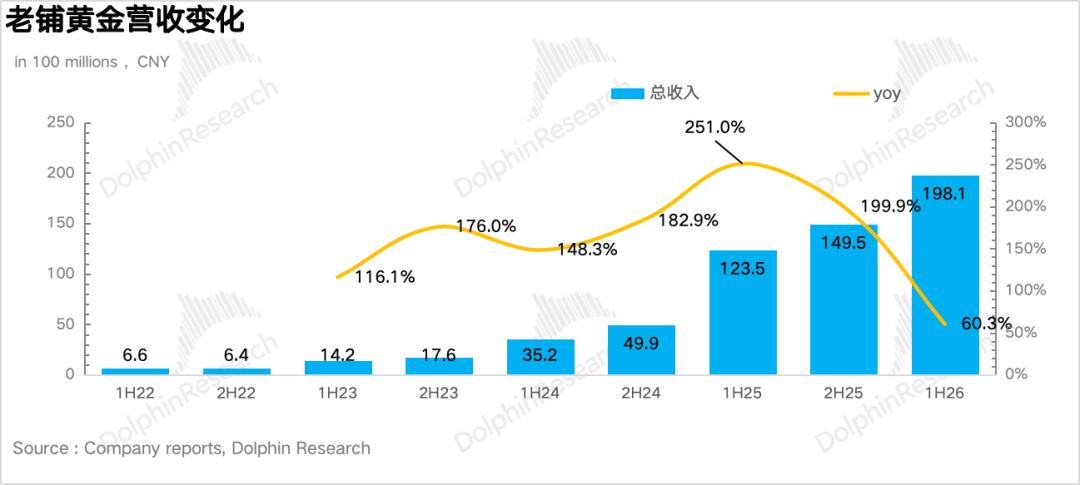
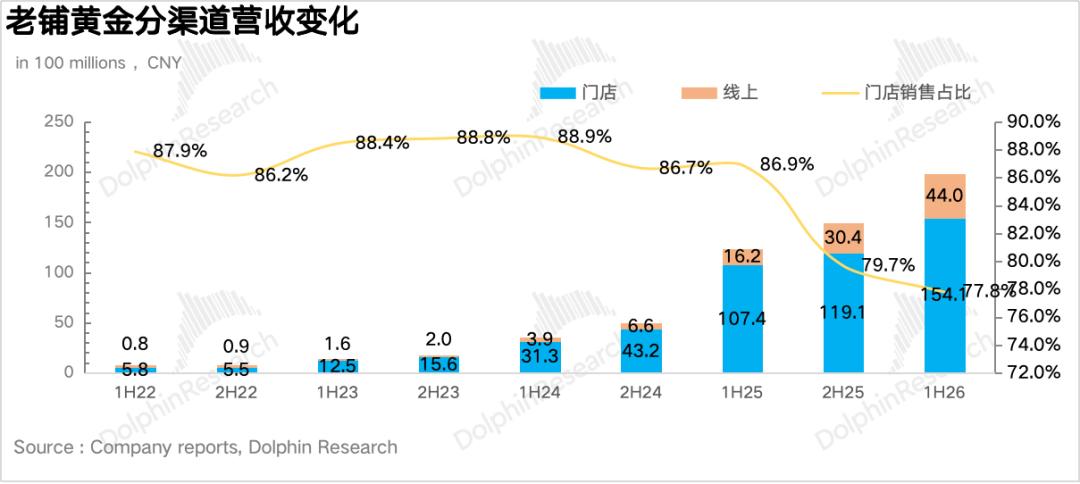
By channel breakdown, online platforms generated revenue of RMB 4.4 billion, surging 172% year on year, and its proportion further increased to 22.2% from 13% in the same period of last year. But in detail, combined with the 63% year-on-year decline in Q2 sales of "Tmall Flagship Store" tracked by Goldman Sachs third party, and Citi's data that "the proportion of SKP + Tmall two channels dropped from about 30% to about 20%", it shows that the decline of channels such as Taobao and Tmall has been hedged by the increment of Douyin, JD and WeChat Mini Programs, which means that Laopu's online business is shifting from relying on Tmall to multi-platform layout, and the channel quality is improving.
As Laopu's main battlefield, offline channels generated revenue of RMB 15.4 billion in the second half of the period, up 43.5% year on year, and its proportion dropped from 86.9% to 77.8%. The offline growth rate (+43.5%) is significantly lower than online (+171.9%), and also lower than the overall growth rate (+60.3%), indicating that the real loss of traffic in Q2 came from offline stores, rather than the overall penetration of the brand.
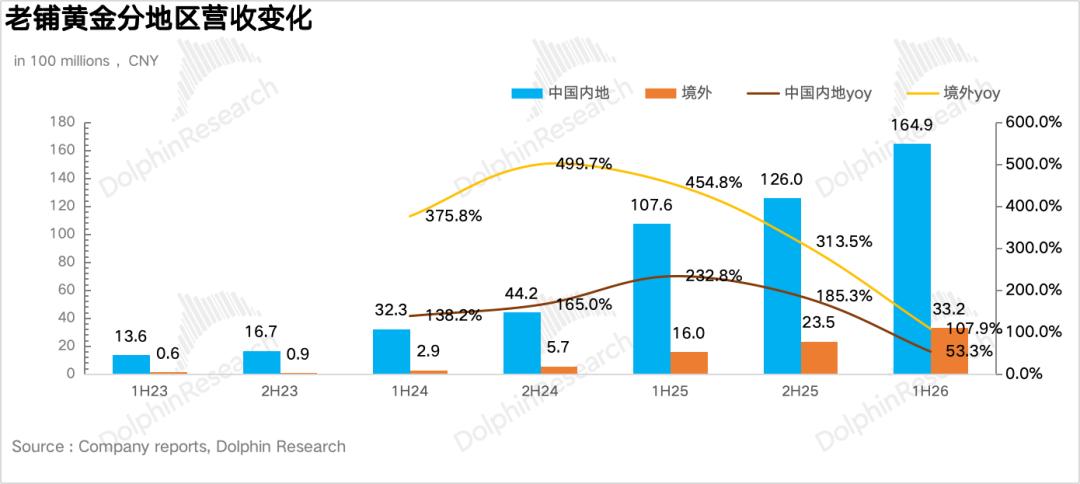
In 1H26, Laopu's overseas revenue was RMB 3.32 billion, up 108% year on year, and its proportion increased from 12.9% to 16.7%. Since November 2025, Chinese mainland has imposed an additional 7% value-added tax on gold jewelry, which widened the terminal price gap between Hong Kong, Macao and the mainland. Dolphin Research speculates that this has attracted a large number of tourists to purchase gold in Hong Kong and Macao.
However, Laopu's penetration rate in Hong Kong and Macao is still relatively low — among the 44 top shopping malls surveyed by UBS that are concentratedly settled by four top international hard luxury brands, Bvlgari, Tiffany, Cartier and Van Cleef & Arpels cover 41 to 43 malls respectively, while Laopu only covers 23. Considering that among the 6 newly settled commercial centers in this period, Hong Kong IFC and the Parisian Macao are included, and they are mainly launched in the second half of the year, the overseas business line will continue to accelerate in the second half of the year.
The domestic region achieved revenue of RMB 16.5 billion, up 53% year on year, with a significantly lower sequential growth rate.
II. Stop opening new stores in domestic market, focus on store area expansion and overseas expansion
In terms of store count, Laopu had 45 stores at the end of the period, with no net new stores. Compared with the end of June 2025, 6 new commercial centers were settled: Shenzhen Bay MixC, Shanghai Xintiandi, Nanjing IFC, Hong Kong IFC, Shanghai Plaza 66, the Parisian Macao; and 9 stores were optimized and expanded in the already settled commercial centers.
The company clarified that 10 to 12 stores are planned to be optimized in 2026, 6 of which have been optimized as of the announcement date, and this round is defined as "a new stage of location upgrading" — moving stores to the core positions of shopping malls, not only expanding the business area, but more importantly, "making the store location form synergy with the high-end brand positioning".
III. Inventory level is further raised, but the growth pace slows down sequentially
In terms of inventory, Laopu's inventory reached RMB 19 billion by mid-2026, Dolphin Research calculates that the amount used for procurement and production feeding is about RMB 14.6 billion. Compared with the financial gold hoarding wave in the second half of 2025 supported by rights issue fundraising (procurement amount was RMB 16.7 billion), it has converged significantly sequentially, which is more like operational stock preparation.
Calculated according to the average gold price in the first half of the year, the cost is around USD 4,660, while the cost line of the batch of inventory at the end of 2025 is around USD 3,850, and the mixed cost line has moved up to about USD 4,200, which still has a buffer of about 10% compared with the current gold price