With Tencent and Alibaba both placing their bets on it at the same time, what makes XPeng Robotics worth 43 billion yuan?
On August 24, XPeng Group released two major pieces of news at the same time.
One comes from the robotics business. XPeng's humanoid robotics business has completed its first round of equity financing. The total financing amount of this round exceeds 900 million US dollars, with a post-money valuation of more than 6.3 billion US dollars, equivalent to about 43 billion yuan. This financing is led by IDG Capital, participated by Gaorong Ventures, and joined by Tencent and Alibaba as strategic investors. This also sets a new record for the single-round private equity financing of embodied intelligence industry in China.
The other comes from the automotive business. XPeng released its Q2 "report card". In the second quarter of 2026, XPeng delivered 103,300 vehicles, generating a revenue of 19.74 billion yuan, with a comprehensive gross profit margin of 20.7%. The delivery volume and revenue increased by 64.8% and 51.5% quarter-on-quarter respectively, and the operating status rebounded significantly compared with the first quarter.
Putting these two events together, the signal released by XPeng is very clear: automobiles are still the fundamental business, and the value of "Physical AI" is gradually becoming prominent.
01
The Second Growth Curve Valued at 43 Billion Yuan
In XPeng's planned future layout, there are three major growth curves: AI vehicles, robotics and globalization.
XPeng bet on robotics earlier than the outside world expected. As early as 2020, XPeng officially entered the legged robot track. At the 2025 XPeng Tech Day, the humanoid robot IRON walked a "catwalk", which attracted widespread attention inside and outside the industry due to its extremely natural and smooth gait.
After the completion of this round of financing, XPeng Group still holds a controlling stake in the robotics business, and the related business will continue to be incorporated into the group's financial statements.
What is more noteworthy is the list of investors. XPeng Robotics has obtained strategic investments from both Tencent and Alibaba. In the history of China's Internet, it is very rare that Tencent and Alibaba appear in the same round of financing of a company. These two giants have almost competition in fields such as cloud computing, large AI models, autonomous driving, and local life services.
But at XPeng Robotics, they chose to stand on the same side. At least in the direction of embodied intelligence, the two giants have spotted similar opportunities.
Previously, both Tencent and Alibaba have invested in Unitree Robotics; this time, they have jointly bet on XPeng Robotics. It is reported that in this round of financing, Alibaba and Tencent each invested 100 million US dollars, while IDG Capital and Gaorong Ventures invested 300 million US dollars and 100 million US dollars respectively.
For XPeng, Tencent and Alibaba bring more than just funds. For robots to truly enter daily life, cloud computing, AI infrastructure and users are required, as well as real application scenarios such as retail and logistics. The business ecosystems of Tencent and Alibaba may allow XPeng to find real scenarios faster.
A more realistic consideration is capital. At present, the robotics industry is still in a very early stage, the technical paradigm has not yet been finalized, and long-term capital investment is required. The independent financing of XPeng Robotics can prepare a longer-term fund for the robotics business without significantly increasing the group's capital pressure. After all, in the new energy vehicle industry where XPeng Motors operates, the "decisive battle" is far from over.
More importantly, independent financing can also establish a more flexible equity incentive and talent mechanism for the robotics team. The competition of humanoid robots is essentially a competition for talents. Previously, a large number of talents from the automotive industry have entered the embodied intelligence track.
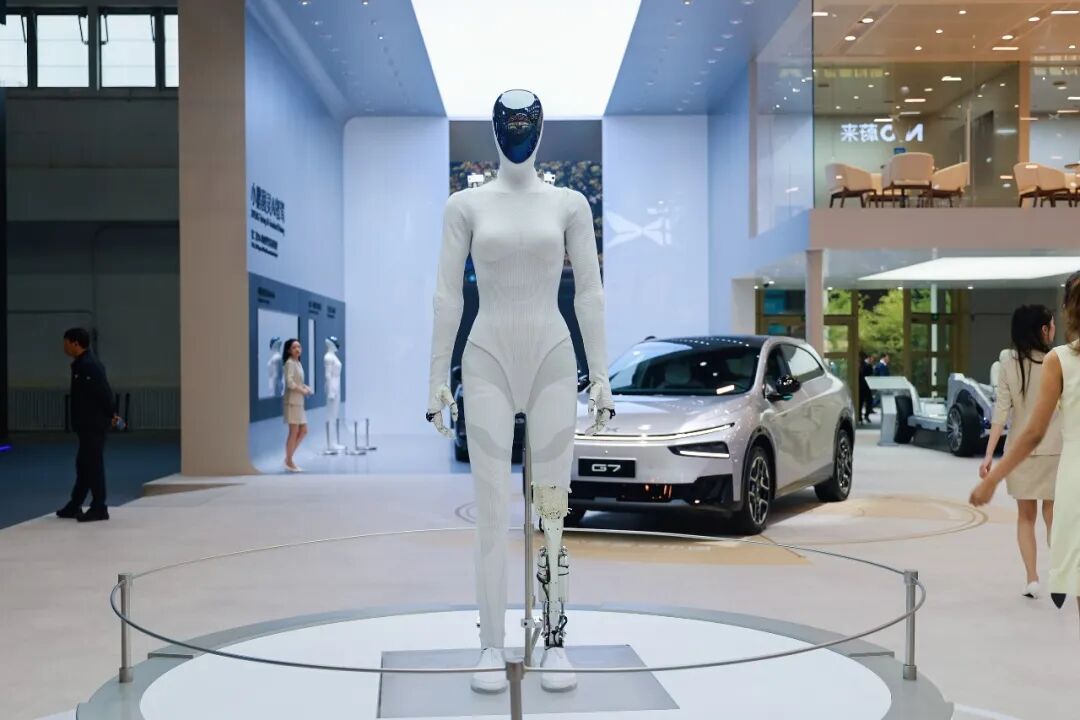
XPeng's goal is to create elegant and safe humanoid robots | Image source: Visual China
The outside world may ask, why can XPeng Robotics obtain more than 900 million US dollars in its first round of financing? Many people think XPeng has vehicle manufacturing experience. This answer is correct, but not comprehensive enough.
More importantly, XPeng positions itself as "the world's leading Physical AI company", it migrates the chip, model, supply chain and manufacturing system accumulated in its automotive business to humanoid robots. Automobiles and robots seem to be two different categories, but in the AI era, their underlying logics are converging.
He Xiaopeng said that they may be the only company in China that conducts full-system independent research and development of robots, with a technical stack covering ontology, brain, midbrain, cerebellum, data and Infra.
In terms of ontology, IRON has 76 degrees of freedom in the whole body and 21 degrees of freedom in one hand, adopts a fully covered flexible lattice, and independently develops core components such as controllers, motion modules and dexterous hands; in terms of chips, IRON is equipped with 3 XPeng self-developed Turing AI chips, with an effective computing power of 2250 TOPS. XPeng hopes to support complex task reasoning with end-side computing power to reduce dependence on cloud connection and remote control.
In addition, in terms of models, XPeng plans to deploy the Physical AI base large model, which is homologous with that of AI vehicles, on the robot end side to obtain lower latency and strengthen data security; in terms of data, anthropomorphic hardware can adapt to spaces and tools originally designed for humans. After robots enter real working scenarios, they can continuously generate operation data, which can then be used for model training and iteration.
In terms of manufacturing capacity, the robotics industry did not lack cool demos in the past, but lacked stable, reliable and mass-deliverable products. A prototype that can complete demonstrations on the stage is completely different from a batch of robots that can run continuously for several months in real scenarios. The quality and cost control and supply chain collaboration accumulated in the automotive industry are XPeng's key advantages to enter the commercialization of robotics.
XPeng hopes to build a closed loop of "data - model - application": robots enter more scenarios to generate more real data; data promotes model upgrading; the improvement of model capability enables robots to enter more complex scenarios.
Only when this data closed loop is realized, can the imagination space of the robotics business be truly opened. Because what embodied intelligence lacks most is not text data, but actions, interactions and scenario data in the real physical world. Whoever can enter real scenarios earlier can accumulate data earlier; whoever has more and more closed-loop data can iterate its models faster.
The capital is willing to give a high valuation today, betting on exactly this possibility.
02
Robots represent the future, while automobiles support the present
On the same day the robot financing was released, XPeng announced its performance for the second quarter of 2026. Compared with the humanoid robotics business with a valuation of 43 billion yuan, the automotive financial report seems less "exciting", but it determines XPeng's current fundamentals.
Data shows that in the second quarter of 2026, the total delivery volume of XPeng Motors was 103,300 units, a year-on-year increase of 0.1%; the total revenue was 19.74 billion yuan, a year-on-year increase of 8%, of which the automotive sales revenue reached 17.05 billion yuan, and the service and other revenue reached 2.7 billion yuan, a year-on-year increase of 93.9%.
Judging only from the year-on-year data, this set of figures is not very impressive. But looking at the overall market of the entire automotive industry this year, XPeng's performance is actually not bad.
According to data from the China Passenger Car Association, in the first half of 2026, the retail sales of narrow-sense passenger vehicles in China reached 8.701 million units, a year-on-year decline of 20.2%. Among them, the retail sales of fuel vehicles reached 3.996 million units, a year-on-year decline of 26.4%; the retail sales of new energy vehicles reached 4.704 million units, a year-on-year decline of 14.0%. Against the background of a double-digit decline in new energy vehicles, XPeng's Q2 delivery volume can still maintain a basically flat year-on-year performance, which is already a good result.
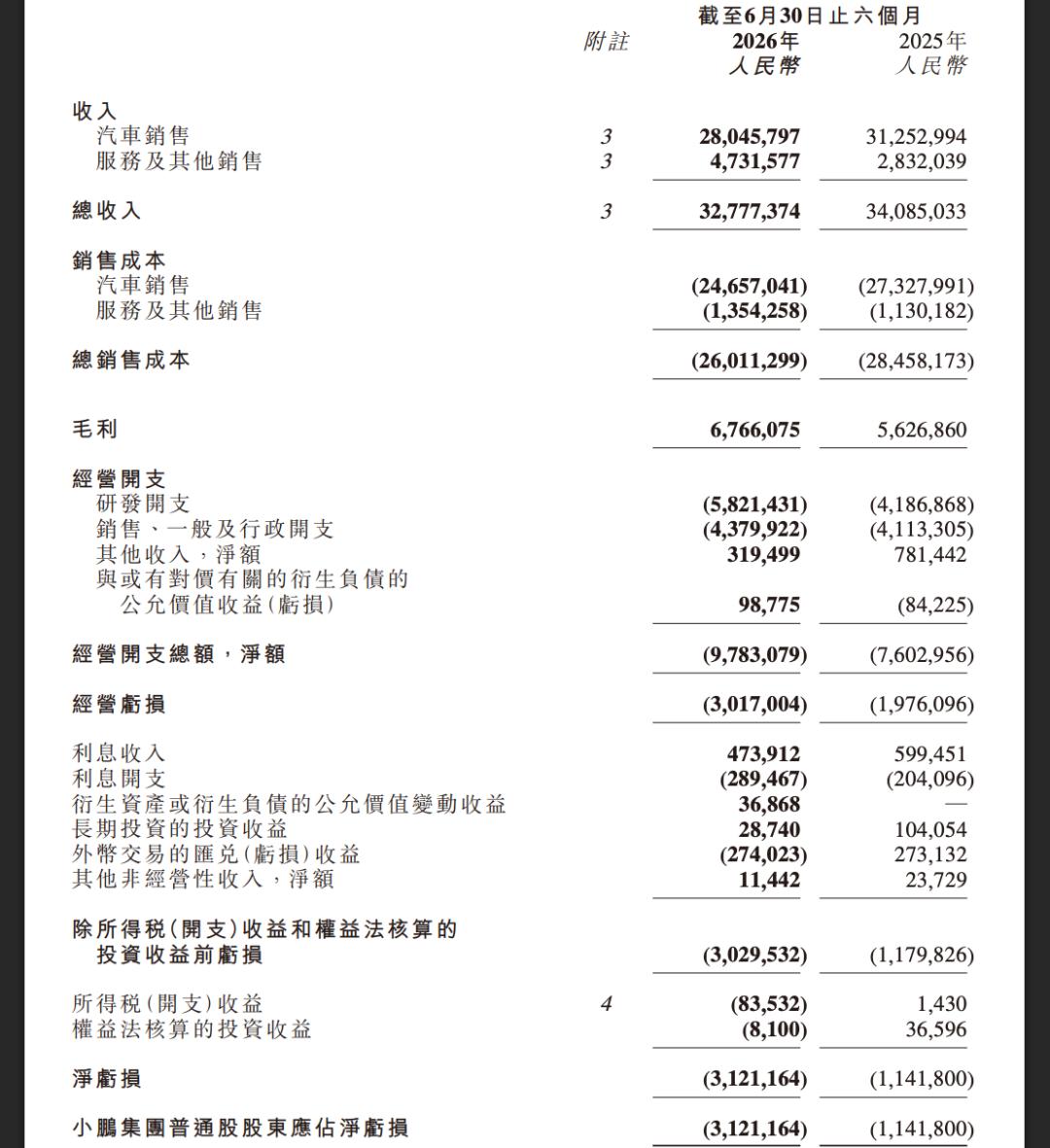
Key financial indicators of XPeng Motors' Q2 financial report | Image source: XPeng Motors financial report
The more critical indicator is the gross profit margin. In the second quarter of 2026, XPeng's comprehensive gross profit margin reached 20.7%, 3.4 percentage points higher than the same period in 2025; the automotive gross profit margin was 12.1%. From the quarterly performance, delivery, revenue and gross profit margin have all improved significantly compared with the first quarter, and XPeng is getting out of the low point at the beginning of the year.
However, there is a key detail here: XPeng's comprehensive gross profit margin is higher than the automotive gross profit margin, which is largely related to the rapid growth of service and other revenue. In the second quarter, XPeng's service and other revenue reached 2.7 billion yuan, a year-on-year increase of 93.9%.
This part of the growth mainly comes from providing technology R&D services to the public, as well as the increase in sales of parts and accessories. In the first half of 2026, the first jointly developed model "Avatr 08" cooperated by Volkswagen and XPeng Motors was launched, and the new car integrates XPeng Motors' latest technologies in areas such as intelligent driving.
Although XPeng is still in a loss-making state, the overall state is stable. As of June 30, 2026, the company's cash reserve was 40.48 billion yuan. This cash reserve is not thin, which can at least support XPeng to continue investing in products, technologies and overseas markets.
Another growth curve of XPeng is globalization. While the robotics business is still talking about the future, the overseas business has begun to contribute incremental revenue. Data shows that in the second quarter of 2026, XPeng's overseas sales volume exceeded 20,000 units for the first time, a year-on-year increase of 81%; the overseas business contributed more than 25% of the revenue in the first half of the year.
Different from many people's imagination, the average selling price of XPeng's overseas models exceeds 40,000 euros, close to the price range of traditional luxury brands such as BBA. This shows that XPeng's overseas expansion is not simply relying on price competition, but wants to gain a foothold in the overseas mid-to-high-end market by relying on intelligence and product experience.
In terms of channels, XPeng has now entered more than 60 countries and regions around the world, with 467 overseas stores deployed. XPeng's overseas channels have also moved from trial operation to large-scale expansion.
According to XPeng's plan, MONA L03 is expected to start overseas delivery in the fourth quarter, which will drive XPeng's overseas quarterly sales to exceed 40,000 units. By 2027, XPeng also plans to launch multiple extended-range models in overseas markets.
03
Mass production and implementation are the real big test
Financing only shows that the capital is willing to pay, and the next step, whether the robots can be sold and put into use, is the real big test.
According to XPeng's plan, IRON will enter the stage of large-scale mass production at the end of 2026, and will first be applied in XPeng's stores to start commercial landing attempts. In 2027, IRON will accelerate the delivery in overseas markets, and the production capacity can be increased to thousands of units in the second half of the year according to market demand.
However, the technical route has not been fully finalized, the business model has not been verified, and the large-scale landing has only just begun. There is no verified large-scale market similar to smartphones or new energy vehicles. There are still a large number of engineering problems in the dexterous operation, battery life, reliability, safety and cost of robots.
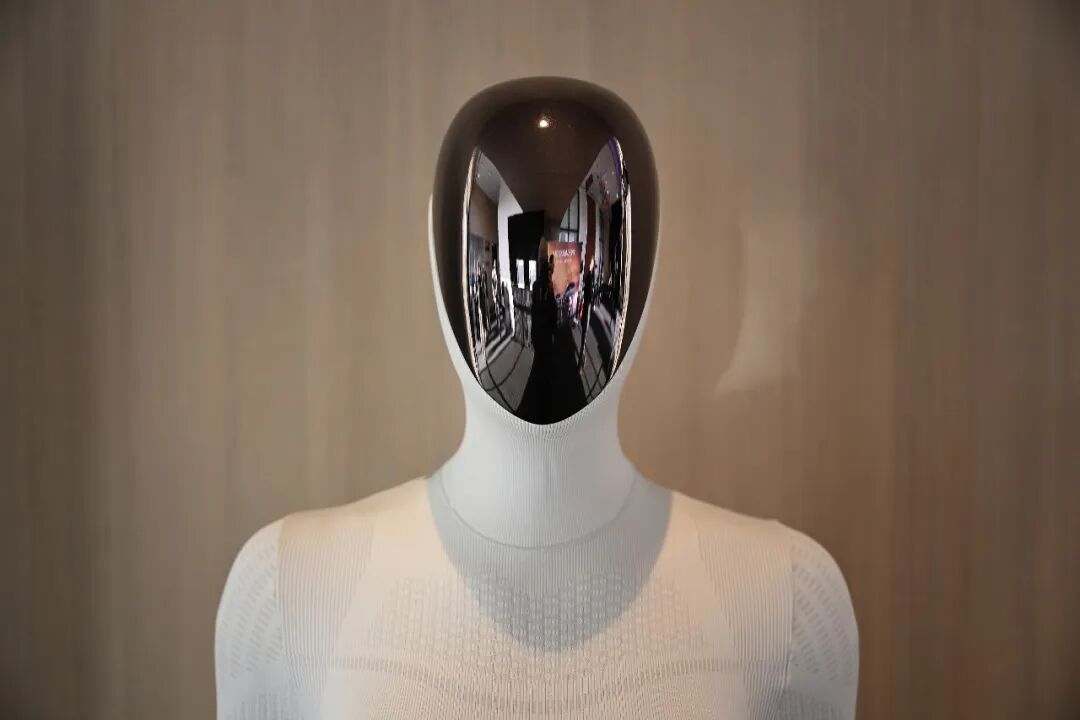
In the second half of 2026, XPeng Robotics will enter the mass production stage | Image source: Visual China
This round of financing of XPeng Robotics not only refreshes the financing record of the embodied intelligence track, but more importantly, it makes the market see that the accumulation of car companies in AI chips, models and supply chains may become the foundation for robots to move towards mass production.
At the moment when embodied intelligence is still in its early stage, projects like XPeng Robotics receiving long-term capital support will help promote the maturity of the supply chain and attract more capital to enter. At the same time, the participation of industrial capitals such as Tencent and Alibaba also provides more real scenarios for robots and accelerates commercial verification.
For the industry, this financing of XPeng Robotics will push robots further from technical demonstration to mass production and landing. This will push the entire track to answer a key question: in which scenarios can robots stably create value?
This article is from the WeChat official account "GeekPark" (ID: geekpark), written by Zhou Yongliang, edited by Jing Yu, and released with authorization from 36Kr.