ByteDance has integrated TRAE and Coze into Doubao, while you are still calculating the per capita revenue.
On August 24, ByteDance announced that TRAE and Coze have been fully merged into Doubao, and the independent AI office brand "Doubao Work" will be launched as early as this week.
The moment the news broke, public opinion became bustling as usual. Some calculated the product matrix, some weighed the pros and cons of the integration, and others began to speculate on ByteDance's "AI office ambition". For all the hustle and bustle, after going through various interpretations in the media, I found almost none of them got to the core of the matter.
What ByteDance did this time is ostensibly a product move, but essentially an organizational move, which will naturally bring changes to manpower efficiency. However, most people are still responding to product changes with the simple method of calculating revenue per capita, ignoring that this is an organizational-level "surgery".
This kind of view that treats the headache by healing the head and treats the foot pain by healing the foot makes little sense at all.
01
Organizational Surgery, Not Product Display
Public opinions generally fall into the following categories:
The first category is the PR interpretation style. It claims that this is ByteDance's show of determination and strength for its "All in AI" strategy. This statement is completely meaningless. Which internet company is not talking about "All in AI" now? Is there any need to show such determination? Which internet company has not set up several AI departments, and who does not have some strength? It's just that the "AI strength" of many internet companies is blocked by "organizational fat". ByteDance does not need to show off its determination or strength. What it needs is to embed its strength into the business, not into press releases.
The second category is the product inventory style. It uses a diagram or a table to explain which part TRAE is assigned to, which part Coze is merged into, and how Doubao is divided. This is a statement at the factual level, which actually has certain value, but fails to interpret the profound meaning behind it. It is a bit like using a product manager's way of thinking to solve an organizational problem.
Adding or subtracting one more product in ByteDance has never been the focus; the focus is who makes decisions, who can mobilize resources, and whose output is linked to whose interests. Product is the result, while organization is the cause. If you reverse the cause and effect, all you get is "noise".
The third category is the manpower efficiency calculation style. It starts to calculate the DAU of Doubao, how many users the independent brand can bring, how much revenue (or GMV) it can generate, and then estimate the possible scale of personnel integration, so as to draw the conclusion that manpower efficiency will be greatly improved. This is a trick that treats manpower efficiency as "per capita traffic", and then uses per capita traffic to deduce broad-caliber non-core manpower efficiency data such as "revenue per capita". Does ByteDance lack traffic? What it lacks is to turn the already available AI capabilities into real combat effectiveness within the organization. There is no simple and fixed "conversion rate" from AI capability to revenue, and the "conversion rate" depends on the efficiency of the organization. The outside world focuses on counting traffic and headcount through entrances, while ByteDance focuses on whether someone in the organization really uses AI to win battles.
These types of interpretations share a common root problem — they all look at a company in isolation from its organization. In these views, companies have no difference in organizational models, but are just combinations of a group of people who generate performance. Dividing the overall performance by the total number of people gives a seemingly professional manpower efficiency figure, and then they claim they have fully understood the situation.
Without talking about the organization, only talking about strategy and products, you can never understand a company.
02
Fight Organizational Ailments with Organizational Models
Musheng Consulting has been observing the issue of "AI entering enterprises" for quite some time. Our conclusion is very straightforward: AI improves individual efficiency, but whether individual efficiency can be transformed into organizational efficiency depends on whether the organizational model is reformed.
AI investment without organizational reform is essentially replacing a thicker faucet for a leaking bucket. The water flow is larger, but the water in the bucket may not necessarily increase.
As a super technology, AI itself cannot fight against those typical big enterprise ailments — departmental walls, insulation layers, process bottlenecks, and KPI vacuum covers. In the past, meetings were "each one sticks to his own argument"; now with AI, meetings become "each one has his own model", making prevarication more professional, more confident, and harder to refute. Each department maintains its own set of data calibers and analysis models. The stronger the AI is, the thicker the walls will become instead.
It is rumored that a leading e-commerce enterprise has begun to show a trend where departments pass AI solutions to each other, burning real money the company pays for tokens. The organizational efficiency has not improved as expected, but has decreased instead.
Therefore, the method to judge whether an enterprise's "AI transformation" is a real move or a fake one is very simple — see if it has adjusted its organization.
Looking back at ByteDance against this standard, the weight of this merger becomes very clear.
TRAE is an AI tool for developers, Coze is a low-code/agent platform, and Doubao is the C-end entrance plus ByteDance's full-stack self-developed large model matrix (including the base model Skylark and segmented models like Seedance, Seedream, etc.). These three parts used to be scattered behind different walls. Now that they are merged under the same brand and the same decision-making chain, the first thing ByteDance does is actually to tear down the walls. It prevents AI capabilities from being cut into three parts by departmental boundaries, but rearranges them according to a clear business logic.
In Musheng Consulting's organizational analysis framework, this means combining those modules in the organization that face different KPIs into a "business unit", which delivers business results together rather than process indicators. This is enlightening for all enterprises. Institutions that do not generate business value should not be given too much budget in the first place. They should be aligned to the direction of generating revenue through organizational adjustments.
After this kind of organizational adjustment, another thing ByteDance does is to reset the input-output ratio. The independent brand "Doubao Work" means that AI office is no longer a cost center for internal use, but a business unit that needs to deliver services externally and account for its profits and losses.
03
Truly Improve Efficiency? It Depends on Indicators!
Of course, a good-looking move is not enough. ByteDance will not publish its organizational accounts, but any attentive business owner can use three indicators to check their own AI department, and also check how solid ByteDance's move is.
First, Token Efficiency.
This is the latest original research of Musheng Consulting. One caliber is dividing financial or business data by the total human-machine input — "labor cost + total AI investment". With this indicator, whether "AI really improves efficiency" changes from a slogan to a calculable fact. In the past, you might brag that you have improved efficiency by 30%, but now dividing the relevant data by this indicator will show the real result clearly at a glance.
Second, the efficiency improvement of key decision-making cycles.
This indicator does not look at how much AI you use, but only at whether you make decisions faster. Pick three typical decisions — one budget addition, one cross-department resource allocation, and one new product launch, and measure how many days each takes from proposal to implementation. If after using AI for a whole year, these three figures remain completely unchanged, it means that AI only enters the tool layer, not the management layer. It changes the way you work, but not the way you make decisions. Then it is just a more expensive Office.
Third, the Synergy Benefit Sharing Index.
Our original indicator, the Real Incentive Index, which reflects whether enterprise performance appraisal is practical, has been widely used by enterprises, especially HR practitioners. The Synergy Benefit Sharing Index is an extension of the Real Incentive Index in the AI dimension. It asks: how much of the business increment created by AI is turned into incentives and distributed to employees? If this figure is zero, then AI in your company is nothing more than an expense. No one will sincerely promote AI, because those who push it cannot get benefits; only some people will pretend to promote it, because the boss is watching.
Of course, we have also developed more advanced indicators, because AI, as a major technical variable, has brought fundamental changes to the business model, which will naturally drive changes in the organizational model. A new indicator system is definitely needed to describe organizational efficiency. In particular, the emerging concept of "manpower efficiency management" now needs to enter a new era.
But in this article, we do not need to expand on these advanced indicators. The above three indicators alone are already very illustrative. These indicators, when applied to the vast majority of enterprises that shout "All in AI", are basically unflattering — they are almost zero, and some are even negative, which is quite embarrassing.
04
HR Should Understand This Move
At this point, I have to trace back to the root of the human resources profession.
Many HR practitioners understand "manpower efficiency management" as calculating revenue per capita and profit per capita, as well as cutting headcount and reducing costs. This is too superficial. Manpower efficiency management focuses on managing the input-output ratio, not reducing input; it is about reasonably "placing chips", not blindly "saving chips". In the AI era, this logic needs to be further advanced — the object of manpower efficiency management should be expanded from "people" to "human-machine".
After ByteDance's move, it seems to have achieved several advancements:
First, it treats AI as a resource that requires input, output and accounting, rather than a sacred artifact to be enshrined. A sacred artifact only needs to be enshrined and supported by faith, while a resource can be allocated and its input-output ratio can be calculated. That is why we repeatedly emphasize that enterprises should build their own Human Resource Efficiency Dashboard (HED) — turning the causal chain of "Function → Team → Manpower Efficiency" into a manageable and observable indicator system. When AI is introduced, the enterprise dashboard must reserve a dimension for "Token Efficiency".
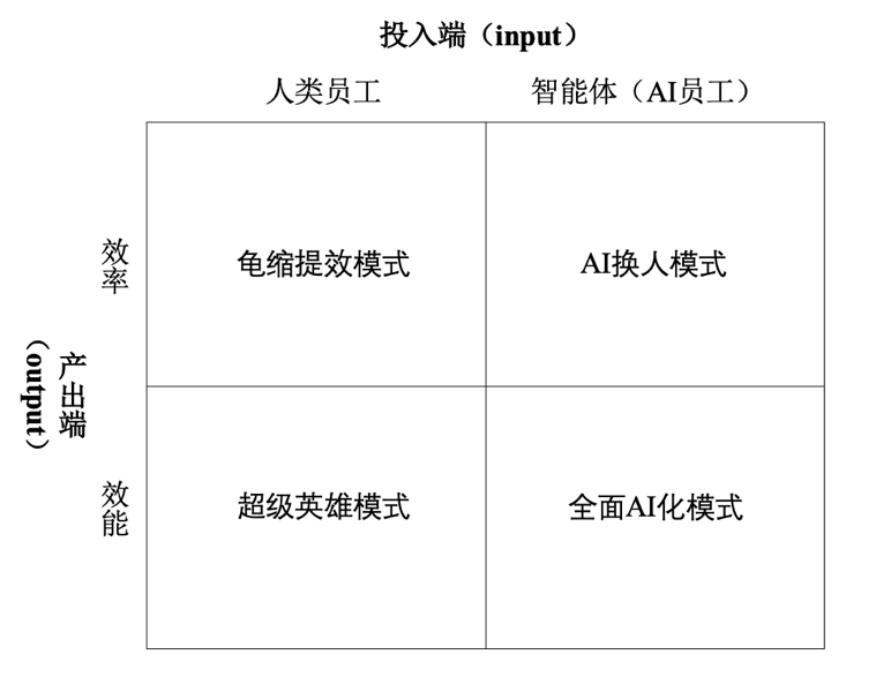
Second, it uses organizational moves rather than tool moves to drive manpower efficiency. We break down manpower efficiency in the AI era into the "AI Efficiency Improvement Quadrant" of Musheng Consulting (as shown in the figure):
The horizontal axis is the two input ends of human and machine, and the vertical axis is the output end of efficiency and effectiveness. Here is the explanation (see "Human Resource Efficiency? Human Resource Effectiveness!" for details): Efficiency refers to Efficiency, that is, input-output ratio. Although effectiveness is also translated as Efficiency in English, it essentially means "effect + capability". The first part is "effect", that is, efficiency; the second part is "capability", that is, output. In other words, effectiveness does not simply emphasize reducing input (denominator), but emphasizes converting input (denominator) into output (numerator).
In this quadrant, most enterprises are struggling in the "shrinking efficiency improvement mode", which makes things more and more involution by reducing staff, controlling headcount and implementing stricter assessments. Quite a number of enterprises also try to use the "AI replaces human mode" to reduce staff and control headcount. Some enterprises are still insulated from AI and refuse organizational reform, using the "superhero mode" to resist the trend of the times. The real high-level move is to enter the "full AI-enabled mode", that is, by building various agents to increase the conversion rate of various resources of the enterprise, and achieve a comprehensive improvement in effectiveness.
What ByteDance is doing seems to be this mode. It is not replacing tools for people, but replacing a set of "AI-embedded organizational skeleton" for people. Of course, it is still unknown whether this skeleton is built according to the Agentic Organization, but at least they have taken the first step.
Source: Musheng Consulting
Third, which is also the most easily overlooked point, through this organizational adjustment, it seems that it can bind incentives with AI. The logic of the Synergy Benefit Sharing Index is exactly the leveraged incentive mechanism we have always talked about — distributing the benefits of increment clearly to the people who create the increment in the form of variable compensation. Tools will become outdated, and algorithms will be copied, but the incentive design of "who creates, who benefits" is an organizational capability that cannot be copied.
So you see, from the product perspective, ByteDance's move is the merger of three applications; from the organizational perspective, it is a manpower efficiency reconstruction leveraging AI. Different interpretations lead to completely different levels of understanding.
05
What Is Worth Being Anxious About Is Never ByteDance
I know that after reading this, many business owners will feel anxious: ByteDance is so large and so rich, it plays with human-machine input-output ratio, and I cannot follow suit.
You are anxious about the wrong thing.
What you should be anxious about is not "whether I can learn from ByteDance", but "my HR practitioners still only know how to calculate revenue per capita". ByteDance is not scary. What is scary is that no one in your organization can translate "AI efficiency improvement" into indicators that can be managed, assessed, and shared. Tools are affordable for everyone, and models can be adjusted by everyone, but the organizational logic that turns tools into combat effectiveness is the real moat of an enterprise.
For HR practitioners, the AI era has brought their career prospects to a real crossroads.
I have long asserted that manpower efficiency management is no longer a branch of the human resources profession, but the future of this profession. An excellent HR must be able to take manpower efficiency as the fulcrum to drive business operations; an excellent business owner must be able to let HR stand on this fulcrum.
The fact is that in the past few years, most HR practitioners have been "pretending to manage manpower efficiency". You know, it is easy to reduce costs by laying off employees; but it is difficult to improve efficiency, which requires organizational reform. However, the vast majority of enterprises and their HR practitioners are using the former to pretend to be the latter.
In the AI era, with the emergence of disruptive technologies, where will manpower efficiency management go? "Pretending to manage manpower efficiency" will naturally make HR practitioners continue to stay in the "shrinking efficiency improvement mode", or pretend to follow the trend and switch to the "AI replaces human mode". But these are not the right paths. They will not build a broader career stage for HR practitioners, nor will their profession be respected. On the contrary, they will become "executioners" who are despised by employees and public opinion, and finally sacrificed by the boss. As a scholar who has long studied organization and human resources, I cannot help but feel deeply distressed when foreseeing these situations. Conversely, how promising can an enterprise that sacrifices HR to defuse public anger be? Many enterprises with good fundamentals have gone astray in this matter, ignoring the organization and blindly raising manpower efficiency, which really makes me sigh.
At the end of the day, enterprises should wake up, and HR practitioners should also save themselves.
ByteDance may have already figured it out, and their HR practitioners have a larger stage. What about you?
This article is from the WeChat Official Account "Musheng Office" (ID: hrm-yun), written by Mu Sheng, published with authorization from 36Kr.