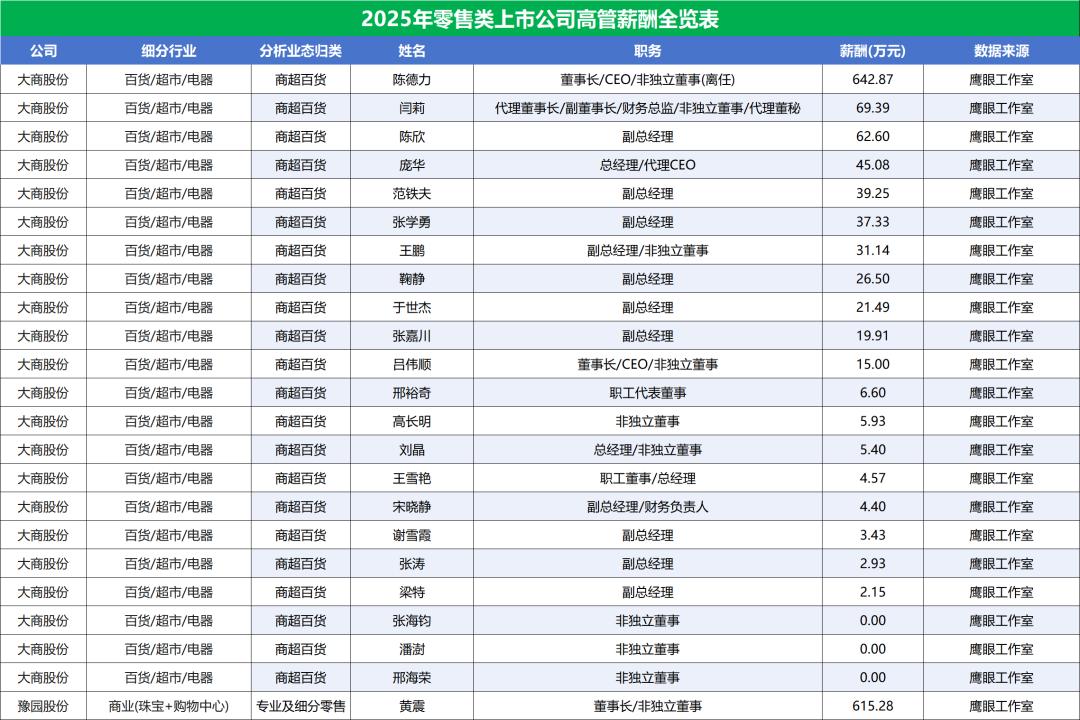
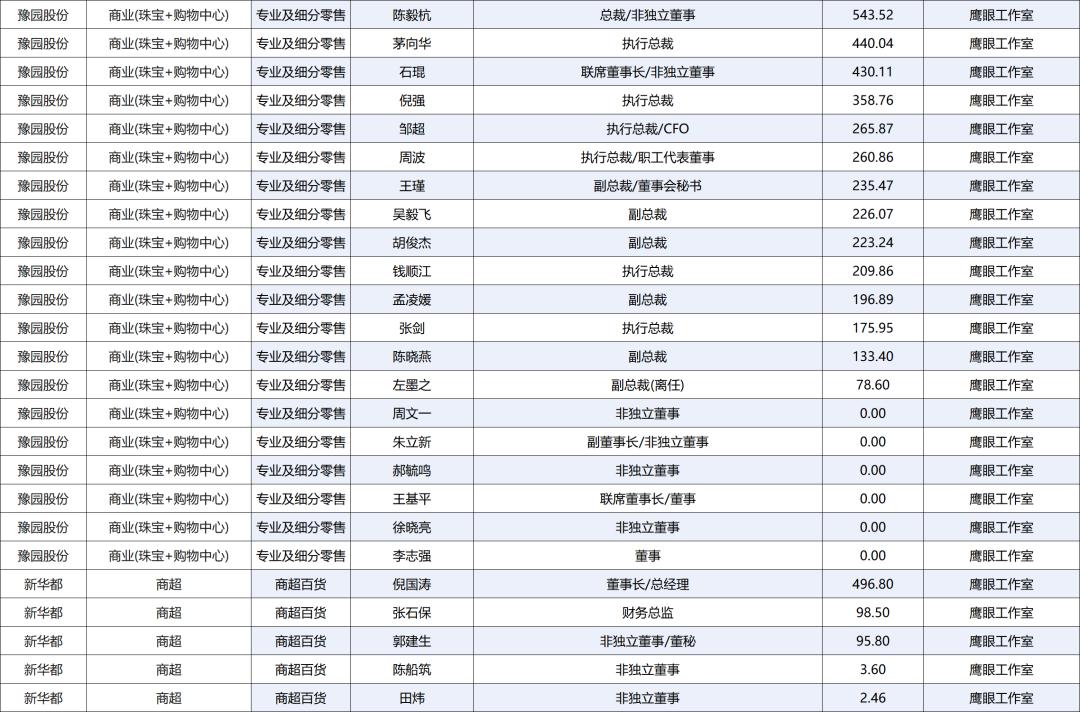
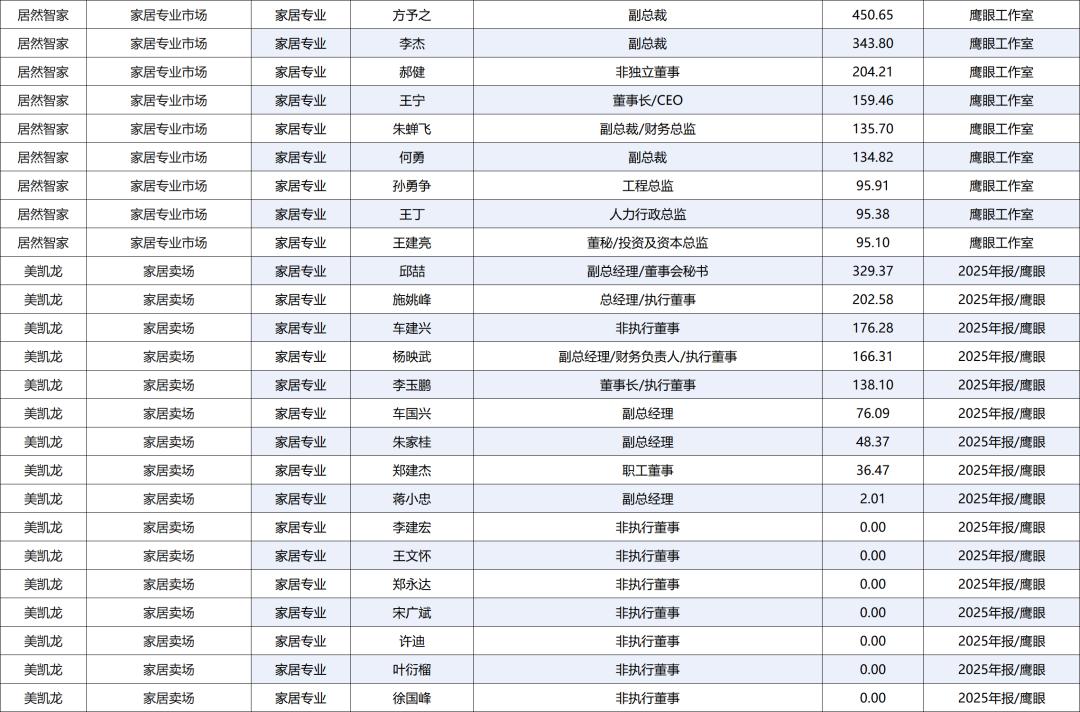
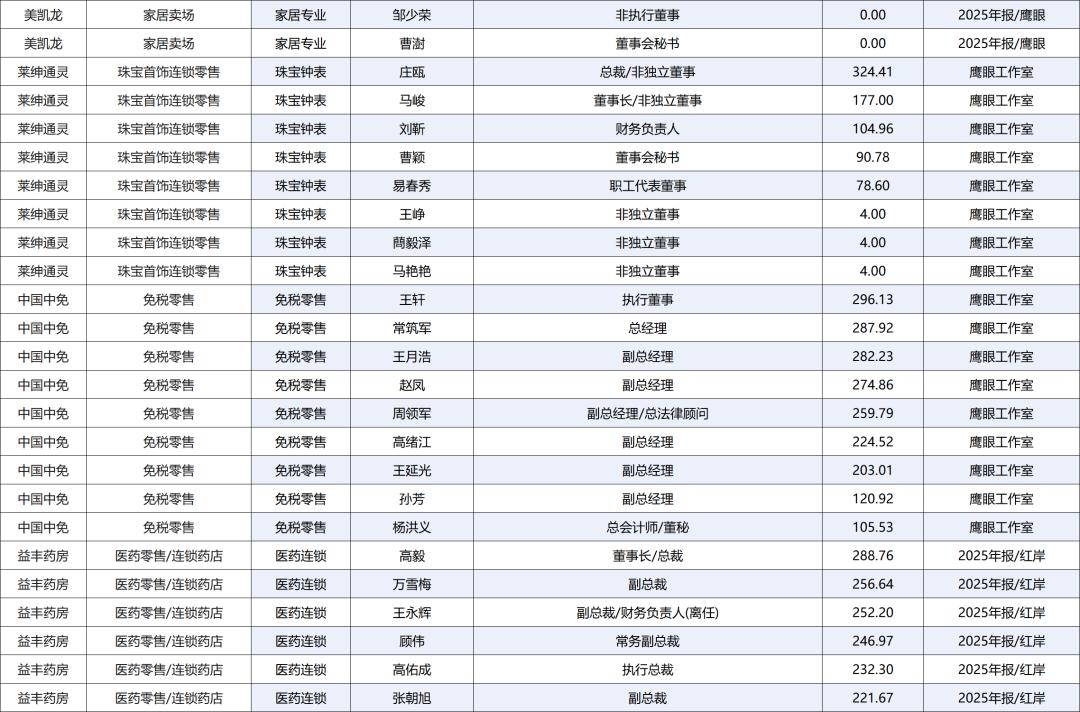
222 people have an annual salary exceeding one million yuan, a full panorama of remuneration for 84 listed retail companies
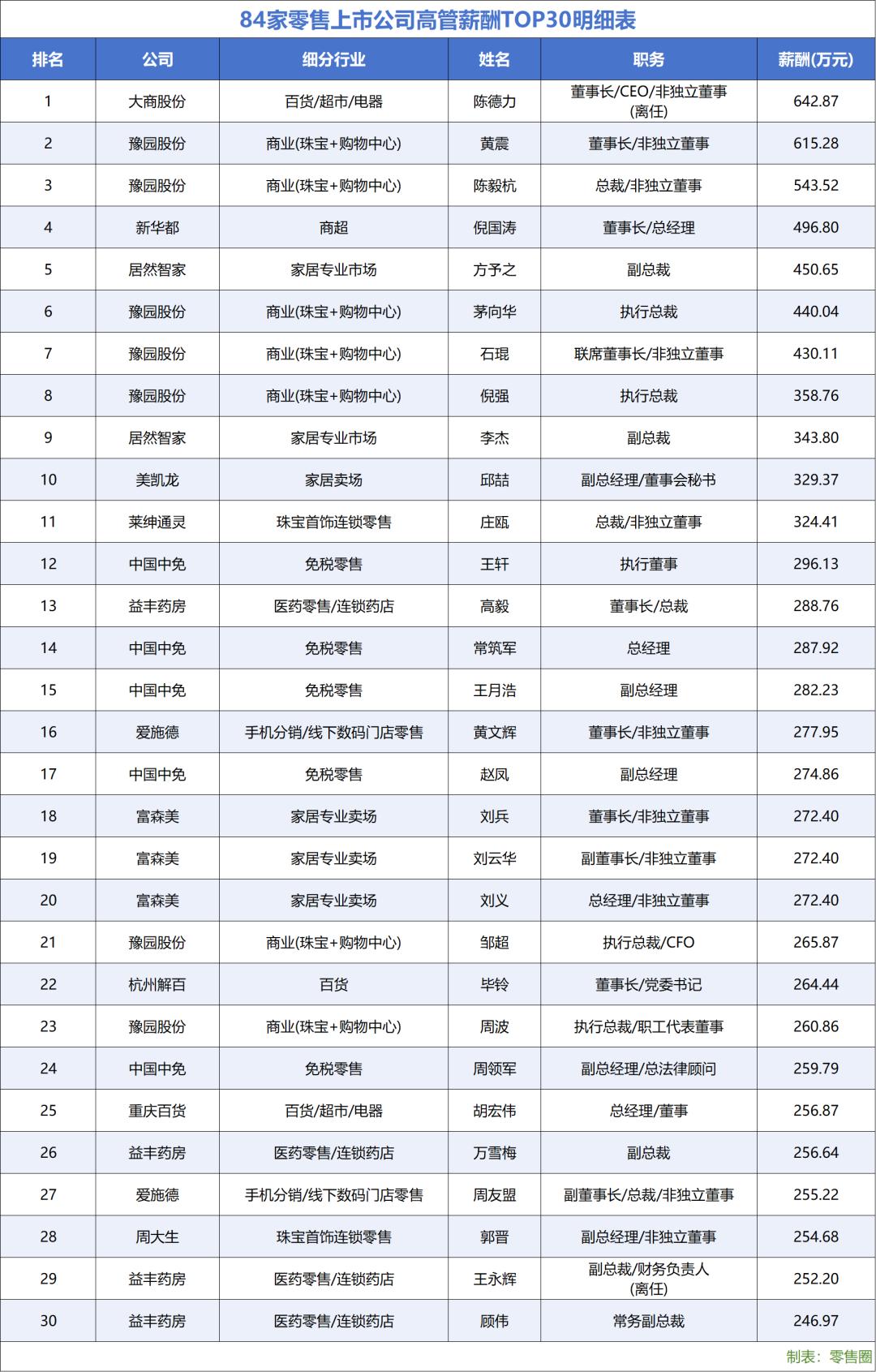
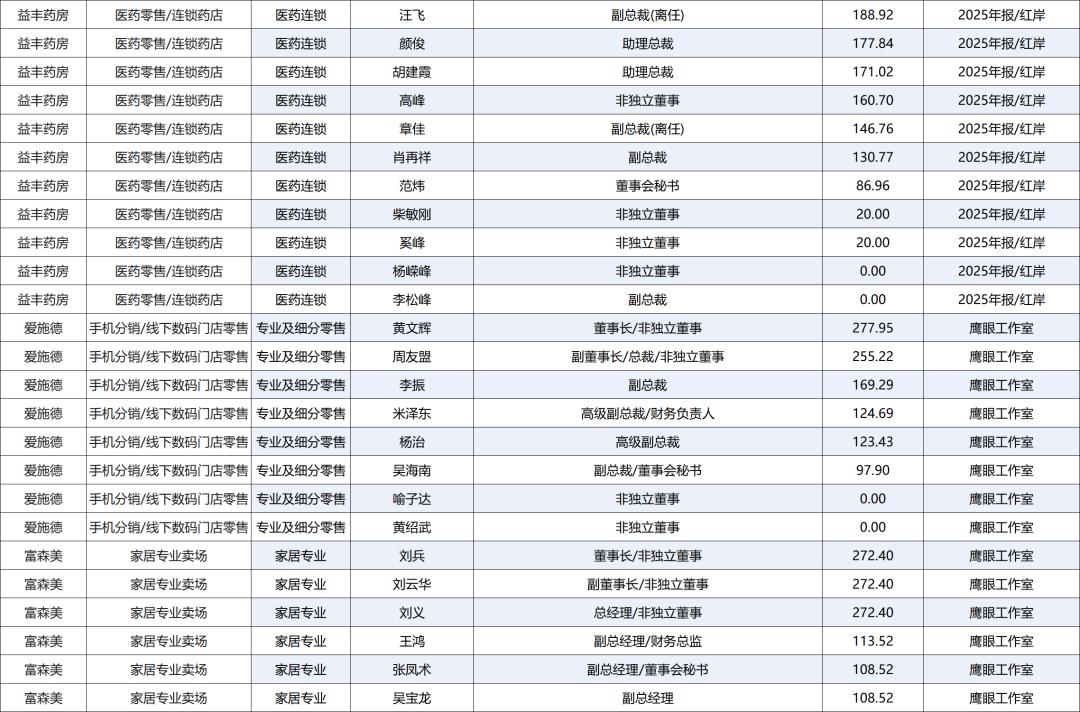
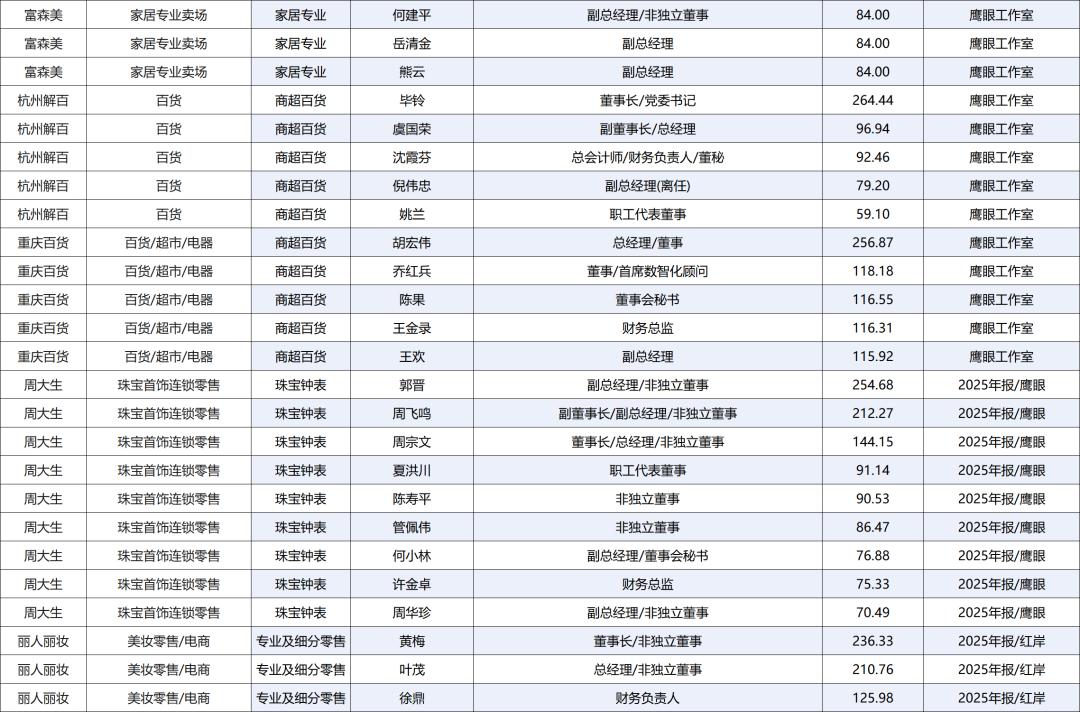
[Data source: Publicly disclosed 2025 annual reports of 84 listed retail companies, compiled by Hawkeye Studio; partial data is quoted from public information platforms including CNINFO, WaBei, Eastmoney and others. The compensation caliber refers to the pre-tax remuneration (tax included) disclosed in the 2025 annual reports of each listed company]
After sorting out 84 copies of 2025 annual reports of listed retail companies, 767 senior executives took a total of 605 million yuan from the listed companies. When all payslips are placed together, the first thing that catches the eye is not the average figure, but a string of sharply disparate numbers that are glaringly obvious.
The highest paid is Chen Deli from Dashang Co., Ltd., who gets 6.4287 million yuan. The lowest paid is Li Xiaohong, employee director of Central Mall, who only earns 6,000 yuan. Among these 767 people, 108 do not receive salaries from the listed companies. Among the 659 people who get remuneration from listed entities, 437 have an annual salary of less than 1 million yuan, and 222 exceed the 1 million yuan mark. Among these 222 people, 52 earn more than 2 million yuan, 11 earn more than 3 million yuan, and 3 earn more than 5 million yuan.
If you only look at these numbers, you may easily regard it as a ranking of wealth disparity. In fact, that is not the case. Compensation is a thermometer for the industry, which measures the changes taking place in 2025. The industry is differentiating, the tracks are diverging, and job positions are being re-priced. The interweaving of these three layers of factors constitutes the real value of this form.
01
At the industry level, the first feature is differentiation
When the 84 companies are categorized by business format, the gap in average compensation is very noticeable. Duty-free retail reaches 1.54 million yuan, jewelry and watches reach 940,000 yuan, home furnishing specialty retail reaches 1 million yuan, pharmaceutical chain retail reaches 940,000 yuan, while supermarket and department store retail only reaches 630,000 yuan. The gap between the highest and the lowest is more than double. Supermarkets and department stores have the largest number of employees, 402 people accounting for more than half of the total in the form, but their average compensation is the lowest.
This is not a matter of which industry is high-end or low-end. Compensation is the transmission of profit structure. The duty-free sector has license dividend, the jewelry and watch sector has considerable gross profit, while the supermarket and department store sector has meager profit. The maximum level of compensation first depends on how much profit the business itself can generate. With this gap clearly presented in 2025, retail is no longer a single homogeneous business. It is splitting into several different tracks, each with a completely different talent pricing logic.
Differentiation also spreads along the urban hierarchy. Retail senior executives in East China and South China have significantly thicker payslips than those in Northwest China and Northeast China. The price of talents always follows the regional retail vitality. Where the business is still booming, there the companies are willing to offer high salaries for core operators.
The total annual compensation pool is about 605 million yuan, with an average of 790,000 yuan per person. The top 222 people, less than 30% of the total headcount, take the majority of the pool, while a large number of people at the bottom only get 200,000 to 300,000 yuan. Money is gathering towards the top, which is the obvious differentiation in front of us.
02
Each track has its own unique logic
Among the six major categories, supermarkets and department stores have the largest number of people and the lowest average compensation, which is the category that best reflects the low-profit background in this form. But if you look closely, the top core operators are not treated unfairly at all. Chen Deli's 6.42 million yuan is the ceiling of the whole list, and the senior management of Chongqing Department Store and Yonghui Superstores also have high incomes. This shows that the high-performing core personnel in supermarkets and department stores are still hired with high salaries, while ordinary management positions are constrained by weak profitability. The low-profit background has not changed, but the premium gap for talents is extremely large.
Jewelry and watches are another high-track sector, supported by high gross profit. Zhou Dasheng's Guo Jin gets 2.54 million yuan, Lao Fengxiang's Wang Yongzhong gets 2.22 million yuan, and FIYTA's Lu Wanjun gets 1.51 million yuan, all of which are real market prices for talents in this track. The 6.15 million yuan of Huang Zhen from Yuyuan Inc. is a special case: the company covers multiple categories including gold, beauty and alcohol, and it is a retail holding platform under Fosun Group. Its high salary reflects the pricing logic of platform-based operation, which cannot be simply regarded as a single business format.
The pharmaceutical chain sector presents a different situation. The compensation systems of the four leading companies, Laobaixing, Yifeng, Jianzhijia and Shuyi, are significantly more mature. Yifeng's Gao Yi gets 2.88 million yuan, Laobaixing's Xie Zilong gets 2.16 million yuan, and the compensation of middle and senior management is on a clear echelon. Chain pharmacies have a high degree of standardization and large scale, so talent pricing is also standardized, without the sharp ups and downs seen in the supermarket sector. This is the stable price for talents provided by a relatively stable business.
The home furnishing specialty sector is currently in the throes of transition. Fang Yuzhi from Easyhome gets 4.5 million yuan, Qiu Zhe from Red Star Macalline gets 3.29 million yuan, both are at high levels, but both companies are burdened with the pressure of transformation from heavy assets. The high salaries not only mean retaining existing talents, but also introducing external professionals to explore new development paths.
The specialty and segmented sectors are more diverse: Huang Mei from Lirun gets 2.36 million yuan, Huang Wenhui from Aisidi gets 2.78 million yuan, those engaged in beauty channels and digital product distribution all have their own independent pricing logic. This segment has not formed a unified measurement standard, which exactly shows that the segmented tracks are still exploring their own pricing rules, and no one has put forward a price system recognized by the whole industry.
The duty-free retail business has a license moat. China Duty Free Group supports the whole track, with Executive Director Wang Xuan getting 2.96 million yuan, General Manager Chang Zhujun getting 2.88 million yuan, and several deputy general managers all getting more than 2.7 million yuan. Its high salaries come from the franchise right, which can only be regarded as a special sample and cannot be compared with market-oriented tracks.
03
What is really changing is the market value of talents
Among the 222 people with annual salary over 1 million yuan, 46 are chairmen of the board. Among the remaining 176 people, 148 are practical operators holding positions such as president, vice president, executive president and general manager. Chen Yihang from Yuyuan Inc. gets 5.43 million yuan, Fang Yuzhi and Li Jie from Easyhome get 4.5 million yuan and 3.44 million yuan respectively, Qiu Zhe from Red Star Macalline gets 3.29 million yuan, Zhuang Ou from Leysen gets 3.24 million yuan. Most of these people are not business owners, but professional managers hired by the owners to operate the business.
This shows that the control right and ownership of retail enterprises are further separated. In the early years, many regional retail business owners took charge of operation themselves, but now more and more enterprises are willing to offer high salaries for high-performing talents. The situation that an externally hired operator earns more than the chairman of the board was rare in the retail circle ten years ago, but now it has become a normal state. The right to price talents is gradually shifting from the capital side to the hands of people who can create actual performance.
Functional positions follow another set of pricing rules. Positions such as chief financial officer and board secretary generally get 500,000 to 800,000 yuan per year in listed companies, and those in high-quality tracks can reach over 1 million yuan. The board secretary of China Duty Free Group and the financial head of Yifeng are at high salary levels, which is not because the positions themselves are expensive, but because the businesses they serve are stable. The salary level of positions is ultimately determined by the business itself.
On the other side, there are 108 people with zero salary. Most of them are chairmen of the board, who do not get paid from the listed companies, but get remuneration from the group, related parties or family systems. Red Star Macalline has 9 zero-salary positions, Yonghui Superstores has 7, Yuyuan Inc. has 6, and Wangfujing, BBK, Hongqi Chain, Haining Leather City have 5 each. This is not a sign of poverty, but a difference in governance roles. The payslip of the listed company only records the part of their compensation related to this listed entity. For group-based and family-style retail enterprises, the public and hidden parts of compensation are never recorded on the same form.
At the zero-salary end, old-brand regional department stores are the most prominent. In Dalian Friendship, Xujiahui, New World and Guofang Group, the chairmen of the board do not take any salary from the listed companies, and some even hold board positions with zero remuneration, with their compensation paid through family and group channels. Compared with companies with high professionalization, the governance of old-brand regional retail enterprises still stays in the last era.
There is also a special group of people. In recent years, the second-generation successors have gradually taken over the retail business, and how to set their compensation has become a new topic. Most of the second-generation successors do not take high salaries from listed companies, they belong to the same category as those 108 zero-salary chairmen, with their benefits tied to equity and family assets. The logic of hiring external professional operators and using family second-generation successors coexists in the retail industry, which is clearly reflected on the payslips.
Looking at these two situations together, the change of position compensation is actually two sides of the same trend. On one side, the value of professional operators is rising, on the other side, the business owners are stepping back from the front line. The retail industry is transforming from the logic of "the owner has the final say" to the logic of "the one who can make the business better gets the high reward".
04
Viewing the changes from the trend perspective
Differentiation will continue. High gross profit tracks have the confidence to continuously absorb high-value talents, while low-profit tracks rely on system and management premium. In the future, the market value of retail practitioners will not depend on which large industry they are in, but on how much profit the business they serve can generate.
The separation of control right and ownership is a long-term direction. The professional manager market will become more and more transparent, and the market value of core operators will continue to rise. Business owners will get more and more used to the fact that excellent talents should be paid at market price, not at emotional price.
Talents will flow. High gross profit tracks offering high salaries will naturally poach high-performing talents from low-profit tracks. This cross-track talent outflow will only become more obvious in the next few years. If supermarkets and department stores want to retain excellent core operators, relying only on seniority and personal relationship is not enough, they have to keep up with the market price level.
New business models are also reshaping talent requirements. With the emergence of new formats such as instant retail, discount retail and membership stores, the core operators required by the future retail industry are no longer just people who know how to manage physical stores, but people who understand supply chain and traffic operation. The payslip will change along with the development of the industry, and the skills that are valuable today may not still be valuable in a few years.
Final note:
For the practitioners still in the industry, this form is a reminder. In the past, the retail industry emphasized seniority and faction, but now it emphasizes what actual value you can create. The market value of an operator is no longer determined by the signboard of the company he works for, but by how much extra profit he can bring to the business. The more difficult the business environment is, the more enterprises need truly capable operators, and the more willing they are to offer high salaries for such talents. In the cold winter of the industry, the value of skilled practitioners is even firmer.
This form does not draw conclusions for anyone, it just lays out the real operating status of each enterprise's business in 2025 on the table, completely unmodified and as it is.