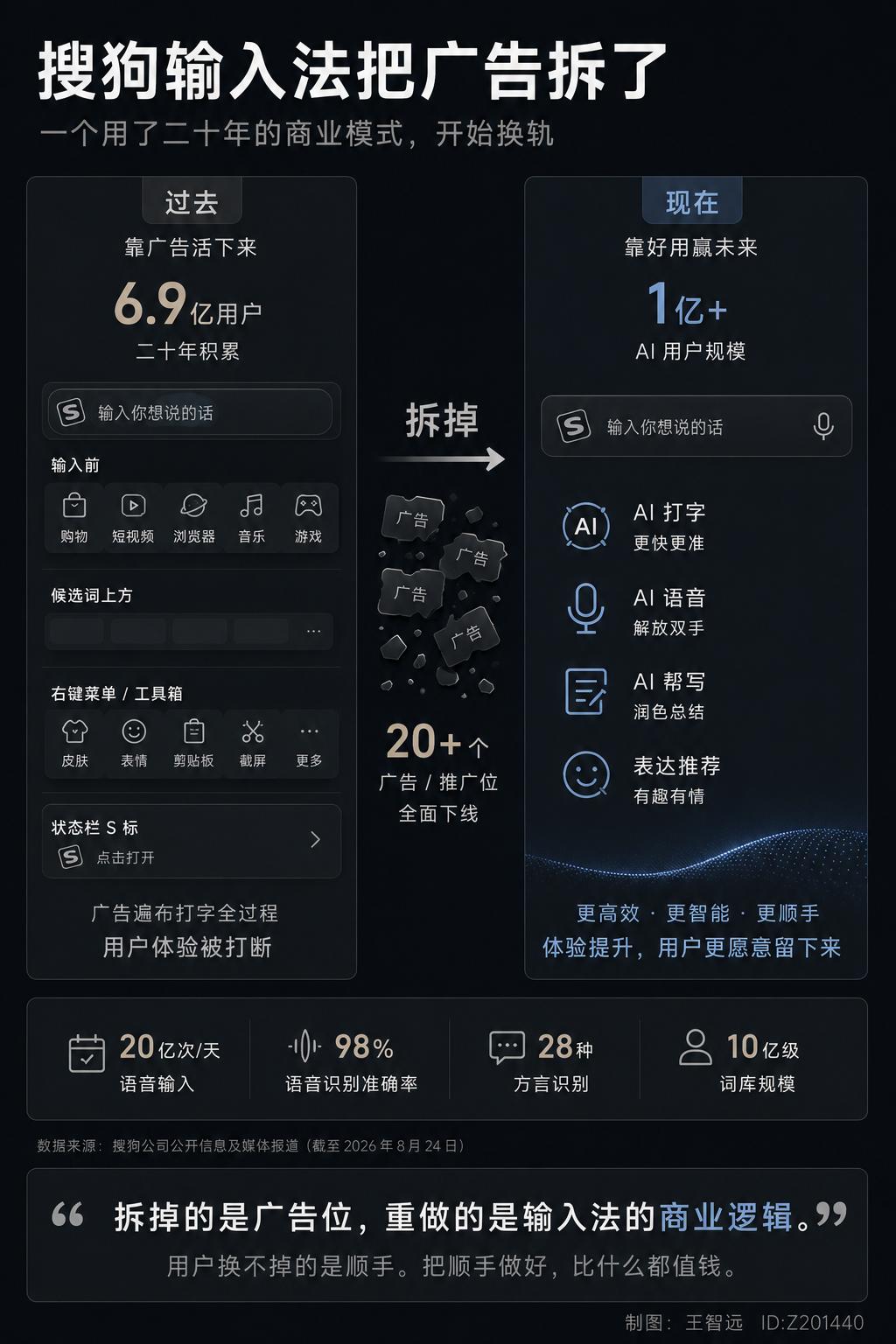
Sogou Input Method has split its most profitable advertising slots.
Finally, it's quiet now.
In the past, when I was typing smoothly, a promotion section would pop up out of nowhere, but now it's gone. The permanently lit S logo on the keyboard no longer leads to a page full of recommendations when clicked.
I did a specific search to confirm that Sogou Input Method has indeed removed all these sections. This is quite an interesting move.
I wonder if you have ever thought about this: Why did an input method that used to plaster ads everywhere remove all these ad slots all at once this time without making much noise?
The answer is simple: it has put user experience ahead of commercialization.
For the first time in all these years, it has not turned a deaf ear to user feedback. Anyone who uses Sogou Input Method should be well aware of this change.
This round of overhaul covers all platforms, including mobile phones and computers. More than 20 ad and promotion slots have been removed in total, with over a dozen slots taken down on the mobile end alone, covering Android, iOS and Windows systems, no platform is left out.
What does more than 20 slots mean? They cover the entire process of typing.
The promotions that block your view right after you pull up the keyboard before you start typing are gone. The annoying experience where you are in a hurry to reply to a message but have to pass through a bunch of recommendations first no longer exists.
You pass by these positions every day and get annoyed by them, but you could never tell who put them there. They would just appear as soon as you called up the keyboard, and now they are all gone.
Let's talk about the ads above the candidate word bar.
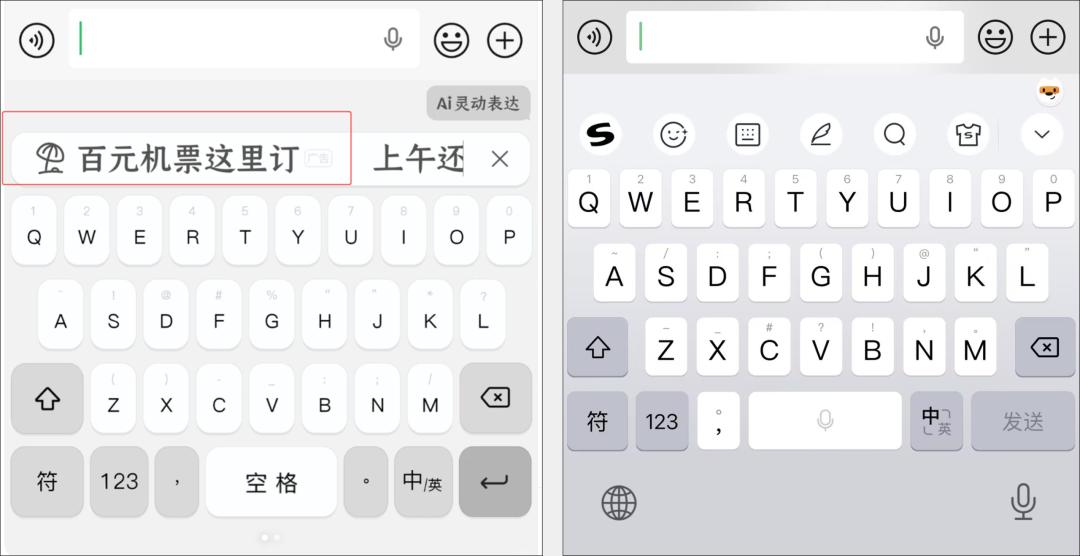
Previously, an ad would pop up when you were halfway through typing. For example, when someone typed the word "contract", an ad would appear in the candidate bar, and this situation no longer happens now.
The input method is closest to your fingers, so its ads are also the closest to you.
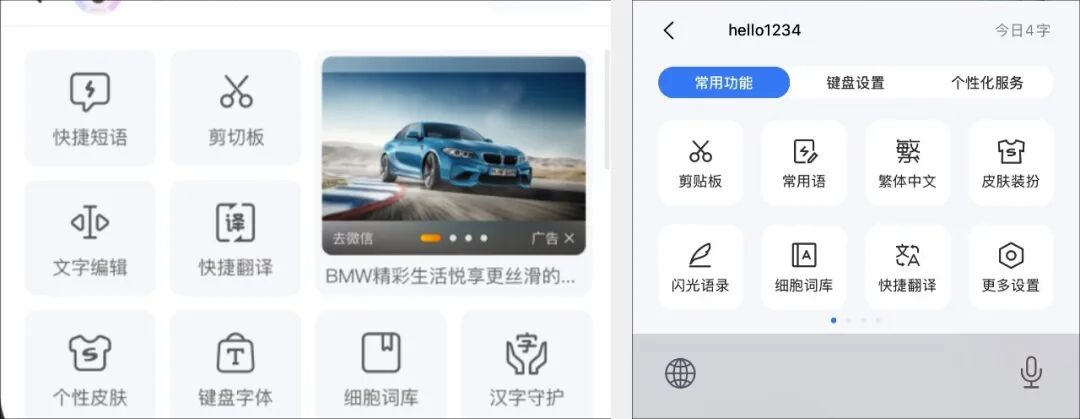
In addition, apart from the keyboard, that S logo is also gone. You used it as a typing tool, but it treated you as traffic and showed you tons of recommendations when you clicked into it, and that's all removed now.
Complaints aside, operating an input method is also a business. The team needs to be paid, and commercialization is unavoidable, so ads used to be its main source of revenue.
What's interesting is that the positions it removed this time are exactly the same positions that users have been complaining about.
Users complained that the candidate bar was full of ads, so the ad slots on candidate word positions were removed. Users complained that the right-click menu was stuffed with a bunch of irrelevant content, so the right-click menu was cleaned up.
To be honest, ads on internet products all have similar problems, and users have been complaining about them for more than a year.
If you search casually on Xiaohongshu or other major social platforms, you will find countless users saying these ads are as annoying as psoriasis; some people are so fed up that they even uninstall the app but still can't avoid the ads.
Some elderly users don't dare to click on the pop-up content when using their phones, for fear that a wrong click will install an unknown app on their device, and they have to wait for their children to come home to delete it.
Complaints go on, but software updates still pop up as usual. You turn off one ad switch and there is another one hidden behind it, and after an update, all your ad-blocking settings are reset, making all your previous adjustments useless.
This time Sogou Input Method is different: it removes exactly the positions that users complain about, and handles all these problems at once, which is really satisfying.
......
As satisfying as it is, you may wonder: someone has to pay for a free input method right? Without commercial revenue, how can the team be sustained and where will the server costs come from?
In the past, who paid for all this? The answer is advertisers.
Why are advertisers willing to pay?
First, the positions on the input method are extremely valuable. Everyone can't avoid using it when chatting, shopping and searching. It is displayed on the screen hundreds of billions of times a day, and every single display is an exposure opportunity.
Second, the ad slots are right under users' eyes. Above the keyboard, next to the candidate words, the position you stare at when typing is exactly the spot that advertisers want to occupy. Advertisers are willing to pay a high price for such positions.
A friend who is familiar with this industry once told me:
Strictly speaking, input methods do not make money directly. They generate revenue through redirects and recommendations. When you type a word and hover your mouse over it, it prompts you to search, and you click to enter a results page full of ads.
Or it recommends you to install a software or try a new game, and then it can charge the corresponding party. All the revenue is accumulated bit by bit in this way.
Let me tell you a story:
In 2019, Sogou was still listed on the US stock market and had not been merged into Tencent. Its financial report of that year clearly showed that the revenue related to the input method recommendation system increased by nearly 90% year on year.
There is also a sentence in the financial report: The number of recommended content that Sogou Input Method users click on every day reaches hundreds of millions (though the "recommended content" here does not all refer to ads, there are also sticker recommendations, and ads are only part of it).
Wang Xiaochuan, then CEO of Sogou, said at the financial report conference call that recommendation services, namely advertising and diversion monetization, are expected to become the second growth engine after search.
In fact, Sogou has also considered letting users pay for the service.
I remember in 2017, it planned to launch a membership service, which charges 9.9 yuan per month for ad-free experience, a price even cheaper than most video platform memberships.
What was the result?
The plan died down and no one mentioned it again. Why? At that time, users in the input method industry had long been accustomed to free services. If you charged even a penny, users would immediately switch to other products.
People are willing to buy video memberships because the content is valuable, but for input methods, users only use them for convenience, why would they pay for it? Sogou has done the math, and found that the number of users who were willing to pay for ad-free experience was not even enough to cover a fraction of the cost.
All in all, being free is the armor of the input method, but it also becomes its cage.
690 million users sounds like an impressive number, but all these users come for free. In the past two decades, the paid model has never worked, and to survive, the input method has to rely on ads.
So you see, in the past two decades, the only payer for the input method is advertisers. They tried to change this, but never succeeded.
There is also a saying in this industry:
The input method is too close to users, so users are extremely sensitive to any of its changes. Too many ads will make users complain, while too few ads will make the company lose money. It's a dilemma.
You can imagine that these high-traffic ad slots have higher and higher rents year by year. More than 20 ad slots are like more than 20 storefronts. Removing ad slots is equivalent to giving up these storefronts and pushing away the money that is already in your pocket.
In the past two decades, the number of ad slots on input methods only kept increasing, no one has ever taken the initiative to remove them. They can't afford it. Once the number of ads decreases, the revenue will drop, which will cause a series of problems, and no one dares to open this Pandora's box.
Of course, Sogou Input Method also knows exactly what it is giving up.
In January this year, product manager Chai Baoquan admitted at a media communication meeting that the move of cutting ads conflicts with the product's commercial goals.
But after communicating with a large number of users, the team still decided to make the change. In his words, only when the user experience is good enough can the product have more promising prospects.
Chai Baoquan added that this revision is largely overturning the previous product, resetting the mindset and abandoning the historical burden.
He said he had talked to many users. This statement sounds easy, but what it actually means is that the complaints have really reached the office, reached the ears of the product managers.
To put it bluntly, we are willing to accept less revenue for this move.
......
The word "acceptance" sounds easy, but it is not easy for a company. Think about it: where will the revenue come from after removing the ads? We need a new group of payers, who will that be?
In my opinion, Sogou Input Method has changed its own business model this time.
You may think I'm talking nonsense: how could a product that has survived on ads for 20 years change its model so easily?
In January this year, it released the 20.0 version, announcing full transformation to AI. The number of AI users has exceeded 100 million, voice input is used 2 billion times a day, and the average number of voice uses per capita has increased by 20%.
What does that mean?
100 million users are already using AI typing, AI voice input, and AI writing assistance. The people around you who send voice messages without typing may be using it, and the person who always replies to voice messages instantly in group chat for red envelopes is most likely using it too.
100 million users sounds like a large number, but in the 690 million user base, it is just the beginning. The AI features in the input method are already widely used by you, you just haven't noticed it.
First, the AI that speaks for you.
You may speak incoherently with lots of filler words, and AI can sort it out with one click and turn it into smooth written language, so you can send it right after you finish speaking.
After a meeting, you can dictate the content to your phone, and it will output a clear meeting note. In the past, the most annoying part of voice input was that you had to edit the text after dictation, but now the machine does the editing for you.
Take myself as an example:
Sometimes I need to send a long message to others, and I'm afraid I will forget my ideas if I type too slowly. I will habitually turn on the voice input, speak directly, and after a little sorting, the text can be sent to others directly. After using it for a long time, I will avoid typing manually whenever possible.
Then there's AI typing.
It has a 1-billion-level thesaurus, and the names of the main characters of a new TV series released today can be typed out correctly as early as tomorrow. When you type "qiangpi" in the game, it will output the corresponding word "gun skin". If you want to order Yangzhi Ganlu (mango sago with pomelo), just type the first two characters, and the rest of the phrase will be fully prepared for you.
There are more than 50 million local life related words in its thesaurus, it recognizes the small shops you often go to and the place names near your home.
Doctors can type medicine names quickly, and lawyers can type legal provisions easily. You just need to type a few abbreviations and the correct content will show up. There are customized thesauruses for different professions, and half of your fast typing speed is thanks to it.
There is also AI voice input.
The recognition fluency has increased by 40%, and the overall accuracy rate reaches 98%. Even in the library or late at night, when your speaking volume is as low as 20 decibels, as quiet as a whisper, the recognition accuracy can still reach 97%.
It supports 28 dialects, and can recognize mixed Cantonese and English, and all kinds of accents. A few years ago, voice input was considered a useless feature, but now even your parents are using it.
These features, which input methods could never have imagined in the past, are now all provided to you for free along with the keyboard.
So why does Sogou Input Method dare to remove ads? Apart from determination, it also has enough confidence.
This confidence is accumulated over 20 years: the thesaurus, input habits, and user scale are all there. 690 million people use it to type every day, these are assets that cannot be taken away.
Other competitors need 10 or 8 years to build a comparable thesaurus, and the cultivation of user input habits takes even more time.
Sogou Input Method pioneered the cell thesaurus, which is open for sharing and can be updated online. It started its business with this feature 20 years ago, and today's AI thesaurus is still based on this foundation.
Chai Baoquan once said a sentence:
This revision is largely overturning the previous product, using AI to rebuild a user-friendly input method. He added that full AI transformation is the starting point, not the end point.
What I understand is that the old model that relies on ads is now a thing of the past.
In fact, it has already been testing new models, such as themes and value-added services, to gradually explore a healthier and more sustainable business model.
Different from 2017, when it tried to sell "reduced ads" and no one paid for it, this time it sells "better usability", and users who are willing to pay for the service have started to appear.
The new model is to exchange services for user usage, and exchange efficiency for user retention. In the past, it earned revenue from advertisers who grabbed users' attention, but now it provides services in exchange for "better usability".
Can this new model work?
To be honest, I can't draw a conclusion easily. The AI industry changes every three months, no one can make a definite prediction.
Advertising is a stable source of revenue. Removing ads means a real reduction in revenue, and whether AI can fill this gap depends on whether users are willing to accept the new model.
However, I think Sogou Input Method may have figured out one thing:
For an input method that people have used for 20 years, the reason why users can't replace it is its familiarity and convenience. Making it more convenient is more valuable than anything else.
Of course, only time will tell whether this path works. Users don't care about ads, they care about experience.