Half of Nvidia's employees have a net worth of over 100 million yuan, no wonder the company's employee turnover rate is so low.
Apart from chips, what else is Nvidia exceptionally good at producing as a "product"?!
This "product" does not refer to hardware, but millionaires.
According to the latest internal anonymous survey, around half of Nvidia's employees have a net worth exceeding 25 million US dollars, which is equivalent to over 100 million RMB.
The proportion of millionaires (in USD) is even more than three quarters.
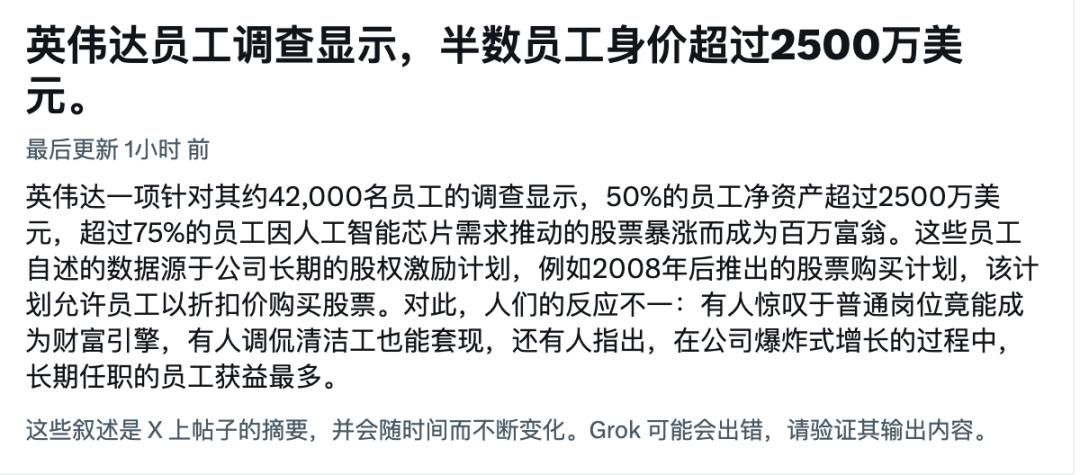
Calculated by this proportion, among the colleagues you pass by every day in Nvidia's campus, more than 15,000 of them could afford to buy a single-family villa in the Bay Area with full payment.
A year ago, Jensen Huang was a guest on the All-In Podcast, saying that "among my management team, I have created more billionaires than any other CEO in the world".
The host exclaimed on the spot that in the past, it was NBA players who signed 300 million US dollar contracts, but now it's Nvidia's engineers' turn.
These remarks sounded like boasting at the time, but now this survey shows that Jensen Huang's statement was even conservative.
The 42,000-Person Millionaire Factory
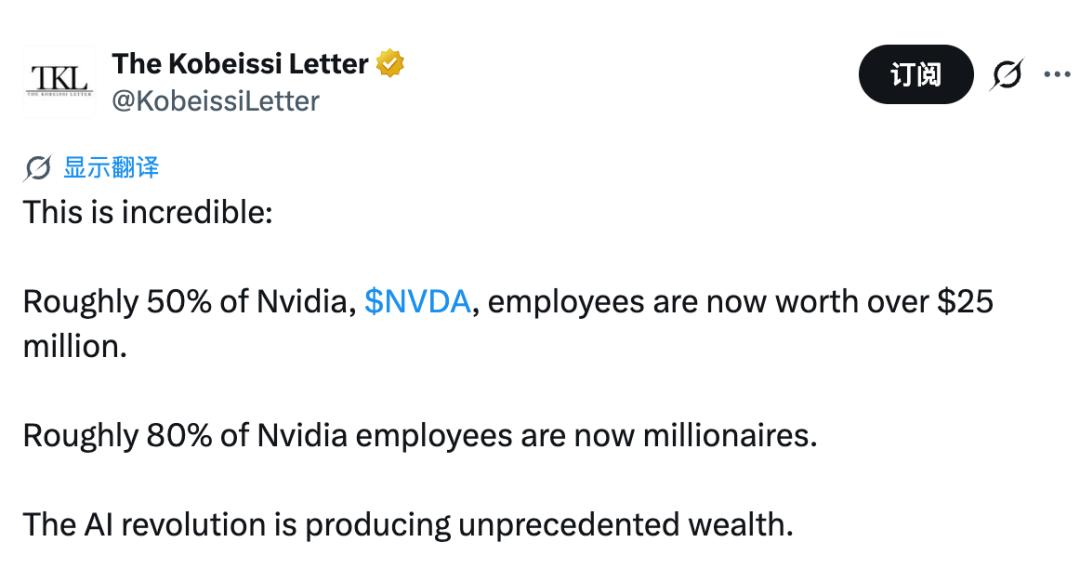
This survey was first disclosed by The Kobeissi Letter on X, and the questionnaire covered roughly one-tenth of Nvidia's employees.
The survey did not release the specific wealth distribution range, but gave two key dividing lines.
The first line is 1 million US dollars, and 78% of respondents are above this line.
The second line is 25 million US dollars, and roughly half of the respondents have crossed this threshold.
The figures for the management team are even more staggering.
Colette Kress, CFO, and Jay Puri, Executive Vice President, both saw their personal net worth exceed 1 billion US dollars last July, becoming the two latest additions to the list of "billionaires I created" as mentioned by Jensen Huang.
In terms of scale, the number of people covered by this wealth-creation machine is equally astonishing.
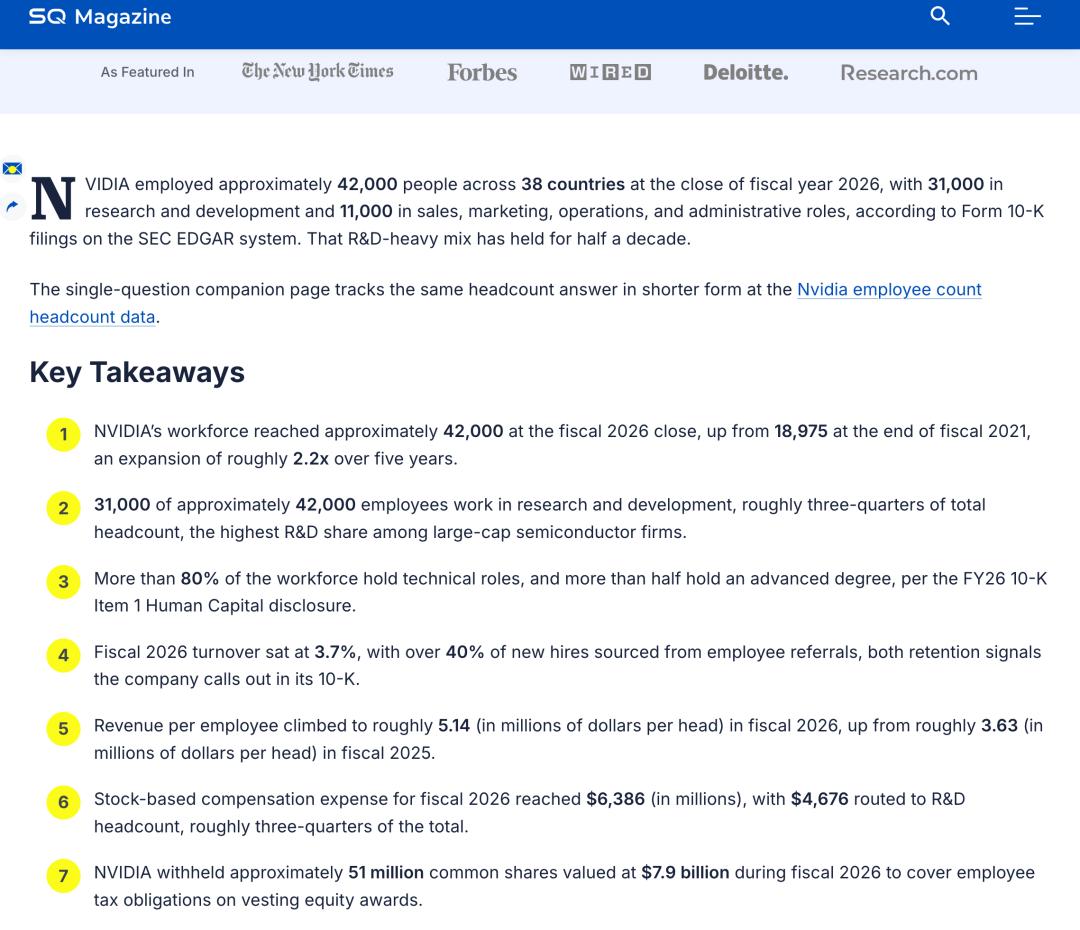
By the end of the 2026 fiscal year, Nvidia's total global headcount reached 42,000, distributed across 38 countries and regions.
This figure was less than 19,000 five years ago, with a net increase of 12,400 people in just two years.
Despite such a large number of employees, the company's turnover rate is only 3.7%.
What does 3.7% mean? The average turnover rate in the US tech industry hovers around 13% all year round, and Nvidia's rate is less than one-third of the industry average.
More than 40% of new employees come from internal referrals, where existing employees bring in new hires.
To some extent, this is not hard to understand: after all, referring a friend to join the company is equivalent to helping him board a fast train to wealth.
But the other side of the coin is not so glamorous.
Some former employees revealed that under the high-pressure working environment at Nvidia, leaving the company would cost them more than 15 million RMB in lost stock returns in a single year.
Leaving means giving up a sum of wealth that is still growing. Staying means continuing to endure Jensen Huang's famously high-intensity management style.
"Golden handcuffs" is an accurate term Silicon Valley uses to describe this dilemma.
Jensen Huang himself does not think this is a problem.
He said in an interview that he personally reviews the compensation of all 42,000 employees, with only one principle: "pay as much as you can".

How the Wealth-Creation Machine Runs
Nvidia's crazy wealth-creation story dates back to 2008.
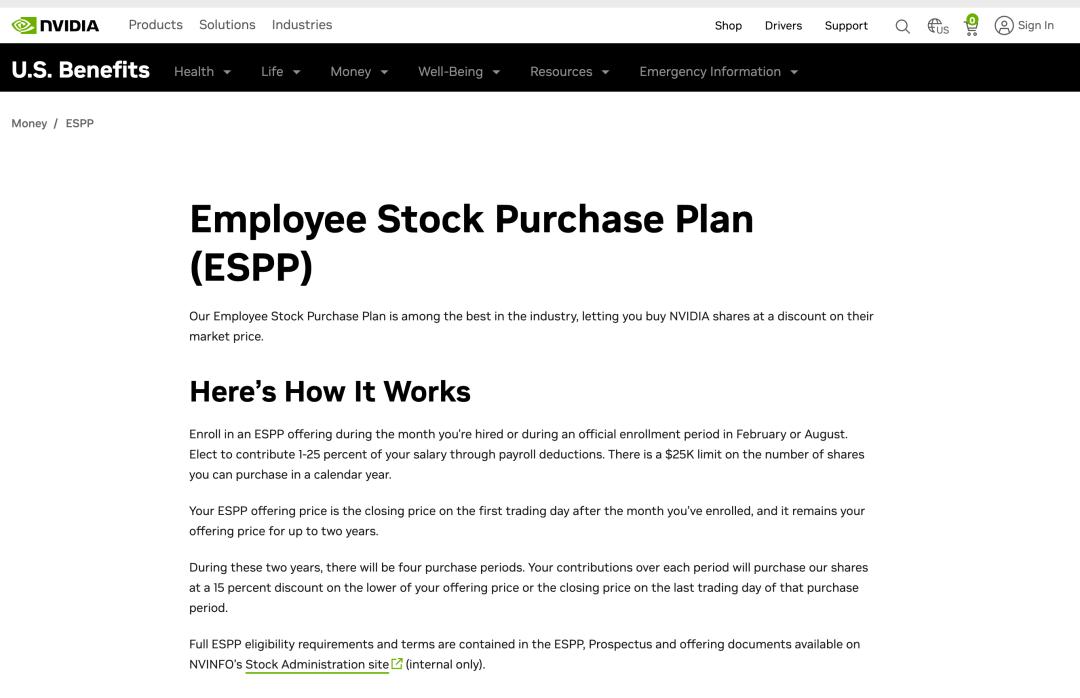
The global financial crisis swept across the world that year, and Nvidia's stock price hit rock bottom. The company took the opportunity to launch the Employee Stock Purchase Plan (ESPP).
The plan was cleverly designed, allowing employees to buy company stocks at a 15% discount off the lowest stock price in the past two years.
What does the lowest price in 2008 mean? It means the cost price for employees was so low that in hindsight, it was almost like getting the stocks for free.
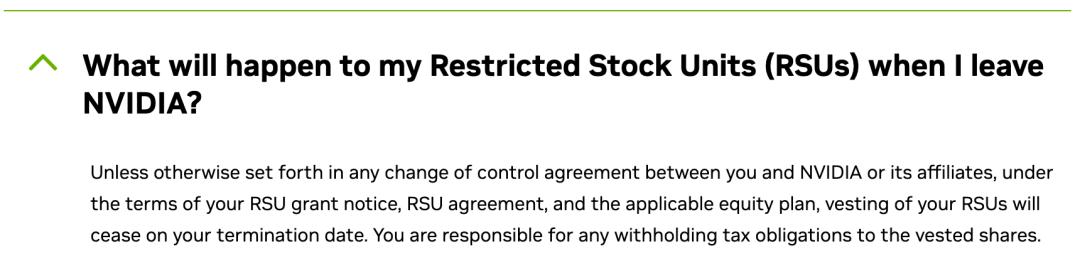
On top of ESPP, Nvidia also added Restricted Stock Units (RSU) as the core part of the compensation package.
The RSU rules are standard: the shares are locked for the first year after onboarding, 25% of them are unlocked all at once after one year, then a batch is unlocked every quarter, and all shares are fully vested in four years.
A typical onboarding package for an engineer is roughly an annual salary of 180,000 US dollars plus RSUs worth 300,000 US dollars distributed over four years.
The base salary of 180,000 US dollars is not high in the Bay Area, and what is really valuable is the 300,000 US dollars worth of RSUs.
Because the value of RSUs moves in line with the stock price.
Nvidia's stock price has surged 22,687% over the past decade, climbing from 0.87 US dollars all the way to 198 US dollars.
By August this year, the stock price further rose to around 214 US dollars, and the company's market value reached 5.2 trillion US dollars, firmly ranking first in the world.
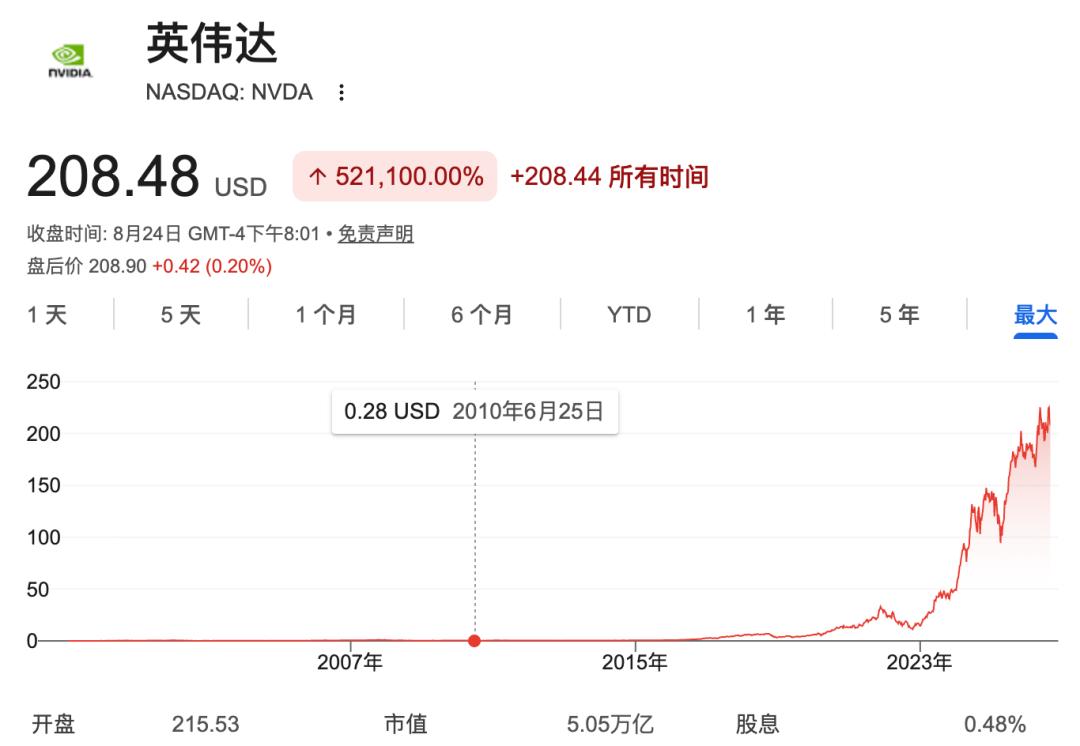
This means that for an engineer who received 300,000 US dollars worth of RSUs in 2016, as long as he never sold them, the value of these stocks has swelled to nearly 70 million US dollars today.
This is not an option gamble. No one needs to bet on whether the company can go public, as the stocks are there from the first day of employment, and the only variable is time.
The combination of ESOP and RSU, plus a stock that has risen more than 200 times in ten years, is how this wealth-creation machine operates.
Double Happiness
In the same week when this survey was repeatedly cited by the media, Nvidia announced another piece of news.
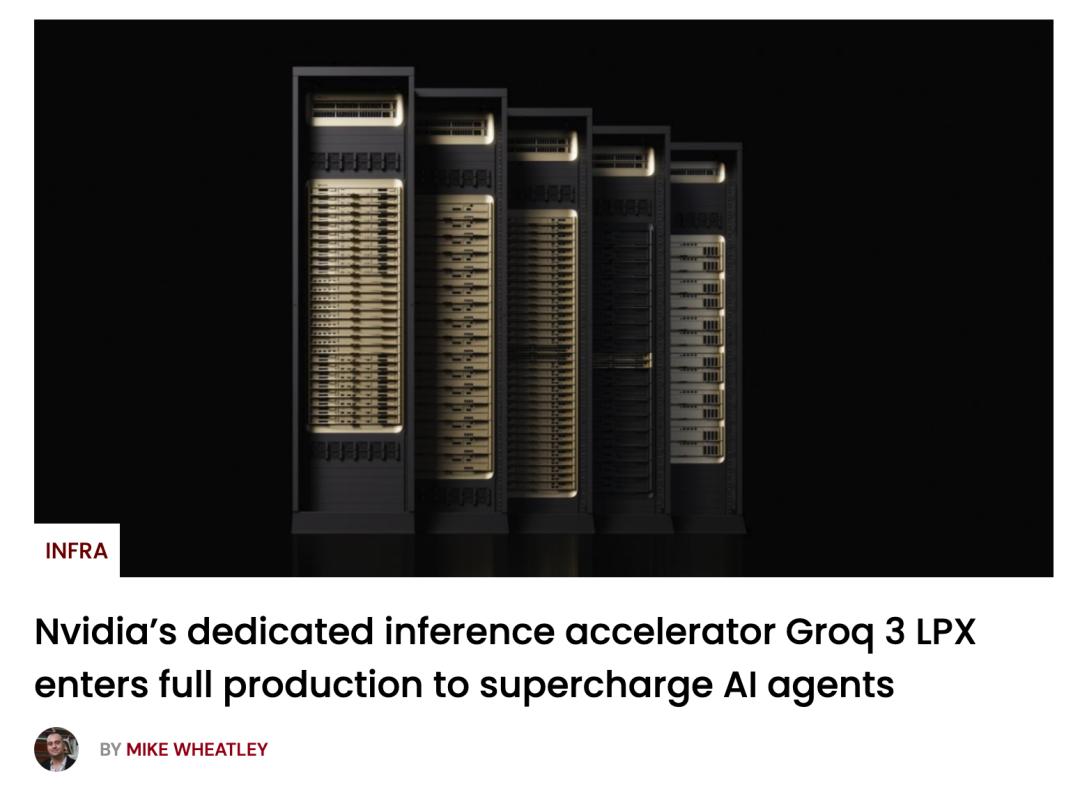
On August 24, at the Hot Chips 2026 conference, Nvidia announced that its dedicated inference acceleration chip Groq 3 LPX has officially entered mass production.
This chip is not designed for training, but only for inference, and is specially made for AI agents.
In the benchmark test running the open-source model Gemma 4 (31B parameters, 100,000 token context window), Groq 3 LPX achieved an output speed of 3400 tokens per second, as evaluated by the independent testing agency Artificial Analysis.
For latency-sensitive tasks, its response speed is 4 times faster than the closest competing platform available, and multi-step inference tasks that originally took several hours are now compressed to the minute level.
As an extension module of the Vera Rubin data center platform, Groq 3 LPX can integrate 256 LP30 accelerators in a single rack, and its first production-grade customer is the cloud service provider Nebius.
Wealth creation relies on stock prices, and stock prices rely on products.
Nvidia has just added a new ring to this flywheel.
References:
[1]https://x.com/KobeissiLetter/status/1952499417681998197
[2]https://sqmagazine.co.uk/nvidia-employee-count-statistics/
[3]https://fortune.com/2026/06/02/jensen-huang-nvidia-staff-pay-ai-investment-equity/
[4]https://www.nvidia.com/en-us/benefits/money/espp/
[5]https://siliconangle.com/2026/08/24/nvidias-dedicated-inference-accelerator-groq-3-lpx-enters-full-production-to-supercharge-ai-agents/
This article is from WeChat Official Account "QbitAI", written by Kresey, published with authorization from 36Kr.