"Doubao Work" rallies to join the competition, and the AI office sector has entered a stage of systematic head-to-head showdown?
On July 30, ByteDance completed an internal restructuring of rare intensity: the entire Feishu product team was integrated into Doubao. An independent product that has been deeply rooted in the enterprise collaboration software field for ten years was thus disassembled, restructured, and embedded into ByteDance's core AI strategy axis.
After the organizational restructuring was implemented, adjustments on the product side followed quickly. On August 14, the former Feishu "Aily Smart Partner" was officially renamed "Doubao Work Partner". Since mid-August, Doubao has intensively launched features such as mobile phone remote control of computers and virtual desktops, paving the way for the launch of independent office products.
On August 24, 36Kr's "Intelligent Emergence" exclusively reported two key pieces of news: ByteDance has completed a new round of team integration for its in-house office AI products, with the TRAE and Coze teams fully integrated into the Doubao system. After the adjustment, all product and operation teams report directly to Zhao Qi. Meanwhile, the independent AI office product "Doubao Work" is expected to be launched as soon as this week, serving as ByteDance's unified brand for AI office scenarios.
From the organizational restructuring in July, to capability integration in August, and then to the launch of the independent brand, ByteDance has been moving at full speed after forming an independent unit in the AI office track. Tencent, Alibaba, and Baidu are also advancing intensively in their respective paths in the same period to consolidate their ecological moats, and the competition logic of the AI office track is shifting rapidly.
What are the odds of ByteDance winning at this stage of the game?
From Organizational and Product Integration to Brand Unification
ByteDance Completed Three Steps in One Month
At the end of July, ByteDance took the first step. The situation where Feishu and Doubao operated independently came to an end, and enterprise collaboration data and large model capabilities were placed under the same organizational framework. But this step only solved the ownership problem. Putting people together does not mean their capabilities are fully aligned.
After the integration was completed, the accumulation of each business line became clear: Doubao has C-end entrances and model capabilities, Feishu has enterprise collaboration data, TRAE has deep experience in desktop-side Agents, and Coze has accumulated a tool and plugin ecosystem on the agent development platform. The four lines have their own respective accumulations, but have not formed a unified product for end users.
This round in August is the second step: the full integration of TRAE and Coze into the Doubao system, which aims to precisely complement missing capabilities.
TRAE and Coze originally belonged to ByteDance's Product R&D and Engineering Architecture Department. The two lines explored in the directions of AI programming and AI agent development respectively, and had no direct connection with Doubao. However, since the beginning of this year, productivity Agents have become Doubao's most important strategic direction, and the previous accumulation of these two lines exactly corresponds to the two most missing parts when Doubao moves from a chat tool to a work platform.
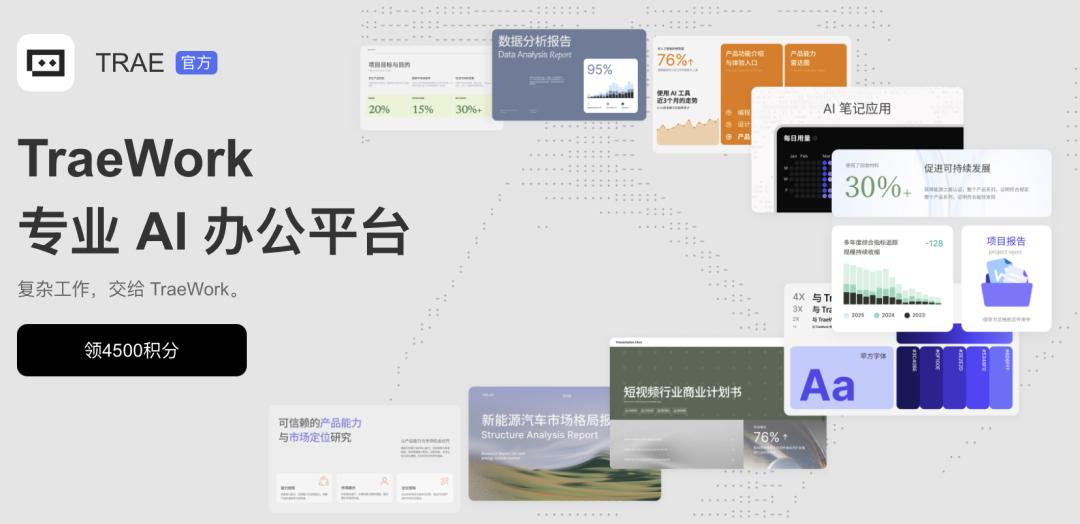
TRAE complements the "practical execution capability". TRAE has been exploring in the desktop-side Agent direction for more than a year. The TRAE Work line targets work scenarios, exploring to enable AI to understand interfaces, operate files and execute tasks, which directly matches the desktop execution capabilities required by Doubao's work scenarios.
After the adjustment, the capabilities of TRAE Work are integrated into Doubao's work scenarios, while TRAE IDE and CLI remain as independent programming product lines under the Doubao brand, continuing to focus on the developer market — this is a segmented track with the strongest willingness to pay and the highest technical barriers. Independent operation is much more cost-effective than being diluted by the popular positioning of general office, and the capabilities polished in programming scenarios can continuously feed back the general office line.
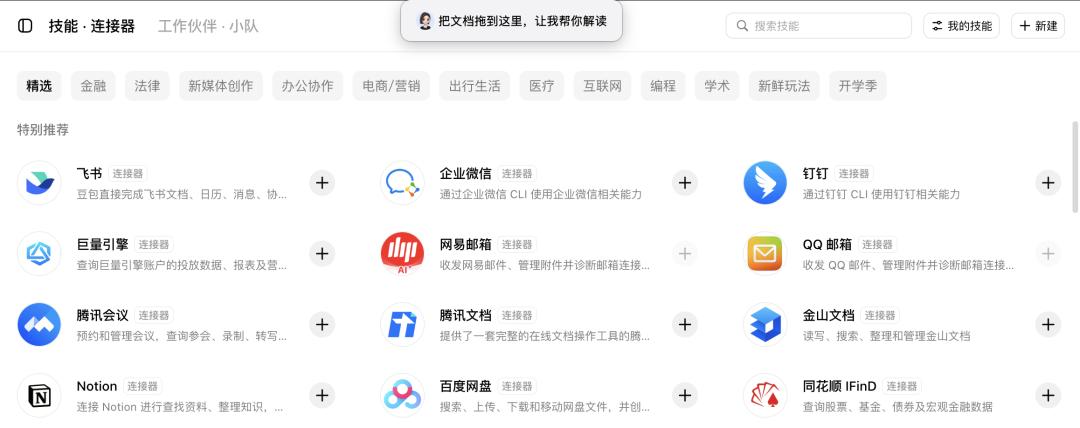
Coze complements the "ecosystem connection capability". As an agent development platform, Coze has precipitated a complete underlying framework for Agent construction, tool invocation, and plugin ecosystem. Around August 21, Doubao's work task mode launched the "Skill · Connector · Work Partner" feature, and more than 200 skills and connectors have been launched so far. After Coze is integrated, this infrastructure will become the underlying support for the continuous expansion of Doubao's skill system.
With the capability puzzle completed, the third step follows immediately — brand independence.
Yicai's "NeoCortex" reported on August 22 that the Doubao team will launch an office product benchmarking Tencent's WorkBuddy as soon as next week; 36Kr's exclusive news from "Intelligent Emergence" on August 24 shows that this independent brand is called "Doubao Work" and will be launched as soon as this week. The two sources point to the same thing: Doubao's office capabilities will be upgraded from a mode in the App to an independent product. The batch of features intensively launched in the past week is not so much new product updates, as the final infrastructure construction for the launch of the independent brand.
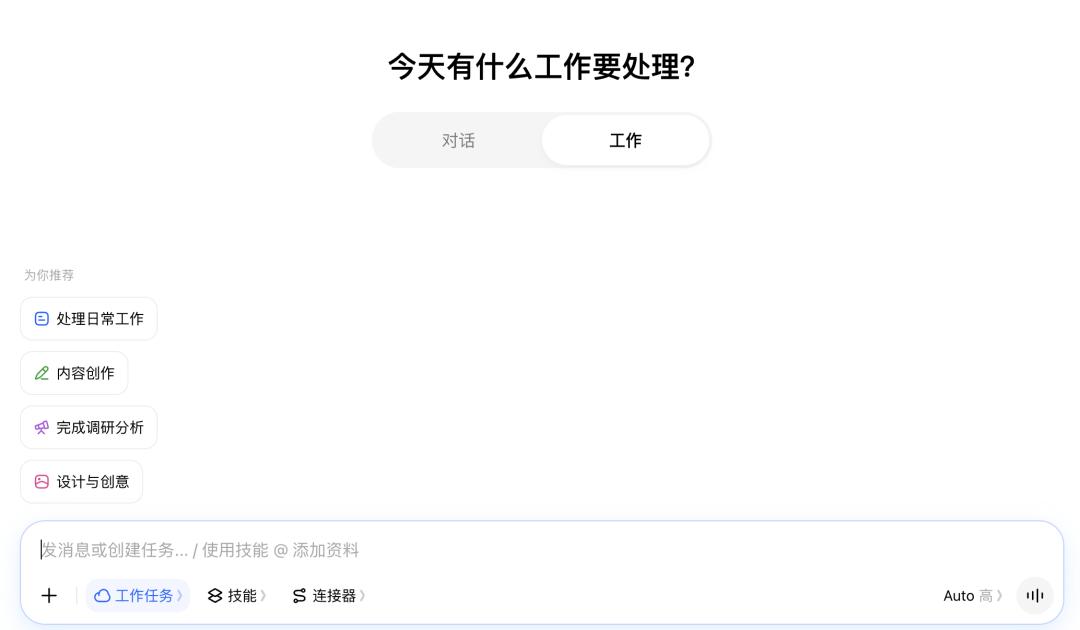
From the organizational ownership in July, to capability integration in August, and then to the brand independence of "Doubao Work", after completing the three steps, ByteDance has finally presented a complete offensive posture in the AI office track.
At the mid-year all-hands meeting on August 6, Liang Rubo listed AI, information platforms and transaction services as three core businesses, and Doubao and Douyin as two major "backbone" businesses. The meeting also reaffirmed the three principles of ByteDance's overall business strategy — "high priority, thick backbone, long-term optimization". The acceleration of integration is not only a matter of product rhythm, but also a direct reflection of strategic priority.
Tencent Consolidates Product Moats
Alibaba Leverages Enterprise Service Ecosystem
In the same period when ByteDance took intensive actions, Tencent, Alibaba and Baidu are also advancing their respective layouts, but the three have chosen completely different paths.
Tencent's WorkBuddy has taken a two-pronged approach this month: "deepening moats and generating revenue from industry scenarios".
In terms of capabilities, WorkBuddy released version 5.3.11 on August 13, upgrading the "Document Library" to an AI-native knowledge management space, and expanding the "human-AI co-writing" capability from the Office suite to AI-native formats such as HTML and Markdown, supporting real-time multi-person and multi-Agent collaboration on the same screen.
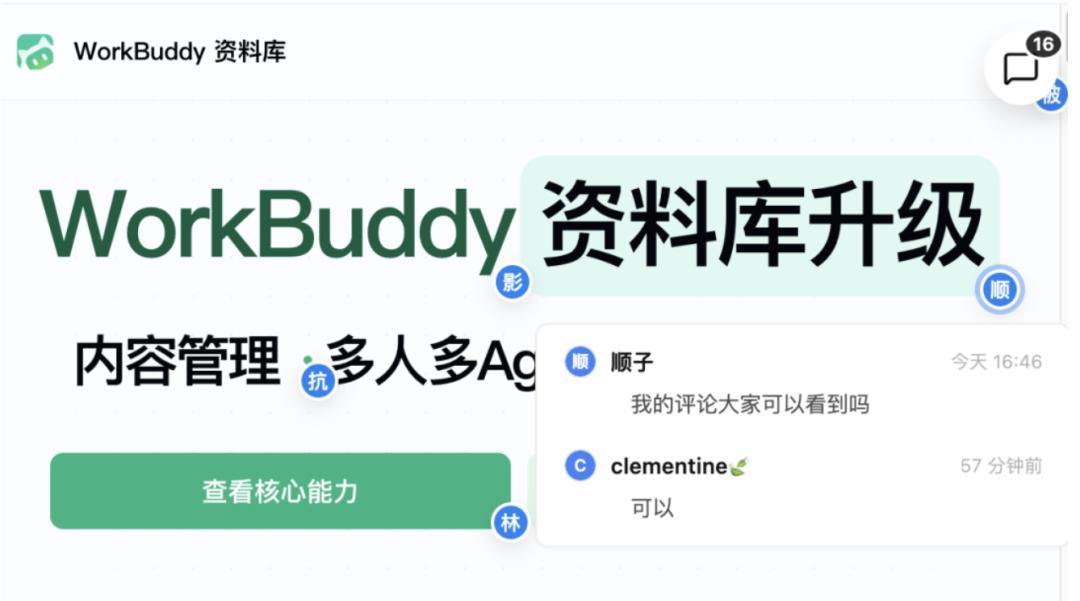
The essence of the Document Library upgrade is to further increase user migration cost — when documents, materials and work outputs are all stored in WorkBuddy, and AI understands work habits based on these historical data, the cost of switching platforms will become higher and higher. The expansion of human-AI co-writing to AI-native formats means that AI begins to intervene in work forms unique to the AI era such as web page generation and data storage, not just helping you edit Word and PPT.
In terms of industry scenarios, on August 18, BayEngine · WorkBuddy was officially released in Guangzhou. Relying on the "BayEngine" base of Guangdong provincial government intelligent hub, it deeply integrates WorkBuddy's general AI capabilities with government scenarios. On the same day, WeCom released version 5.0.10, fully opening CLI and MCP capabilities, allowing AI Agents such as WorkBuddy to be directly accessed by enterprises of all sizes, and invoking ten core office modules.
BayEngine · WorkBuddy cuts into the high-unit-price government market from general office scenarios, while the WeCom opening policy connects the work flows of small and medium-sized enterprises downward. The government market is characterized by high unit price, strict compliance requirements and strong user stickiness. Tencent's choice to cut into the vertical market from here shows that WorkBuddy is no longer satisfied with being a general office tool, and is looking for a second battlefield that can generate sustainable revenue.
In August, Alibaba took the path of "integration, reshaping and ecosystem grafting". Qwen Office integrated three Agents including QoderWork, Wukong and MuleRun, launched internal beta on July 27, and official public beta on August 3, led by Chen Yusen, the new CEO of DingTalk. Completing the integration of three independent product lines in a short period of time is by no means an easy task.
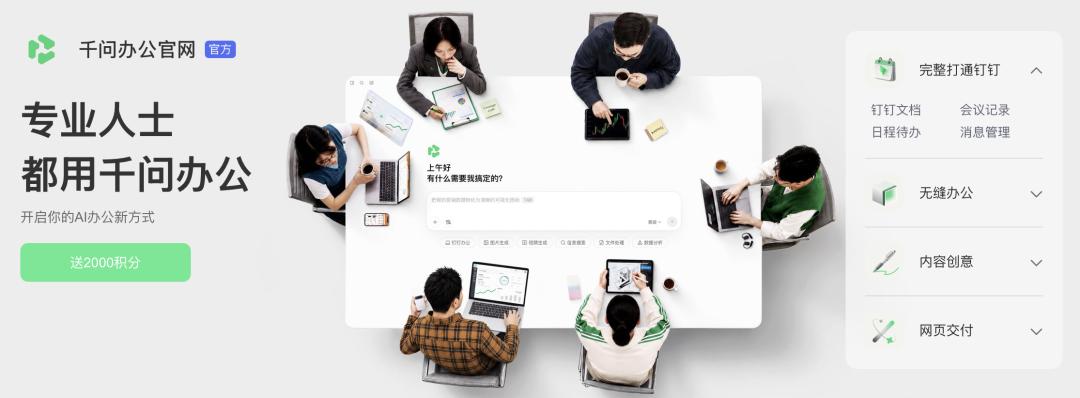
What is really worth paying attention to about Qwen Office is its strategic positioning within the Alibaba system. According to media reports citing Alibaba insiders, Qwen Office is defined as the "only flagship SaaS product" jointly promoted by Alibaba Cloud and DingTalk, with all underlying talents and computing resources integrated into it. The product side is led by the DingTalk team, while the commercialization side relies on Alibaba Cloud's sales system. This level of resource tilt is rare within Alibaba.
The underlying logic is that Qwen Office is naturally embedded in Alibaba's core enterprise service ecosystem: the public beta simultaneously opens deep integration with DingTalk, allowing users to directly invoke DingTalk's organizational structure, approval processes and business data. AI does not just help you write documents, but can truly "understand" the operation logic of your company. Qwen Office does not need to persuade enterprise customers from scratch, it only needs to make the existing enterprises on DingTalk willing to pay extra for AI capabilities — relying on DingTalk's B-end stock is a condition that products with pure C-end background are difficult to replicate in the short term.
At the AI Day event on August 14, Baidu renamed its general Agent GenFlow to "Kuku AI", upgrading it from a functional module in Baidu Wenku and Baidu Netdisk to an independent product, and simultaneously launched the PC client and web version. The official announced that the monthly active users of AI office products have exceeded 25 million. Its differentiated base is the UGC documents accumulated by Baidu Wenku for many years and the storage resources of Baidu Netdisk — AI can directly read users' historical files and understand their knowledge precipitation, no longer competing on general capabilities, but competing on "understanding your documents better".
Putting the three companies together: Tencent is building ecological moats and seeking revenue from vertical industries, Alibaba is deeply leveraging the enterprise ecosystem, and Baidu is creating differentiation with data assets. The three paths point to different moats, but there is a common judgment behind them — homogeneous competition can no longer create gaps in the AI office track, and the differentiation in the next stage depends on who can make users inseparable in specific scenarios.
From Product Competition to Systematic Confrontation
AI Office Enters the Brand Competition Era
After the launch of "Doubao Work", several clear structural changes will take place in the AI office track.
Branded competition begins. In the past year, AI office capabilities were scattered in the feature lists of various products, and users only remembered that "a certain App can help me make PPT". In the past month, the four players have almost simultaneously completed brand independence. The focus of competition has shifted from features to brand awareness. Once users form the habit of "I use XX to get work done", the customer acquisition cost for latecomers will multiply.
The fight for a unified entrance has become the core battle. The essential action of several players is the same: to gather the AI capabilities scattered in multiple business lines behind one entrance. ByteDance merged TRAE, Coze and Doubao, and Alibaba combined three Agent products into one. The underlying judgment is that users do not need five AI tools to do five different things respectively, they need one entrance to solve all work problems. Whoever becomes the default entrance will grasp user mindshare and data closed loop — this is the reason why all parties are willing to bear the pain of integration to achieve this goal.
In this battle for entrance, ByteDance's strongest card is its C-end traffic. According to QuestMobile data, in June 2026, Doubao ranked first among AI-native Apps with 382 million monthly active users, far ahead of Qwen which ranked second with 167 million MAU. After the launch of "Doubao Work", there is no need for cold start, and users who are already used to using AI to process documents and search for information in Doubao are ready to be converted.
The task data brought by this group of users will quickly feed back product iteration, forming a flywheel of "large traffic driving fast iteration". Coupled with TRAE's desktop-side execution experience, Coze's agent ecosystem framework, Volcano Engine's cloud infrastructure, and Feishu's ten years of accumulated enterprise collaboration data, ByteDance's hand of cards is indeed very strong.
But the other three players also have strong cards in their hands: Tencent has the social connection chain from WeChat and WeCom, as well as the collaboration data accumulated by Tencent Docs; Alibaba has DingTalk's enterprise organizational structure and Alibaba Cloud's computing power base; Baidu has the search entrance and the document assets of Wenku and Netdisk. The four players all have full-stack configurations, the gap does not lie in "whether they have the required resources", but in "whose resources are more tightly aligned".
The dimension of competition itself is upgrading. The admission ticket is the basic execution capability of "let AI get work done" — virtual desktop, local control, task decomposition, all four players can now deliver a basic qualified answer. But after the execution capabilities are at the same level, the next round of differentiation lies in who can make AI more irreplaceable.
Tencent embeds AI into the collaboration process with Document Library and human-AI co-writing, and builds industry moats by cutting into government scenarios through BayEngine; Alibaba uses the DingTalk ecosystem to enable AI to truly "understand" enterprise organizations; Baidu uses the data assets of Wenku and Netdisk to achieve deep context awareness; ByteDance uses Coze's plugin framework to build an open ecosystem. The core problem has changed from "can AI complete the task" to whether AI is embedded in users' data, business processes and work habits.
AI office is shifting from the feature competition of the group war era to systematic confrontation among a few brands. ByteDance has completed three steps of organizational integration, capability aggregation and brand independence in two months, getting the admission ticket for this confrontation.
But after entering the track, brand awareness needs to be precipitated over time, the unified entrance needs to be verified by user habits, and willingness to pay needs to be exchanged for through real delivery — traffic and integration speed can help ByteDance seize a favorable position, but cannot finish the second half of the race for it. After "Doubao Work" is launched, the real exam has just begun.