Claude Code has surpassed GitHub Copilot to take the first place, 90% of programmers have already used Agent, and the latest AI coding survey report is released.
AI programming is entering a new stage.
Over the past few years, when selecting AI tools, developers have mostly focused on code completion, Q&A capabilities and the experience of AI IDEs. However, with the rapid popularization of AI programming Agents such as Claude Code and Codex, the way developers collaborate with AI is changing: AI is no longer just helping write a few lines of code, but has begun to take over complete development tasks directly.
Recently, JetBrains Research, the research team under software development tool vendor JetBrains, released the 2026 Developer Ecosystem Survey Report, marking the 10th consecutive year of this survey. The survey covers more than 15,000 professional developers worldwide. In addition to programmers and software engineers, the respondents also include AI/ML engineers, DevOps engineers, architects, data engineers, QA engineers and other roles, among whom about 90% are developers, programmers and software engineers.
The survey shows that AI code agents are gaining a firm foothold in developers' toolchains, and their adoption rate across the entire industry continues to rise. From May to July this year, about 90% of professional developers worldwide have used AI programming Agents at least once a week at work, and 68% of them use them every day.
At the same time, the competitive landscape of AI programming tools is also reshuffling rapidly. The adoption rate of Claude Code has doubled in half a year, surpassing GitHub Copilot which has long occupied a leading position. OpenAI Codex has also achieved rapid growth, while Cursor, which was once very popular, has seen a decline in its adoption rate in work scenarios.
This means that the competitive focus of the AI programming market is shifting from "whose AI IDE is easier to use" to "whose Agent can truly take over development work".
01
Claude Code Doubles in Half a Year, Directly Reaches the Top
Undoubtedly, Claude Code is the most eye-catching player in this round of changes.
Data from JetBrains Research shows that Claude Code is growing at an unprecedented rate and has become the most widely used AI coding tool in the workplace. In January 2026, only about 18% of professional developers worldwide said they would use Claude Code at work; by May to July, this proportion has soared to 39%, doubling in just over half a year.
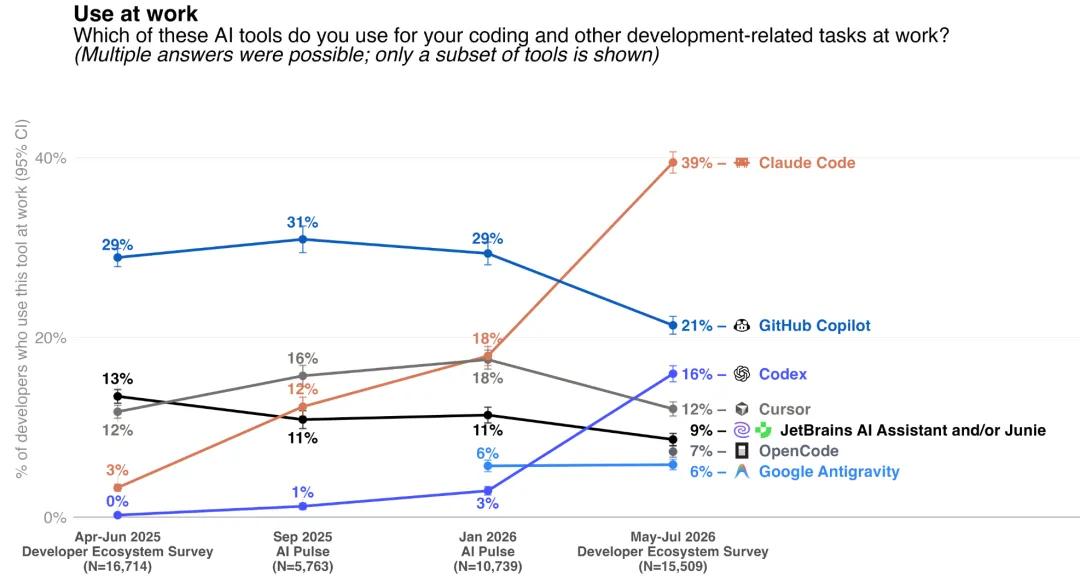
In the US market, this proportion even reaches 47%, which means that nearly half of American developers have used Claude Code at work.
In addition, the proportion of developers taking it as their primary AI coding tool has also increased significantly. The survey shows that 31% of developers take Claude Code as their most commonly used AI coding tool. That is to say, among developers who already use Claude Code, a considerable number of them have transformed it from a trial tool into a core tool for daily work.
This has also directly changed the previous competitive landscape of AI programming tools.
GitHub Copilot once occupied the leading position in this market for a long time. From mid-2025 to early 2026, its work scenario adoption rate once remained at about 29% to 31%, but from May to July this year, this figure has dropped to 21%.
In contrast, Claude Code has reached 39%, almost twice that of GitHub Copilot.
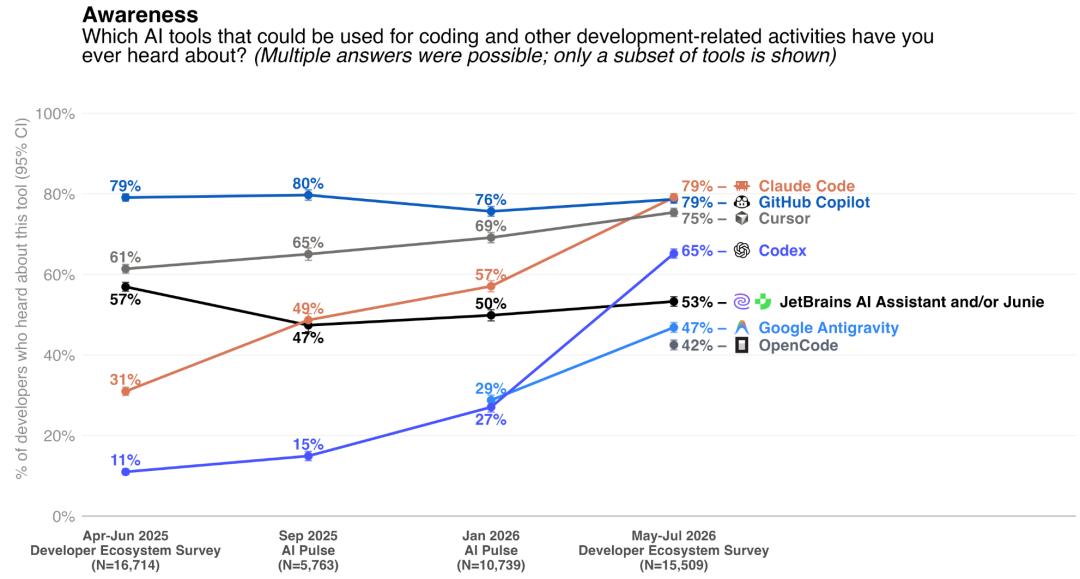
From the perspective of developer awareness, the two are still in the same echelon at present. Both GitHub Copilot and Claude Code have an awareness rate of 79%. The difference is that the actual adoption rate of Claude Code is quickly catching up with and exceeding Copilot.
In addition, if Claude Code is the biggest winner in this round of changes, OpenAI Codex is another player worthy of attention.
In January this year, only 3% of professional developers worldwide used Codex at work. By May to July, this proportion has grown to 16%, an increase of about 5 times.
The growth of Codex's awareness rate is even more obvious. In January this year, only 27% of developers had heard of Codex, and by May to July, this figure has reached 65%.
That means OpenAI's brand advantage has begun to truly translate into product recognition, and the adoption rate of Codex itself is also rising rapidly.
If we follow the current trend, the head competition of AI programming tools is no longer just a contest between GitHub Copilot and Cursor. Claude Code is becoming a new top player, and Codex is also catching up rapidly.
In contrast, Cursor's performance is somewhat unexpected. In January this year, Cursor's work scenario adoption rate was 18%, but from May to July it dropped to 12%. At the same time, however, its developer awareness rate did not decline, but rose from 69% to 75%.
In other words, it's not that no one knows Cursor, but "more people know it, but fewer people actually use it". The change in the Chinese market is particularly obvious. In January this year, about 28% of developers said they would use Cursor at work; by May to July, this proportion has dropped to 16%.
The changes behind this may just reflect a product form transformation that is taking place in AI programming tools. In the past few years, the competition of AI programming largely revolved around AI IDEs, and Cursor is the most typical representative of them. Developers open the editor and collaborate with AI through code completion, conversation and modification functions. But now, Agents such as Claude Code and Codex are gradually stepping out of the IDE.
What developers need may no longer be just an "editor with AI added", but an Agent that can understand the code base, modify code, run tests, and even continuously execute tasks until the work is finally completed.
02
90% of Developers Are Already Using Agents
Putting aside the ranking of specific products, the really important signal from this survey actually comes from another set of data: 90% of professional developers use AI programming Agents at least once a week, and 68% of developers use them every day.
This means that AI programming Agents can hardly be regarded as new tools that developers occasionally try. For the vast majority of developers, it is becoming part of the daily development environment.
JetBrains has a relatively broad definition of Agent, which includes both locally running Agents and remote Agents running in the cloud.
From this perspective, a very obvious change is taking place in the developer workflow: the role of AI is changing from "assisting in writing code" to "executing development tasks".
03
Open Source Agents Have Also Joined the Competition
This competition is not only participated by several large technology companies. JetBrains' survey shows that the work scenario adoption rate of open source coding Agent OpenCode has reached 7% from May to July this year, and it has 42% developer awareness at the same time.
The adoption rate of Google Antigravity has reached 6%, and its awareness rate has grown rapidly from 29% in January this year to 47%. Among them, the adoption rate in the Indian market is particularly prominent, reaching 15%, which is basically on par with Cursor.
In addition, JetBrains' own AI tools have also obtained about 9% of the work scenario adoption rate, including JetBrains AI and Junie.
From these data, the AI programming market has not yet formed a monopoly pattern. On the contrary, developers are getting access to more and more Agents, and choose different tools according to different tasks.
04
The Competition of AI Programming Is Turning Into the Competition of Agents
According to this survey from JetBrains, the rapid growth of Claude Code, the continuous catch-up of Codex, and the change of Cursor's adoption rate all indicate that developers' choices are being reshuffled.
More importantly, the weekly adoption rate of 90% and the daily adoption rate of 68% show that Agents have entered the daily workflow of a large number of developers.
Therefore, what is really worth paying attention to in this survey may not be whether Claude Code can maintain the first place for a long time, nor whether GitHub Copilot has a chance to regain the top spot.
The bigger change is that AI programming Agents have evolved from "new tools that developers can try" to part of the daily work of more and more developers.
As developers hand over more and more development tasks to Agents, the subsequent competition will no longer be just a contest of code generation capabilities.
Whoever can make the Agent truly get things done is more likely to win the next stage of the AI programming market.
Reference: https://blog.jetbrains.com/research/2026/08/ai-coding-agent-adoption-2026/
This article is from the WeChat Official Account "CSDN", translated by Su Mi, published with authorization from 36Kr.