As it sprints for the "largest IPO in history", what areas is Anthropic playing catch-up on?
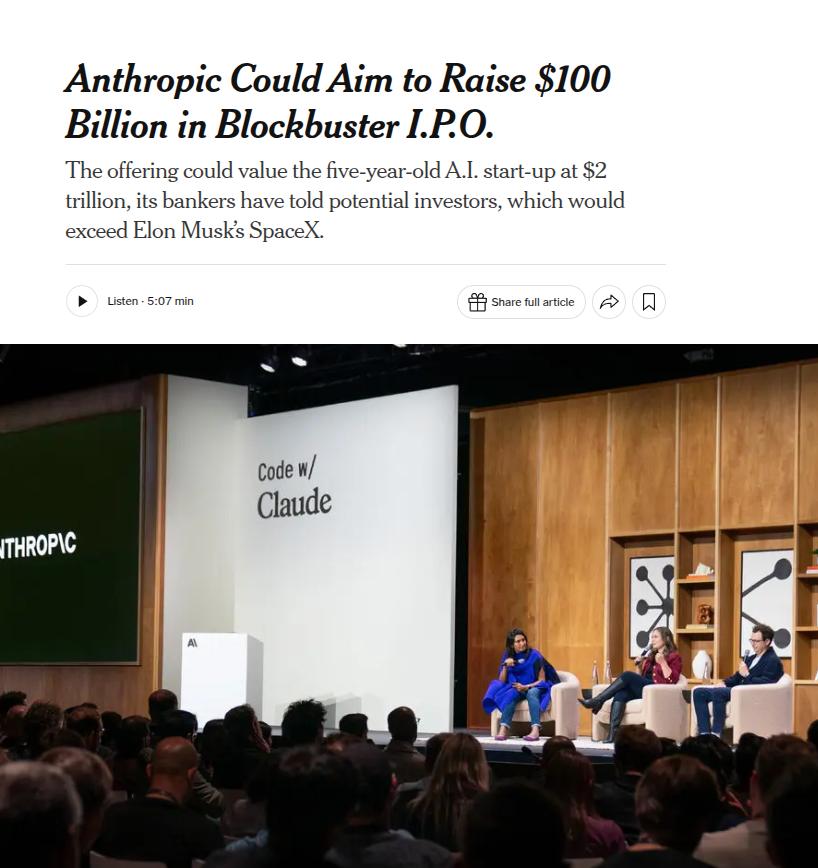
In the second half of 2026, Anthropic is accelerating its advancement of the IPO. What it strives for is not only a financing that may exceed 100 billion US dollars, but also to get the public market to accept an AI company that still heavily relies on computing power investment, with a valuation close to 2 trillion US dollars.
To support this valuation, Anthropic has made a great deal of preparations in the past few months: using enterprise products such as Claude Code to prove the sustainability of revenue growth; explaining how computing power costs will decline through multi-chip supply, data center agreements and self-developed chip teams; using the long-term benefit trust and the proposed super voting right arrangement to re-divide the control rights among founders, investors and public missions.
The real difficulty lies in the fact that these three sets of narratives have not yet formed a natural closed loop. The faster the revenue grows, the higher the investment in reasoning and infrastructure will be; the more the founders want to maintain long-term decision-making power, the more the public market will question the governance position of external shareholders.
01
Grow the revenue first
On June 1, 2026, Anthropic secretly submitted the draft Form S-1 registration statement to the U.S. Securities and Exchange Commission, officially entering the IPO process. Now, the company is shifting from confidential filing to public submission. It may release the prospectus as early as around the end of August, and strive to go public this autumn.
If everything goes smoothly, Anthropic's listing time will be significantly earlier than that of OpenAI.
This may also become a record-breaking IPO in terms of scale. During recent communications with potential investors, Anthropic's bankers revealed that the company may seek financing of more than 100 billion US dollars, and the listing valuation may even reach 2 trillion US dollars.
According to reports from multiple media outlets, Anthropic's listing preparation has been ongoing for some time. The underwriting team has been basically confirmed, with Morgan Stanley, Goldman Sachs and JPMorgan Chase serving as the lead underwriters, and banks such as Citigroup may also join. Legal affairs are handled by Wilson Sonsini, a law firm that participated in Google's IPO in 2004.
Before officially submitting the prospectus publicly, Anthropic has begun to promote to potential investors, introducing the company's business status, revenue growth and future plans, and testing the market's interest in the company's stocks at the same time.
Anthropic is also preparing a revolving credit line of more than 10 billion US dollars, which is significantly larger than the previous level of about 2.5 billion US dollars. For an AI company that needs to continuously purchase chips, data centers and energy resources, this financing can increase the liquidity before listing and leave room for subsequent expansion.
The current market expects that Anthropic may publicly submit the S-1 around the end of August, and go public in the next few months, with the IPO completed as soon as October.
In contrast, although OpenAI is also negotiating with investors for listing, the market expects its IPO to be more likely in 2027.
Anthropic has also prepared a sufficiently large growth story for this listing.
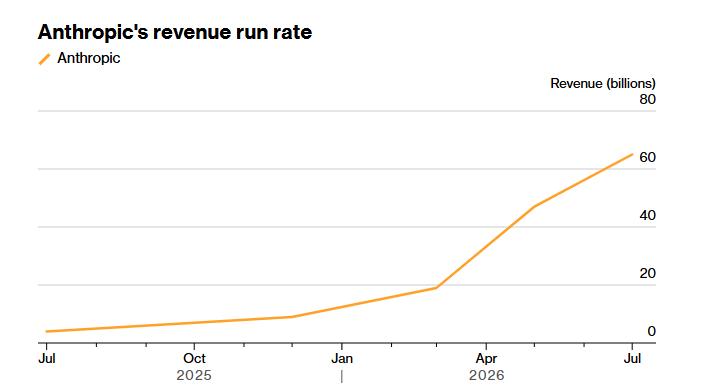
At the end of 2025, the company's annualized revenue was about 9 billion US dollars. By May this year, this figure had exceeded 47 billion US dollars, and further reached about 65 billion US dollars at the end of July. A person familiar with the matter said that Anthropic's revenue in the second quarter reached 11.5 billion US dollars, a year-on-year surge of 14 times.
Revenue growth mainly comes from the Claude model and its enterprise products. The breakthrough of Claude Code has allowed Anthropic to expand rapidly in the AI programming agent market. After that, the company launched Claude Cowork, and integrated it with productivity software suites such as Microsoft 365.
In May this year, Anthropic completed the Series H financing of 65 billion US dollars, with a post-investment valuation of about 965 billion US dollars. The valuation of the Series G financing in February earlier was about 380 billion US dollars. In the same period, OpenAI's valuation was about 852 billion US dollars. As a result, Anthropic has become one of the private startups with the highest valuation in the world.
Anthropic's internal forecast shows that the revenue in 2028 may reach 190 billion to 200 billion US dollars. Some investors judge that the company's listing valuation may be close to or even exceed 2 trillion US dollars based on this growth expectation.
However, high growth also brings another problem: how much computing power does Anthropic need to support this revenue.
02
Apart from computing power, Anthropic starts to develop self-designed chips
Anthropic is solving the problems of chips and data centers at the same time.
At present, Anthropic adopts a multi-chip strategy, using Amazon AWS Trainium, Google TPU and NVIDIA GPU at the same time. In the meantime, the company continuously signs new computing power capacity agreements. The first order with the British chip startup Fractile is about 250 million US dollars, and it has also signed computing power capacity agreements with Riot and Volta Infra.
This method can rapidly expand the computing power pool, but the long-term cost is still very high. As the demand for Claude continues to grow, Anthropic needs more server chips, data centers and energy, and AI infrastructure itself has become one of the largest investments of model companies.
To this end, Anthropic has begun to form its own chip team.
According to the disclosure of U.S. technology media BI, Anthropic has officially confirmed that it is establishing a "custom silicon chip team", recruiting engineers in the fields of chip design and verification, and hopes to cover the whole process from architecture design to tape-out, first silicon verification and production preparation.
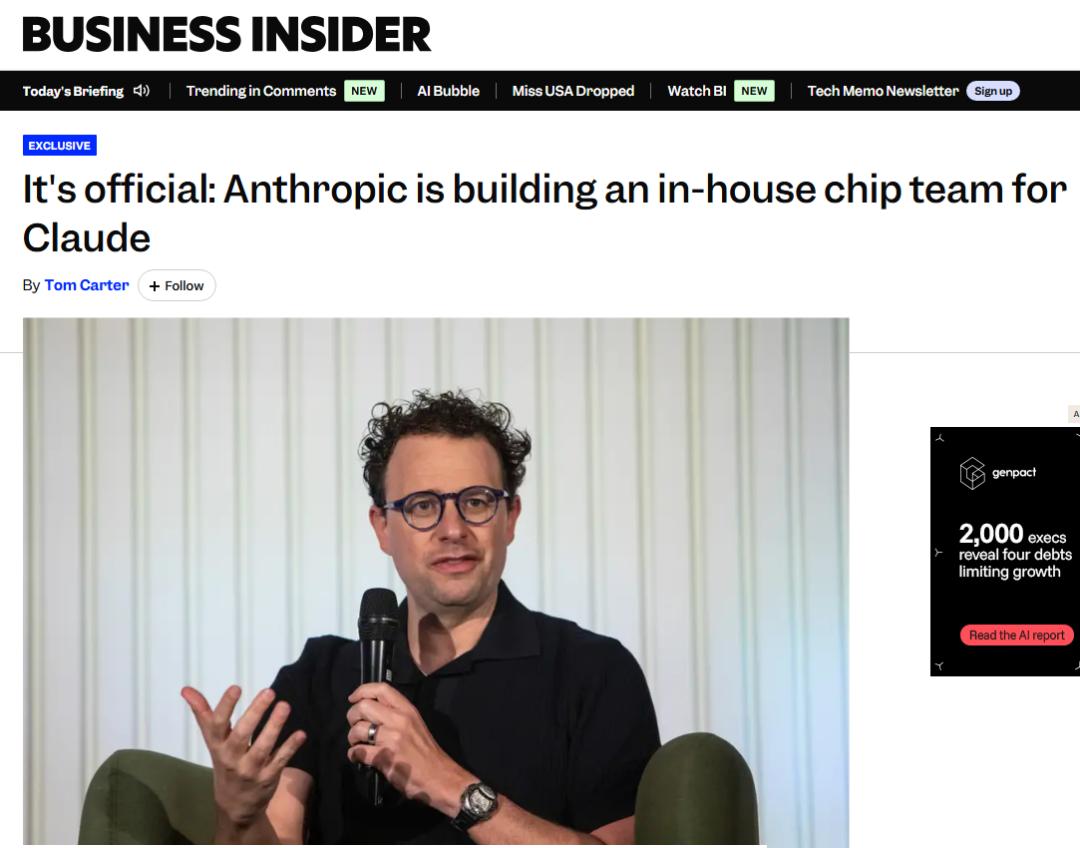
A Silicon Engineer recruitment information shows that the salary range of this position is 320,000 to 485,000 US dollars, and candidates are required to have experience in directly participating in the finalization of semiconductor design and mass production delivery.
On August 21 local time in the United States, it was also exposed that Anthropic recruited Amir Salek, the "father of Google TPU", to join the computing team, reporting directly to James Bradbury, the head of the computing power infrastructure and hardware/system team.
Salek has long been in charge of Google's custom chip business and participated in the launch of the first seven generations of TPU. Before joining Google, he worked at NVIDIA for about eight years, serving as senior director of engineering, responsible for forming and leading the system-on-chip design team, and participating in the R&D of chips such as GPU and Tegra.
He is not the first custom chip talent introduced by Anthropic recently. In June this year, Clive Chan, an early member of OpenAI's custom chip team, joined Anthropic. Chan participated in OpenAI's chip project with Broadcom and was one of the early core members of the team.
At the same time, Anthropic is also discussing potential manufacturing cooperation with Samsung Electronics. People familiar with the matter said that Anthropic is still in the early stage of determining chip functions, performance and deployment methods, and has not yet entered the detailed design, testing and manufacturing links, but is considering adopting Samsung's 2-nanometer manufacturing process and advanced packaging technology.
However, this does not mean that Anthropic is preparing to get rid of NVIDIA, Google or AWS. The company has made it clear that the hardware provided by AWS, Google, NVIDIA and AMD will still be the core of expanding computing power. Self-developed chips are more likely to become a supplement outside the existing supply system, which is used to optimize computing efficiency for the specific needs of Claude and reduce dependence on a single supplier at the same time.
Anthropic chose to promote this business before the IPO, which is also related to the company's future capital needs. After the scale of the model and the number of users continue to grow, even if the efficiency of a single reasoning is only partially improved, when scaled up to large-scale operation, it may significantly affect the computing cost.
This is also an account that Anthropic must explain to investors: the faster the revenue grows, the more infrastructure needs to be invested, and whether future profits can cover these costs will directly affect whether the 2 trillion US dollar valuation is valid.
03
Arrange the control rights properly before listing
In addition to finance and infrastructure, Anthropic is also adjusting the governance structure after listing.
The company is a Public Benefit Corporation (PBC), and the management can legally consider social goals beyond the interests of shareholders at the same time. In 2023, Anthropic established a long-term benefit trust, which is composed of a team of advisors who are neither employees of the company nor investors.
At present, the trust has an important governance right, which can elect the majority of the seven members of Anthropic's board of directors. Anthropic grants this power to the trust through Class T stocks, and this type of stock itself has no economic rights and interests.
Members of the trust include Ben Bernanke, former chairman of the Federal Reserve. After another member, Mariano-Florentino Cuéllar, head of global affairs at Anthropic, left this year, there are only three members left in the trust.
After the IPO, external investors enter the public market, and the shareholding ratio of the founding team will be further diluted. According to two people familiar with the matter, Anthropic is considering offering stocks with additional voting rights to CEO Dario Amodei and other co-founders, so that the founding team can still maintain greater control after listing.
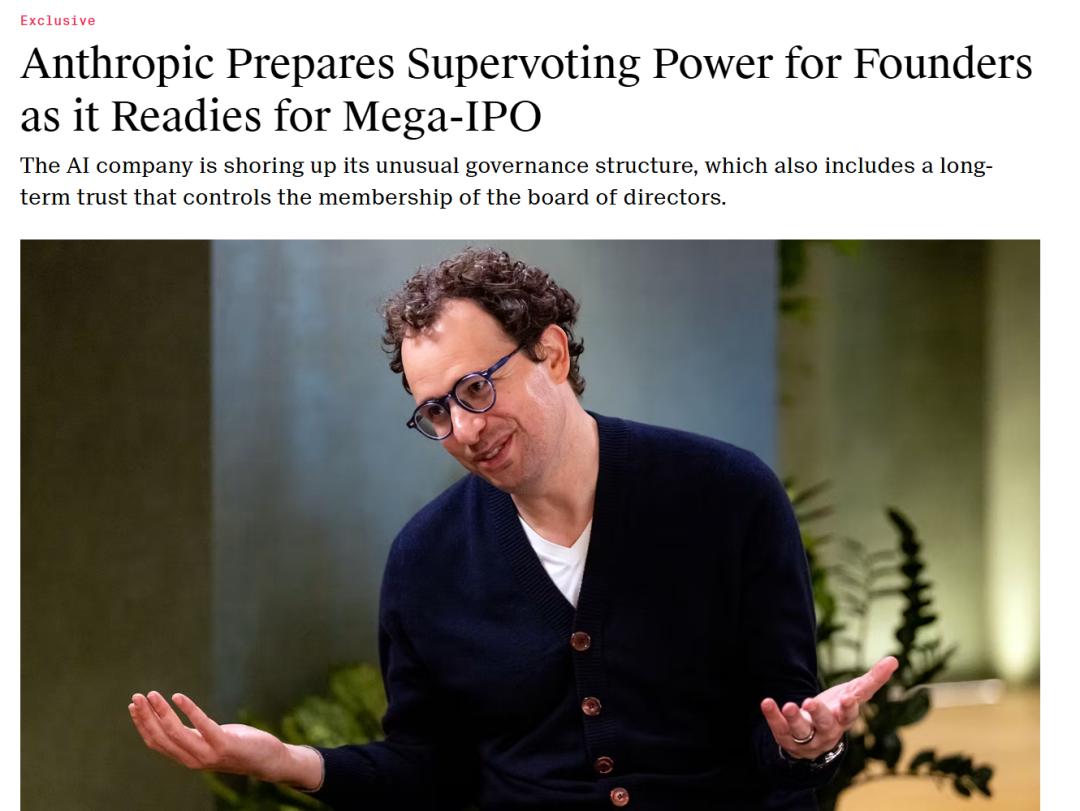
Amodei currently holds about 2% of the shares in Anthropic. Compared with economic rights and interests, super-voting shares allow the founding team to obtain higher voting rights with a relatively low shareholding ratio.
This arrangement is not uncommon. SpaceX adopted a dual-class share structure before its IPO in June, granting Elon Musk super-voting stocks. Technology companies such as Meta and Snap have also adopted similar methods.
The special feature of Anthropic is that the company already has the governance mechanism of the long-term benefit trust. Therefore, this IPO not only needs to determine how to distribute the economic benefits between the founders and investors, but also needs to handle the control relationship between the founding team and the long-term benefit trust.
The specific voting right arrangement has not been finalized yet, and the relevant plan may still change.
04
The biggest test is whether growth can continue
What Anthropic most needs to prove to the capital market at present is whether high growth can be sustained.
In the past year, the company's annualized revenue and private placement valuation have continued to grow, and products such as Claude Code have been continuously expanding the enterprise market. But at the same time, Anthropic's capital demand is also increasing rapidly.
In 2025, Anthropic's net loss was about 42 billion US dollars, about 5 times that of the previous year. Although the adjusted operating profit has turned positive in the second quarter of this year, the company still needs to continuously invest a lot of funds to build and rent data centers, purchase chips and obtain energy resources.
Investors have begun to pay attention to whether Anthropic can maintain the current revenue growth rate and profit margin if the price of AI models continues to drop or open-source models further expand their market share.
In addition, low-cost open-source AI products from China are also the competition that Anthropic needs to face. Open-source models can provide services at lower prices, which may further affect the pricing power of high-end models.
Data centers are another risk.
Both Anthropic and OpenAI are pushing infrastructure partners to expand data centers rapidly, but opposition from American society to AI infrastructure construction is increasing. A survey released by Gallup in May showed that 70% of Americans oppose the construction of AI data centers in their local areas, and nearly half of them said they "strongly oppose".
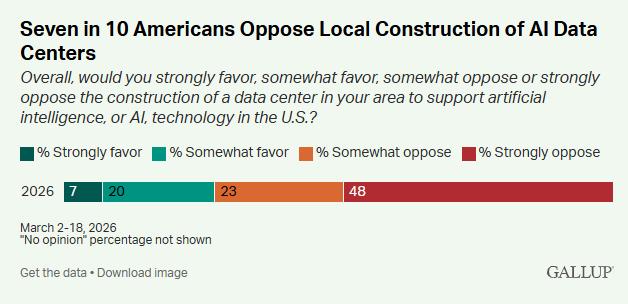
Data center construction has become a political issue in some states. For Anthropic, if the speed of data center construction is limited, the speed at which the company obtains computing resources may also decrease, and computing power is directly related to model services and revenue growth.
Anthropic also faces frictions with the U.S. government, copyright lawsuits and other issues, all of which may become risk factors in the IPO prospectus.
Anthropic's IPO will ultimately face the practical test after the AI industry shifts from rapid expansion to large-scale operation. In the past few years, capital has been willing to pay higher and higher prices for model capabilities, user growth and computing power investment, but after entering the public market, investors will further question the quality of revenue growth, the return on infrastructure investment and when profitability can be realized.
For Anthropic, the 2 trillion US dollar valuation not only corresponds to Claude's current performance, but also includes the market's expectation of the continuous growth of AI demand in the next few years. As the company evolves from a fast-growing AI laboratory to a public listed company, whether this expectation can be transformed into stable revenue and profits will become the key for the capital market to re-evaluate Anthropic.
This also makes Anthropic's IPO have more direct industry significance: the valuation logic of AI companies is gradually shifting from "what the model can do" to "how much sustainable commercial value the model can create".
This article is from the WeChat Official Account "Tencent Tech", author: Joanne, editor: XU Qingyang, published with authorization from 36Kr.