Investors are scrambling for a post-1997 talent from Peking University.
Such a financing pace is quite rare.
According to PE Daily, Yanhe Technology has recently successively closed its Series A2+, A3 and A4 rounds of financing, with the total funding raised in the entire Series A rounds exceeding 500 million yuan. The company has completed 6 rounds of financing within just one year, only three months after the last official financing announcement.
The latest financing round features well-known industrial investors including Zhonghuan Haihe Fund under TCL, Yuanhang Capital and Yuekai Capital, market-oriented state-owned institutions such as Shanghai Science and Technology Innovation Fund, as well as many leading financial institutions including Delian Capital and Bojiang Capital. All existing shareholders including Shunwei Capital, Caixin Capital, Xingxiang Capital and Lenovo Capital participated in the follow-on investment. Lingxiao Capital, Yundao Capital and Xingtang Capital served as joint financial advisors.
The founder behind the company, Feng Fan, was born in 1997, and graduated from Peking University for his bachelor's degree and Columbia University for his master's degree. In 2024, he co-founded Yanhe Technology with Peng Zongyang, his alumni from Peking University, targeting consumer electronics with perovskite photovoltaics, while setting its longer-term goal on space energy.
During a break from a business trip, Feng Fan talked with PE Daily for nearly two hours. He described himself as an "optimist" and also joked that he was a "manufacturing migrant worker". When talking about space, he mentioned *Interstellar* and multi-planet survival; then he quickly shifted the topic to power cost and five-year plans. The romance of the sea of stars can only be fulfilled by down-to-earth efforts.
"The boundary of human civilization has always been defined by the boundary of energy." In Feng Fan's view, intelligence is inseparable from energy, and passive operation is inseparable from primary energy; intelligentization based on passive operation is an inevitable trend of human development, and new photovoltaic technology is the core energy base supporting mankind to move towards a higher civilization. China's photovoltaic manufacturing capabilities that have been accumulated for more than ten years can now support the landing of the passive energy supply revolution on the consumer side, with the next stop being space.
Two Peking University Alumni Join Forces
Break Into The Most Challenging Track
In 1997, Feng Fan was born in Zibo, Shandong Province. At the age of 19, he was admitted to Peking University, majoring in Materials Chemistry, and later pursued a double degree in Economics at the National School of Development. After that, he went to Columbia University to study for a master's degree in Management Science and Engineering.
His academic experience made him realize very early that an achievement established in the laboratory still needs to pass the test of the market. Starting a business became his way to find answers.
After graduation, Feng Fan successively joined CITIC Securities and Deep Potential, and his work gradually turned to investment and financing, strategy and commercialization. When he joined Deep Potential, the company only had a dozen employees, and AI for Science was not a popular concept yet. Feng Fan was attracted by the technological vision, and at the same time he had a clear purpose: to figure out exactly how a startup can get on track.
In just a few years, Deep Potential quickly grew into a unicorn, but Feng Fan chose to leave and prepare for starting his own business. Although Sun Weijie, the founder of Deep Potential, felt sorry for his departure, he still supported his decision, and only gave him two exhortations before he left: entrepreneurship requires both persistence and pragmatism.
On his entrepreneurial journey, Feng Fan broke down the problems into more specific ones: Why should I do this? Why are my advantages hard for others to replicate? These two questions became the criteria for Feng Fan to choose his entrepreneurial direction.
He and his Peking University alumni Peng Zongyang successively studied rockets, satellites, commercial aerospace materials and AI hardware, and finally returned to perovskite — the field where they have the deepest accumulation. Peng Zongyang is a doctor of Polymer Chemistry and Physics at Peking University, studying under Professor Zou Dechun, one of the early pioneers in the field of organic electroluminescence and perovskite research in China. The team has many years of accumulation in materials, devices and industrialization.
In 2024, Yanhe Technology was officially established. The name "Yanhe" is taken from "Yandi" (the Yan Emperor) and "Xihe" (the sun goddess), implying the sun and harmony. In his view, the opportunities for this generation of young Chinese entrepreneurs come from the country's development and long-term industrial accumulation.
At that time, a group of large companies had already gathered in the ground photovoltaic power station sector, and the barriers of capital and production capacity were gradually rising. If Yanhe tried to catch up head-on, its chances of winning would be very slim. Therefore, the team set a differentiated route from the very beginning: to do things that crystalline silicon cannot do. Relying on the characteristics of perovskite, which can generate power under weak light, and is light, thin and flexible, the team opened up new scenarios of consumer electronics and IoT passive energy supply that cannot be covered by crystalline silicon, and actively positioned consumer-grade photovoltaics as its first strategic foothold.
Perovskite can generate electricity even under weak indoor light, and can also be made light, thin and flexible. With the full popularization of AIoT devices, billions of terminals around the world have spawned a 100-billion-level incremental market for passive energy supply. Wearable devices and various smart hardware have long been restricted by both endurance bottlenecks and form factor design, and there is an urgent demand for new power supply solutions.
Although the unit price of a single battery installed in a keyboard, door lock or sensor is not high, this track can quickly verify the mass production capacity and market willingness to pay, and leverage the replacement space of massive terminals. The turning point came at the end of 2024 — Yanhe received its first consumer-grade order, with thousands of units in the first batch, and the order volume soon rose to tens of thousands of units.
The situation was thus opened up.
Today, the company has built a 100MW-level fully automated mass production line for consumer perovskite, with products covering dozens of categories such as keyboards, mice, smart door locks and sensors, entering more than 50 countries and regions around the world, and serving more than 100 brands including Lenovo, Samsung, Haier and Xiaomi's ecosystem. The consumer photovoltaic business has become a stable revenue pillar and self-sustaining engine of the company, and it is also the core sign that distinguishes Yanhe from most perovskite startups that are still in the laboratory stage.
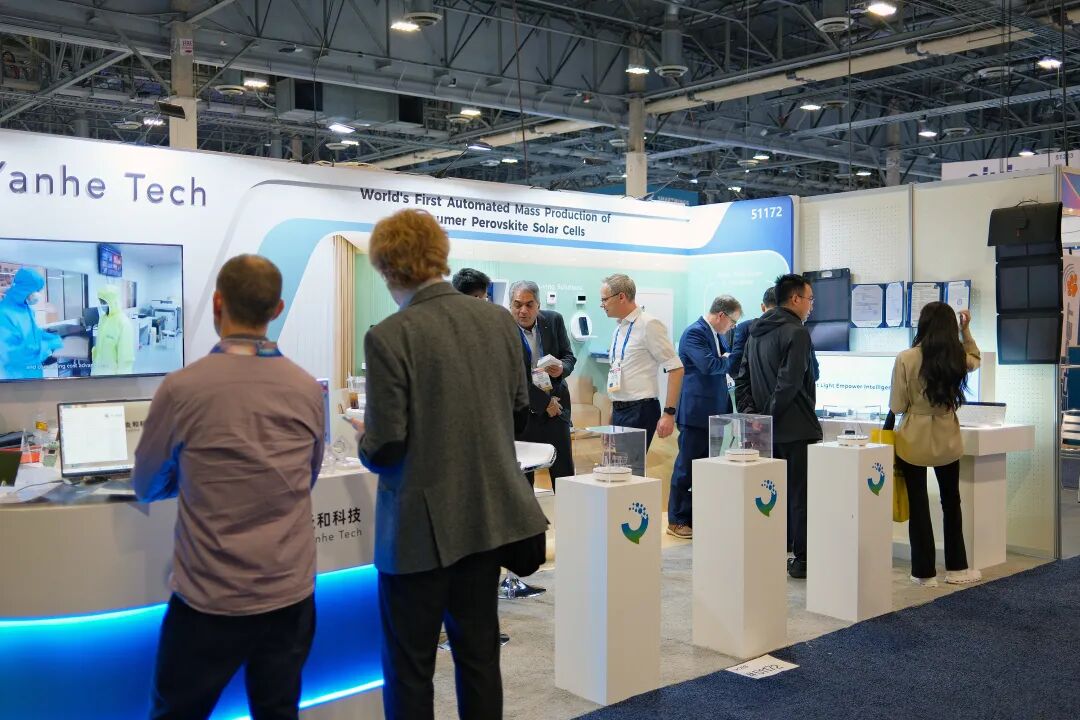
Yanhe and its clients jointly released more than 10 passive smart terminal products at CES2026
The large-scale implementation of the consumer-grade photovoltaic business has brought Yanhe a more scarce resource: time. After the consumer business became self-sustaining, the company was able to continue investing in a longer-cycle route — space photovoltaics, building a business matrix driven by both consumer and space sectors.
The consumer business and space may seem far apart, but their underlying requirements are the same: the batteries need to be light, thin and efficient, and large-scale mass production capacity is equally critical. The real difference lies in the environment: indoor products need to be protected from water and oxygen, while in space, materials also need to withstand extreme temperature changes, thermal vacuum and strong radiation. To this end, Yanhe has built an AI for Science R&D line to accelerate material screening, and completed solar wing splicing and energy transmission tests on the ground, with all core technologies fully independent and controllable.
As early as in the first version of the BP, Feng Fan and his team wrote down the company's mission: "Let photovoltaics enter thousands of households, and let photovoltaics go to the vast universe." Two years later, the "thousands of households" part has turned into orders, and the "vast universe" is no longer just a vision.
The long journey has already begun. "This is bound to happen," he said, "so why can't it be us, and why can't it be now?"
Finally Warm Up The Cold Bench
Decoding The Financing Story
Feng Fan did not expect that raising the first sum of money would be so difficult.
Investors' first concern was the founding team. Perovskite is a manufacturing industry that values experience, but both founders were only in their twenties; at that time, Peng Zongyang was still pursuing his doctoral degree at Peking University and had not joined the team full-time. "Can a few young people make this work?" Feng Fan was asked this question over and over again.
Doubts also fell on the field they chose. At that time, the primary market was in a downturn, and both the consumer and aerospace sectors were non-consensus choices for perovskite. Not many people were willing to bet on these two routes, especially the aerospace sector, where one investor simply advised him to give up: the track is too narrow.
Feng Fan could explain the technology and the market, but it was difficult to prove the mass production capacity of a company that had not yet built a factory.
The first institutions that gave different judgments were Hunan Caixin Group and Zhongke Guangrong. Caixin had previously investigated many perovskite projects, and the two sides quickly reached a consensus. The Changde team visited the Peking University Laboratory several times, and after more than a month of contact, the first investment was closed.
This sum of money also connected Yanhe with Changde, where the 100MW-level fully automated mass production line for consumer perovskite was built. In every communication, Caixin paid more attention to what difficulties Yanhe encountered and what other help it needed. This trust and companionship that did not urge quick returns was especially precious for the fledgling team.
By the end of 2024, Chaoxi Capital exclusively invested tens of millions of yuan in Yanhe's angel+ round of financing. Wang Bin, partner of Chaoxi Capital, met Feng Fan several times and found that he always wore AR glasses of different brands. After asking, he learned that Feng Fan was experiencing the products one by one to compare the user experience and power supply requirements.
Feng Fan's backpack was also like a portable sample library, containing perovskite batteries of different specifications. No matter what scenario they talked about, he could take out the corresponding product. Wang Bin joked that it was "Doraemon's pocket".
What really dispelled the doubts was the factory. Yanhe held its first large-scale board meeting in Changde. After visiting the production line, the shareholders left two words: "Reliable." Later, when investors came to Changde, they often brought other invested companies with them.
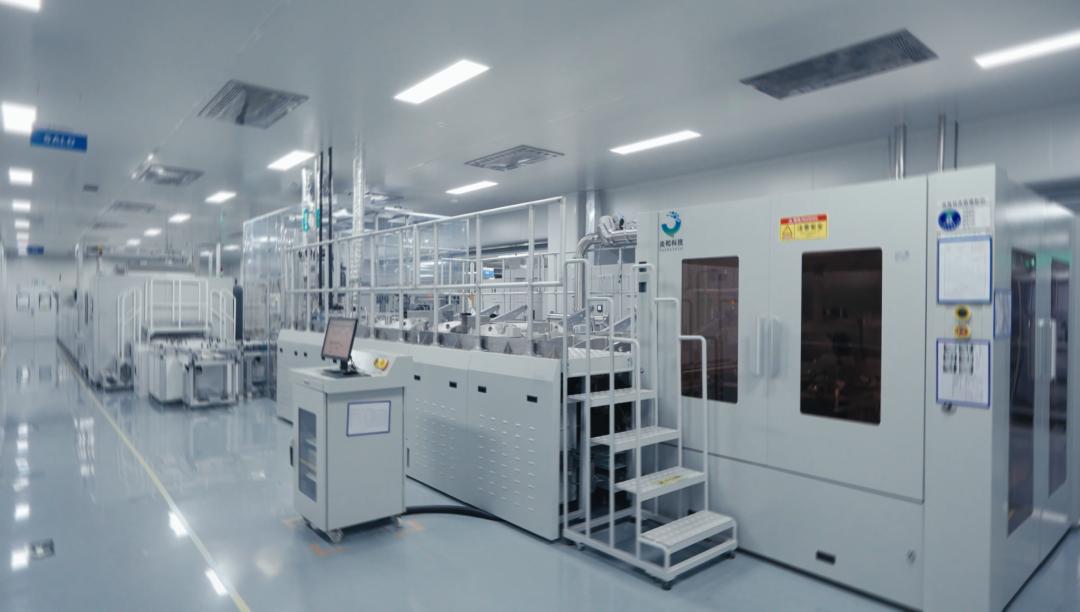
Yanhe's world's first 100MW fully automated mass production line for consumer-grade perovskite
While most perovskite startups are still stuck at the stage of laboratory samples and efficiency records, Yanhe has used a fully automated mass production line, a customer matrix covering more than 50 countries around the world and continuously growing orders to prove that perovskite is not only a cutting-edge technology in the laboratory, but also a mature product that can be implemented, profitable and scalable. This certainty has become the core inflection point for the shift in capital attitudes — the consumer business provides a current safety cushion, and the space business opens up long-term imagination space, the combination of the two allows Yanhe to build unique competitiveness among startups of the same period.
Judgments from the capital market also shifted accordingly. The investor who once advised Feng Fan to give up the aerospace business came back more than a year later, asking "Yanhe's space photovoltaics are doing well, are there still investment opportunities?"
Since then, the financing process has accelerated significantly. Last October, Yanhe Technology completed a Series A financing of over 100 million yuan, led by Oriental RichFund, with participation from Zhuichuang Venture Capital, Xingxiang Capital, Guoke Venture Capital, Xiaochi Capital and other institutions, and existing shareholder Caixin Capital made a follow-on investment. This January, the company completed its Series A1 financing, led by Guoke Investment, with participation from Huixin Investment. In May, Yanhe completed several hundred million yuan in Series A2 financing, led by Chaoxi Capital, co-led by Shunwei Capital and NIO Capital, with participation from Lenovo Capital, Yutian Guanjia, Zhongke Tiansuan and other institutions, and Oriental RichFund and Caixin Capital continued to increase their stakes.
In just three or four months, the company successively completed the Series A2+, A3 and A4 rounds of financing.
"We firmly recognize the first-mover advantage of Yanhe Technology," said Shanghai Science and Technology Innovation Fund. Yanhe has achieved consumer-grade mass production breakthrough and commercialization landing in more than two years since its establishment, won a number of leading consumer electronics clients, and is simultaneously extending to space photovoltaics.
Yuanhang Capital described this step as "crossing the core difficulty of transforming laboratory technology into industrialization". The orders have verified the process replication capability, and the full-chain accumulation of materials, packaging and manufacturing has laid the foundation for the company to enter the cislunar space energy supply chain.
"Perovskite is one of the few third-generation technologies that can simultaneously break through efficiency, reconstruct costs and expand application scenarios," said Lanxi Capital. Relying on packaging innovation, Yanhe Technology has overcome the stability bottleneck, its consumer electronics business has been commercialized, and its space photovoltaic business has entered a critical period of verification, which is expected to reshape the market pattern.
Yuekai Capital said that the construction of low-orbit constellations is driving up the demand for lightweight, high specific power energy systems. Yanhe is extending from consumer-grade mass production to flexible solar wings and space energy systems, and has already possessed certain engineering foundation.
Xingxiang Capital, an old shareholder, has continuously increased its investment. Xue Zhen, its Chief Investment Officer, commented directly: The company has solid technical research, fast mass production landing, and proper layout of the space photovoltaic business, and Xingxiang is willing to "dig deep wells and accompany the company for long-term development".
The Sea of Stars
Build The Power Grid In Space
Feng Fan has set a slightly aggressive goal for Yanhe: "Eliminate charging cables at the physical level".
In the consumer electronics sector, this means enabling door locks and sensors to draw power from ambient light without replacing a single battery. In space, this goal is further amplified: after a spacecraft is launched, it can still obtain electric power from external sources.
Today, every spacecraft is like an energy island. Before launch, the solar wings and energy storage equipment must be fully carried at one time. The increase in power reserves will also lead to higher weight and launch costs; to reduce weight, the computing power, service life and mission capability of the spacecraft may be restricted. After entering orbit, there is hardly any way to replenish energy from outside.
Yanhe wants to move the logic of the ground power grid to space. Satellites can get power supply when they are short of electricity, and lunar surface equipment can maintain operation even during the long lunar night. In this way, spacecraft can carry fewer solar wings and batteries, and allocate the limited launch weight to payloads.
This used to be too expensive and too ahead of its time. Aerospace-grade batteries are expensive, the cost of launching per unit payload into orbit is high, and the limited power demand cannot support large-scale construction. Now, new solutions to this equation are emerging: new photovoltaic materials provide the possibility of weight reduction and cost reduction. With the advancement of reusable rocket technology and the increase in the frequency of commercial launches, the cost of entering orbit continues to drop, and space computing power and in-orbit manufacturing have also brought clearer power demand.
In Feng Fan's view, the commercial window for space energy is approaching.
Photovoltaics is the most realistic solution at present. The new generation of photovoltaic technology can be made lighter, thinner and flexible, providing another path to reduce the cost of space power consumption. Another source of confidence for Yanhe comes from China's photovoltaic industry chain that has been accumulated for more than ten years, and this capability has the potential to be brought into orbit.
