Beauty brands have begun to carefully calculate the incremental growth brought by livestreaming.
On August 17, the National Bureau of Statistics released the consumption data for January-July: the retail sales of cosmetics of units above designated size reached 272.3 billion yuan, a year-on-year increase of 6.3%, which is faster than the total retail sales of consumer goods in the same period (up 1.2%). Beauty care remains a relatively active category in the consumer market, but compared with the double-digit growth that the industry was accustomed to in the past, the single-digit growth rate has lasted for a period of time.
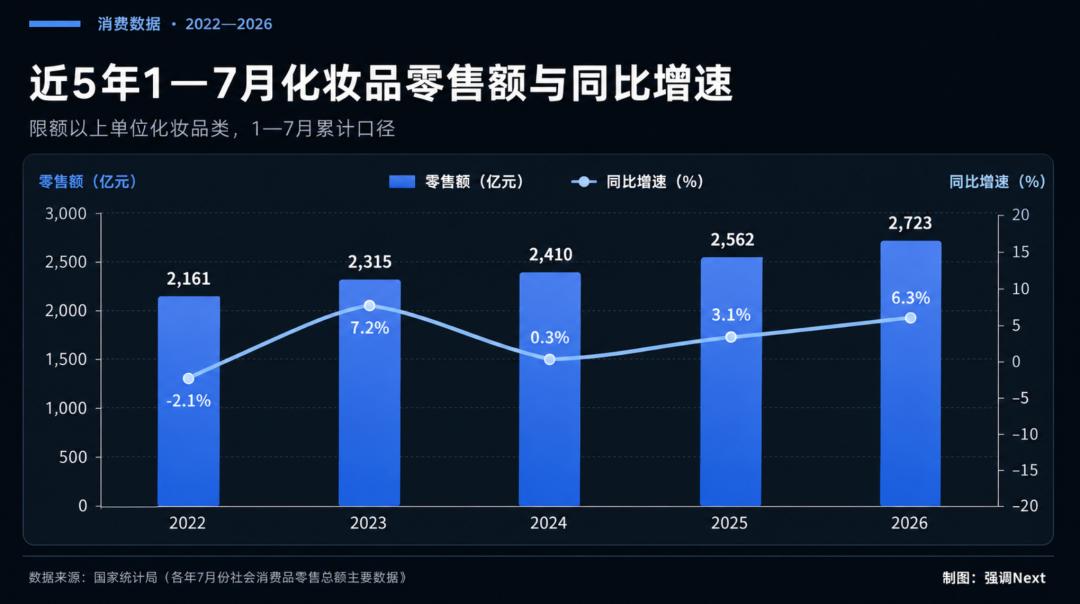
For mature beauty brands, the single-digit growth rate points to a reality: The era when growth was solely supported by repeat purchases from existing users is passing.
According to data from Douyin E-commerce, during the Qixi Festival campaign, branded beauty products became a popular choice for gifting consumption: the transaction value of more than 400 beauty brands doubled month-on-month; in terms of specific categories, products such as liquid essences, sheet masks, facial toners, lipsticks, base makeup and perfumes are more favored by consumers, among which the average daily transaction value of creative gift boxes of branded beauty products saw the fastest increase. At the same time, categories with high unit price and tech-sense also showed more obvious driving effect: luxury makeup recorded a month-on-month increase of over 200%, while the average daily transaction value of luxury body care products and smart beauty mirrors doubled month-on-month.
"Zhiben" is one of such samples. This domestic brand founded in 2012 accumulated its first batch of users in the early years with skin barrier repair products, and mainly operated through shelf e-commerce. For many years thereafter, it has always insisted on no celebrity endorsement and no hard advertisement placement, invested more than 80% of its costs in R&D, relied on product reputation, content promotion by mid- and micro-influencers and ingredient popularization content for dissemination, and its price system has also remained stable. In August this year, "Zhiben" held its first live stream across the whole network on Douyin. Third-party data shows that within two days of the live broadcast, the brand's GMV was nearly 100% higher than the average daily level in August.
A brand that has no shortage of channels or repeat purchases, why did it start to take live streaming rooms seriously at this very moment?
The answer can be traced back to the business logic of the entire industry.
01
The growth logic has changed
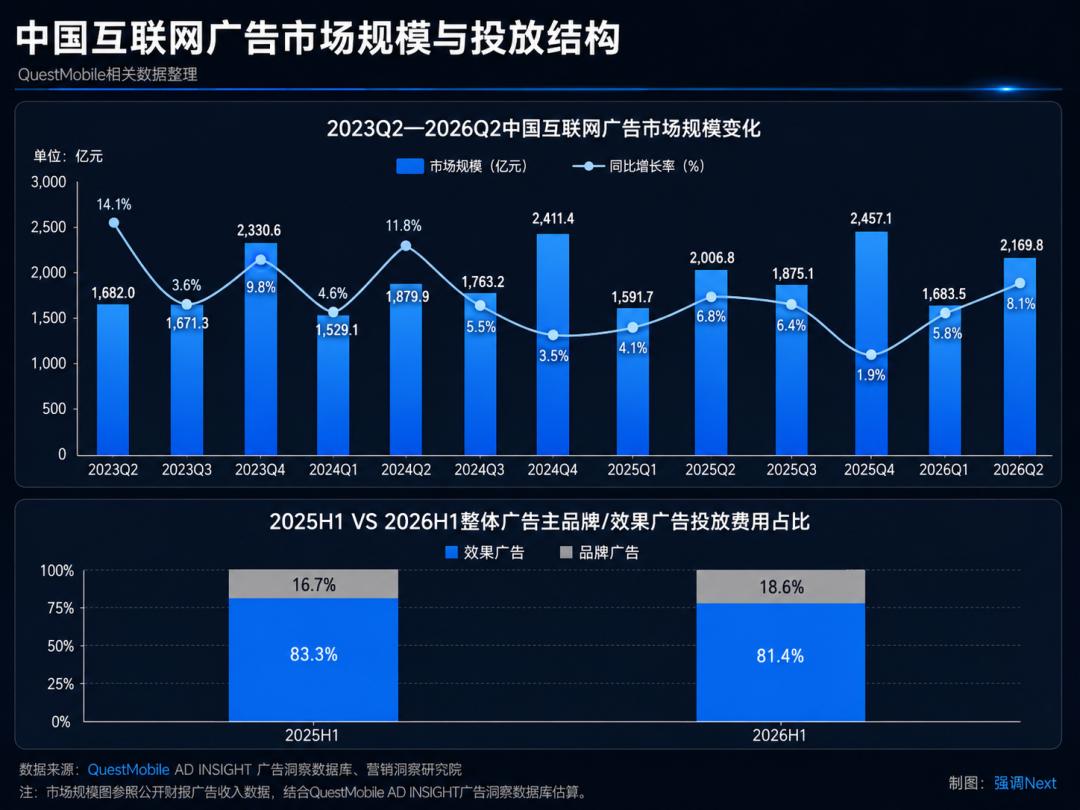
According to data recently released by QuestMobile, the scale of China's internet advertising market reached 2169.8 billion yuan in the second quarter of 2026, a year-on-year increase of 8.1%, and the total scale in the first half of the year is close to 3900 billion yuan. A signal worthy of more attention is that the proportion of brand advertising has rebounded compared with last year, rising from 16.7% to 18.6%. The marginal benefit of performance advertising in driving conversion is getting thinner and thinner, and advertisers are returning to the longer-term and more solid path of "mindshare". Reaching new customers that have not been covered and precipitating content into brand assets is becoming the growth space for the next stage.
The trend of live e-commerce in recent years has exactly catered to this demand. According to the calculation of the China Commerce Industry Research Institute, the transaction scale of China's live e-commerce reached 5.26 trillion yuan in 2025, a year-on-year increase of 16.48%, and it is expected to reach 6.12 trillion yuan in 2026. The industry has long passed the stage of mainly relying on top influencers to create transaction peaks. The self-broadcast mode independently operated by brands has become the norm, with the transaction volume accounting for more than half of the overall scale, and the product selection logic and content capabilities are also moving towards specialization.
This in itself is proof that brands are operating live streaming rooms as content positions rather than just channels. When self-broadcast stably outputs content fields of product logic, usage scenarios and word-of-mouth, it naturally has both the capabilities of content marketing and transaction conversion.
Shelf channels solve the problem of "how people who already want to buy can get the products faster", while live streaming and content scenarios solve the problem of "how people who haven't decided to buy, or even don't know about the brand, can be noticed first". The two things do not conflict, and are connected sequentially: content influences search, search feeds back to shelves, and new increments are growing on this link.
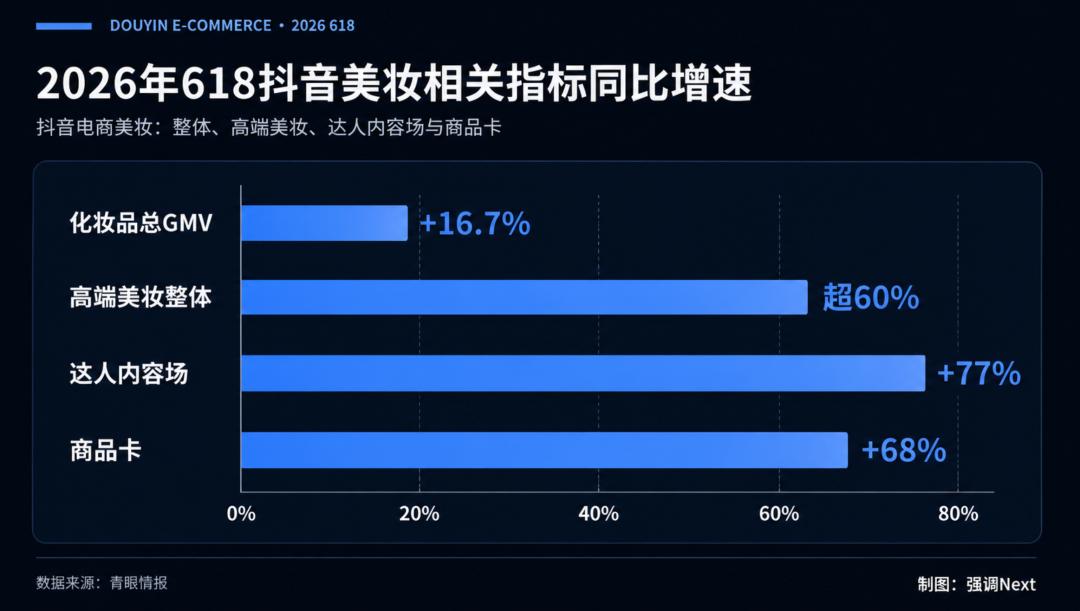
Data from Qingyan Intelligence shows that during this year's 618 shopping festival, in the beauty category of Douyin E-commerce, the influencer content field increased by 77% year-on-year, and product cards increased by 68% year-on-year. Transactions occur at both the content end and the shelf undertaking end: after a short video or live stream arouses interest, users search for brands, compare products, and then complete purchases from the mall or product cards. This link is being run through by more and more brands.
Zhiben's first live show is a very good example. It proves that a brand that regards price stability and product reputation as its foundation and rarely uses traffic tactics can also obtain real new transactions from content scenarios. For more similar mature brands that have already consolidated their shelf business, this is exactly what they need to strive for next: not repeat purchases, but new increments that cannot be reached through original channels. And self-broadcast is the most practical path at present.
02
Another path of Estée Lauder
Estée Lauder has a different starting point. As a mature international brand, Estée Lauder has long operated counters, department stores and mature e-commerce channels in China, and in the past two years, it has begun to systematically increase investment in Douyin content and self-broadcast.
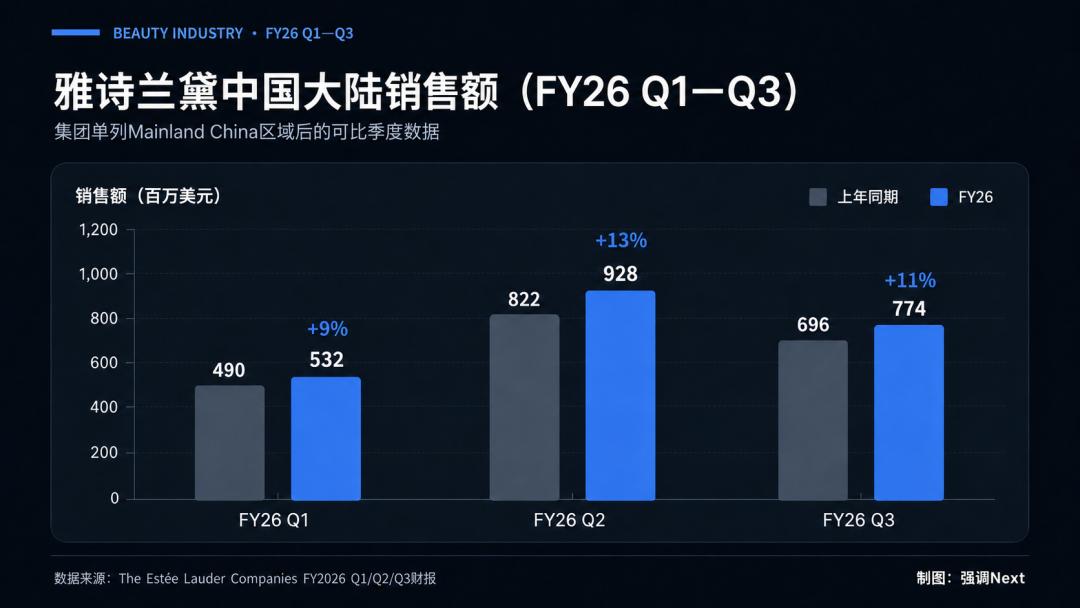
In May this year, at the Morgan Stanley Luxury Summit held in Paris, Stéphane de La Faverie, President and Chief Executive Officer of The Estée Lauder Companies, talked about the Chinese market and said that one of the major breakthrough points for the group in 2025 is on Douyin: the platform helps the brand acquire more new consumers. The group's financial report for the same period shows that the sales of The Estée Lauder Companies in mainland China in the third quarter of fiscal year 2026 reached 774 million US dollars, representing a year-on-year increase of 11% on a reported basis, and organic sales growth of 6%.
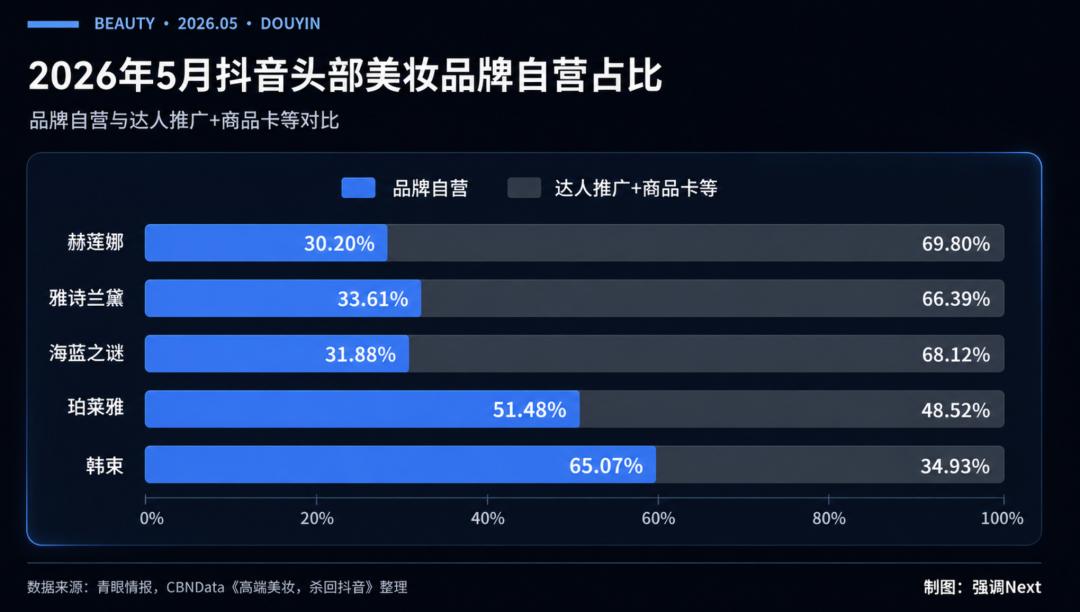
At the specific operational level, Estée Lauder's layout on Douyin is no longer limited to one official flagship store. Instead, it has opened multiple self-operated live streaming rooms such as "Estée Lauder Nutritious", "Estée Lauder Makeup", and "Estée Lauder Light Revealing Small Tube" according to categories and star SKUs. During this year's 618, the brand adopted a combined strategy of "promoting large gift sets, driving volume with top influencers, and precipitating assets in self-operated positions", and used Hongguo short dramas to drive attention to the "Small Tube". On the day of content diversion to the live stream, the brand's self-broadcast GMV was close to 2 million yuan; according to statistics from Qingyan Intelligence, Estée Lauder's total GMV during the entire promotion period was about 735 million yuan.
What is more noteworthy is that during the same period, the number of new customers of Estée Lauder on Douyin E-commerce increased by 189% year-on-year, and the proportion of new customers reached 78%. What this promotion brought is not mainly the migration of old customers between channels, but a considerable number of new users who were not covered by counters and department stores before.
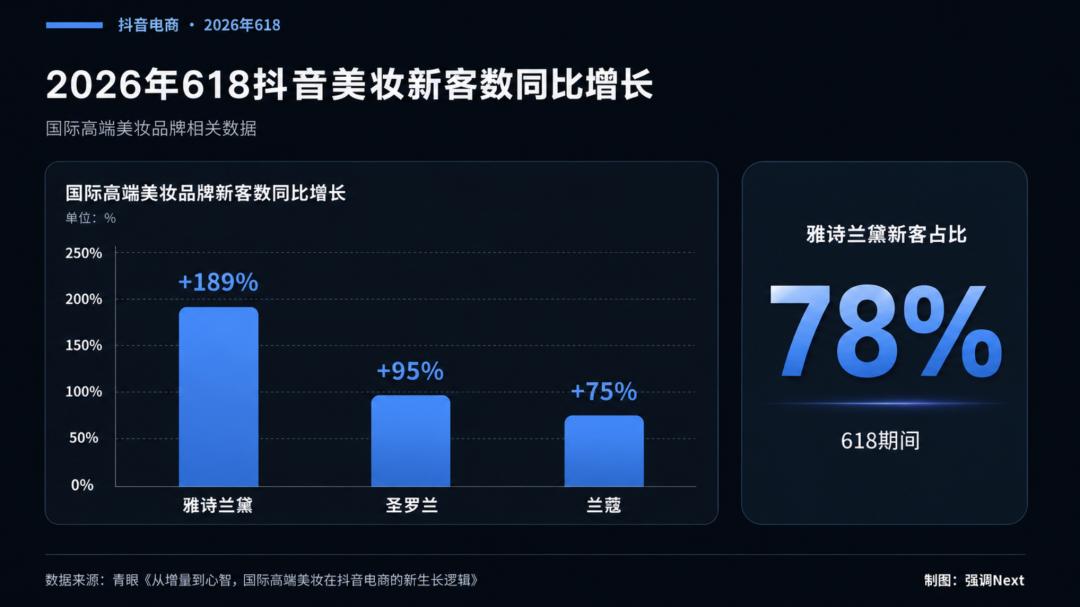
Estée Lauder's investment direction is very clear: gift sets are responsible for products and rights, influencers expand external reach, self-broadcast provides stable explanations, short dramas create content entrances for new products, and live streaming is the closest link to transactions in this operating system.
For a company that has accumulated brand assets offline for many years, the new task is to translate products, scientific research and usage scenarios into content suitable for short videos and live streams, and then retain the users obtained therefrom in subsequent operations. This is also another equally valid path besides Zhiben: no matter whether the brand originally started with shelf e-commerce or offline channels, Douyin captures the same segment of increment.
03
A ranking list and the logic behind it
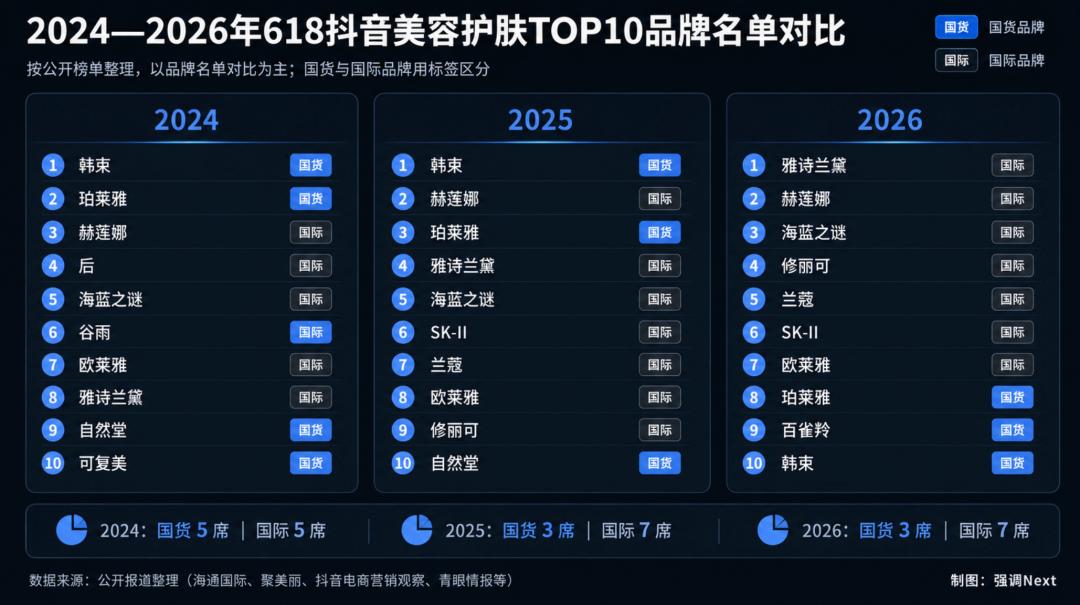
Similar changes are not unique to Estée Lauder, which is more like a common shift in the brand operation mode across the industry. Sorting out the beauty rankings of 618 in the past three years shows that in the early stage, traditional domestic brands and emerging brands dominated the list, while this year, domestic and international high-end beauty brands have all entered the top ranks. Brands such as Helena Rubinstein, La Mer, YSL, Guerlain and Charlotte Tilbury all recorded a growth rate of over 70%, with YSL reaching the highest of 105%; the year-on-year growth rate of domestic high-end brand Mao Geping also exceeded 50%.
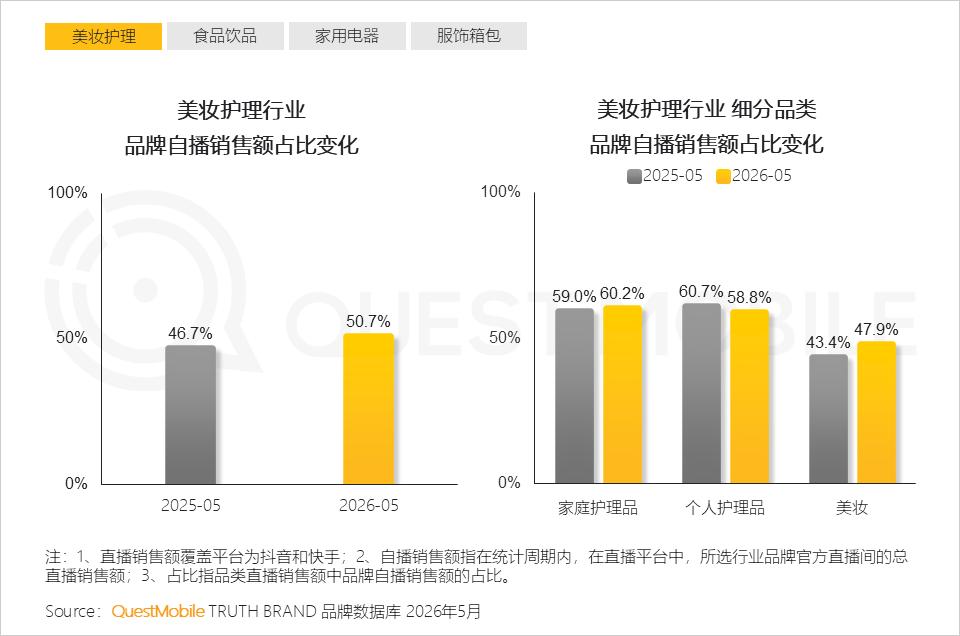
QuestMobile data shows that during this year's "618" period, the proportion of self-broadcast of beauty brands increased from 46.7% last year to 50.7%. Brands have strengthened their self-operated live streaming positions to better precipitate and convert membership assets. Data from Qingyan Intelligence also confirms this trend. During the 618 period, the GMV of the cosmetics category on Douyin E-commerce increased by 16.7% year-on-year, among which the overall increase of high-end beauty brands exceeded 60%.
Behind this, an old problem has been re-solved: in the past, there were often several steps between content marketing and transaction conversion. Users were first impressed by the content in one place, and then jumped to another place to complete the purchase. With each additional step, attention and purchase willingness would be lost to some extent.
For brands, the more critical thing is to integrate the content field that "makes people noticed" and the shelf field that "makes people buy" into the same system. Short videos and live streams arouse interest, while malls and searches undertake the generated purchase intention, allowing the same group of users to flow naturally in different scenarios.
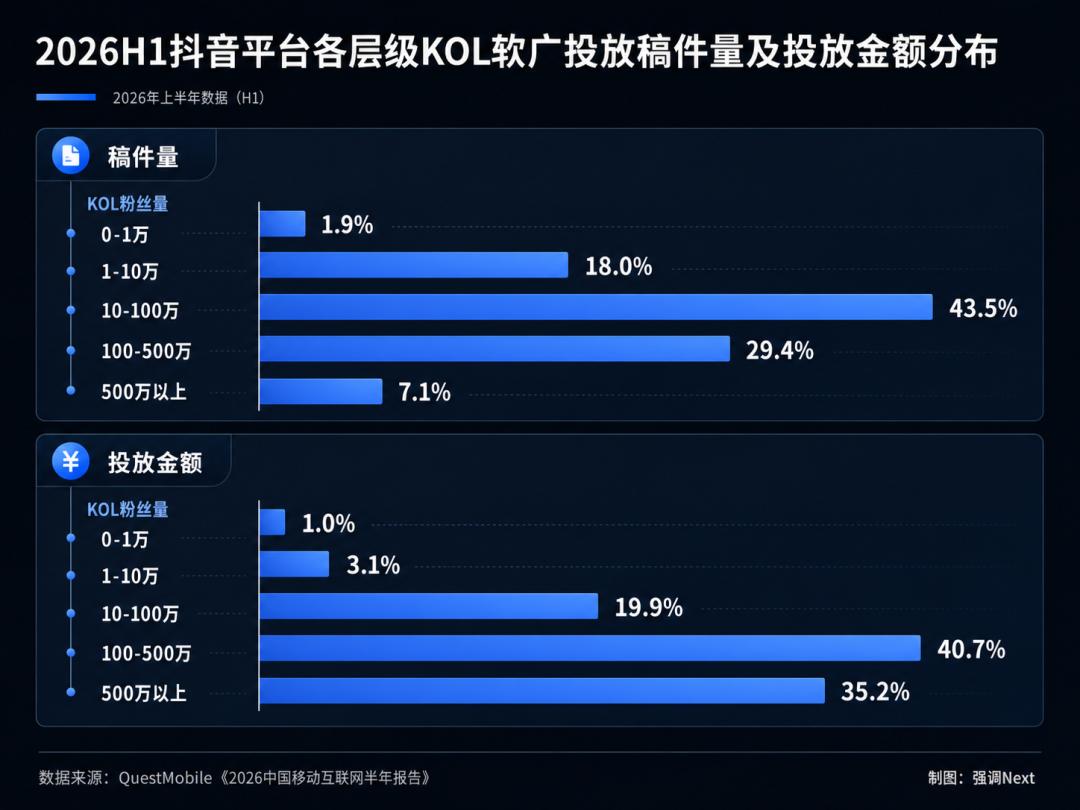
This logic is also reflected in the hierarchical strategy of influencer placement. According to the industry observation of QuestMobile, the beauty care industry is still the one with the highest proportion of soft advertisement placement, but the influencer strategy is becoming more refined: mid-tier KOLs are responsible for explaining products thoroughly and deepening interest, while top KOLs are responsible for promoting the brand to more people who have never heard of it. The strategy of "spreading volume with mid-tier influencers and amplifying influence with top influencers" is essentially two mappings of the same logic at the placement end and the operation end, which is consistent with the path of "content marketing - self-broadcast undertaking - mall search precipitating repeat purchases" adopted by Zhiben and Estée Lauder.
04
What content leaves behind after transactions are completed
Looking at the timeline from a long-term perspective, a more noteworthy change is that the competitive focus of content e-commerce is shifting from the scale expansion of traffic to the long-term precipitation of brand mindshare.
Helena Rubinstein's newly launched Black Bandage PX50 this year carried out nearly 9 months of continuous content preparation on Douyin around themes such as product traceability and brand days before its launch, and then concentrated on conversion at the promotion node. During the 618 period, Helena Rubinstein's overall settlement rate increased by 18 percentage points year-on-year, ranking at the top level across all platforms.
Guerlain has also adopted a similar long-term content strategy. It continuously explains the research of Orchidée Impériale repair, the anti-aging principle of Orchidée Impériale and perfume craftsmanship through short videos, and then demonstrates and answers questions in live streams. For high-end beauty products,