The unavoidable pay-to-work scheme for all salaried employees has seen another price hike.
White-collar worker Wenwen finds that shared bikes have raised their prices again.
Following the collective price hikes of Qingju, Meituan and Hello in June, Hello Bike released another announcement on fare adjustment on August 10, stating that from the effective date, the billing rate for standard bikes on holidays is adjusted to 2.5 yuan per 60 minutes, with an additional duration fee of 0.1 yuan per minute.
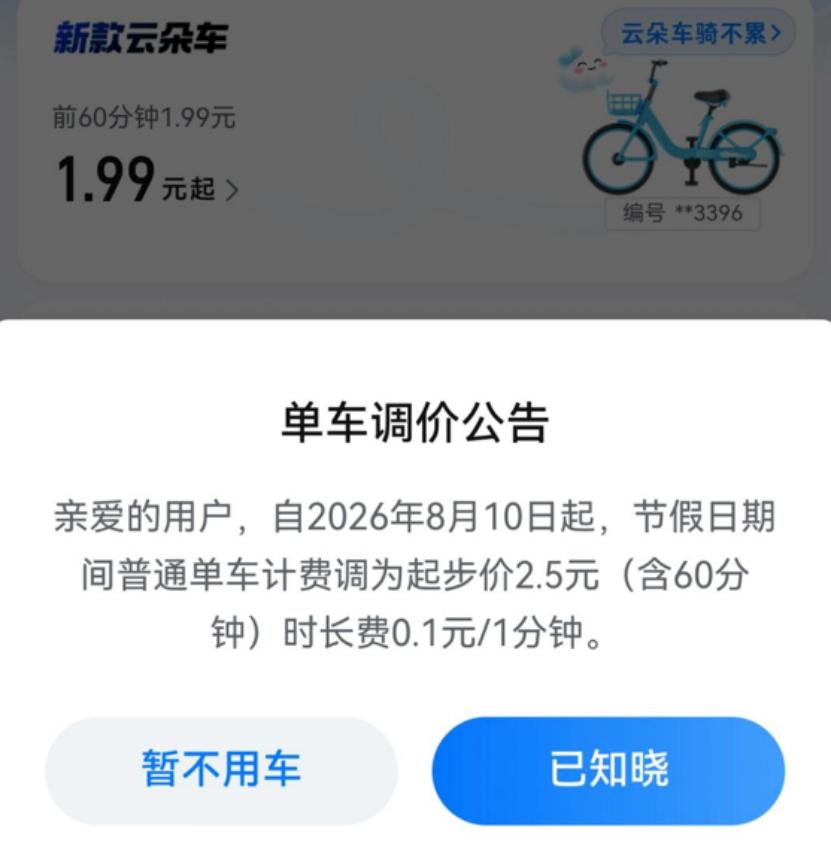
In a corner unnoticed, Hello Bike has stealthily raised prices once more. (Photo: Hello Bike Mini Program)
What's more subtle is that, like many people rushing to clock in for work at the last mile, Wenwen only saw the "friendly reminder" of the bike price adjustment at the final step of scanning the code to unlock the bike.
That means when you notice the notice, you are usually already standing right next to the bike. It is worth mentioning that grabbing a fully functional shared bike at the subway exit during the morning peak is already a tiny little blessing for office workers on their commute.
Spending a few extra cents to avoid being late, versus saving a few cents but risking a 50-yuan fine. Commuting under the scorching sun, when you face this hard-won lifesaver for your trip to work, even if you think the price is higher, you can hardly really turn around and leave — after all, the time of office workers is often more valuable than a few yuan.
But as you can see, the money office workers spend on their way to paid jobs is also piling up little by little.
When you open your eyes on a workday, before you earn a penny, you have already spent several sums of money quietly: 5 yuan for subway commute, 7 yuan for a budget breakfast, 9.9 yuan for the essential office coffee to stay awake, and increasingly expensive shared bikes.
However, when the last mile turns into the "most expensive mile", office workers will really start to resist.
01
"Abandon shared bikes,
Embrace a free life."
When Xiaojie wrote this sentence on social media, he had just bought a second-hand electric scooter.
In the recent massive graduation clearance sale, Xiaojie can be regarded as a counter-trend player. While others were busy packing their luggage to travel light, he quickly added a new piece of equipment to himself.
The reason is very simple: an internship before graduation made him suffer a lot on commutes. The special bikes placed in universities cannot be ridden out of the campus, so he had to ride to the school gate, park the bike, and then run all the way to the subway station. The situation at the subway station near his company is even more unpredictable. Finding a shared bike at the subway exit during morning rush hour is like a random drop that refreshes at fixed time every day in a large online game: the refresh time is fixed, and whether you can grab it depends entirely on your hand speed and luck.
To maximize his chance of getting a shared bike, Xiaojie once bought monthly passes for both Hello and Meituan, but after calculating the bill, he found that this single expense alone cost him more than 40 yuan every month.
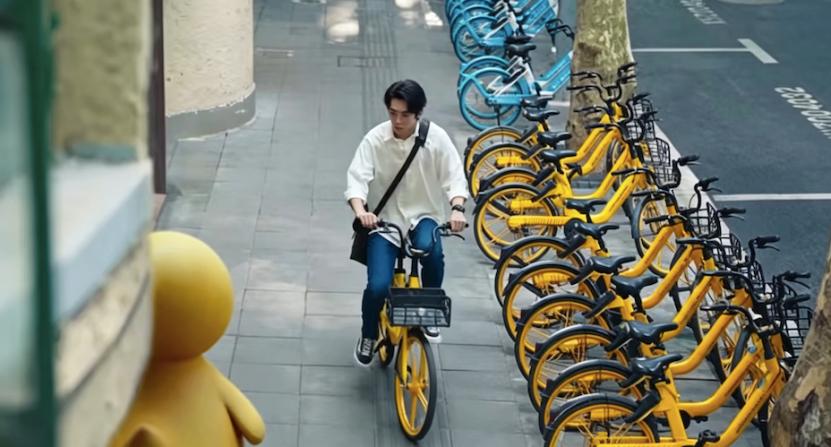
After buying a monthly pass of one platform, you will somehow fail to find bikes of that brand. (Photo: *Right by My Side*)
Counting the 8 yuan spent on the three-stop subway round trip every day, Xiaojie found that the money he spent on commuting in one year at work was enough to buy two electric scooters. And his commute distance is completely within the mileage range that an electric scooter can cover.
Electric scooters can only save the wallet of people with short commutes, but people who commute long distances are also considering whether to abandon shared bikes.
Kumi, who works in Shanghai, needs to commute across districts. Every day she travels from home to the subway station, takes the subway to Pudong where her company is located, then scans a shared bike at the subway station and rides to the company.
After several attempts to calculate the time cost, Kumi found that subway plus shared bike is the fastest way. "No secret, just practice makes perfect". As long as the connection between each link is precise enough, she can arrive at the company within one hour after getting up.
However, in Shanghai where it always rains, shared bikes often make office workers lose their decency. Kumi said that especially in summer, when the outdoor temperature is extremely high and it is drizzling at the same time, "it is inconvenient to hold an umbrella, but if you don't hold one, your hair will be completely flat by the time you arrive at the company, and you can't tell whether it's rain or sweat, there is no decency at all".

On the way to work on rainy days, even Luo Zijun's designer coat can't help office workers maintain decency. (Photo: *The First Half of My Life*)
Kumi never liked taking buses, as she thought the road conditions for buses are complicated, the ride is not smooth, and she is prone to carsickness in the morning, so this option has always been excluded from her commute choices.
One day, she woke up early and on a whim took a bus to the company. "Maybe there are fewer people taking buses now, most of the time there are seats along the way."
The most unexpected discovery for Kumi is that switching between different means of transportation in the past seemed to take less time, but it invisibly consumed a lot of energy. "Every day after getting off the subway and riding to the company, I was already half-dead. But the bus dropped me right downstairs at the company, I didn't even sweat a drop, and I felt completely different in energy."
Xiaojie, who embraced electric scooter commuting, found that a personal mobility tool brings not only faster commuting, but also a certain kind of freedom to go anywhere whenever he wants. In the past, his understanding of the neighborhood near his residence was limited to the streets from the subway station to the community, but after he got the electric scooter, he and his partner often go to explore the hidden streets and alleys around after work or on weekends.

A bike that belongs to you means greater freedom. Photo: *The Pentacle of Million Dollars*
In the summer night breeze, the wind brought by the small electric scooter blows up the hair of the two people, and they sing soft sweet songs together, which is the smallest unit of little happiness under heavy work.
Xiaojie fell in love with the feeling of shuttling through the breeze, and he wants to buy another road bike. "Shared bikes are just too full of the smell of going to work." He concluded that this is not just a matter of cost performance, "Only after I have my own beat-up bike, do I feel like I have got my life back".
02
A world where only the laborers get hurt has been achieved
They are not the first group of people who decided to leave. In the summer of 2026, more and more office workers find that the price of shared bikes has been rising steadily, and it is no longer the cheapest option.
In this round of shared bike price hikes, Meituan was the first to break the silence.
On May 1, Meituan Bike released a new billing rule: the starting price on weekdays is 1.5 yuan per 30 minutes, and the starting price on holidays is 2.5 yuan per 60 minutes.
On June 19, Meituan adjusted the starting price uniformly to 1.88 yuan per 60 minutes, with an additional duration fee of 0.1 yuan per minute for the time exceeding the starting duration.
Hello Bike and Didi Qingju Bike quickly followed up with adjustments. Among them, the classic model of Didi Qingju adjusted the starting price on weekdays and weekends from 1.5 yuan per 30 minutes to 1.99 yuan per 60 minutes. Hello Bike strictly distinguishes between weekdays and holidays: the starting price on weekdays is 1.99 yuan per 60 minutes, and the starting price on holidays is 2.5 yuan per 60 minutes.
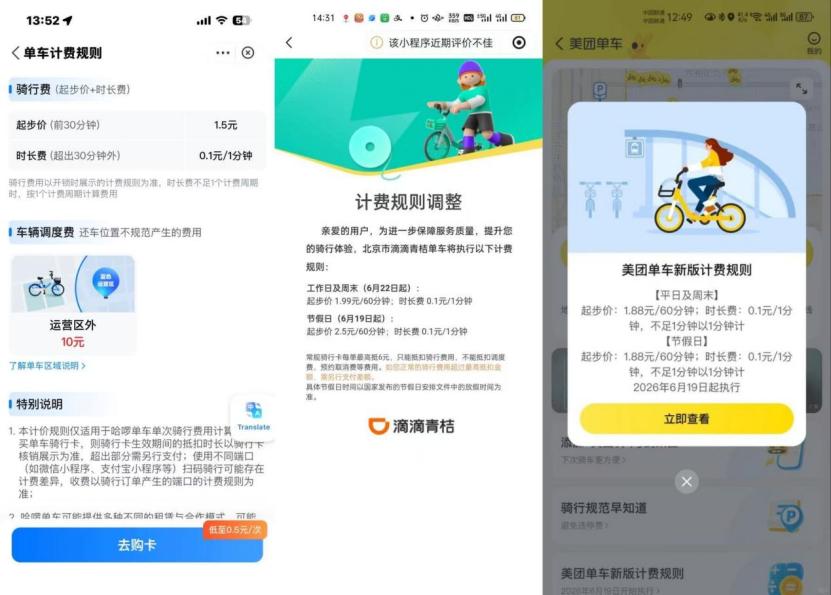
(Photo: Screenshots of Hello, Meituan and Qingju Mini Programs)
It seems that you pay a few more cents, but you also get a longer riding time, which seems to be a pretty cost-effective adjustment? But behind the massive riding data and big data model decision-making of the platforms, ordinary consumers can hardly really take advantage of it.
Data shows that the shared bike usage scenarios of the vast majority of people do not require a riding time of as long as one hour. According to 2025 statistics from the China Bicycle Association, the average one-way riding distance of national residents is 2.7 kilometers, with an average riding duration of 15 minutes. The *2024 Report on Shared Bike/E-bike Riding in Major Cities of China* shows that the average one-way riding distance of shared bikes is even only 1.5 kilometers, which is only 30 meters longer than that in 2023.

For too long a distance, riding a shared bike seems to be thankless. (Photo: *A Good Life*)
If the loudest voice in this round of price hikes comes from the price sensitivity of office workers in Beijing, Shanghai, Guangzhou and Shenzhen regarding commuting costs, then in some second-tier cities, shared bikes are quietly getting more expensive.
Some netizens found that the starting price of Hello Bike in Qingdao is as high as 2.8 yuan per 15 minutes, and after exceeding 15 minutes, an additional 1 yuan duration fee will be charged for every 5 minutes. That means riding for half an hour in Qingdao costs nearly 6 yuan.
Similarly, in February this year, Tianjin netizens complained that the starting price of Hello Bike in the local area is 2 yuan per 15 minutes, and after exceeding the starting duration, an additional 1 yuan is charged for every 15 minutes.
After checking the Hello Bike Mini Program, *New Weekly* found that the starting price for riding in Wuhan is 1.8 yuan per 10 minutes, and for the part exceeding 10 minutes, a duration fee of 1 yuan per 15 minutes is charged.
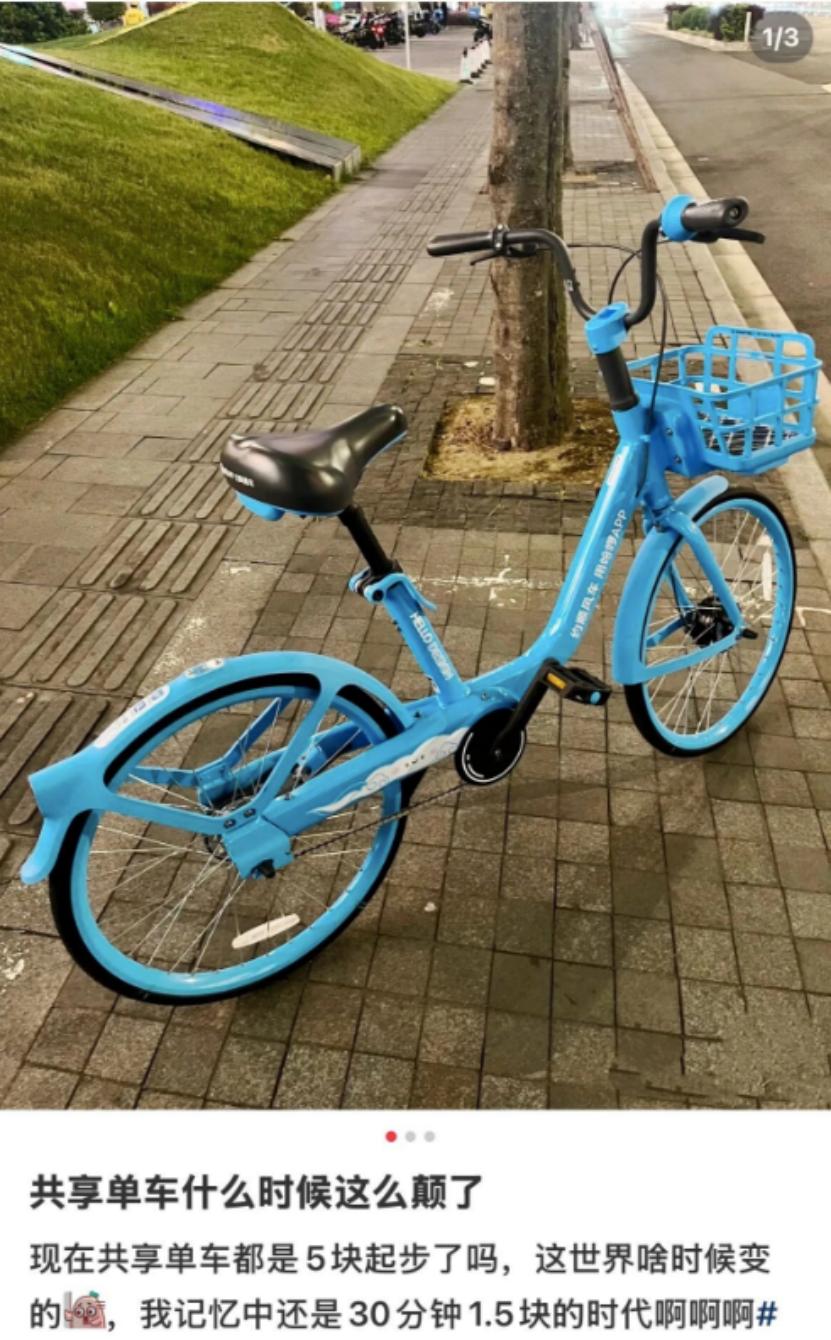
Consumers all over the place are shocked by the "price assassin". (Photo: Xiaohongshu)
Frequent price adjustments and floating billing standards have turned shared bikes into a dynamic market situation that almost everyone in urban life has to face.
What's more ironic is that when office workers forget to set their alarm clock on a make-up workday, scan a shared bike right before being late, and pant their way to the downstairs of the company, they will find out: this daily commute buddy that accompanies you every day will not accompany you for the make-up work arrangement.
In the billing schedule of shared bikes, it does not recognize the make-up workdays arranged for office workers, but only follows the price calendar of the platform: statutory small long holidays are holidays, and weekends used to make up for holidays are also holidays.
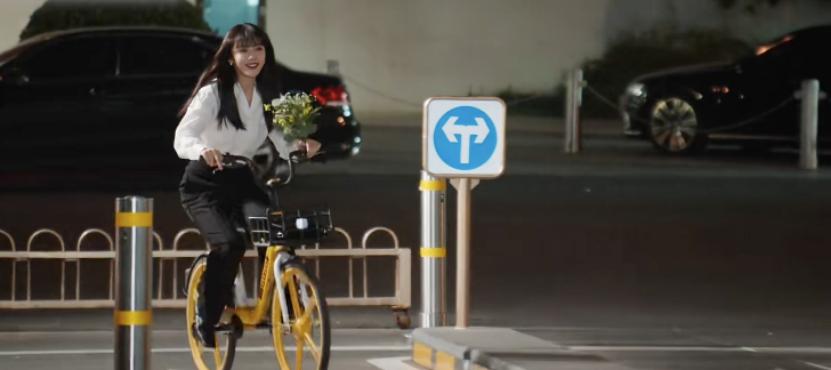
Shared bikes do not believe in make-up workdays. (Photo: *Fake It Till You Make It*)
What? You say shared bikes have betrayed the laborers?
Sorry, shared bikes are just strictly following the opening and closing rules of the stock market. After all, the A-share market does not need to make up for holidays.
03
"Sorry,
I won't renew this pass"
The frequent adjustment of billing standards for shared bikes is not new.
The topic #Shared Bikes Are Almost Too Expensive to Ride# sparked discussions on Weibo back in 2022. But in fact, as early as 2019, the first wave of price hikes had already begun. In April of that year, Bluegogo (the predecessor of Qingju Bike) and Mobike (the predecessor of Meituan Bike) took the lead in adjusting the billing rules in Beijing: 1 yuan for riding within 15 minutes, and an additional 0.5 yuan for every 15 minutes after exceeding 15 minutes. Shortly after, Hello Bike also announced to follow up, adjusting the billing rule to "1 yuan per 15 minutes". At the same time, cities like Shanghai also raised the starting price to 1.5 yuan one after another.
Since then, the billing rules of shared bikes have been continuously refined. From distinguishing weekdays, weekends and holidays to further dividing peak hours in the morning and evening, a set of precise pricing algorithms has been formed behind the billing standards.
Amid various complex billing standards, office workers who have rigid demands for commute connections finally feel exhausted. When shared bikes were first born, their prominent selling point was to solve the "last mile" problem at a low price. More and more frequent price hikes force them to re-calculate the cost performance of shared bikes.