China's auto exports are skyrocketing at a blistering pace, and another major province has joined the fierce competition.
In the first seven months of this year, China's auto exports have delivered an impressive performance: total exports reached 6.399 million units, representing a year-on-year increase of 53.7%. Among them, monthly exports in June exceeded the 1 million unit mark for the first time, and hit 1.092 million units in July, staying above the 1 million unit level for two consecutive months.
The industry generally forecasts that China's auto exports will exceed 10 million units for the first time in 2026. Cui Dongshu, Secretary-General of the China Passenger Car Association (CPCA), gave a more positive judgment to Urban Evolution: based on last year's 8.324 million units, this year's export volume may directly hit 12 million units.
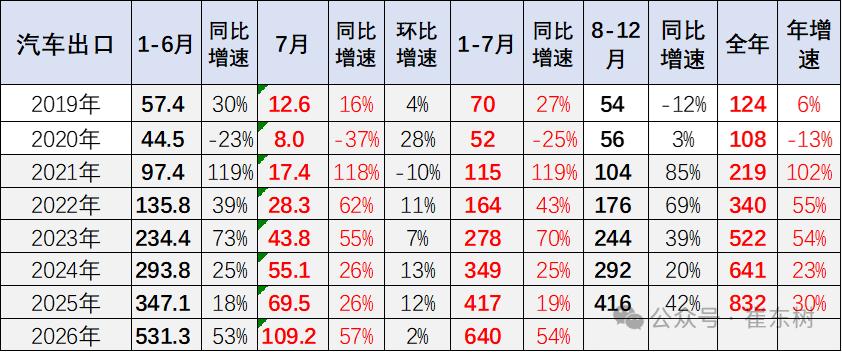
Annual auto export data over the years
This high-potential incremental market is becoming the new strategic priority for major auto-producing provinces —
On August 21, Yang Xian, Deputy General Manager of FAW-Volkswagen Jetta, revealed at the Chengdu International Auto Show that Jetta will lay out overseas markets as soon as possible, and its new vehicles have already been exported to Uzbekistan and Kazakhstan. This local brand jointly established with Sichuan state-owned capital participation is one of the main forces driving Sichuan's auto exports.
On August 20, Dongfeng Peugeot Citroen Automobile Technology (Wuhan) Co., Ltd. was officially inaugurated. With a total investment of about 8.2 billion yuan from six parties including Dongfeng Peugeot Citroen Automobile, Dongfeng Motor Group, Stellantis Group, and provincial, municipal and district state-owned capitals, the company will launch at least 4 new energy vehicle models for the global market by 2027.
According to news on August 19, Chery Automobile will set up a passenger vehicle R&D center in the UK to further expand its business in the British market.
At the same time, Guangdong is accelerating overseas expansion relying on BYD and GAC, Shanghai is stabilizing its basic export market with support from Tesla and SAIC Motor, and Anhui has achieved globalization breakthrough for its independent brands through Chery... An all-out "global expansion race" has been fully launched.
01
Major Provinces' Strategic Shift
34 years ago, Dongfeng and France's Citroen jointly established Dongfeng Peugeot Citroen Automobile Co., Ltd., which directly gave birth to the Wuhan Economic and Technological Development Zone.
At that time, Fukang, Santana and FAW-Volkswagen Jetta were still the most popular "three iconic models" in China's auto industry, and Wuhan, Shanghai and Changchun all enjoyed their respective heyday.
Today, Dongfeng Peugeot Citroen Automobile has recorded a cumulative sales volume of 6.5 million units, reaching its peak of 710,000 units in 2015. However, the situation took a sharp downturn afterwards, with sales dropping to only 52,000 units in 2025.
This was almost the starting point of the decline of Hubei, a major auto-producing province. In 2021, Hubei's auto output reached 2.099 million units, accounting for about 7.91% of the national total, second only to Guangdong, Shanghai and Jilin. However, with the sweeping wave of new energy vehicles, traditional major auto-producing provinces generally saw a decline. By 2025, Hubei's auto output stood at 1.514 million units, ranking 10th nationwide.
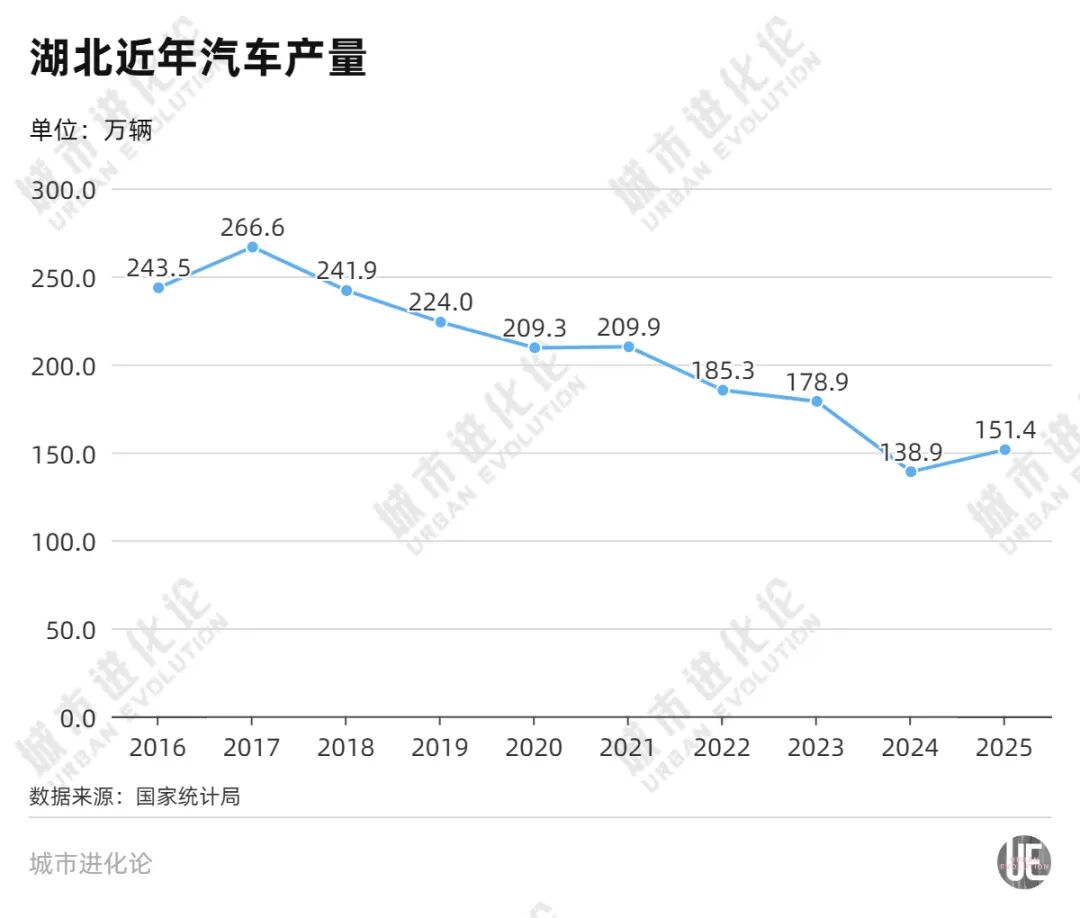
In the first half of this year, Hubei's auto output was 606,900 units, and for the first time it was squeezed out of the top 10 nationwide by Hunan. Against this backdrop, the inauguration of Dongfeng Peugeot Citroen Technology sends an extraordinary signal —
Data shows that three local state-owned entities, Yangtze River Industry Group, Wuhan Financial Holdings Group and Economic Development Zone Industrial Investment Group, hold a combined stake of nearly 48.8%, while Dongfeng Motor Group and Stellantis each hold about 25.6% of the stake in Dongfeng Peugeot Citroen Technology after equity penetration.
This is not a simple restructuring of an automobile enterprise, but a restructuring of production relations. According to the currently announced cooperation plan, Dongfeng will lead the core technologies of new energy and intelligent connected vehicles, while Stellantis will provide the Jeep and Peugeot brands, classic designs and global marketing networks.
In other words, new models will be developed in Wuhan, manufactured in Hubei, and then sold to the whole world through Stellantis' channels. From 2027 onwards, Dongfeng Peugeot Citroen Technology will successively launch 4 brand-new new energy vehicle models under the Jeep and Peugeot brands, which will strongly promote the transformation of Hubei's automobile industry.
"This is a very good growth opportunity." Cui Dongshu believes that Dongfeng Peugeot Citroen has been facing relatively high operating pressure in recent years, and exports are a good breakthrough point, which is expected to bring huge market increment and help ease its operational pressure.
At the inauguration ceremony, Liu Ziqing, Member of the Standing Committee of the Wuhan Municipal Party Committee and Secretary of the Working Committee of Wuhan Economic and Technological Development Zone, said that the zone now has 10 complete vehicle enterprises, 14 complete vehicle factories and more than 1,400 auto parts enterprises, with the output of new energy vehicles accounting for 54.4%. The launch of Dongfeng Peugeot Citroen Technology will further strengthen the cluster effect and promote the Auto Valley to evolve into a world-class auto valley.
This will also support Hubei in building the national-level "Wuhan-Xiangyang-Shiyan-Suizhou" automobile industry cluster, driven by the two wheels of "independent brands + new-type joint ventures" to achieve the goal of building a trillion-yuan-level automobile industry.
02
Growth Engine
"I think exports are a huge opportunity for automakers. Those that do not go global may be eliminated." Cui Dongshu believes that competition in the overseas automobile market is relatively moderate, especially in the Global South markets that previously lacked effective supply. Combined with factors such as high oil prices, Chinese automakers have very prominent advantages in intelligence and electrification.
This is also an important factor driving both established automakers and new forces to expand overseas. CPCA data shows that in the first half of 2026, three Chinese automakers, BYD, Geely and Chery, ranked among the top 10 in global automaker sales rankings, at 3rd, 7th and 9th place respectively.
Without exception, overseas markets are their most important growth engines. In the first half of this year, BYD, Geely and Chery sold 1.809 million, 1.423 million and 1.358 million units respectively, of which exports accounted for 43%, 33% and 69.5% respectively.
At present, independent brands such as SAIC Motor, Changan Automobile and Great Wall Motors are also accelerating the expansion of their overseas footprints. SAIC Motor has deep presence in Europe, Southeast Asia and South America, Great Wall Motors focuses on Southeast Asia and Latin America with its factories in Thailand and Brazil as pivots, and Changan Automobile mainly targets the ASEAN new energy vehicle market.
Of course, new forces such as Xpeng, NIO and Li Auto have also successively entered overseas markets including Europe and Southeast Asia to find new growth curves.
This trend not only profoundly affects the development of automakers, but also touches the "economic lifeline" of major auto-producing provinces. In the first half of 2026, the top 10 provinces by automobile output are Anhui, Guangdong, Zhejiang, Jiangsu, Chongqing, Shandong, Shanghai, Henan, Beijing and Hunan.
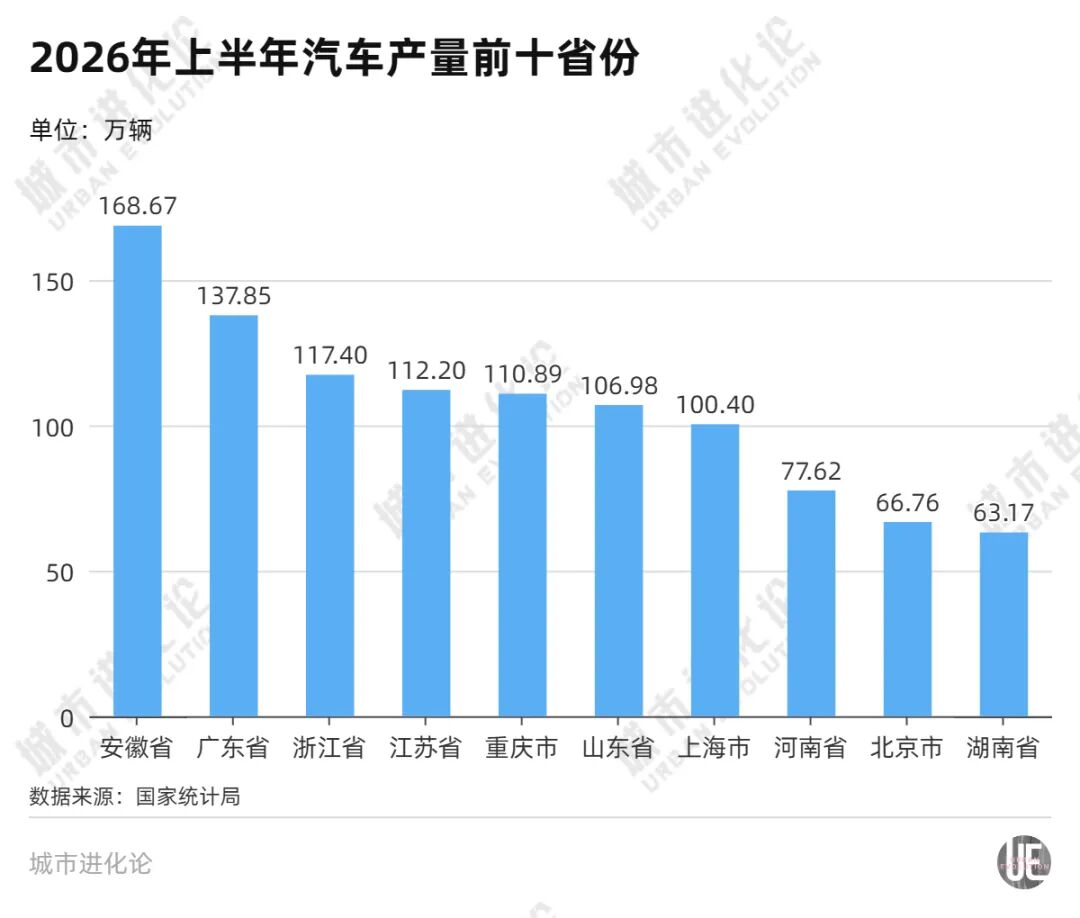
Among them, the rankings of Anhui, Zhejiang, Jiangsu and Hunan have risen by 7, 12, 5 and 8 places respectively compared with ten years ago, making them the biggest winners in the pattern change.
This is largely attributed to the two-way drive of new energy vehicle transformation and export growth, with Anhui and Hubei delivering particularly outstanding performance.
CPCA data shows that from 2021 to 2025, Anhui's automobile output climbed from 1.5 million units to 3.69 million units, representing a 146% increase, among which the proportion of new energy vehicles rose from 16.8% to 48.62%; Hubei's automobile output fluctuated and declined from 2.1 million units to 1.51 million units, while its new energy vehicle output rose from 149,800 units to 824,000 units, with the proportion increasing from 7.13% to 54.57%.
At the same time, Anhui's automobile exports increased from 240,000 units in 2021 to 1.23 million units in 2025, while Hubei's automobile exports rose from 60,000 units in 2021 to 200,000 units in 2025. Both have achieved very significant growth, but their scales are no longer at the same level.
The divergence behind this lies in that Anhui's automakers represented by Chery entered overseas markets very early, forming a complete system covering product R&D, international certification, sales and service networks. In contrast, the joint venture brands that Hubei relied on in the past mainly served the domestic market, and the global distribution channels of Dongfeng's independent brands had shortcomings.
03
New Opportunities
In fact, the restart of Dongfeng Peugeot Citroen Automobile is not only the transformation of Hubei's automobile industry, but also a shift in the development model of joint venture vehicles. Over the past years, joint venture vehicles followed the path of "exchanging market access for technology", but now more and more technologies and supply chains are going global with the help of "brands and channels".
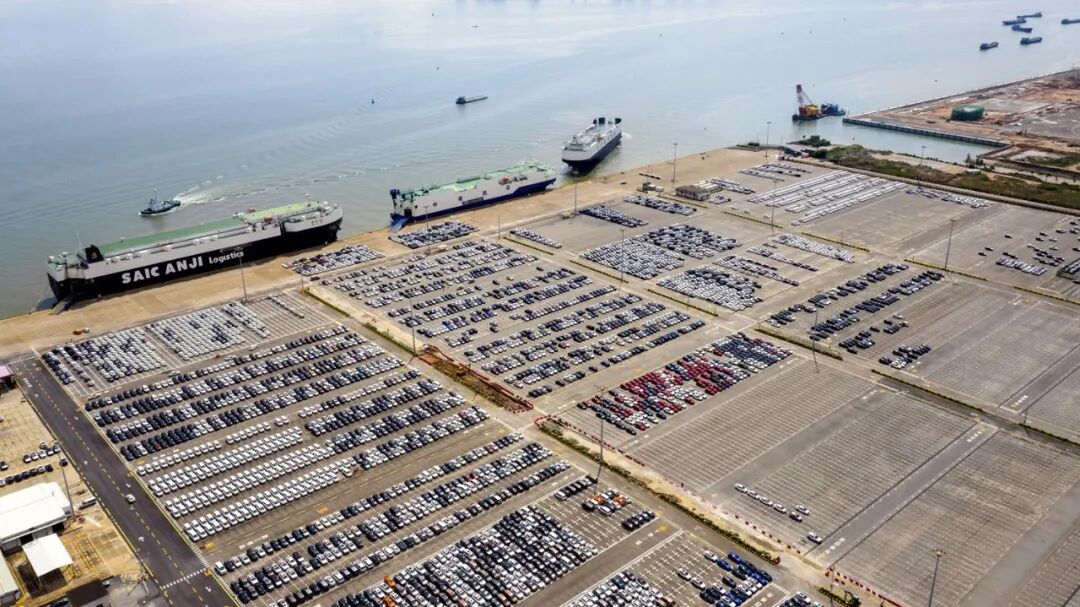
Image source: Shetuwang_501786334
Not only Hubei, Sichuan has made explorations even earlier. In January this year, the launching ceremony of FAW-Volkswagen Jetta Automotive Technology Co., Ltd. was held in Chengdu, marking the first time that Chengdu has realized the integrated operation of "R&D, production, supply and sales" for local complete vehicle enterprises.
Similar to Dongfeng Peugeot Citroen Technology, Jetta Technology is also jointly funded by state-owned capitals at the provincial, municipal and district levels in Sichuan, representing in-depth collaboration between joint venture brands and local industrial chains.
At this Chengdu International Auto Show, new "Chengdu-made" auto products made a collective appearance, among which the pure electric sedan Jetta M6 featuring "German precision craftsmanship + Chinese technology" and the high-end intelligent model Yijing X9 co-developed by Dongfeng Motor and Huawei Qiankun have drawn widespread attention.
However, with the continuous growth of auto export volume, China's auto exports are also transforming from "complete vehicle export" to "ecosystem export", realizing the all-round output of technology, products, services and brand value. Judging from the "15th Five-Year Plan" outline of various regions, this trend is very obvious —
Anhui: In-depth implementation of the "Anhui Brands Go Global" overseas expansion action and partner program, and foster world-class export-oriented industrial clusters with a scale of hundreds of billions yuan such as the automobile industry.
Guangdong: Actively expand emerging markets including ASEAN, the Middle East, Latin America and Africa, continue to cultivate traditional markets such as Europe, America, Japan and South Korea, and build a number of high-quality export industrial clusters for advantageous industries including automobiles.
Shanghai: Expand the import and export of high value-added products, and enhance the export competitiveness of industries including integrated circuits and automobile manufacturing.
Chongqing: Cultivate world-class automobile brands. Build an international marketing and service network, deeply develop and expand diversified international markets, and promote the transformation of "Chongqing Auto Goes Global" from product export to brand output.
Hubei: Actively promote the quality improvement and scale expansion of exports of advantageous products such as automobiles, and continuously enhance the quality, brand influence and added value of export products.
Shaanxi: Consolidate traditional markets including ASEAN, the European Union, Hong Kong, Macao and Taiwan, expand emerging markets such as Belt and Road co-building countries, RCEP member states, Central Asia and Africa, and stabilize and expand the export scale of products such as new energy vehicles.
Driving the upgrading of the automobile industry ecosystem through exports has become a key development direction for all regions.
In the view of Kang Bo, Vice President of Seres Group, Chinese brands' internationalization goes through "three stages" —
"Getting in": establishing business foundations through trade cooperation; "Moving up": promoting localized production and R&D; "Going global": realizing global output of technical standards and brand value.
From this perspective, the restructuring of Dongfeng Peugeot Citroen and Jetta is only the first step for traditional major auto-producing provinces to transform. When more and more provinces focus on "ecosystem globalization" in the next five years, a new round of competition in the automobile industry has just begun.
This article is from the WeChat official account "Urban Evolution", written by Dan Zhongkui, and authorized for release by 36Kr.