AI has incurred debts at excessively high borrowing costs, so Alibaba has chosen to sell its shares.
Michael Burry, the real-life prototype of *The Big Short* and a well-known investor, is highly dissatisfied with Alibaba's HK$80 billion new share placement.
He stated bluntly on Substack that he cannot endorse Alibaba's decision to issue additional shares, and revealed that he has converted all his previously held Alibaba shares into JD.com holdings. Burry is concerned that if continuous increases in AI investment are not matched by synchronous growth in new profits, the return on invested capital will keep declining. Issuing new shares under such circumstances means existing shareholders will have to bear extra costs from diluted equity.
On August 24, Alibaba's Hong Kong-listed stock once plunged by 10.5%. The core question raised by the market is that as of June 30, 2026, Alibaba still holds RMB 474.505 billion, equivalent to roughly US$69.9 billion in cash and other liquid investments, why does it still need to raise an additional US$10.2 billion (HK$80 billion) in financing?
01
Alibaba Chooses Share Issuance, Nomura Says It Is Beyond Expectation
In its latest commentary on August 24, Nomura Securities pointed out that what truly exceeds market expectations for Alibaba is its financing method. For large tech companies with stable cash flow and strong credit capabilities, debt financing is usually more conducive to protecting the rights and interests of existing shareholders: debt requires interest payments but can be repaid at maturity; equity financing has no fixed interest obligations but permanently dilutes existing shareholders' share of future profits and corporate value.
This time Alibaba chose the latter option, placing 710 million new shares at HK$112.70 per share to raise about HK$80 billion, equivalent to roughly US$10.2 billion. All the funds raised will be used for AI infrastructure and full-stack AI capability building. The newly issued shares account for approximately 3.6% of the enlarged share capital, and the placement price represents an 8.4% discount to the closing price last Friday.
In subsequent analysis, Nomura also tried to explain why Alibaba opted for equity financing.
Nomura estimates that this financing will dilute the ownership of existing shareholders by around 3.7%, which it considers to be within a controllable range. At the same time, the finalization of the financing scale and method eliminates the previous market uncertainty over how much additional financing Alibaba still needs and what tools it will use for the financing.
What Nomura values more is the change in the external financing environment. Since the beginning of this year, global tech companies have continued to expand their capital demand for AI infrastructure, which has altered the supply-demand relationship in the bond market. Nomura notes that the credit spread of tech bonds has widened, new bond issuances need to offer higher yield premiums, and the subscription multiples have also declined. In other words, Alibaba is not incapable of issuing bonds, but the relative attractiveness of debt capital has decreased.
This makes the choices Alibaba faces more pragmatic: if it continues to issue bonds, the company can avoid immediate dilution of shareholders' equity, but it will have to bear higher long-term interest costs and take up the room for future debt raising; if it issues new shares, the cost will be reflected in equity dilution at one time, in exchange for permanent capital that requires no interest payment and has no fixed maturity date.
What Michael Burry, the "Big Short" investor, opposes is that the latter type of cost is transferred to existing shareholders. Nomura believes that against the backdrop of a deteriorating debt financing environment, this choice has become understandable.
From this perspective, Alibaba's this round of financing is not a choice between "cheap equity" and "cheap debt", but a trade-off between two types of capital that are both not low-cost. Which option has a lower final cost depends on how much return the AI investment can generate in the next few years.
If the return on AI projects is sufficiently high, the 3.6% equity sold this year will seem costly; if the realization of returns takes longer, avoiding pushing the balance sheet to high leverage ahead of time also has practical value.
In terms of investor structure, according to foreign media disclosures, this placement received about US$28 billion in orders, of which approximately US$6 billion came from long-only funds and sovereign investors. Eventually, around 40% of the issued shares were allocated to this type of long-term capital, including sovereign wealth funds from Europe, Asia and the Middle East.
This at least shows that while the market is worried about AI investment returns and equity dilution, there are still long-term institutions willing to take on the risks of Alibaba's future AI investments at the current price level.
In a large-scale equity financing of HK$80 billion, Alibaba secured nearly 3 times oversubscription and attracted a large amount of long-only and sovereign capital. For a company that has committed to investing in AI infrastructure for many consecutive years, this move provides a large amount of equity capital with no fixed repayment period. For Alibaba's management, they need to secure the capital required for future operations before the strategic window closes.
Right after the HK$80 billion placement was completed, the management announced an increase in their shareholdings. On August 24, Joe Tsai, Chairman of Alibaba Group, purchased 720,000 shares at an average price of about HK$112 per share, and Wu Yongming, CEO of Alibaba, purchased 350,000 shares at an average price of about HK$111.6 per share. The two of them increased their holdings by a total of 1.07 million shares, investing approximately HK$120 million. This price is almost the same as the placement price of HK$112.70. Compared with the HK$80 billion financing scale, the impact of HK$120 million on the capital structure is very small, but the management's signal is quite clear.
However, there is still one question here: since debt financing has become increasingly expensive, why are US tech giants such as Amazon and Meta still choosing to issue large-scale bonds, and even willing to extend the maturity to 40 years?
02
Bond Issuance Is Costly, US Giants Have Started Borrowing 40-Year Funds
In July this year, Amazon issued US$25 billion in bonds at one go, divided into 8 tranches with maturities ranging from 2029 to 2066. The coupon rates of fixed-rate bonds rose all the way from 4.6% to 6.25%. Calculated based on the size of each tranche, the US$24.25 billion fixed-rate bonds correspond to an annual coupon of about US$1.31 billion, plus an additional US$750 million in floating-rate bonds.
In May this year, Meta also issued US$25 billion in long-term bonds. The coupon rate for the 2031 maturity tranche is 4.55%, and the coupon rate for the 2066 maturity tranche has reached 6.45%, with a total annual fixed coupon of about US$1.43 billion. As of the end of June, Meta still has US$84 billion in outstanding bond principal.
One important reason why these companies choose debt financing is that they believe the return on their AI projects can be significantly higher than the cost of capital. Vishy Tirupattur, Chief Fixed Income Strategist at Morgan Stanley, recently pointed out that one core assumption supporting large Hyperscalers to continue expanding AI capital expenditure is that these projects can eventually generate a return on invested capital of more than 25%. As long as this assumption holds, financing at a cost of 5% to 6% is still an effective leverage.
However, the market is demanding increasingly higher premiums. Neil Sutherland, Head of US Fixed Income at Schroders, described that the credit spread of tech bonds has begun to show "indigestion". The issuance size of AI-related corporate bonds has risen rapidly this year, and the average credit spread of tech bonds relative to US Treasury bonds has widened to about 89 basis points. Some new bonds even need to provide additional new issue concessions to attract investors.
Goldman Sachs Research estimated with a broader statistical caliber that AI-related credit financing including corporate bonds and project financing has approached US$500 billion since the beginning of this year. Amanda Lynam, Head of Credit Strategy, believes that the importance of this round of changes can hardly be overestimated, because the capital market is not facing a short-term bond issuance boom, but a financing cycle that may last for several years.
03
Multiple Financing Methods for AI, "Taking Data Centers Off the Balance Sheet"
As relying solely on parent company debt becomes increasingly difficult to meet the capital demand of AI, tech giants have started to adopt more and more complex financing methods.
Alphabet is looking for different capital pools around the world. On August 19, the company issued Australian dollar-denominated bonds for the first time, raising A$5.5 billion at one go, with maturities ranging from 3 years to 20 years. The 20-year tranche has a coupon rate of 6.9%, and the total orders exceeded A$18 billion.
Previously, Alphabet has entered multiple bond markets including the pound sterling, Swiss franc and Japanese yen markets. Which country has more abundant capital, which currency has lower financing cost, and which investors are still willing to subscribe for tech bonds, have all become part of AI capital allocation considerations.
Meta has spun off some of its data centers from the parent company's balance sheet. In July this year, Meta and BlackRock established a joint venture project worth about US$14 billion for the El Paso data center in Texas. Funds managed by BlackRock hold 80% of the project, and Meta holds 20%. BlackRock plans to invest about US$4.9 billion in cash, and raise US$12.5 billion in debt financing at the project level. Meta contributes land and related assets, and obtains data center capacity through long-term leases.
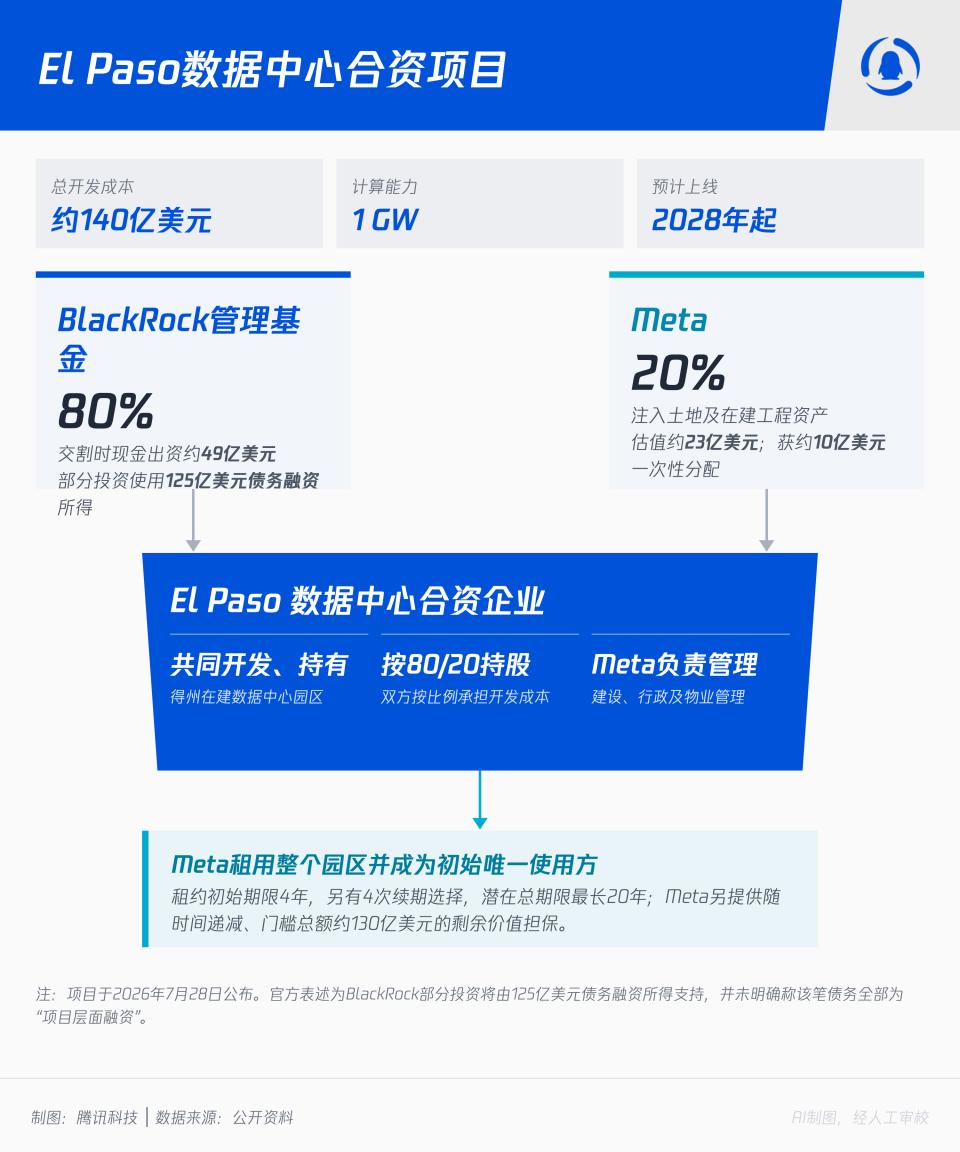
This Project Finance structure is very common in the energy, utilities and real estate sectors, and is now being applied to AI infrastructure. Its significance lies in that the computing power demand of tech companies can grow rapidly, but the parent company's balance sheet cannot expand infinitely.
After data centers are separated into independent assets, infrastructure funds, insurance capital, pension funds and bond investors can all participate in the financing, and tech companies can lock in the right to use the capacity through long-term leases and capacity procurement agreements.
Oracle has taken more extreme measures. To catch up with the AI cloud demand, it raised a total of about US$48 billion through debt and equity in the 2026 fiscal year, while its free cash flow gap reached US$23.7 billion. Under financing pressure, Oracle has begun to require some large customers to prepay for GPU procurement funds, or allow customers to purchase GPUs by themselves and then hand them over to Oracle for operation. It even explicitly stated that this structure can significantly reduce the amount of capital it needs to raise.
Therefore, the funding sources for AI infrastructure have rapidly expanded from tech companies' own operating cash flow to corporate bonds, global local currency bonds, project financing, infrastructure funds, customer prepayments and the equity market.
In its 2026 investment outlook, Goldman Sachs Asset Management reminded that in the stage of sustained high capital expenditure, to assess the risk of a tech company, more and more attention should be paid to whether its original core business can still generate sufficiently strong cash flow continuously.
This is also why the market has different levels of tolerance for Amazon, Meta and Oracle to take on new debt.
04
AI Is Changing the Capital Allocation Priorities of Tech Companies
There is another layer of change behind Alibaba's this placement.
In the past few years, after large internet companies including Alibaba had abundant cash reserves, one important capital allocation direction was share repurchase. The underlying logic is that mature businesses generate large amounts of free cash flow, so companies return cash to shareholders, while reducing outstanding share capital and increasing earnings per share.
Now Alibaba is raising HK$80 billion in capital for AI infrastructure through new share issuance. This does not mean that Alibaba has abandoned share repurchases, but it at least indicates that in the stage of rapidly expanding AI investment, growth investment has been given higher priority.
This change is not unique to Alibaba. Apollo forecasts that the cumulative capital expenditure of Hyperscalers from 2025 to 2029 may exceed US$2.7 trillion. As the scale of investment expands, external capital will play an increasingly important role in AI infrastructure construction.
As AI moves from the model competition stage to the long-term infrastructure investment stage, the competitiveness of tech companies will also depend on how much capital they can obtain and what cost they have to pay for the capital.
The divergence in the capital market will also become more and more obvious.
This article is from the WeChat official account "Tencent Tech", Author: Xiao Jing, Editor: Xu Qingyang, Published with authorization from 36Kr.