Projected to post a loss of 10 million yuan in the first half of the year, Wen Tou Holdings purchases cinemas against the market trend: Is it bottom-fishing or an added burden?
Recently, Wentou Holdings has issued two consecutive cinema acquisition announcements.
The company's wholly-owned subsidiary Hongshu Media plans to acquire 100% equity of two cinemas for a total of 6.7571 million yuan, including 2.6383 million yuan for Yutian Xinyinglian Phoenix Cinema and 4.1188 million yuan for Huailai Xinyinglian Cinema. This was not unusual a few years ago, but in the current cycle when the entire theater chain industry is generally contracting and small and medium-sized cinemas are actively looking for buyers, the signal released by Wentou Holdings' move is undoubtedly thought-provoking.
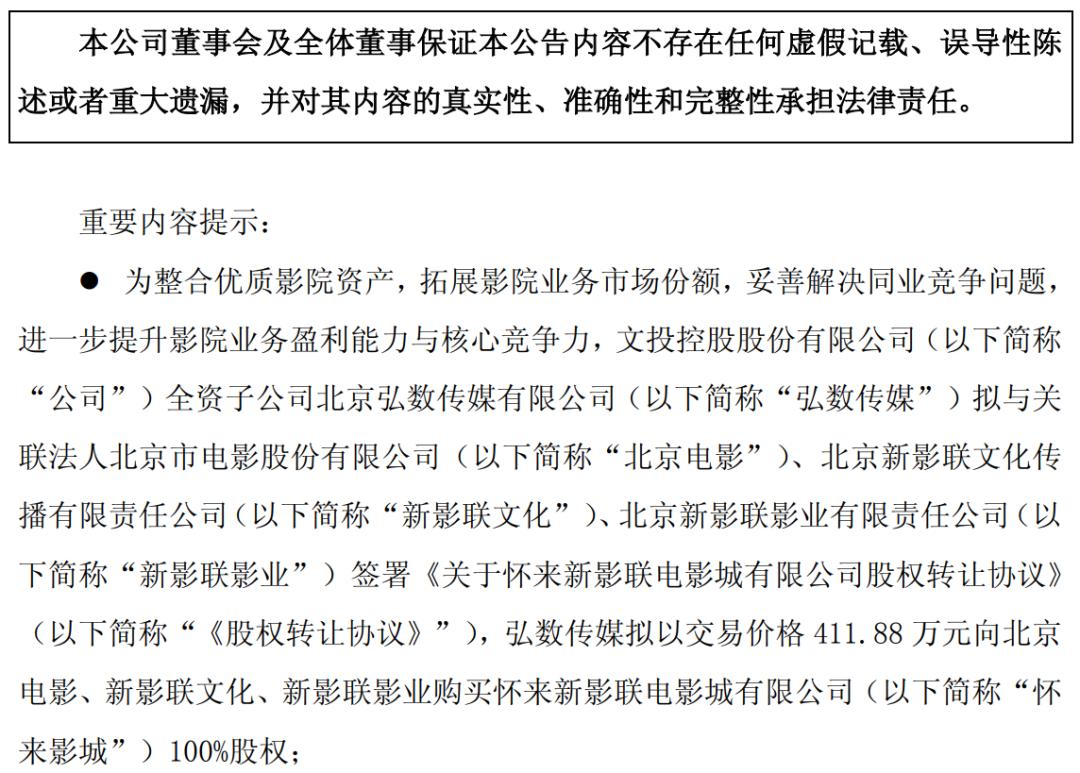
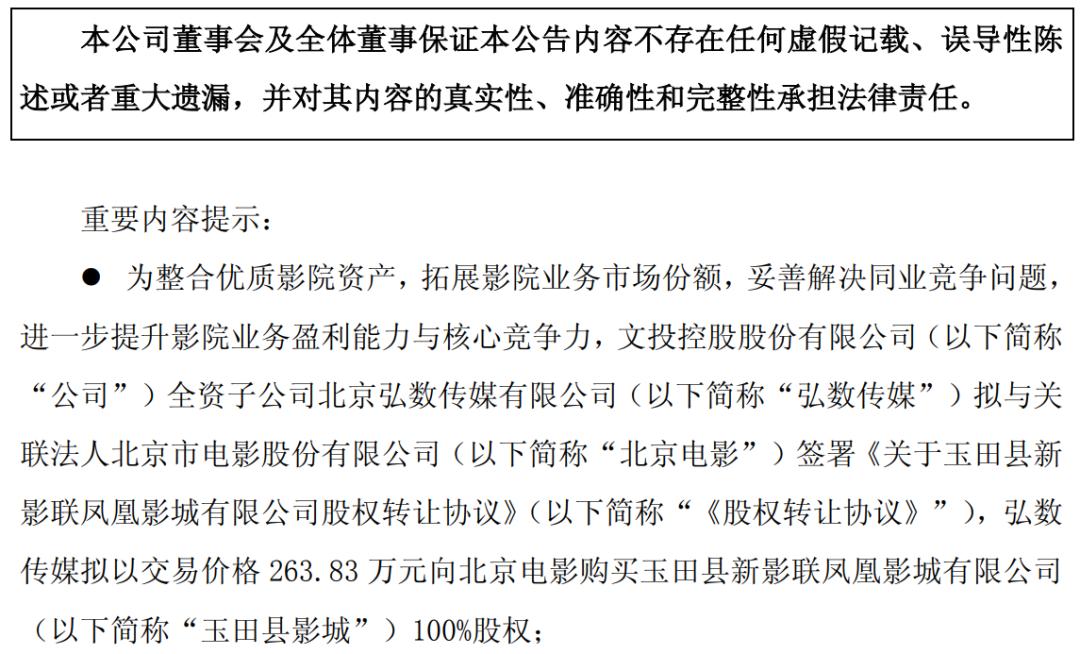
What is more noteworthy is the timing of the announcement. Just one month ago, Wentou Holdings just disclosed its performance pre-loss announcement for the first half of 2026, predicting that the attributable net profit will be a loss of 15 million yuan to 20 million yuan, while it still made a profit of 4.5277 million yuan in the same period of the previous year. Why would a company that has just gone through judicial reorganization, turned from profit to loss in the first half of the year, and whose stock price has been hovering below 2 yuan for a long time, choose to acquire cinema assets at a critical moment when its own operation is under pressure?
This is precisely the most thought-provoking part of reverse expansion. In the past few years, cinema assets have experienced a roller coaster ride from being extremely sought-after to being deserted. Around 2016, Wanda, Perfect World, Poly and other enterprises entered the theater chain sector on a large scale, and the transaction valuation in the cinema M&A sector once remained at a high level for a long time.
Nowadays, the growth of box office in the industry is weak, the growth rate of screens far exceeds the growth rate of moviegoers, and the output per screen continues to decline. Cinema assets are undergoing a long process of value revaluation. But it is precisely at the bottom of such a cycle that a company that has just got rid of its historical burdens chooses to take action against the trend.
From "Survival by Cutting Losses" to "Bottom Position Covering":
The Contradictory Expansion Logic of a Reorganized Enterprise
To understand the logic behind Wentou Holdings' acquisition, we must first see what the company has experienced to get to where it is today.
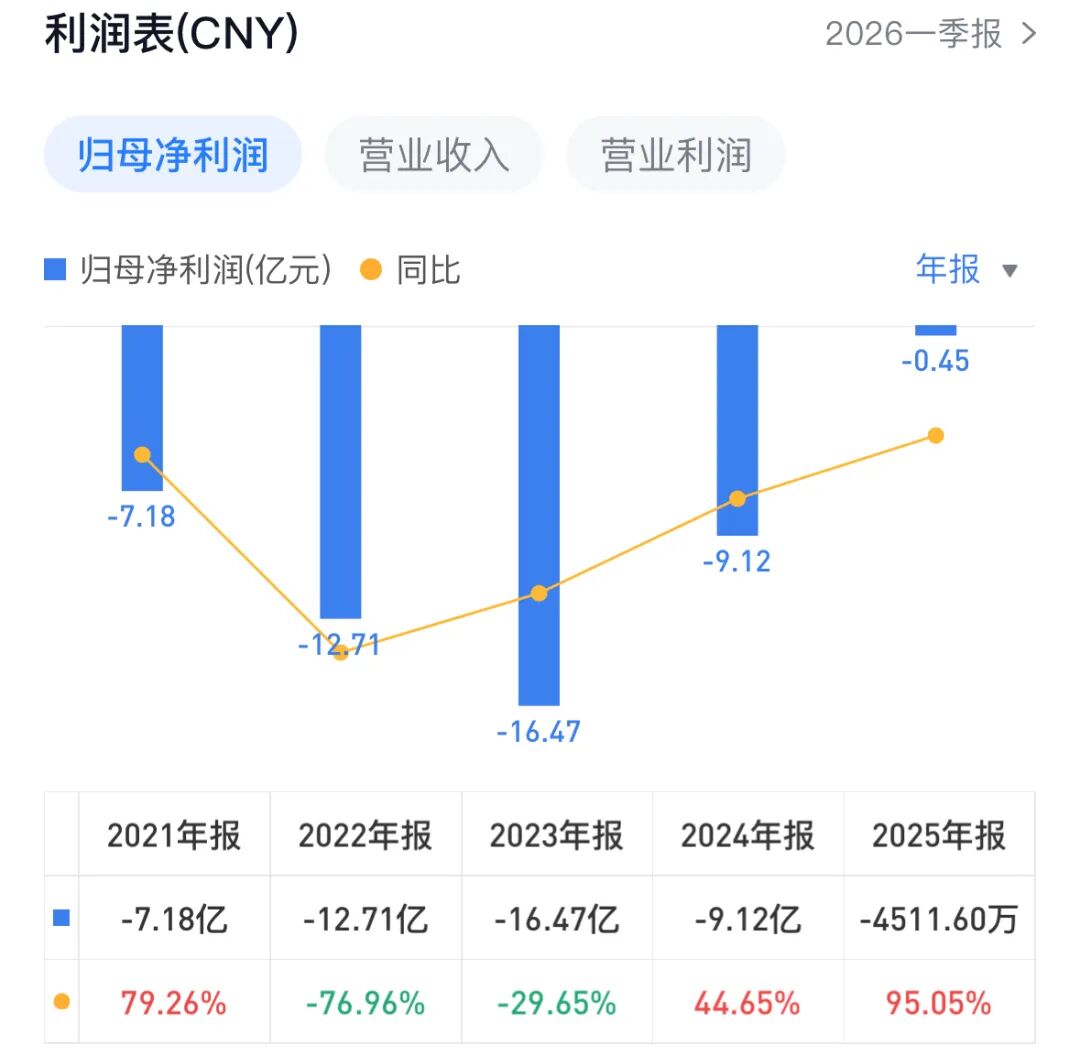
At present, the new controlling shareholder of Wentou Holdings is the Capital Culture and Technology Group under the Beijing Municipal State-owned Assets Supervision and Administration Commission. The company is currently fully promoting the in-depth transformation of "culture + technology", focusing on the integrated development of "films, dramas and games". However, before 2024, the company was overwhelmed by huge debts and consecutive years of losses. It recorded large losses for three consecutive years in 2022, 2023 and 2024, among which the attributable net loss in 2024 was as high as 1.647 billion yuan.
On February 19, 2024, creditors applied for reorganization of Wentou Holdings on the grounds that the company was unable to pay off its due debts. On February 29, Wentou Holdings announced that the equity held by its indirect controlling shareholder Beijing Cultural Capital Holdings Co., Ltd. will be transferred free of charge to the State-owned Assets Supervision and Administration Commission of the Beijing Municipal People's Government, and the actual controller is proposed to change. After the state-owned capital took control, Wentou Holdings completed judicial reorganization at the end of 2024 and got rid of its debt burden.
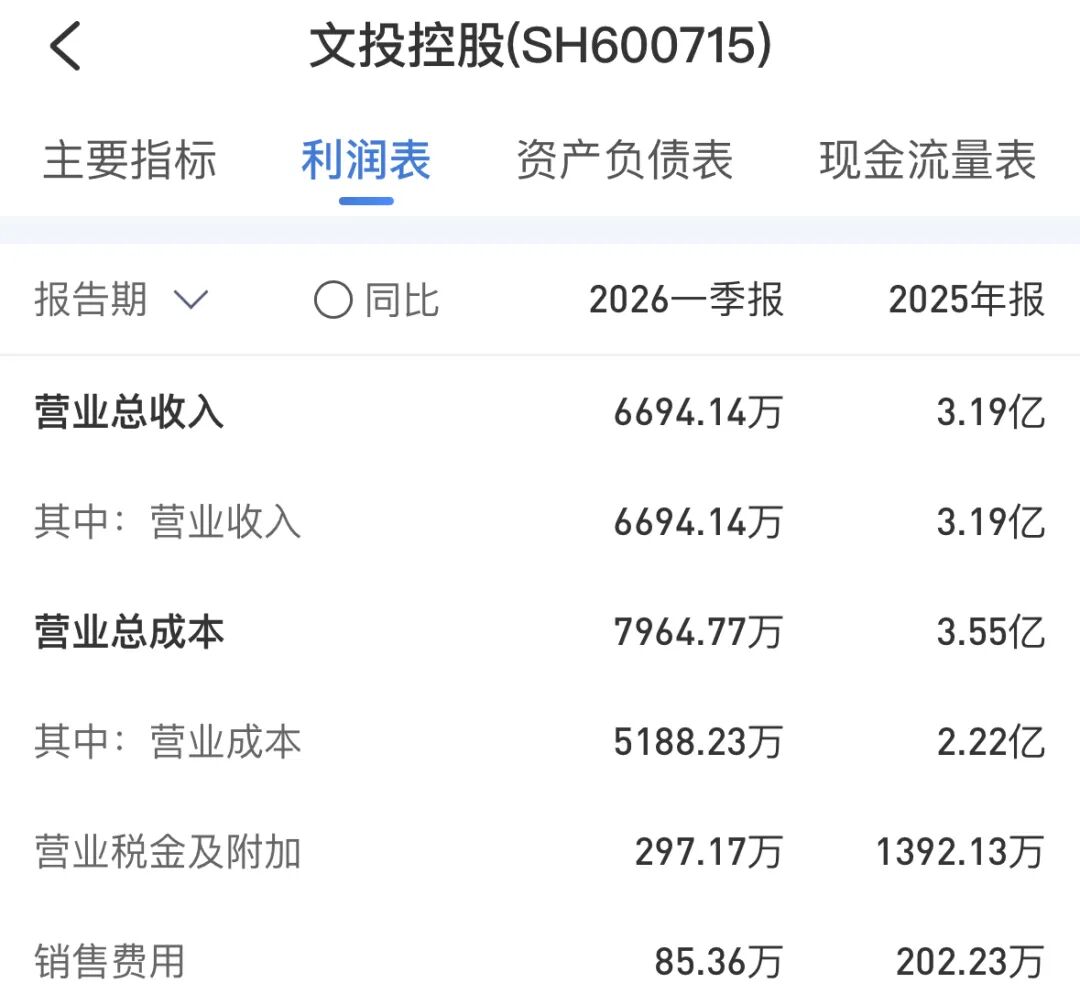
However, judicial reorganization only solved the problem of "survival", not the problem of "thriving". In 2025, Wentou Holdings' revenue reached 319 million yuan, down 19.59% year on year; its attributable net loss was 45.116 million yuan, which was a significant reduction compared with the loss of 912 million yuan in the same period of the previous year. One of the important reasons for the revenue decline is that the company actively closed some inefficient cinemas during the reorganization period, reducing the number of operating cinemas from 34 to 23, cutting off unprofitable stores first, shrinking its business lines to ensure survival.
However, in 2026, the situation changed again. The main revenue in the first quarter was 66.9414 million yuan, down 48.89% year on year. The attributable net profit for the first half of the year is expected to be a loss of 15 million yuan to 20 million yuan, compared with a profit of 4.5277 million yuan in the same period of the previous year, marking a turn from profit to loss. The company explained that the overall performance loss was caused by the sharp decline in the national movie box office, the increase in R&D investment in new games, and the fact that the comic drama projects have not yet achieved large-scale commercialization.
This is the fundamental situation when Wentou Holdings announced the two acquisitions. Why would a company that has not yet got out of the predicament take reverse action and shift from "subtraction" to "addition"? The answer is hidden in the wording of the announcement: "to integrate high-quality cinema assets, expand the market share of cinema business, properly solve the problem of horizontal competition, and further improve the profitability and core competitiveness of the cinema business". Three key points in it are worth analyzing.
The first point is "integrating high-quality cinema assets". The several transaction parties including Beijing Film, Xinyinglian Culture and Xinyinglian Film are legal persons outside the listed company system controlled by Capital Culture and Technology Group, the actual controller of Wentou Holdings, which constitutes a connected transaction, and its essence is to sort out and integrate cinema resources within the group.
The second point is "expanding the market share of cinema business". Acquiring high-quality locations at extremely low prices during the industry trough is the common logic of all reverse expanders. The third point is "properly solving the problem of horizontal competition", which may be the most realistic driving force for this acquisition. The horizontal competition problem between connected parties needs to be solved, and the solution is to complete asset integration when the price hits the bottom.
Therefore, these two acquisitions are not so much active attacks as the combination of "have to do it" and "the price is just cheap". A company that has just completed judicial reorganization not only needs to solve historical legacy problems by integrating connected assets, but also needs to supplement high-quality cinemas at low positions to offset the scale shrinkage caused by the previous closure of inefficient cinemas. Acquiring assets at low positions and realizing their value when the market picks up.
Of course, the risks are also obvious. In the first half of 2026, the national box office reached 17.354 billion yuan, down 40.4% compared with the same period last year. Wentou Holdings also frankly admitted in the announcement that after the transaction is completed, it still faces risks such as "intensified market fluctuations, insufficient integration and synergy, and the development of innovative formats falling short of expectations". If the assets purchased at low prices cannot be value-enhanced through operation, no matter how cheap the acquisition is, it will become a burden.
Wanda Changed Hands, Hengdian Set Up New Facilities:
The Capital "Catchers" in the Industry Trough
To understand the industrial positioning of Wentou Holdings' two acquisitions, we must first look at the fluctuation of cinema asset valuation in the past seven or eight years.
In February 2018, Alibaba and Wentou Holdings signed a strategic investment agreement with Wanda Group, acquiring 12.77% of Wanda Film's shares held by Wanda Group at a price of 51.96 yuan per share. Among them, Alibaba invested 4.68 billion yuan to acquire 90 million shares, accounting for 7.66% of the total share capital of Wanda Film; Wentou Holdings invested 3.12 billion yuan to hold 5.11% of the shares. At that time, Wanda Film had 516 directly-operated cinemas and 4571 screens, accounting for about 14% of the national movie box office market share.
That was the peak of cinema asset valuation, and capital was willing to pay a high premium for the growth expectation of industry leaders. However, by May 2025, Wanda Film's stock price had fallen to 10.66 yuan per share, and Alibaba's entry price of 51.96 yuan per share had shrunk by nearly 80%. In 2024, Wanda Film recorded an attributable net loss of 940 million yuan. Even the industry leader is in such a situation, and the situation of small and medium-sized cinemas is even more difficult.
It is this systematic collapse of valuation that provides the soil for reverse layout. If we broaden our vision from Wentou Holdings, we will find that it is not an isolated case, and there are far more players integrating cinema assets in the industry trough.
The most notable case is Ruyi's acquisition of Wanda Film. In July 2023, Shanghai Ruyi acquired 49% equity of Wanda Investment for 2.262 billion yuan. In December, Wang Jianlin transferred the remaining 51% equity of Wanda Investment for 2.155 billion yuan. China Ruyi indirectly obtained 20% equity of Wanda Film for a total of 4.417 billion yuan and became the actual controller, which is a typical bottom-of-cycle acquisition.
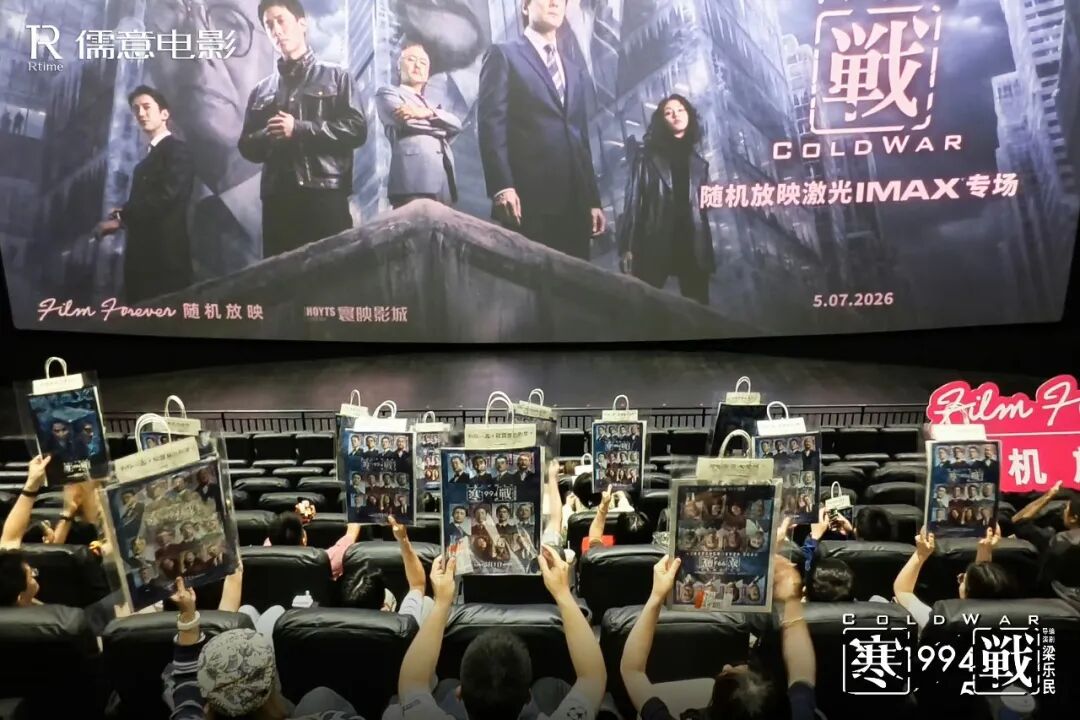
Hengdian Pictures is also increasing its layout. In June 2025, Hengdian Pictures announced that it plans to jointly invest with its wholly-owned subsidiary Hengdian Pictures to establish Zhejiang Hengdian Giant Cinema Development Co., Ltd., engaged in cinema project investment and management. As the second largest cinema investor in China, Hengdian Pictures is deeply rooted in the third- and fourth-tier cities and county markets. In 2025, it achieved operating revenue of 2.298 billion yuan, a year-on-year increase of 16.55%, and an attributable net profit of 159 million yuan, turning losses into profits year on year. The intention of setting up a special cinema investment platform during the industry trough is clear.
State-owned capital players are also taking action. In December 2025, Jishi Media and Changying Group reached capital cooperation on film and theater chain business, and Jishi Media further released the equity of its subsidiary Jishi Cinema Investment to Changying Group. Previously, Changying Group had completed the resource integration of Jishi Cinema and Jilin Provincial Rural Cinema under Jishi Media, which is an integration path extending from provincial radio and television to film and theater chains.
China Film, which continues to promote the transformation from cinema investment to cinema management, is also making layouts. In March 2025, China Film invested in establishing Changsha China Film Huashengrong Cinema Co., Ltd. in Changsha with a registered capital of 19 million yuan. By the end of 2025, China Film had 121 operating holding cinemas and 914 screens in total. As the national team, every step of China Film's expansion has the meaning of industrial guidance.
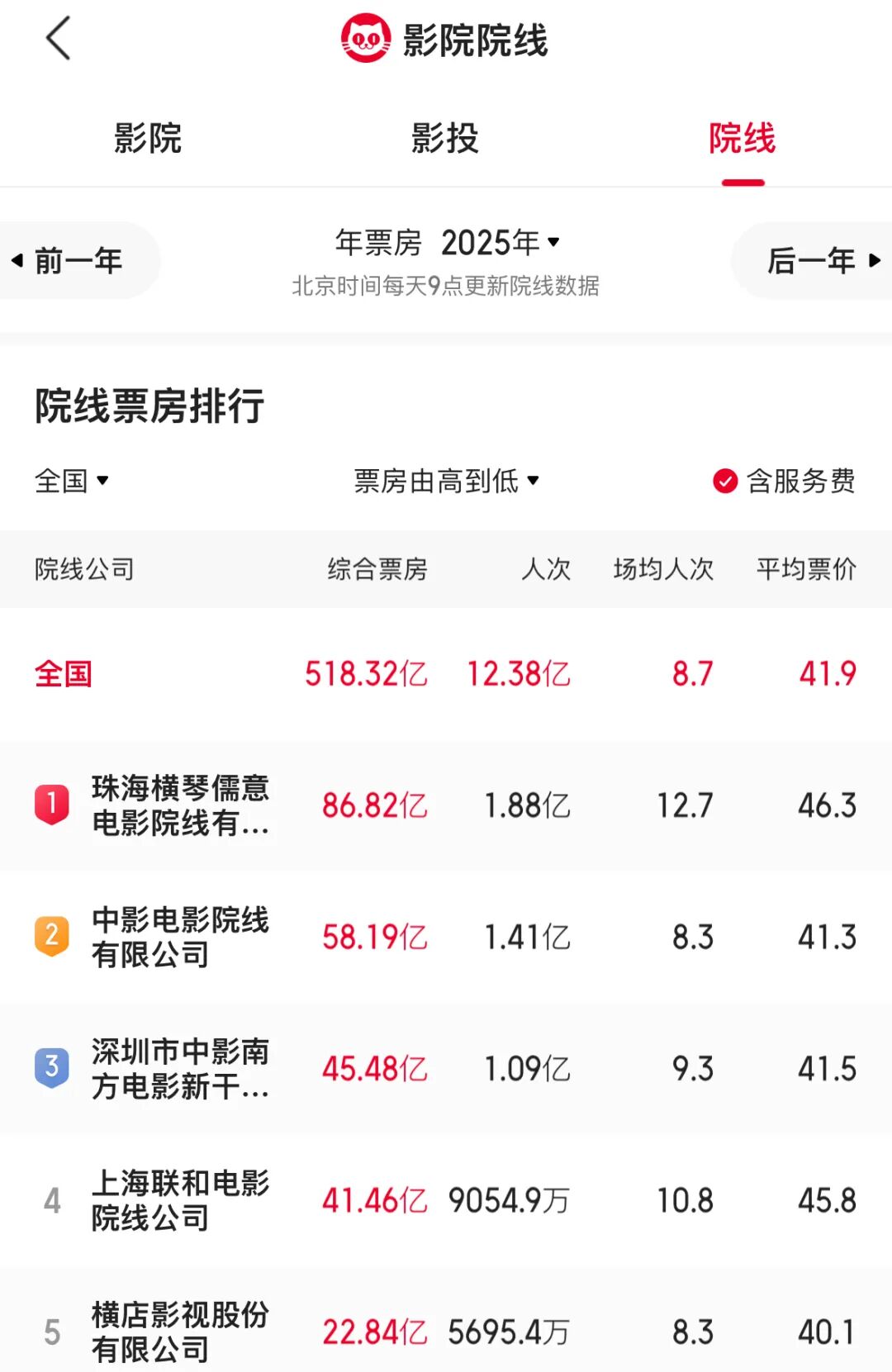
Shanghai Film is making efforts on another path. In September 2025, Shanghai Film completed the acquisition of minority shareholders' equity of its holding subsidiary Shangying Yuan Cultural Technology Development Co., Ltd., acquiring 14% and 5% equity held by Shanghai Film Group and Shanghai Animation Film Studio for 48.79 million yuan and 17.43 million yuan respectively, increasing its shareholding ratio to 70%. Shanghai Film's strategy is "IP development and operation", which feeds back the screening end by strengthening the control of the content end, instead of adopting a pure scale expansion route.
These cases together present a clear pattern. Industry leaders consolidate or even expand their positions at low positions, regional players integrate local resources, and the national team carries out strategic layouts. Cinema assets in the trough are being revalued and redistributed by capitals of different backgrounds. The essence of reverse expansion is cross-cycle allocation. If the industry can pick up, these assets obtained at low positions can bring excess returns.
The Anxiety and Breakout of 80,000 Screens:
Cinemas Are No Longer Just "Places for Screening Movies"
In the past, the core logic of theater chain competition was scale. The more stores and screens you have, the more advantages you can occupy in film scheduling and revenue sharing, but now this logic is failing.
In the first half of 2026, the total number of national screens exceeded 80,000, and the number of screenings reached 73.296 million, setting a new record for the number of screenings in the first half of the year in film history. However, the total box office in the same period was only 17.354 billion yuan. The more screenings, the more the average revenue per session is diluted. The growth model driven solely by increasing the number of screens has come to an end. Scale is an admission ticket, but it is no longer the decisive factor for victory.
As a result, theater chain companies have begun to shift from "quantitative expansion" to "qualitative operation". In June 2025, Ruyi Pictures released the "Super Entertainment Space" strategy. Chen Zhixi, the chairman, clearly proposed that "we should not rely on single box office revenue, but continuously drive the growth of non-box office income". Cinemas are no longer just places for screening movies, but have become urban-level public cultural and leisure landmarks that are "playable, strollable and social". Since then, Ruyi has fully implemented five revenue sectors of "movie viewing + characteristic catering + trendy cultural and creative products + offline activities + venue leasing" in its 33 directly-operated cinemas in Zhejiang.

In terms