iQIYI, it's time to make Nadou Pro independent.
Recently, iQiyi held a creator conference in Beijing.
More than 2,000 AIGC creators and industry partners attended the event on site, and hundreds of creators from Shanghai, Guangzhou, Chengdu, Wuhan and Wuxi also participated through live broadcast sub-venues. Although the name of the conference did not include the word "AI", AIGC was the real protagonist of the event judging from the participants, released content and support policies.
iQiyi introduced Nado Pro, which has iterated more than 200 functions in the past three months, and also released a talent pool, commercial order market, digital asset trading platform and Skill Store. At the same time, the point recharge, model invocation and commercial service system around Nado have also taken shape step by step.
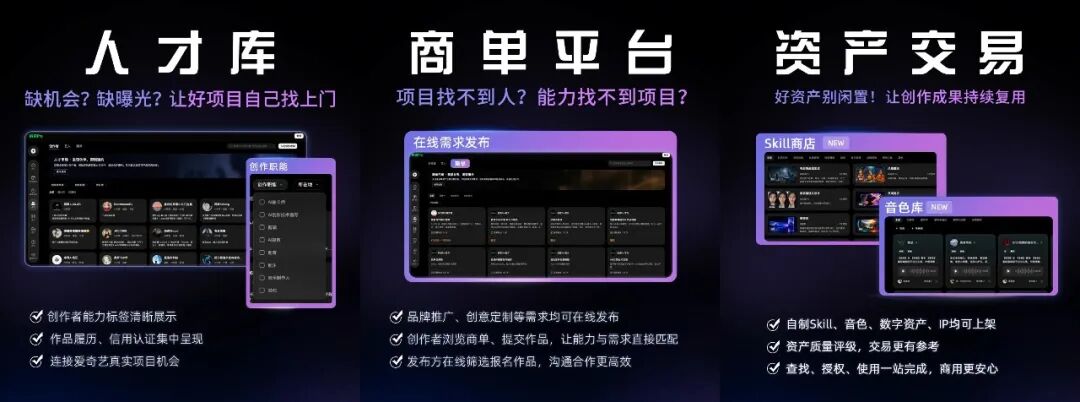
This means that what iQiyi is going to build is no longer just an AI tool to help internal production crews reduce costs and increase efficiency. It is trying to repackage the IP, production methods, creator relationships and content distribution capabilities accumulated over the past ten years into an industry-wide AI film and television production platform.
The effect is remarkable. The finished works have been continuously tested by the market, and the talent reserve is also growing wave after wave.
The narrative written by iQiyi and Nado is quite effective in the current AI capital wave.
The financing rounds and speed of many AI video tools are accelerating, and even news of IPOs is constantly coming out. They all use a unified tone to show how professional they are in producing finished films, and it does not matter whether they have an AI content ecological mechanism; a US start-up company Preview on the other side of the ocean has raised a total of 12 million US dollars, of which HSG led the 10 million US dollar seed round, and stated that "what AI video is missing now is exactly a video version of Cursor".
So, what are iQiyi and Nado, which take an earlier lead in film and television professionalism, IP reserve, content ecology and technical control, waiting for?
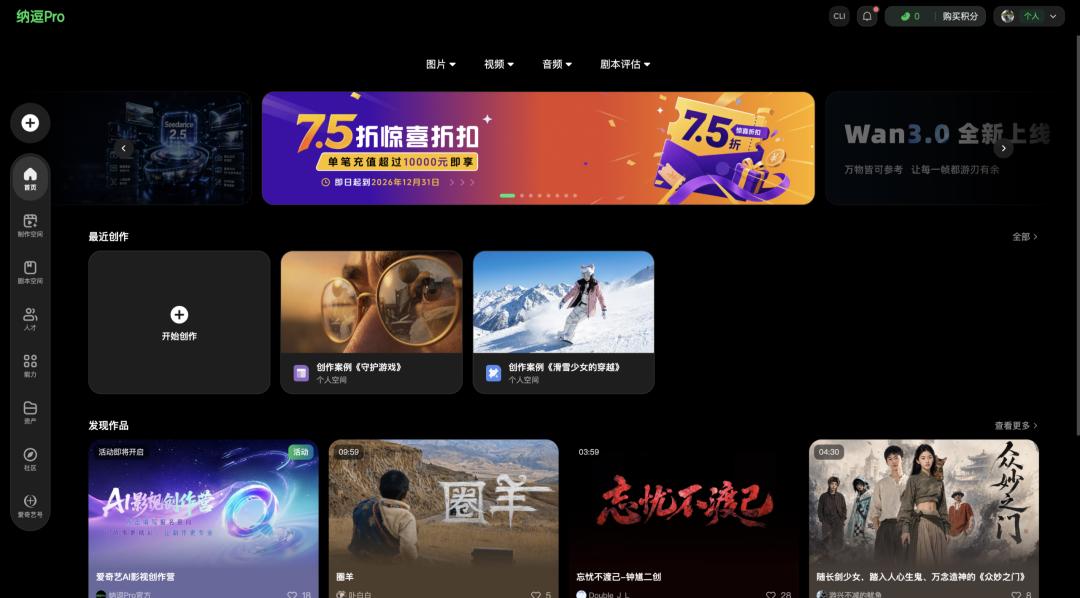
Screenshot of Nado Pro official website
What iQiyi should do most now is not only to continue to improve the production process of AIGC professional content around Nado, but also to split it out of the original business system, establish a clear independent corporate entity, introduce external shareholders and industrial capital, so that Nado can obtain its own set of financing, valuation and incentive mechanisms.
After all, in today's AI market, capital investment is similar to buying 50-cent scratch cards.
01
The "Scarcity" of Nado Pro
In the past few years, the long-video industry has never really got rid of growth pressure.
The scale of members is gradually approaching the ceiling, advertising budgets are continuously diverted by short videos and other content forms, and content costs are difficult to decline synchronously. Platforms can still rely on hit dramas to create phased growth, but whether a hit work can appear and how long it can last always has great uncertainty.
When performance pressure has become a common problem in the industry, the entire long-video industry needs to answer a question: when the growth model driven by members, advertisements and hit works gradually reaches its peak, where is the next growth curve?
Now it seems that the answer given by iQiyi is AIGC.
This is also the reason why although the event on August 20 was named "Creator Conference", the actual core around which it revolved was AIGC creators. Nado Pro, AI Film and Television Creation Camp, AIGC Creative Center, Venture Capital Conference, computing power support and revenue-sharing policies for AI content have formed a relatively complete business line.
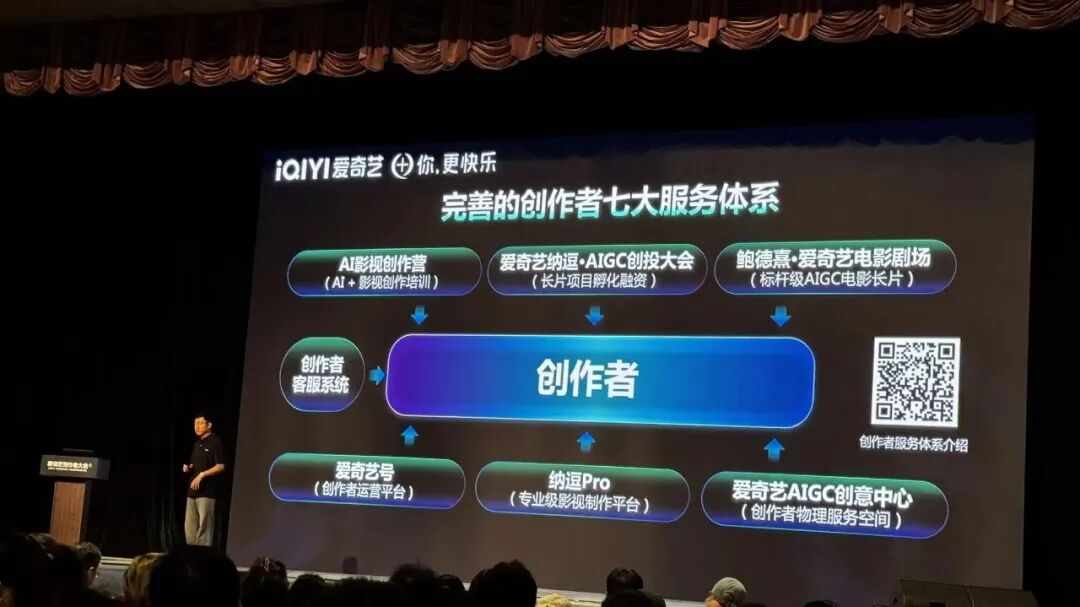
iQiyi Creator Conference
For iQiyi, AIGC can no longer be regarded as a marginal technology. Whether it is Nado Pro as a productivity tool, or the content produced with AI participation and broadcast on the platform, it is becoming part of iQiyi's core content business.
In the past month, iQiyi has continuously launched three AIGC web feature films with a duration of more than one hour: *Strange Tales: Paper Blade Crossing the Wasteland*, *Soul Ferry: Butterfly Dream* and *Soul Ferry: The Dream of the Celestial Maiden*.
The quality of the three films is certainly open to discussion, but they at least prove one thing: iQiyi has begun to move AI feature-length films from occasional technical experiments to continuous content supply.
It is more noteworthy that there are both original projects developed from scratch and re-utilization of mature IPs.
What iQiyi is verifying is not just "whether AI can make a movie", but whether AI can become a new production method for the platform to continuously develop IPs and expand content supply.
What is needed behind this is never just a video generation model.

AIGC feature film *Strange Tales: Paper Blade Crossing the Wasteland*
It also requires IP authorization, participation of professional screenwriters and directors, compliant use of actors' images and voices, long-form narrative control, production management, content review, distribution and subsequent commercialization. The threshold for generating a beautiful shot is rapidly decreasing, but organizing hundreds of shots into a work that can be officially launched is still a professional project.
This is exactly where Nado Pro is truly different from most AI video Agents on the market.
From the perspective of underlying technology, Nado did not choose to self-develop a video generation model that competes head-on with Keling and Seedance, but accesses multiple models, focusing on workflow, agents and film and television resources. On the surface, this seems to mean that Nado's technical barrier is not as solid as products with self-developed models.
But model aggregation does not mean there is no barrier.
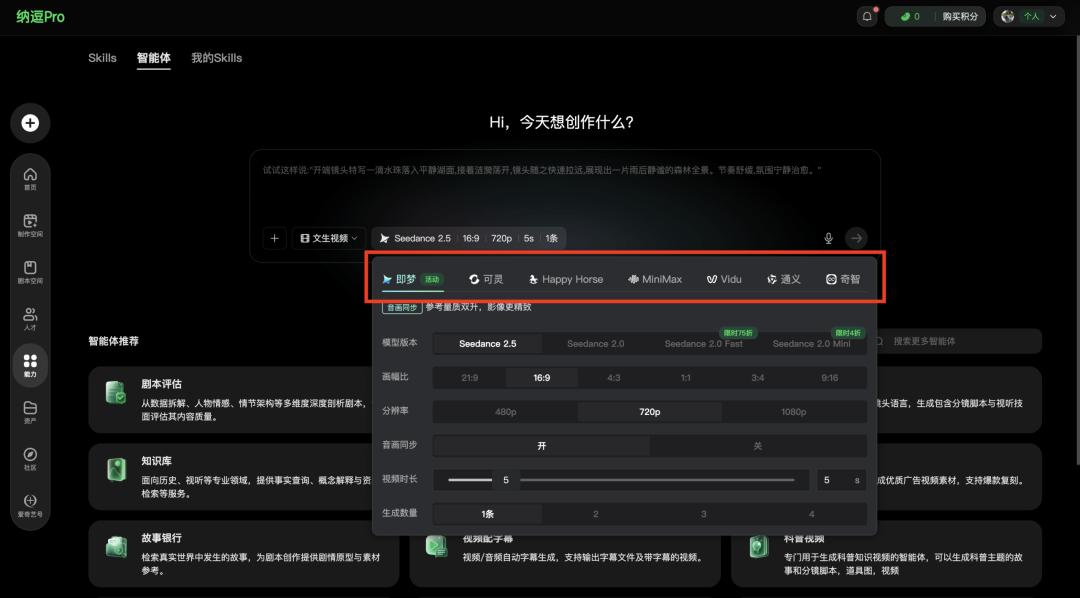
Screenshot of Nado Pro official website
The same video model can be accessed by more than a dozen platforms, and the generation capability will be rapidly popularized as the model is open. Relying only on calling models to earn the point price difference will eventually reduce you to a porter of computing power and Tokens. What is truly difficult to replicate is who can make these models enter the professional production process, and stably produce content that can be broadcast, distributed and profitable.
What iQiyi can give to Nado is exactly this part.
The IP, digital assets and film and television production experience accumulated for nearly 20 years can become the means of production for Nado; the cooperative relationships formed with directors, screenwriters, actors, production companies and post-production teams can become Nado's creator network; iQiyi's own capabilities in review, distribution, recommendation and revenue sharing can help creators complete the last mile from content production to commercial returns.
This is also why most of the AI video creation tools on the market, even if they access the same models as Nado, still mostly linger in the fields of short dramas, advertisements or e-commerce promotion videos.

AIGC feature film *Soul Ferry: Butterfly Dream*
Even if they are all professional tools, there are still thresholds for professional video and film and television content.
It can be said that as an AI film and television tool, the core value of Nado is still the film and television industrial capability accumulated by iQiyi for many years.
If Nado can only exist as an internal product of iQiyi, these capabilities are still just tools for long-video platforms to reduce costs. Only when it starts to serve more film and television companies, creators and commercial customers can it become a truly independent business.
02
AI narrative monetization should be done as early as possible
iQiyi must be more radical than latecomers
Kuaishou has provided a sufficiently direct reference for iQiyi.
In July this year, Kuaishou promoted the restructuring of the Keling business and launched an external capital increase of up to 3 billion US dollars, with a post-investment valuation of about 18 billion US dollars.
It should be said that the split and financing of Keling is the most important inspiration for Nado.
When Keling was placed inside Kuaishou, the capital market could hardly measure its technology, revenue and growth potential separately; when it had an independent entity, external shareholders and a clear financing path, the AI value originally covered by the short video main business had the opportunity to be revalued.
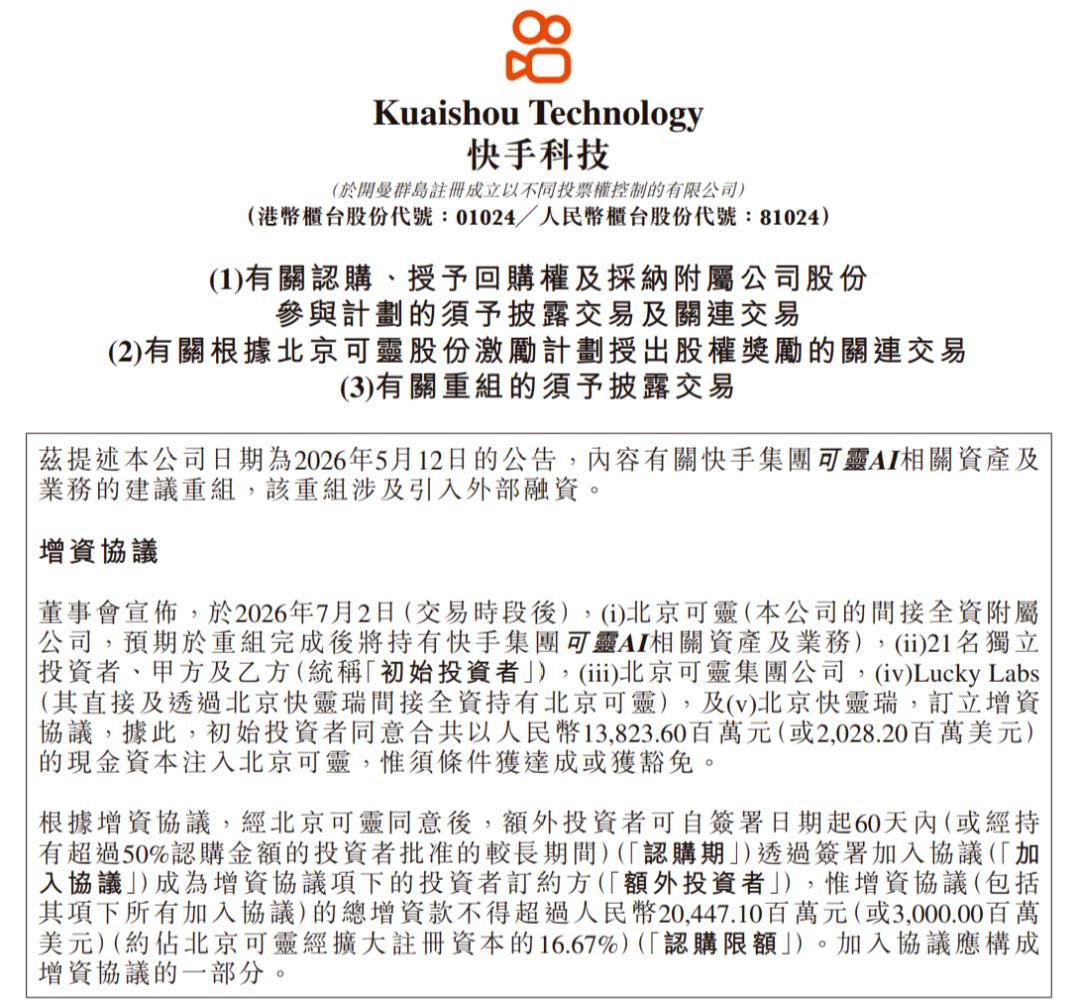
Keling AI completed independent financing of nearly 3 billion US dollars
Nado and Keling are certainly not exactly the same.
The core asset of Keling is the video generation model, and its competitors are Seedance, Vidu, Conch and other basic models around the world; Nado is more like an application platform that aggregates models, film and television workflows and industrial resources.
But this does not prevent Nado from carrying out independent financing.
AI application companies do not need to own a basic model first to be eligible for high valuation. When Yanyu Technology, which owns products such as LibTV, recently completed a financing of about 300 million US dollars, its valuation has exceeded 2 billion US dollars.
It can be said that what the current capital market really values is not just whether a company can train models, but also whether it can grasp the user entry, establish workflows, generate revenue, and occupy an irreplaceable industrial position, or in other words, be good at marketing.
Compared with AI video applications that simply call models, Nado has a set of assets that are more difficult to assemble temporarily.
No matter how many video Agents emerge in the market to heat up AI short dramas and produce various short dramas, they are essentially working for Douyin.
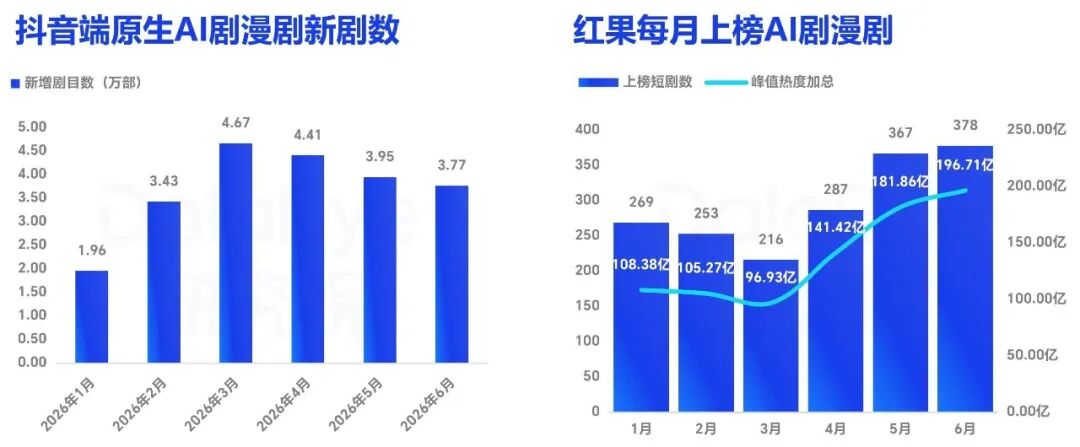
*DataEye 2026 H1 AI Drama and Manhua Data Report*
However, iQiyi obviously has more choices. It knows how to initiate projects for films, dramas and animations, how to control budgets, how to organize creative teams, and also knows what content can pass review and how to distribute it.
These capabilities used to mainly serve iQiyi itself, but now they have the opportunity to be productized by Nado and become services for the entire industry.
The problem is that as long as Nado is still wrapped inside iQiyi, its development will be restricted by the traditional business boundaries of long videos.
First of all, AI film and television is still an industry that requires continuous investment. Model invocation, computing power subsidies, product R&D, asset construction and team expansion all require capital. Long-video platforms themselves are still under operating pressure, and Nado can hardly rely on its parent company's investment forever to compete with AI companies that have raised hundreds of millions or even billions of dollars in financing.
Independent financing can allow Nado to obtain funds specifically for expansion, and also allow iQiyi to reduce the pressure of bearing long-term investment alone while maintaining control.
Secondly, only an independent company can establish a more attractive talent incentive and valuation system. If an AI product team can only share the valuation of a traditional video platform, it will be difficult to compete with basic model companies and AI startups for talents in the long run. After the split, Nado can truly convert product growth into team returns through independent equity and options.
A more realistic issue is industry neutrality.
If Nado only serves iQiyi internally in the future, its upper limit is nothing more than iQiyi's own content demand. But if it wants to become a professional film and television production infrastructure, it must serve other production companies, advertising agencies, short drama teams and IP institutions.
Whether a film and television company is willing to put undisclosed scripts, character assets and production data into iQiyi's internal system, and whether it is willing to use an independent AI film and television company with clear data boundaries and business rules, are two completely different issues.
If Nado wants to access market demand outside the platform, it must maintain a sufficiently close resource relationship with iQiyi, and at the same time establish sufficiently clear corporate and business boundaries.
Source: Internet
iQiyi can fully continue to hold the controlling stake of Nado, keep Nado in the consolidated statements, and introduce external shareholders such as cloud computing companies, model companies, film and television production institutions and industrial funds; it can also continue to provide Nado with IP,