Octopus Power "Rampage"
In the embodied intelligence track, Octopus Dynamics is absolutely a unique presence.
The team boasts an impressive resume, capital has placed its bets rapidly, and product advancement moves forward fiercely. The company was founded only this January, officially launched operations in March, and secured multiple rounds of financing from star-level capital within half a year. Horizon Robotics, Xiaomi, GL Ventures have all entered the game, with the total financing amount approaching 1 billion RMB, and the latest 500 million RMB financing round is about to close.
"There is capital eager to invest in this company every month," an investor told 36Kr.
In terms of products, the three currently hottest tracks in embodied intelligence — world model, dexterous hand, and data collection — are all bet on by Octopus Dynamics at the same time. The company even hung up a banner reading "Fight for WRC" early on, taking this conference as a clear R&D deadline.
The team did not fail expectations. During the 2026 World Robot Conference, Octopus Dynamics released three core products at one go: the embodied-native general world foundation model SYNWorld V0.5, the high-degree-of-freedom bionic tendon-driven dexterous hand OctoH-Hand, and the next-generation full-modal data collection system OctoSense.
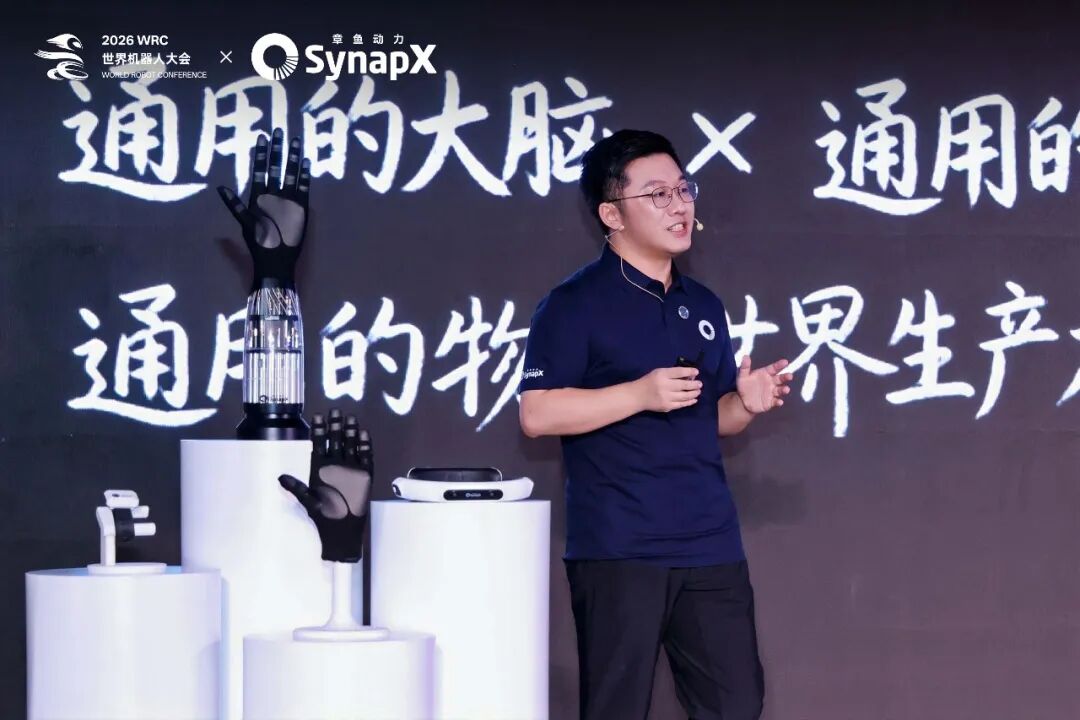
What is even more striking is that among a host of embodied intelligence startups that rely on external "blood transfusion" to survive, Octopus Dynamics has taken the lead in realizing "self-sustainability" — its commercial implementation performance is outstanding, and its revenue is expected to reach the 100 million RMB level by the end of 2026.
Who on earth is Octopus Dynamics? Or, in this increasingly "red ocean" embodied intelligence track, what makes it stand out from the crowd?
"Integrated Brain-Hand Design", Returning to the First Principle of Intelligence
Over the past two years, the embodied intelligence industry has become increasingly segmented. Some teams work on VLA, some on world models, some on dexterous hands, and a growing number of companies are venturing into data collection.
For a startup, "focus" usually means it is easier to achieve breakthroughs in a single field and deliver results quickly.
However, for base models, dexterous hands and data collection, Octopus Dynamics has almost simultaneously cut into the three most fiercely competitive directions in the current embodied intelligence sector, taking a very "heavy" development path.
Why would a newly established company voluntarily extend its frontline so much?
Du Dalong, Founder and CEO of Octopus Dynamics, explained that this decision comes from his understanding of "intelligence" itself.
"Human intelligence has never evolved separately from the body. As hands became more dexterous, humans gained more complex operation capabilities; as tools became more sophisticated, they in turn pushed the brain to develop continuously," Du Dalong said.
"A sharp mind" and "dexterous hands" are inherently complementary and mutually reinforcing.
At this point, the first key word to understand Octopus Dynamics emerges — "integrated brain-hand design".
Let's start with the "brain".
The SYNWorld series of base large models is the underlying foundation. The newly released SYNWorld V0.5 is an embodied-native general world foundation model with over 10 billion parameters, trained on more than 300,000 hours of data. Its MoT architecture enables cross-modal modeling through shared attention, bringing text, vision, action, force perception, tactile perception and proprioceptive state into a unified framework — which is also the core idea of Octopus Dynamics' "vision-force-touch" technical path.
Built on SYNWorld, the model extends in two directions: ACWM (Action-Conditioned World Model) and WAM (World Action Model).
ACWM focuses on "what will happen next if the robot performs this action"; WAM generates the actions that the robot should take based on the environment and goals. The former leans towards world prediction, while the latter leans towards action decision-making, and both share the understanding of the physical world.
Through this unified training, the two separate systems of embodied intelligence "understanding the world" and "acting on the world" are no longer disconnected, thus achieving true generality.
This technical path is not unique to Octopus Dynamics. At present, Google DeepMind, NVIDIA and many other industry giants are already advancing along similar directions.
However, the particularly outstanding breakthrough of Octopus Dynamics is the continuous scaling capability of the SYNWorld model.
Continuous scaling means that as data, models, computing power and task coverage keep growing, the model's capabilities can also continue to evolve.
At present, Octopus Dynamics has clearly positioned the current SYNWorld V0.5 as the starting point of this scaling curve. With over 10 billion parameters at this stage, the company plans to further expand to over 20 billion parameters, then move forward to hundreds of billions of MoE parameters, and gradually expand the evaluation scope to more tasks, scenarios and robot bodies.
Particularly noteworthy is that Octopus Dynamics has built a series of infrastructures including data, training, inference and evaluation around the SYNWorld base model series. Among them, the daily average data production capacity of Data Infra exceeds 10,000 hours, and the measured training efficiency of Training Infra is more than 10 times higher than similar open-source achievements.
This exactly leads to the second product — the OctoSense full-modal data collection solution.
In today's embodied industry, one of the universal consensuses is the shortage of data. Especially for the "tactile" part in the "vision-force-touch" track that Octopus Dynamics has entered, data is extremely scarce.
Fan Qingyuan, Co-founder of Octopus Dynamics, revealed to 36Kr that the OctoSense data collection solution was originally only for internal use by the Octopus Dynamics team. However, due to the lack of mature solutions in the industry, a large number of customers and partners have actively come to discuss cooperation after the product was launched.
Specifically, Octopus Dynamics' OctoSense full-modal data collection solution includes three core products: a four-fisheye Ego headband, an EMG wristband, and a bionic exoskeleton data glove.
The three products fill three gaps respectively. The Ego headband solves the problem of scale and first-person perspective vision; the exoskeleton glove complements high-precision hand pose, contact and force information; the EMG solution further solves the problems of visual occlusion and difficulty in observing active force exertion.
Among them, the EMG wristband has drawn much industry attention.
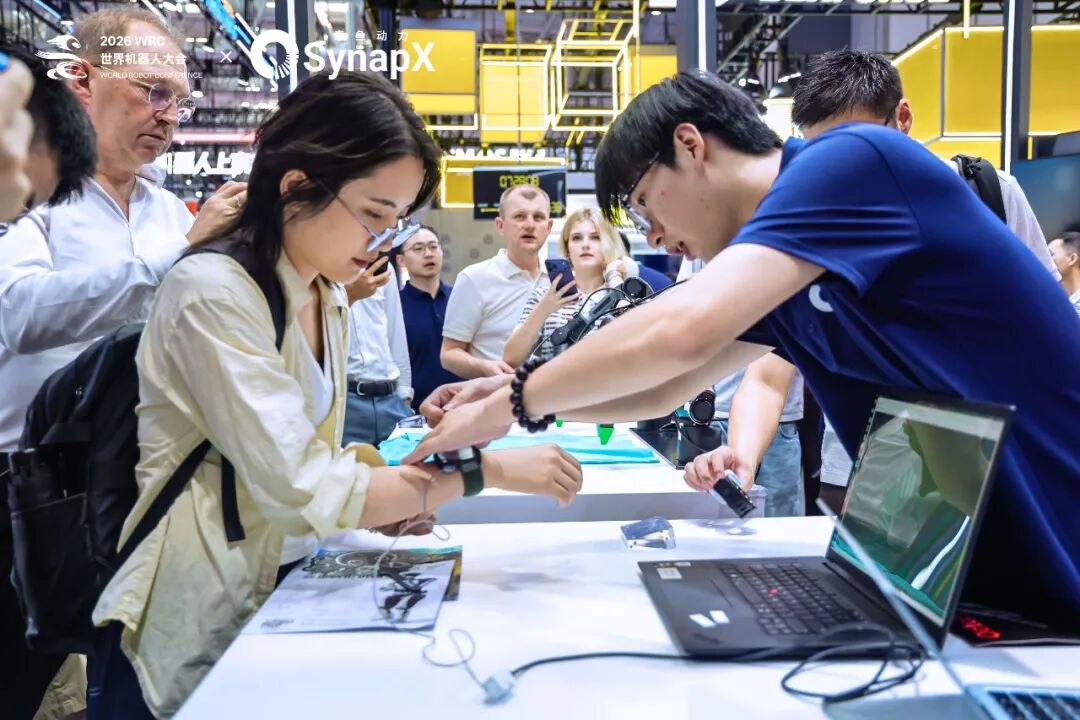
Compared with vision or force sensor solutions, EMG signal collection is more direct and real-time, neither afraid of line of sight occlusion, nor too bulky, greatly lowering the threshold for collecting high-quality human demonstration data. After all, the difficulty of a assembly line worker working for a full day with a bulky data glove is completely incomparable to that of working for a full day with a lightweight EMG wristband.
However, the prominent scaling obstacle of traditional EMG solutions is that EMG signals naturally vary across different individuals. Sensor position, sweating and fatigue will all change the signal distribution, and recalibration is required when switching to a new user.
The remarkable breakthrough of Octopus Dynamics is that it has developed the SynEMG large EMG model, which takes the lead in realizing zero-shot generalization of EMG signal collection across different individuals. When facing new individuals that are not included in the training set, the model does not need to add new individual data or perform incremental training, realizing the transition from "one model for one person" to "one model for thousands of people".
Solving the generalization problem is equivalent to breaking through the ceiling that limits traditional EMG collection solutions, making it possible to scale embodied intelligence data collection.
The third product, the OctoH-Hand dexterous hand, is the other end of Octopus Dynamics' "integrated brain-hand" idea: enabling embodied intelligence to truly enter the physical world.
The OctoH-Hand adopts a high-degree-of-freedom tendon-driven structure with 23 active degrees of freedom and 28 independently controllable actuators. More than 1900 tactile sensing units are integrated in the palm and fingers, and full closed-loop force control is constructed through joint current feedback and tactile feedback, with a mean time between failures (MTBF) reaching 1000 hours.
There are three key designs here:
First, and the most groundbreaking one, is the "digital twin" design concept of the OctoH-Hand.
The OctoH-Hand dexterous hand and the exoskeleton data glove in the OctoSense data collection solution adopt one-to-one corresponding motion configuration, degree of freedom definition and perception configuration.
In traditional solutions, the data collected by humans usually needs to go through motion retargeting, parameter mapping and debugging before it can be converted into actions executable by the robotic hand.
Octopus Dynamics' solution allows the collected data to be directly transmitted to the dexterous hand as much as possible, realizing "collection for immediate use", opening up the loop between "brain-hand-data", and turning the dexterous hand from an independent hardware into part of the entire physical AI system.
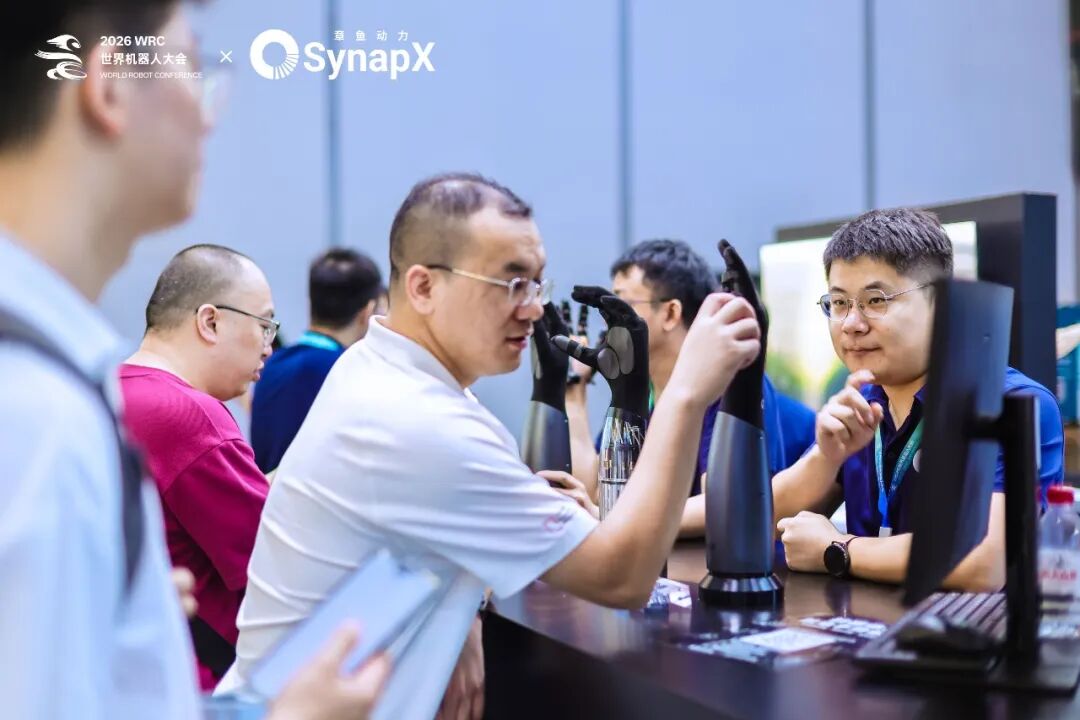
The second is high-level bionics. The actuators of OctoH-Hand are placed on the rear forearm, and the fingers are driven through tendons, which is not only close to the human muscle-tendon structure, but also allows more degrees of freedom to be accommodated in the limited palm space, with its dexterity, motion capability and operation capability almost comparable to human hands.
The last is full closed-loop force control. After robots truly enter household, industrial and service scenarios, the difficulty of operation will quickly upgrade from "grasping objects" to "operating with appropriate force". Based on the back-drivable mechatronic characteristics of joints, OctoH-Hand integrates joint current loop feedback and dual tactile force perception signals, building a true full closed-loop force control system from internal driving force to external contact force, which can complete extremely fine dexterous hand operations such as twisting, inserting, pinching, rotating and pulling.
The three products — base model, dexterous hand and data collection — form a complete closed loop: humans generate data, the model learns physical laws; the model generates actions, the dexterous hand enters the real environment to execute; new tactile, force perception and task results are generated during execution, which are then fed back to the next round of training.
Octopus Dynamics calls this entire set of ideas Bio2Robot. It tries to convert human biological operation information such as vision, motion, contact and force exertion into data that robots can learn and reuse, then the world model learns the laws, and the dexterous hand returns to the real world.
Extreme Scaling, Extreme Generality
During the communication between 36Kr and the founding team of Octopus Dynamics, one word appeared repeatedly — "carbon-based data".
How to convert the constantly occurring motion experience in real human labor into training data that machines can use, build a smarter and more general robot brain, and promote the realization of "silicon-based intelligence".
Yes, Octopus Dynamics' real ambition is not just to build a smarter robot and let it go to the factory to "tighten screws".
What Octopus Dynamics really wants to build is "general physical intelligence" that can achieve extreme scaling and extreme generality.
In other words, embodied intelligence AGI.
At this point, the second key word to understand Octopus Dynamics emerges — "Extreme Scaling, Extreme Generality".
In the past six months, the embodied industry has been talking about the Scaling Law more and more frequently. VLA has proved that robots can learn more and more tasks, but tokens in the language world are naturally unified, and the basic semantics of a word will not change drastically no matter where it appears; the physical world is highly continuous, and the same "grab a cup" action will have different results due to the cup's material, weight, friction coefficient, desktop height, and the robot's hand shape.
This is why there is still no universally recognized embodied intelligence Scaling Law in the industry so far.
On the path of scaling, Octopus Dynamics' idea is very radical.
The reason for working on base models, dexterous hands and data collection at the same time is to ensure that data, models and hardware can all continue to expand, and form a positive flywheel among the three: larger data trains stronger models, stronger models enter more real tasks, real tasks generate more high-quality data, which is then used to train the next generation of models.
Du Dalong once said that if the possibility of scaling is confirmed, the company will "go all out to achieve scaling at all costs".
Accompanied by "extreme scaling" is the "extreme generality" of implementation scenarios.
At present, a large number of embodied intelligence capabilities still highly depend on specific tasks, specific scenarios and specific bodies. The industry often mentions "training for each specific scenario", which is essentially an extension of the "special machine for special use" concept in the traditional automation era.
However, what Octopus Dynamics pursues is not to make robots perform extremely well in a fixed workstation, but the huge generality potential brought by model scaling and data scaling.
Industrial, commercial, household; manufacturing, scientific research, companionship... All far-reaching technological revolutions in history are accompanied by large-scale invocation of certain scarce capabilities. The steam engine amplified physical strength, electricity reduced the cost of energy use, and computers greatly improved information processing capabilities.
Du Dalong believes that if robots become an important infrastructure for the next round of productivity revolution, what they really need to release is physical operation capability.
And this is exactly Octopus Dynamics' real ambition.
Team Members with "Sparkling Eyes"
Finally, to truly understand Octopus Dynamics, the "team" is the most unavoidable point.
Du Dalong, Founder and CEO, participated in early deep learning R&D at Baidu IDL, then became the 6th employee of Horizon Robotics, participating in BPU and AI engineering; in 2021, he co-founded Phantom AI and served as CTO, pushing autonomous driving technology to mass production for real car companies, and Phantom AI was acquired by NavInfo at the end of 2025.
The value of this experience has become even more prominent in the era of embodied intelligence.
At Octopus Dynamics' first global press conference successfully held at WRC on August 19, there is a detail related to the "team".
Du Dalong specially thanked his "two former bosses" — Yu Kai, Founder and CEO of Horizon Robotics, and Cheng Peng, CEO of NavInfo, and the two of them offered support in different ways.
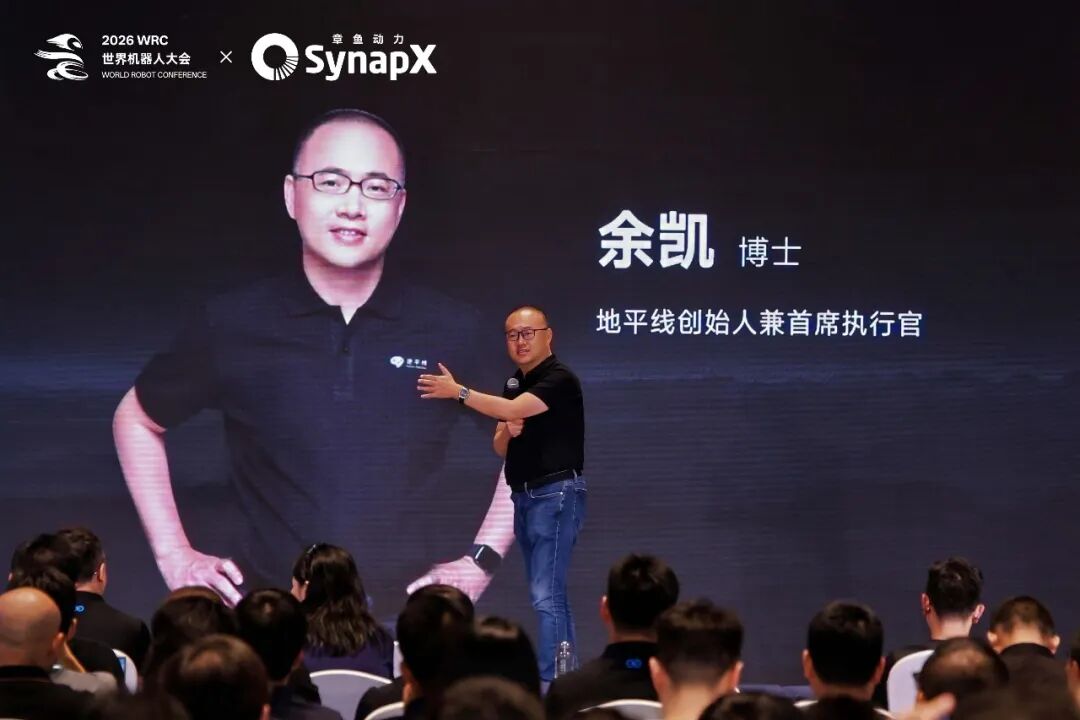
Yu Kai's support is clearly reflected in his identity as a shareholder, while Cheng Peng's support resulted in a strategic cooperation agreement signed the day after the press conference, which more directly connects to Octopus Dynamics' product implementation and industrialization path.
On August 20, Octopus Dynamics and NavInfo officially announced the launch of strategic cooperation. The two sides will carry out cooperation in five specific directions. For Octopus Dynamics, the value of this agreement lies not only in adding a new partner.
Cheng Peng said, "Octopus Dynamics has demonstrated firm first-principle thinking in general world models and full-modal data collection hardware. The deep collaboration between the two sides will completely open up the entire chain from