The middle class in Jiangsu, Zhejiang and Shanghai are thronging to Aldi.
Aldi stores in Shanghai and Jiangsu are already packed with customers, while consumers in Zhejiang are still eagerly asking: When will it be our turn?
Thrifty middle-class families come to buy fresh produce and daily necessities, exhausted office workers rush to the deli and bakery sections after work, and elderly residents who stop by on their daily walks have also become regular customers.
Overnight, hard discount stores, jokingly referred to as "budget supermarkets", have become a prominent focus in the retail industry. They accommodate the small daily needs of ordinary people, and also hold the ambitions of industry giants.
#01
Jiangsu, Zhejiang and Shanghai Are Competing for Aldi's Presence
For Shanghai consumers, Aldi is already a regular part of daily life close to home. But outside Shanghai, the supermarket has become a popular "scenic spot" for consumers across Jiangsu province.
At the entrance of the first Suzhou store, long queuing passages are fenced off with crowd control barriers, and a notice board says "Expected waiting time: 1 hour", while some customers waited for two and a half hours to get in. The first Wuxi store was originally scheduled to open at 8 a.m., but the mall was packed with customers in advance, so the store had to open one hour earlier.
When the first four Nanjing stores opened at the same time, the Qiaoke Square outlet was so crowded that restock trolleys could not get through at all, and staff had to carry goods manually. The Jiangbei Impression Hui store recorded sales exceeding 1.38 million yuan on its opening day, directly ranking first nationwide.
Consumers in neighboring Zhejiang are waiting eagerly. Some Hangzhou consumers even take a high-speed rail ride of about one hour to Shanghai or Suzhou to stock up on goods, then head home with big bags and parcels.
Yet the products being snapped up are not scarce items at all.
Ubest fresh milk, freshly baked toast, pretzel bagels, small portions of fresh meat, plus hand cream, kitchen paper and face masks, are almost all familiar items in the shopping carts of ordinary families, but they are repeatedly listed as "must-buy items" that spread around work group chats, Xiaohongshu and among friends. Aldi has become a shopping destination worth dedicated research.
44-year-old Sister Li was attracted to Aldi by a procurement list sent by her colleague.
When she first walked into Aldi, she thought the space was not large and the goods were not particularly abundant. After visiting several times, she found that the "limited variety" is actually very convenient: she does not need to compare seven or eight brands of milk repeatedly, the portion of fresh meat and vegetables is just right for the whole family, and she does not need to study discount thresholds, coupons and membership prices at checkout.
For middle-level enterprise employees like Sister Li, they are busy with work on weekdays and need to spend time with their children on weekends. A family shopping trip needs to take both the ingredient list and everyone's taste into consideration. Buying a bottle of yogurt is almost like doing market research.
Buying too much also easily leads to waste. In the past, the bagels she brought home from membership stores would lose their appeal to the whole family by the third one; the large-packaged yogurt would still have half a box left when the expiration date was approaching.
Some people online complain: "The rich buy the most expensive, the poor buy the cheapest, only the middle class are the most tired, who have to spend time picking the most suitable one." At Aldi, Sister Li found that she no longer needs to spend so much time picking the right products.
She still goes to Sam's Club to buy ingredients for gatherings and large daily necessities, and uses Hema for instant delivery. But for daily purchases that do not need to be stocked for half a month and cannot be treated carelessly, she is turning to Aldi more and more.
Lin Lin is completely exhausted from work every day, does not want to cook after work, and the price of takeaway keeps rising, while Aldi is right on her way home. She goes straight to the bakery and deli sections after entering the store, and picks up some snacks by the way. The price-comparing instinct of office workers makes her find that some private-label products are even cheaper than those in snack discount stores and on Pinduoduo.
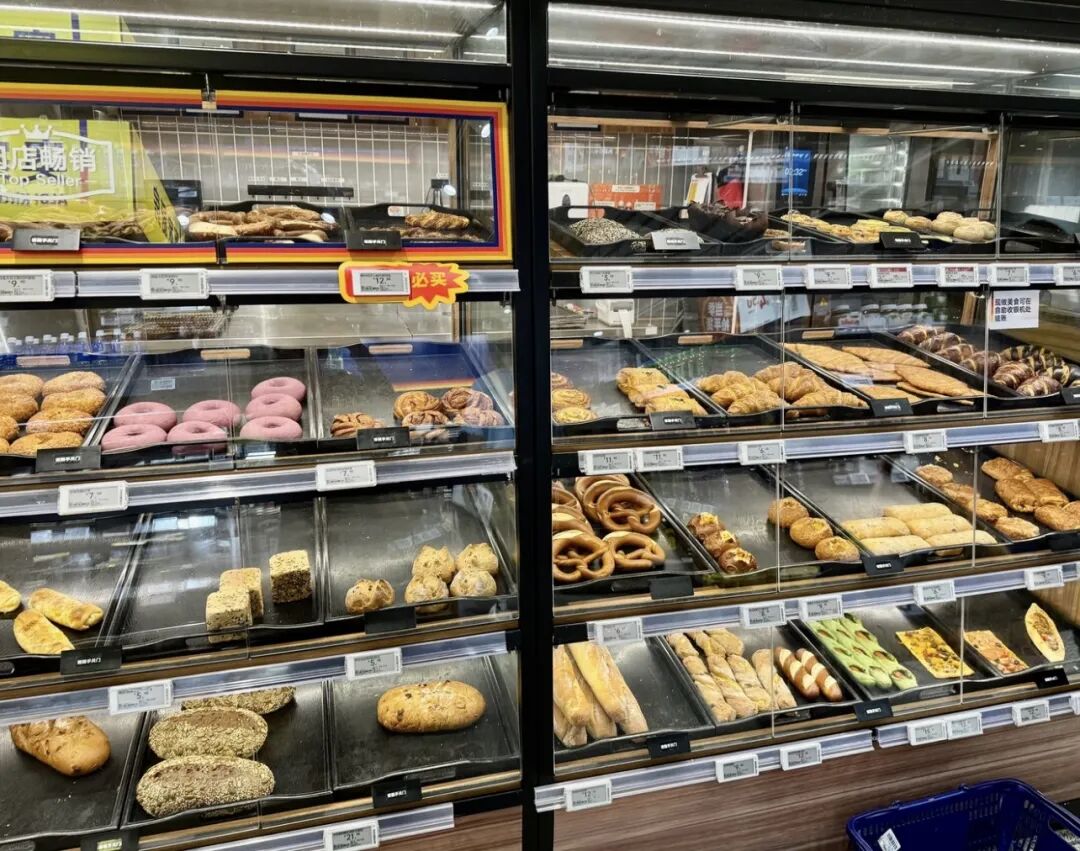
Figure | Freshly baked goods at Aldi
26-year-old planner Xia Xia treats visiting Aldi as an offline "blind box opening" activity. Cinnamon rolls, Basque cakes, LACURA face masks, any products she has seen on Xiaohongshu, she wants to try them. Half of her shopping cart is filled with daily staples, and the other half is "affordable alternatives to luxury products" and content for social platforms.
61-year-old Uncle Chen, a senior living alone, initially just passed by the store during his post-meal walk, and later became a regular customer. The small portions of fresh produce are just enough for one meal, the deli food can be eaten after heating, no need to stock up, and it saves the trouble of washing vegetables and cooking.
Aldi is clearly well aware of whose shopping carts it is competing for. Young people who are in a hurry after work, efficiency-oriented middle-class families and thrifty local elderly people are all looking for the same thing: they are not willing to pay for brand premium, and do not want to live a compromised life with cheap low-quality products.
The perfect balance of price, quality and portion is the key for Aldi to win over these consumers. But easy as it sounds, the actual operation is far more complicated.
#02
To Sell at Low Prices, Aldi Has First Transformed Itself
When it first entered the Chinese market, Aldi's positioning was quite different from what it is now.
In 2017, it first tested the Chinese market through online channels. When it opened its offline stores in Shanghai in 2019, its overall positioning was closer to a premium supermarket, emphasizing its German origin, imported goods and refined shopping experience.
In other words, Aldi at that time was more like an import supermarket hoping to be recognized by the middle class, rather than a community discount store that helps the middle class save money.
The problem is that Shanghai has no shortage of imported goods, nor a lack of well-decorated premium supermarkets. If consumers want large packaged products and membership experience, they can go to Sam's Club; if they need fresh produce and instant delivery, they have Hema; if they want imported snacks and refined lifestyle products, there are already plenty of options in the market.
Relying only on the signboard of "German supermarket", Aldi could hardly find a distinct enough market position.
The real change took place around 2023. Aldi began to emphasize "good quality, sufficiently low price", launched the "Great Value" product series, and gradually shifted its business focus from imported goods to local supply chains and daily household consumption. It started to think about another question: What kind of supermarket do Chinese consumers really need?
Data from the 7th national census of Shanghai shows that the average household size in Shanghai is 2.32 people. Three-person families, young couples and people living alone are increasingly common. Traditional large packages can lower the unit price, but they also increase waste.
Aldi therefore adjusted the specifications of some products, for example, reducing the packaging capacity of fresh milk to a size more suitable for small families. Meat, fruit and deli products also provide small portion options, so that consumers do not have to bear extra storage pressure just to "get a good deal".
What really pushes down the price is its product and cost structure different from traditional hypermarkets.
The first point is private labels. According to information publicly disclosed by Aldi China, the sales proportion of its private-label products has exceeded 90%. For a large number of products on the shelves, Aldi sets product specifications, packaging, quality standards and prices, and then assigns leading brand suppliers to produce them. Without part of the brand promotion costs and intermediate circulation links, the prices are brought down.
The second point is to streamline the number of SKUs. Traditional hypermarkets are used to filling the shelves with products of the same category, allowing consumers to compare repeatedly between different brands, prices and flavors. Aldi controls the number of products in each store at around 2000, with only a few options left for each category. The original sales volume scattered across ten brands is concentrated on two or three products, so factories can get more stable orders, and the supermarket can also secure more favorable procurement prices.
The supply chain has also become more localized. Public data shows that the proportion of local suppliers of Aldi China exceeds 80%. Milk, fresh meat, vegetables and bakery products are mostly produced and distributed by domestic supply chains, rather than incurring unnecessary import costs just to maintain the image of a "German supermarket".
The last point is store operation efficiency. Aldi's stores usually do not set up too many segmented positions. Employees need to take charge of multiple tasks including cashier, restocking and baking, and products are displayed in whole boxes as much as possible to reduce sorting time. Some bakery and deli products are pre-processed in factories, then delivered to stores through cold chain, and the final heating or baking is completed by store employees.
However, no matter how low the cost is, Aldi cannot maintain its business by making tiny profits on every single product. Its shelves actually have two different functional roles. High-frequency products such as milk, paper towels and toast are responsible for building the price perception, making consumers feel that "things are really cheap here". Bakery, deli and ready-to-eat products undertake the task of generating higher profits.
Aldi in the past tried to impress Chinese consumers with imported goods and refined image. The current Aldi is winning the daily shopping carts of more families with local supply chains, private labels, small portion packaging and store operation efficiency.
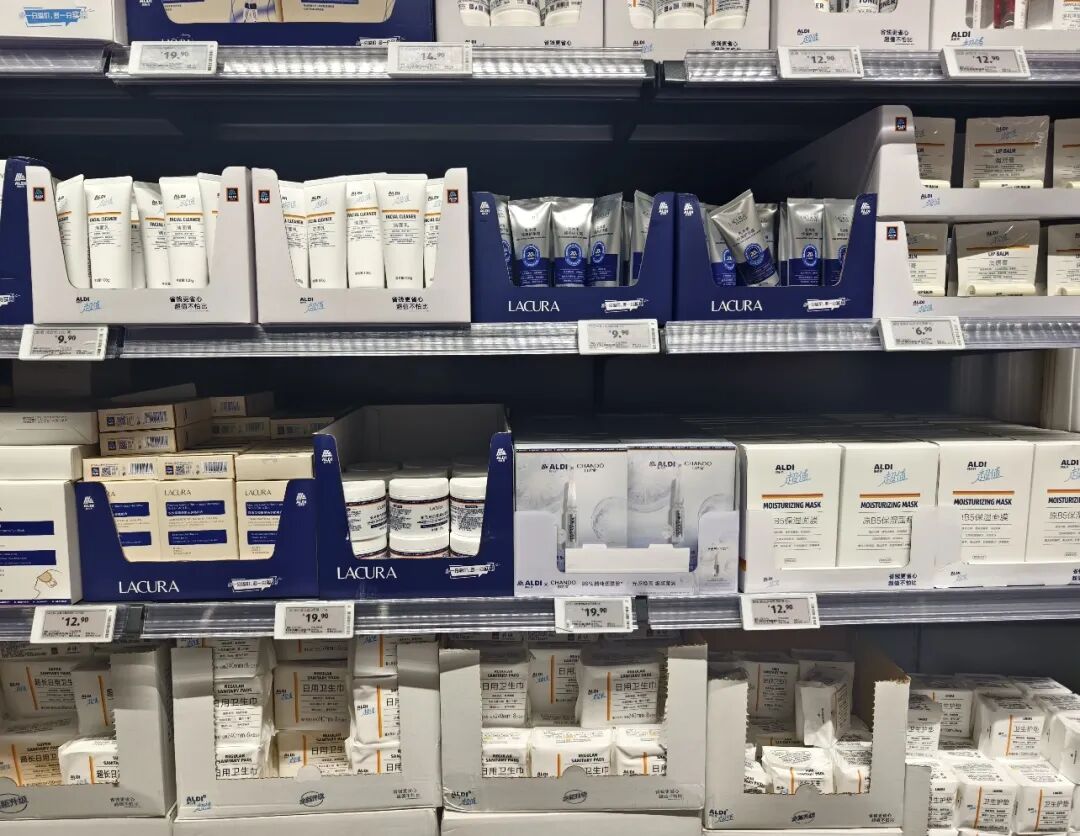
Figure | Daily necessities at Aldi
#03
Hema and HappyMonkey Are Both Joining the Hard Discount Race
Hard discount is not a new concept that emerged in recent years. As early as ten years ago, the domestic retail industry was studying European discount supermarkets such as Aldi and Lidl, many enterprises tried to reduce SKUs, simplify store decoration and deploy private labels, but most of them remained in small-scale pilots and failed to become the mainstream of the industry.
Aldi spent several years making this model work in the local market, and now Hema and Meituan obviously do not intend to give it much time to monopolize the market.
On August 29, 2025, HappyMonkey under Meituan opened its first store in Hangzhou. On the same day, Hema's affordable community supermarket Hema NB was officially renamed "Super Hema Value NB". The two stores are about 800 meters apart.
The competition of hard discount supermarkets has already started at close distance since the opening of the stores.
Super Hema Value NB defines its target users as "pragmatic families", that is, people with rational consumption habits who attach great importance to cost performance, and take the size of the local population who cook at home as an important basis for site selection.
Store operations emphasize "removing all redundant costs", and continuously provide "high-quality and affordable" products for three meals a day. The proportion of private-label products is close to 60%. At the same time, it retains many co-branded or customized exclusive products with established brands, to avoid the product portfolio being too "no-name brand", leaving a buffer zone between low price and consumer trust.
This line of thinking is similar to that of Aldi, but Hema also attaches great importance to store opening speed. In November 2025, Super Hema Value NB opened its franchising program, covering Shanghai, Hangzhou, Jiaxing, Huzhou and other regions in the first batch. In addition to directly operated stores, the capital, store locations and local operation capabilities of franchisees are also incorporated into its expansion system.
By August 2026, according to public reports, the number of Super Hema Value NB stores has exceeded 500.
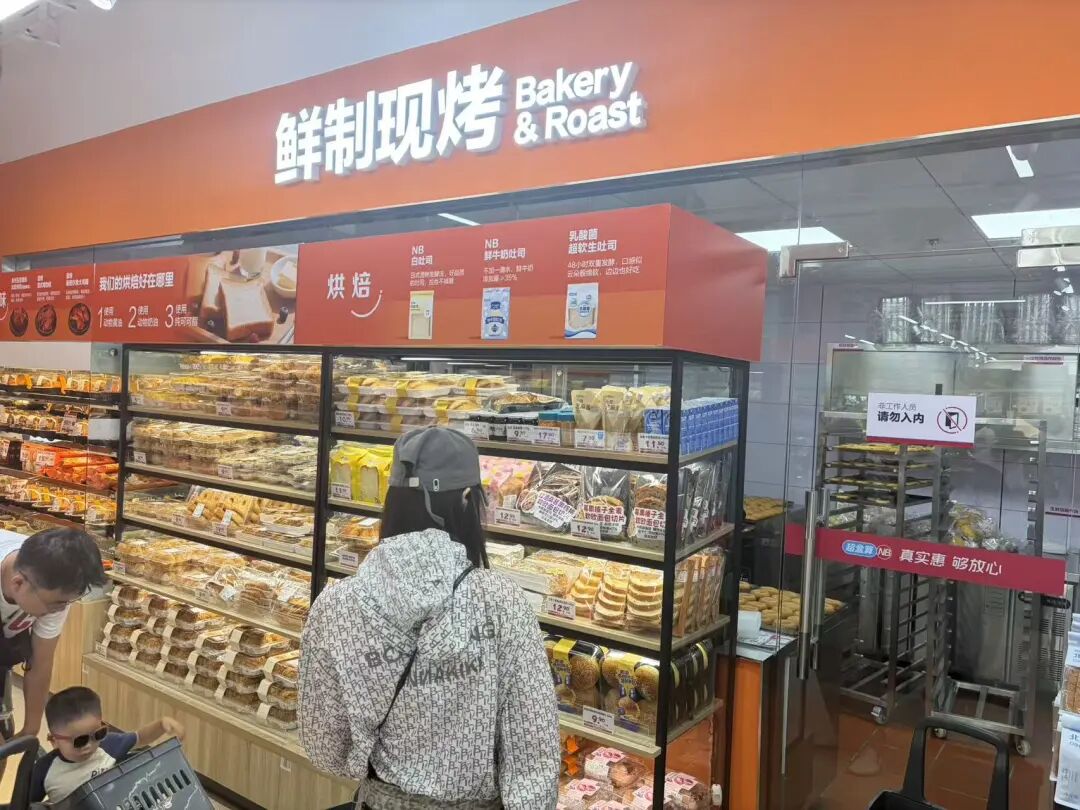
Figure | Freshly baked goods at the first Super Hema Value NB store in Beijing
Meituan is also accelerating its entry into this market. According to the statistics of *Business Observer*, HappyMonkey, Meituan's self-operated hard discount community supermarket business, has now entered 13 cities and opened 58 stores, and is expected to reach a chain scale of 100 stores within the year. All its stores are currently deployed in the three most economically developed regional markets in China: North China, South China and East China.
Wang Xing, CEO of Meituan, said that HappyMonkey is positioned as a community supermarket focusing on extreme cost performance. By adopting a high proportion of private-label products, streamlined SKUs and smaller store spaces, it reduces operating costs to meet the needs of price-sensitive users, forming differentiated competition with Xiaohu Supermarket, and has high development potential.
However, HappyMonkey is still in the stage of polishing its product system and store operation model. Industry media estimate that its private label proportion is about 40%, lower than that of Aldi and Super Hema Value NB.
In contrast, Aldi's expansion pace is still relatively slow.
In April 2025, it expanded from Shanghai to Jiangsu, opening stores in Suzhou and Wuxi. By March 2026, the number of its stores in China exceeded 100, and it put forward a plan to add more than 50 new stores throughout the year. The Zhejiang market has also been included in its layout, and relevant stores in Hangzhou are expected to open at the end of 2026.
The nationwide expansion of hard discount stores is an inevitable trend. At present, all players are competing for store locations and customer flow, and the number of stores continues to rise.
On the one hand, the discount store model has been basically verified now, with relatively considerable profitability. On the other hand, consumers are paying more attention to controlling their consumption expenditure and the cost performance of shopping. On the production side, due to overcapacity in the industry, factories are also motivated to cut costs and cooperate with discount stores in addition to their existing product lines.
In mature markets such as Europe, this format accounts for more than 20% of total retail sales of consumer goods, but China's hard discount will not simply copy the European model. E-commerce, membership stores and instant retail have already taken away a large share of demand, and few consumers will complete all their shopping in just one supermarket.
What Aldi, Hema and HappyMonkey are competing for is not absolutely loyal customers, but a larger share in the family shopping list. The number of stores only shows who expands faster, while repurchase rate, product turnover rate, fresh produce loss rate and single-store profit determine who can stay in the market longer.
Low prices can attract customers into the store, but cannot automatically turn the business into a long-lasting one.
This article is from the WeChat public account "True Story Lab", author: Ma Xinrui, editor: Zhang Duo, published with authorization from 36Kr.