A surreal iconic scene in Shanghai's real estate market: the land price exceeds the second-hand housing price.
In 2026, the land auction market in Shanghai remains red-hot.
Up to now, Shanghai has recorded a total of 30 residential-included land parcels transacted, with a total transaction value of about 84.7 billion yuan and a total gross floor area of 1.776 million square meters. The premium rate of multiple land parcels has exceeded 30%, and there has even been a grand occasion of "no ceiling" bidding for two consecutive days.
The flip side of the hot land market is that the floor price of newly auctioned residential-included land parcels in some core sectors has been higher than the average transaction price of second-hand houses in the surrounding areas.
Land price higher than housing price is counterintuitive in any market, but it is not an isolated case in Shanghai in 2026.
We compared the transaction floor price of each residential-included land parcel from the beginning of 2026 to the present with the average transaction price of second-hand houses in each sector from pti Prui Digital Smart Cloud Data one by one, and the results show that a total of 10 land parcels involving 9 sectors have seen floor prices higher than the average second-hand transaction price.
This is not a market failure, but a repricing of core assets at the bottom. The second-hand houses in these sectors have already stood at the starting point of bottoming out.
01
We compared the transaction floor price of residential-included land parcels (pure residential, commercial-residential, and comprehensive) in the bidding auction market from 2026 to the present with the average transaction price of second-hand houses in Shanghai in the sector where the land parcel is located from 2026 to the present, and found that a total of 10 land parcels involving 9 sectors have experienced "price inversion".
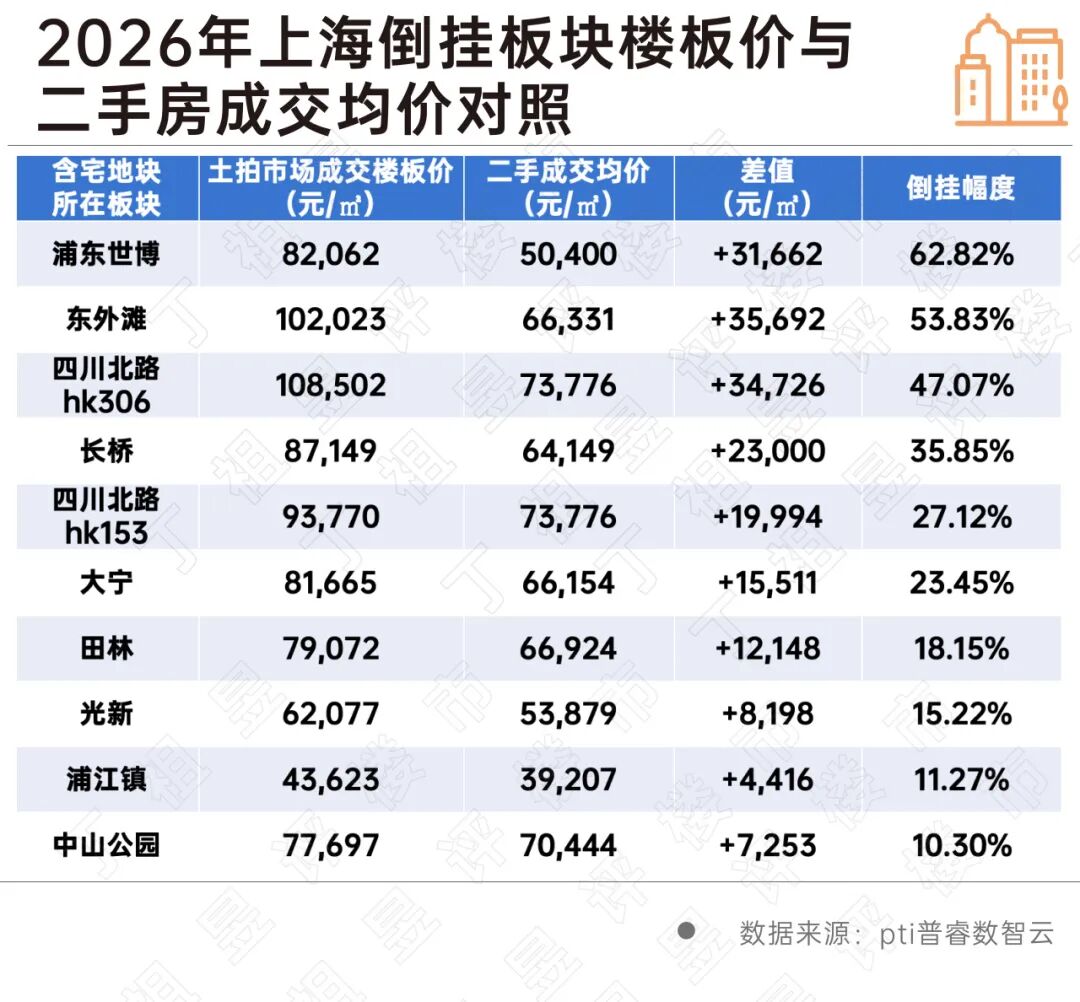
The most prominent sectors including Expo in Pudong, East Bund, and North Sichuan Road have floor prices 40% to 60% higher than the average transaction price of second-hand houses; Daning and Changqiao also have a premium of around 30%; Tianlin, Guangxin, Zhongshan Park, and Pujiang Town have a small inversion, with a range of 10% to 20%.
If we compare the inverted sectors with the non-inverted sectors, the rule is very obvious. "Price inversion" is mainly concentrated in the urban area and the core sectors between the inner and middle ring roads, all of which are hard-core locations with mature supporting facilities and scarce new houses. In contrast, in the outer suburban ring areas such as Qingpu New Town, Zhaoxiang, Zizhu, Maqiao, Nanxiang, Xujing, Dongjing, Zhoupu, and Nanqiao, the floor price of residential-included land parcels is generally lower than the average transaction price of second-hand houses.
This is consistent with the performance that the current land auction market is highly concentrated in core hot sectors, behind which is still the market's scramble for core resources.
02
The "price inversion" between Shanghai's land price and second-hand housing price does not appear out of thin air, but is the result of the three-way dislocation of second-hand housing price, product generation and land price expectation.
First of all, for second-hand houses, after several years of in-depth adjustment, the price of second-hand houses in Shanghai has dropped significantly.
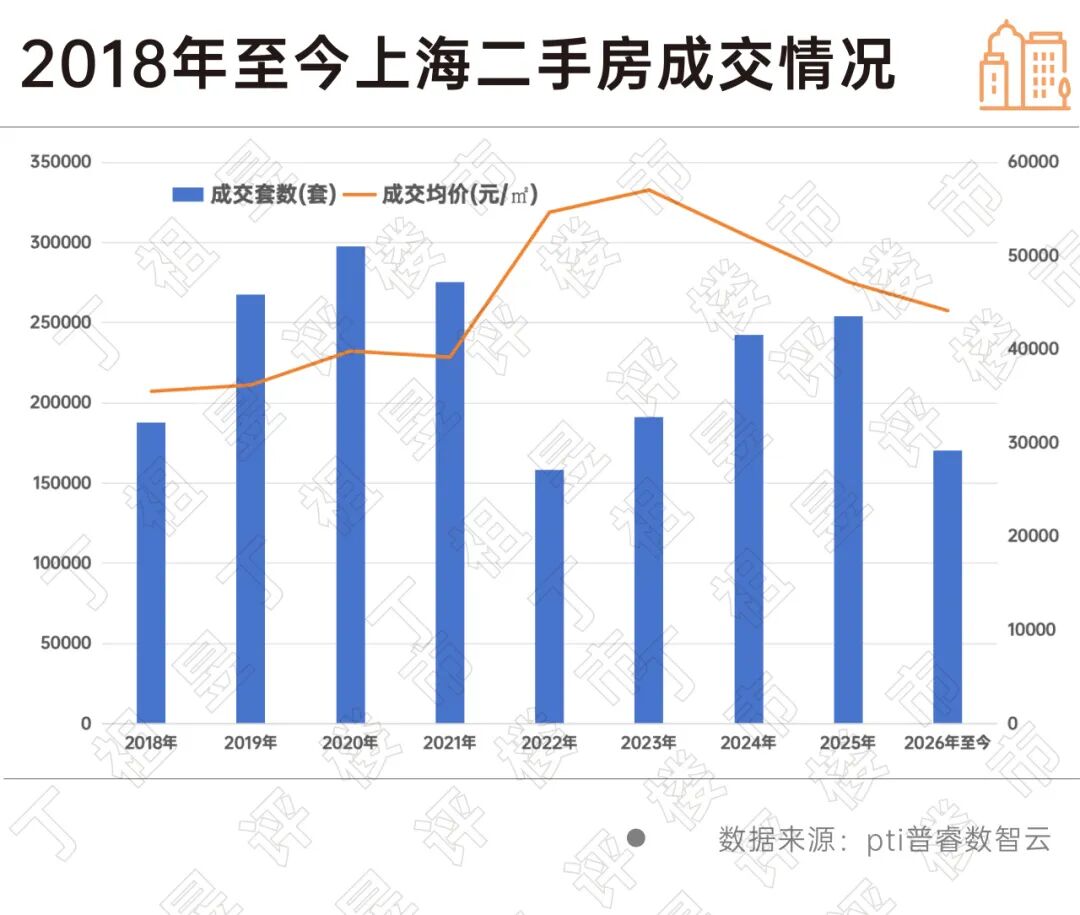
According to data from pti Prui Digital Smart Cloud, the average transaction price of second-hand residential properties in Shanghai continued to decline after reaching a high of 57,062 yuan per square meter in 2023, and has dropped to 44,161 yuan per square meter by 2026, with a cumulative drop of about 22.6% from the high level. Horizontally, the average price in 2026 has fallen below the 2022 level, but it is still about 20% higher than that in 2019, which means that this round of decline has mainly erased the short-term surge from 2022 to 2023.
Under the adjustment of second-hand housing prices, some second-hand houses have begun to "have cost performance". For example, the rental yield of some old and small apartments for extremely rigid demand exceeds 3%, which is higher than the bank deposit rate and the yield of national debt.
Secondly, in terms of product iteration. From the perspective of transaction structure, about 55% of the total transaction price of second-hand houses in Shanghai is below 3 million yuan per unit, and 81% is below 5 million yuan per unit, among which there are many old houses with a construction age of more than 20 years.
In contrast, the current new housing industry is fully embracing the standards of high-quality houses, with high floor area ratio, complete supporting facilities, clubs, three-dimensional gardens, overhead floors, whole-house technology systems, coupled with the iteration of property management and facades, which constitute the differentiated barriers of new generation products.
On one side are old houses with a building age of more than 20 years, outdated house types, insufficient parking spaces, and aging property management; on the other side are new products with higher floor area ratio, supported by technology systems, and complete community supporting facilities. When the floor price of land auction is aligned with the transaction price of second-hand houses, it reflects the value of product iteration over more than ten or twenty years.
Finally, in terms of market expectations. Judging from these 10 land parcels whose floor price is higher than the average transaction price of second-hand houses, most of them will be developed into luxury residences in the future.
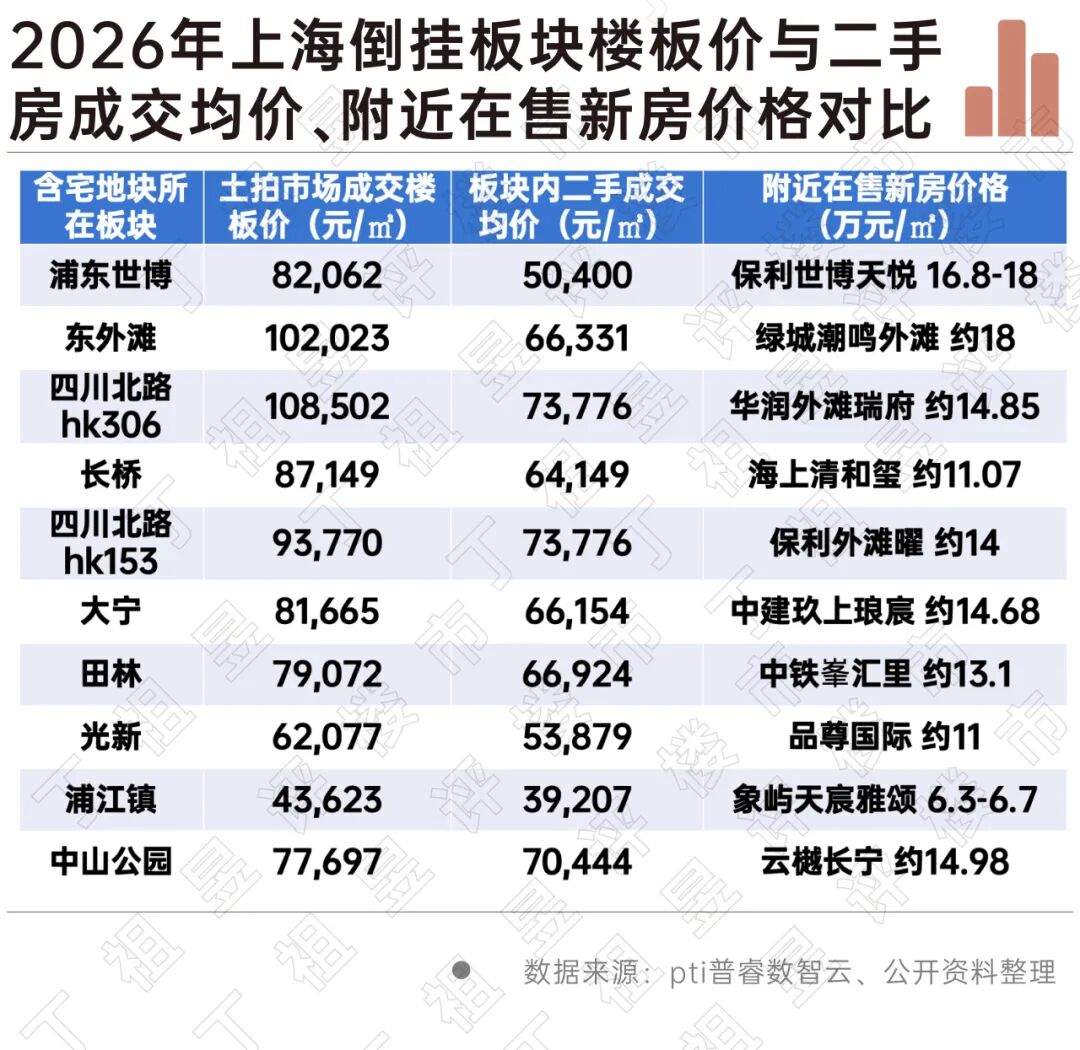
For example, for the residential part of the Badaitou land parcel in East Bund, Yangpu District, after excluding the self-sustained commercial part, the pure residential floor price exceeds 109,000 yuan per square meter, and the selling price is expected to reach 160,000 yuan per square meter; the record-filing average price of Poly Bund Yao, an existing high-end project in the sector, is 140,000 yuan per square meter, and the average price of Greentown Chaoming Bund in the north is about 180,000 yuan per square meter, which still has reasonable profit margins.
Another example is the Nanmatou land parcel located in Pudong Expo, with a transaction floor price of 82,000 yuan per square meter, and the actual floor price after deducting the supporting construction is 92,700 yuan per square meter. The bidding plan includes a decoration standard of 6,000 yuan per square meter, 660 square meters of supporting public service facilities, and 2% of the housing area for high-end talents. About 1 kilometer to the northwest of the land parcel is Poly Expo Tianyue, a riverside luxury residence product with a selling price of about 180,000 yuan per square meter.
It can be seen that the luxury residence prices of these land parcels are in the first tier across the country, and the purchasing power of the new housing market in the core area has been repeatedly verified. Real estate enterprises dare to acquire land at a price higher than that of second-hand houses, betting that the future market is worth such a price.
03
From the perspective of market impact, the land price higher than second-hand housing price first sets a value anchor for the surrounding second-hand houses. Even if the house itself is not favored in the short term, the land is worth so much money, so the second-hand house has a value bottom line. The land price inversion tells the market with real money where the lower limit of core assets in this sector is. For second-hand house owners, when the land price is higher than the house price, the motivation to "sell at a loss" will naturally weaken.
After the anchor point is established, the price of second-hand houses will first stabilize, and transmit along the replacement chain all the way. In the first half of 2026, the total transaction volume of second-hand houses across the country has exceeded that of new houses. According to data from pti Prui Digital Smart Cloud, the transaction volume of second-hand houses in 20 key cities is 2.3 times that of new houses, and Shanghai even reaches 4.9 times. The real estate market has entered the stock era from the incremental era. In the stock market, a large number of housing demands first complete the handover from old and small apartments to relatively new houses in the second-hand housing market, and after multiple rounds of circulation, the ultimate improvement demand is transmitted to new houses.
When the land price in the core sector fixes the value anchor, the price of second-hand houses will first bottom out, the replacement chain will be activated, and the demand will be transmitted in a gradient of old and small apartments, second-hand houses, relatively new houses, new houses, and luxury residences. Forming a virtuous cycle of stock taking the lead and increment following. From this perspective, the market has stood at the starting point of real bottoming out.
The essence of the "price inversion" between Shanghai's land price and second-hand housing price is that the price anchor in the core area is being quietly raised by new land parcels.
The recovery of confidence in the land market is a return to the consensus on the long-term value of core cities. Under the general keynote of controlling increment and destocking, the land acquisition logic of real estate enterprises is more precise, focusing on sectors with solid industrial population, mature supporting facilities, and differentiated and scarce products.
After the prices of these sectors are anchored, the inverted second-hand housing prices will also stop falling. After that, with the bottoming out of second-hand houses and the opening of the replacement chain, the market gradient will be reconstructed for the second time.
It can be seen that the bottom of Shanghai's real estate market has been confirmed.
This article is from the WeChat official account "Ding Zuyu Comments on Real Estate", the author is the editorial department, and is published by 36Kr with authorization.