When Qi Wei develops an AI version of herself, will there be an extra option for brand endorsements?
This month, on multiple social platforms, Qi Wei officially announced the launch of her personal AI digital avatar "Han Qingxia", becoming the first entertainer in China's entertainment industry to voluntarily open standardized image AI authorization.
The digital avatar opens with "Hello, I'm not Qi Wei", clearly drawing the boundary between the real person and the virtual character, and has an independent post-apocalyptic wasteland persona and storyline.
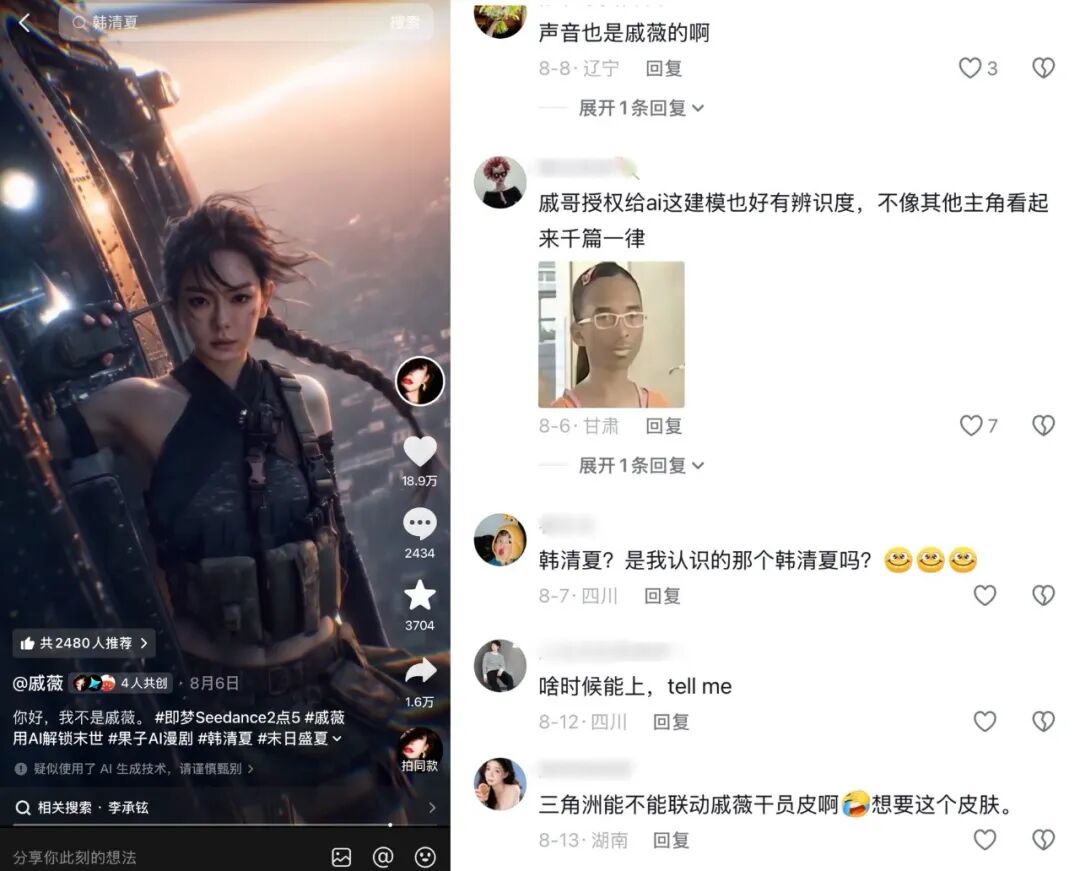
Image source from Douyin
Qi Wei herself also participated deeply, personally adjusting the facial expressions and body movements of the avatar, using her own original voice for dubbing, and participating in the script and content control of the AI comic drama "Doomsday Summer" as a producer.
The first reaction of netizens was not to greet, but to quickly start the "spot the difference" mode, comparing frame by frame. "So beautiful", "thrilling shots", "no need to show abs while wearing a dress", for a while, positive and negative reviews flooded the comment section.
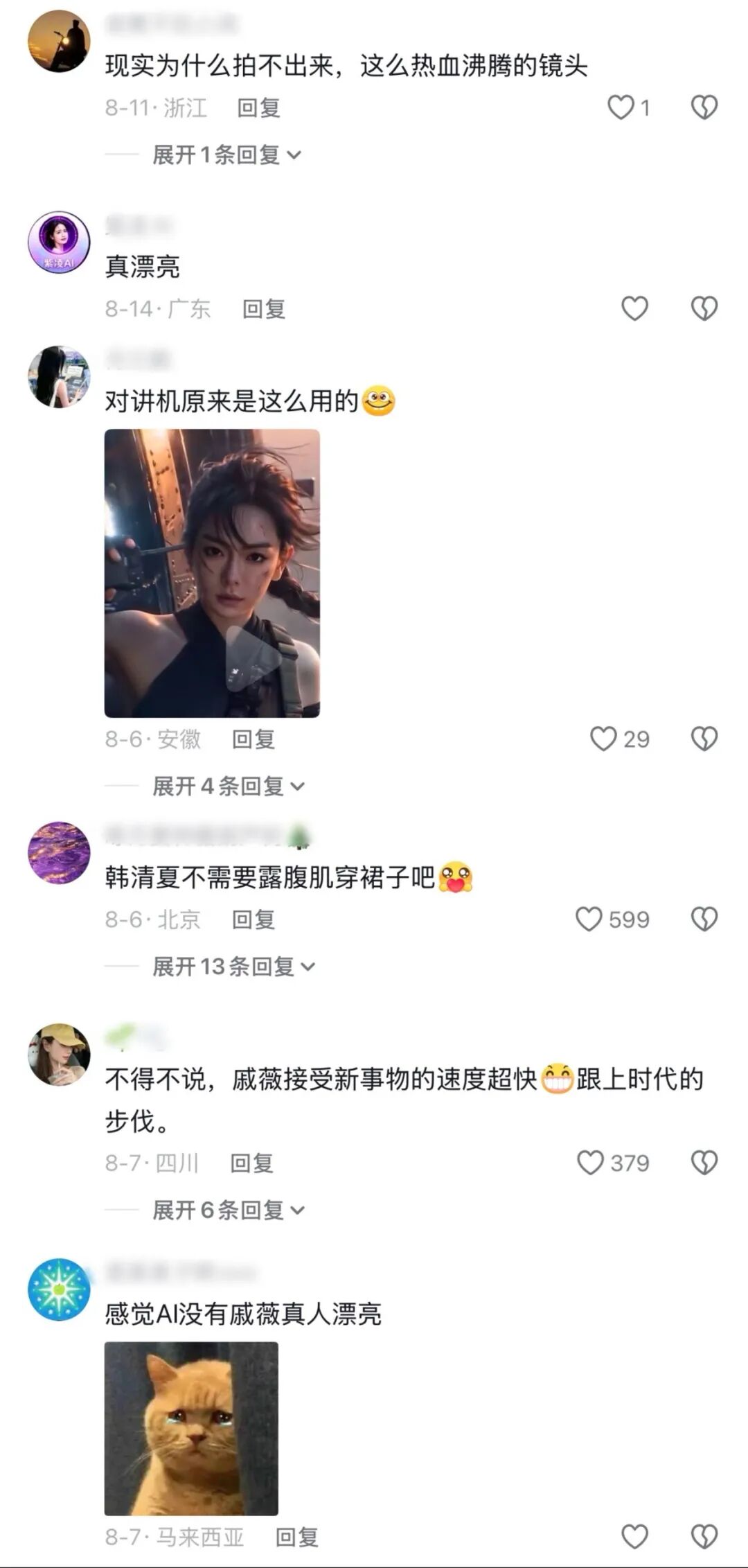
Image source from Douyin
This makes us wonder, when celebrities voluntarily turn their images, voices and expression styles into licensable digital assets, brands are also faced with a new question. When the real person cannot be present, can their avatar continue to operate?
Technology has brought the indistinguishable real and virtual to the forefront. The next questions to answer are whether users accept it, whether brands will use it, and how long the popularity can last? Follow the perspective of "TopKlout" to take a look together.
01
A face can be copied, but can the "human touch"?
A meme can be popular for seven years because new roles, new gameplay and new content are added every year. Looking back on these seven years, from
users creating memes to brands entering the market, and new gameplay emerging every year, the growth of "autumn first drink" has gone through three stages.
Virtual humans are no longer a new species. As early as 2021, @Liuyexi quickly gained followers with a two-minute video. The combination of suspense plot, beauty label and metaverse boom turned her from a virtual face into a "demon-catching beauty influencer" that the whole internet was chasing updates for.
The breakout success of @Liuyexi is the first glance amazement brought by technology display. As the virtual human boom faded, it proved that a face can be seen once, and a continuous persona and content can make people keep paying attention.
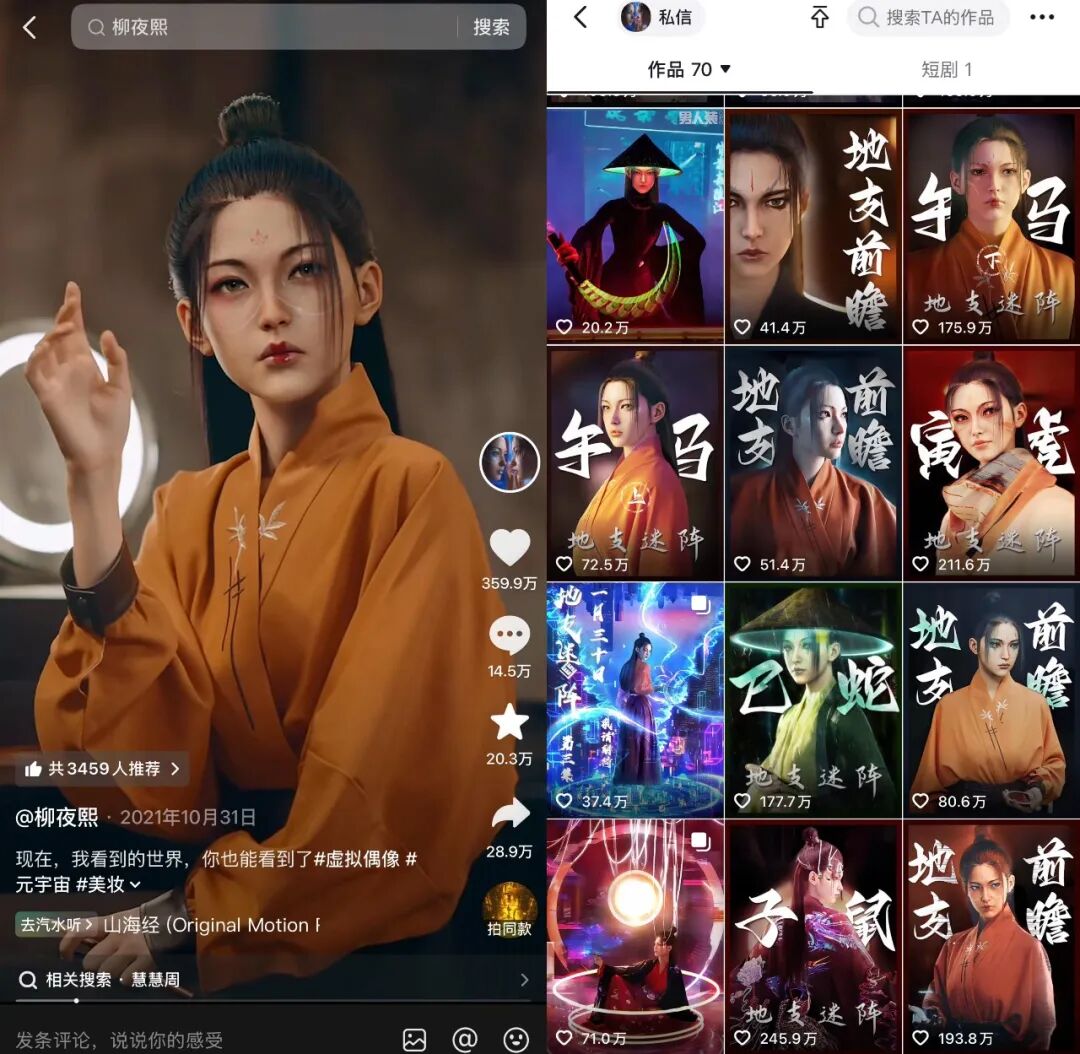
Image source from Douyin
This is exactly the difference between Han Qingxia and Liuyexi. Liuyexi needs to build a worldview from scratch, while Han Qingxia inherits the public recognition that Qi Wei has accumulated over many years. Users already have a set of "Qi Wei standard answers" in their minds about what she looks like and the rhythm of her speech, so they will scrutinize her more strictly.
However, the face can be made very similar, which does not mean the real person is there.
When people like a celebrity, they don't just like their facial features. Works, on-the-spot reactions, personal expressions and special moments constitute the "human touch". AI can learn a person's pauses and small movements, but it is difficult to replicate why they said that sentence at that exact moment.

Image source from Douyin
If only the appearance is online but the expression is like a unified template, the more realistic the face is, the more it looks like a high-definition "electronic standee".
But what technology wants to answer is not only whether it looks like, but also whether it is usable. The face can be copied, but the "human touch" cannot. For brands, avatars cannot make up for the "human touch", but they can fill in the schedule gaps.
When being indistinguishable between real and virtual gradually becomes the standard configuration of technology, the real competitor of digital avatars is not the real human face, but users' emotional memory of real celebrities.
02
24/7 Online
What problems do digital avatars solve
Traditional celebrity endorsements have problems such as tight schedules, limited content output, and high cross-regional shooting costs.
One concentrated shooting can complete TVCs and posters, but cannot cover the growing demands such as live streaming, short videos, and fan interactions. When a hot topic emerges, brands want the spokesperson to respond to the meme quickly, but they may first run into the problem of the entertainer's conflicting schedule.
Digital avatars just fill these gaps. They can quickly generate multi-version materials, complete product explanations, multilingual content and long-tail interactions. They never get tired or sleepy, and can handle densely scheduled, complex-script live streaming marketing scenarios.
In the past, the endorsement mode of "one shooting, centralized release" has the opportunity to become a continuously updated content form. The digital avatar of Luo Yonghao has verified this possibility. According to National Business Daily, in 2025, Luo Yonghao's digital avatar completed a 6.5-hour live stream on Baidu E-commerce, attracting more than 13 million views, with GMV exceeding 55 million yuan, and the sales volume of some categories exceeded the performance of the real-person live stream in the same period before.

Image source from Weibo
For the gap in time, e-commerce platforms have already run out the answer with real money. For example, in the live streaming rooms of JD.com, many brands choose digital humans for 24-hour non-stop live streaming. Moreover, the daily cost of JD Cloud Yanci digital human is less than 100 yuan, and it can go live in as fast as two hours. No matter how dedicated a real anchor is, they cannot achieve such duration and production capacity.

Image source from JD Live
When digital avatars can be online 24 hours a day, produce content in batches, and fill in shifts at any time, endorsement has a new meaning. The endorsement of a real celebrity is one-time shooting, while the endorsement of a digital avatar is continuous online content output.
What brands get is not a cheaper celebrity, but an option that can be called at any time.
03
Can digital avatars become really popular?
As for whether digital avatars can become really popular, Liuyexi's previous explosive popularity and subsequent silence have already provided a reminder.
According to data from QuestMobile, the GMV of virtual anchors in 2023 was less than one fifth of that of real anchors. After the freshness fades, problems such as high production cost, homogeneous content and insufficient interaction are gradually exposed. Users may be willing to watch once to see "this is unexpectedly not a real person", but they will not come back to check in every day for the same welcome script.
This also explains why digital avatars are not new technology anymore, but still have not been widely included in brand endorsement lists. Endorsement is not just about letting a celebrity's face read the advertising lines. What brands really borrow is the celebrity's real resume, aesthetic choices and public image.
Many brands still need the feeling of the real person being present. Red carpets, fashion shows and offline events can show a sense of reality, and the fact that "the celebrity really chose it" also becomes part of the brand story. The face can be copied, but these relationships and endorsements accumulated over time cannot be generated with one click.
The performance of Luo Yonghao's digital avatar is also a verification. It can fill in time slots, expand production capacity, and repeat explanations, but what drives the transaction is still Luo Yonghao's years of accumulated language style, product selection credibility and traffic.
The core reason why audiences pay is still the name "Luo Yonghao", not an AI personality that can exist independently of the real person. If you remove the real person's assets and only leave the technical shell, the commercial results may not be reproducible.
Looking back, whether Qi Wei's digital avatar can go further first depends on whether Han Qingxia has her own content mission. She can try high-frequency interaction, cross-language content or virtual-reality linkage. If she only repeats what Qi Wei has said with AI, the freshness will be used up soon.
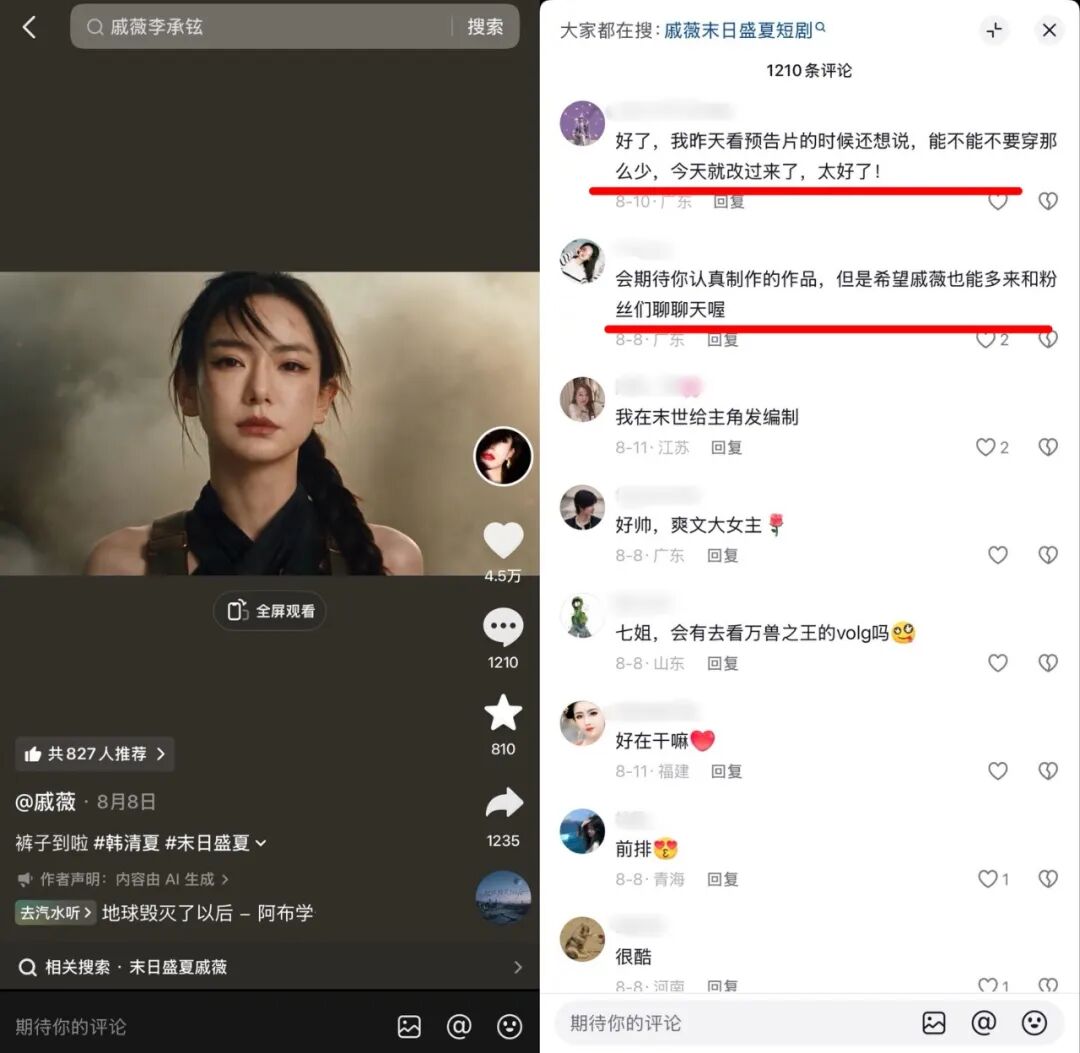
Image source from Douyin
Secondly, what brands need is not just the popularity during the release period, but also reviewable commercial results. Indicators such as how much content output has been increased, the number of effective interactions and conversions, etc. If the data can be stably achieved, it will become a regular option in the budget sheet from a technology show.
More importantly, brands must let users know "who is speaking". Clearly marking the AI identity and explaining the scope of authorization will help build trust. If consumers are misled into thinking that the celebrity is personally recommending, they will gain traffic in the short term, but the credibility of both parties will be overdrawn in the long run.
Social platforms will become the key field for digital avatars to develop "human touch". Netizens' finding faults, meme creation and secondary creation are also helping the new identity enrich content. A truly vibrant avatar should not just be an on-demand advertising player, but also be able to respond to users' emotions.
When people no longer ask "is this really a real person" and start to look forward to "what will Han Qingxia do next", the digital avatar has truly crossed the popularity threshold.
So at least at this stage, digital avatars are more like an incremental tool for brand marketing, suitable for creating topics at the first release, filling live streaming shifts and producing content in batches. At present, it is still difficult for them to become the core spokesperson of brands, especially high-end brands.
Its most mature value is to have one more working avatar. If it only has a sufficiently realistic face, but no continuous content, independent personality and verifiable commercial results, after the popularity fades, it may still be just a more delicately packaged technology gimmick.
04
Conclusion
When celebrities are turned into digital avatars, there will most likely be one more option for brand endorsement, but this problem is not a choice between real person and AI.
Technology will make celebrities' faces easier to copy, and also make the real "human touch" more valuable. For actors, AI may become a second interface to amplify personal value. In the future, what brands need to choose may be a new structure, that is, which highlight moments are completed by real people, and which high-frequency demands are handed over to digital avatars.
After all, being able to be online all the time is just the basic operation. Being able to make people always want to watch is the real skill.
This article is from WeChat official account "TopKlout" (ID: TopKlout), author: Xiao Yang, published with authorization from 36Kr.