Tims China: It can neither become Starbucks nor successfully emulate Luckin Coffee.
01
Not Optimistic!
Performance Declines for Two Consecutive Quarters
The situation of Tims China is getting increasingly worse.
The first quarter was already tough, and the second quarter saw further decline. Even Zhang Guohua, the brand's new CEO, frankly described the performance as "disappointing".
Looking at the first quarter first, Tims China's revenue reached 257 million yuan, down 14.6% year-on-year, with a net loss of 109 million yuan, expanding by 113.98% year-on-year; system-wide sales amounted to 323 million yuan, down 14.2% year-on-year.
Breaking down the figures, the problem mainly lies in the store business. Revenue from self-operated stores was 207 million yuan, down 18.7% year-on-year; same-store sales decreased by 12.4% year-on-year, the average customer unit price dropped by 7.5% year-on-year, and order volume fell by 11.2% year-on-year.
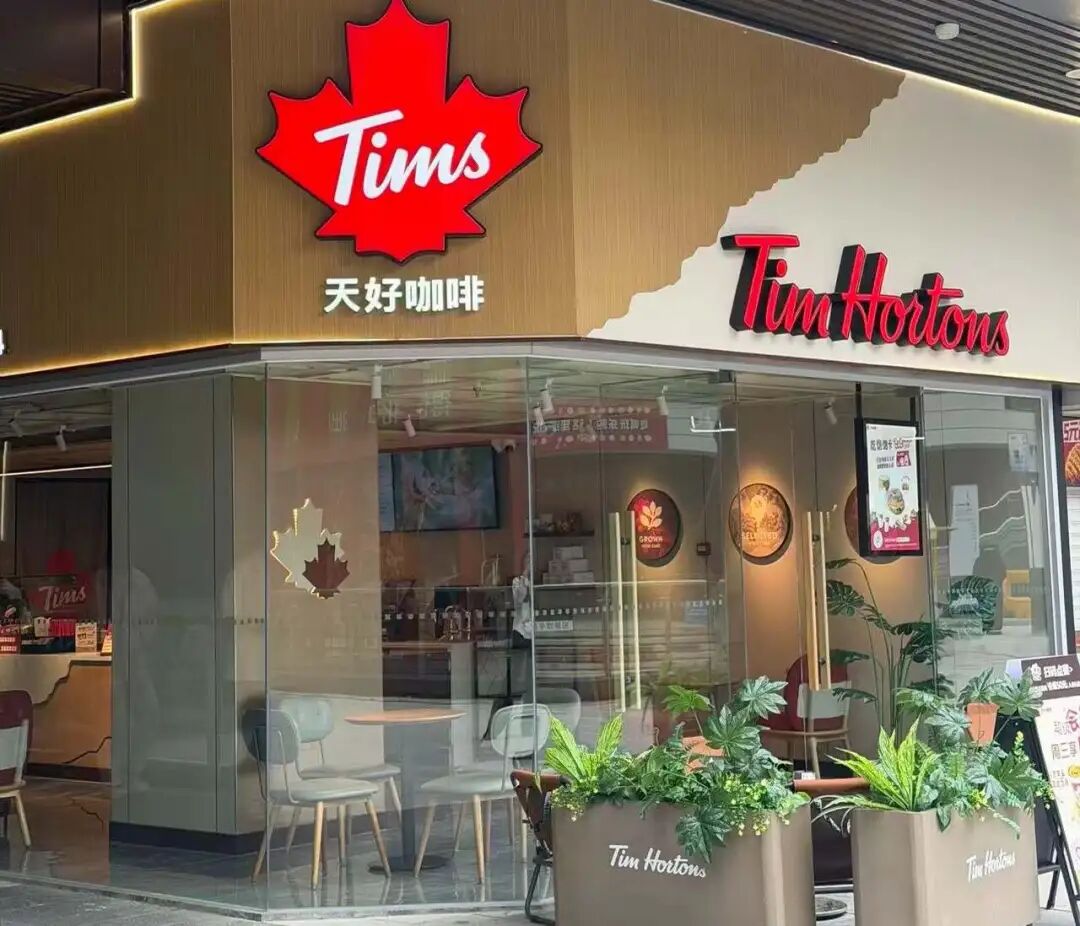
Entering the second quarter, this pressure became more prominent. Tims China's revenue hit 273 million yuan, down 21.67% year-on-year; net loss stood at 97.469 million yuan, widening by 28.38% year-on-year; system-wide sales reached 347.8 million yuan, down 15.1% year-on-year.
Self-operated stores still recorded the most significant decline. Their revenue was 221 million yuan, down 21.6% year-on-year, same-store sales decreased by 17.3% year-on-year, the average customer unit price fell by 0.9% year-on-year, and order volume dropped by as much as 20.7% year-on-year.
Overall, fewer customers are coming, and they are spending less when they do come.
In terms of stores, as of June 30, 2026, Tims China had a total of 1,028 stores, including 544 self-operated stores and 484 franchised stores. Only 2 new stores were added net during the period, which is almost standing still in the chain coffee track that relies most on scale.
The most awkward situation Tims China is facing now is that it has neither achieved growth nor maintained its original business performance.
Worse still, Tims China is facing relatively severe cash flow pressure.
Financial reports show that as of June 30, the total amount of cash, cash equivalents and restricted cash of Tims China was 121.1 million yuan, compared with 129.7 million yuan at the end of last year. Among them, cash and cash equivalents on the account were only 107.8 million yuan.
02
7 Years Since Entering the Chinese Market
Cumulative Net Loss Has Exceeded 3.1 Billion Yuan
The problems of Tims China certainly did not emerge suddenly in 2026.
From 2020 to the first half of 2026, Tims China's cumulative net loss was about 3.196 billion yuan. In other words, 7 years after entering China, Tims China has never achieved profitability for a full fiscal year.
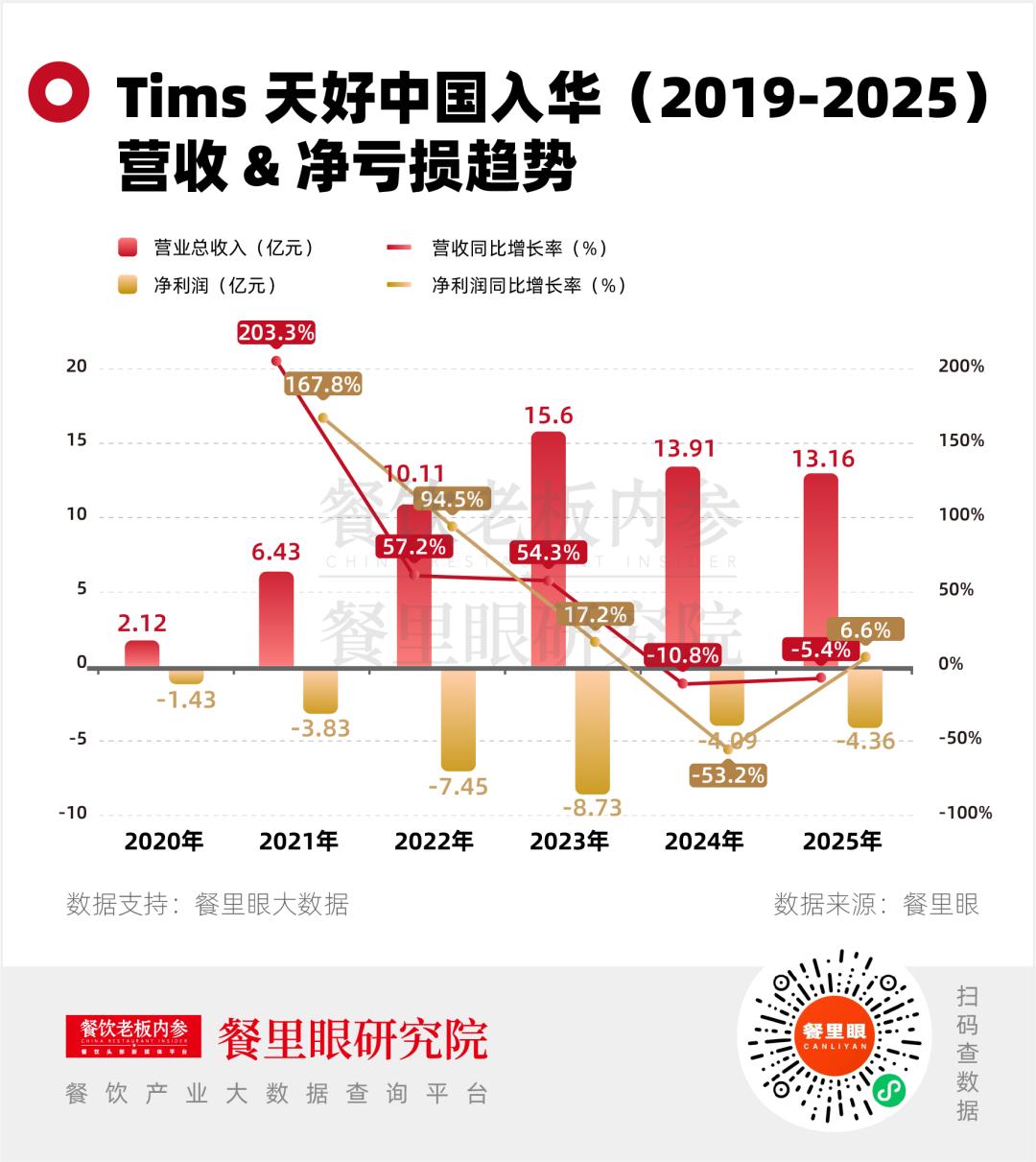
Behind this 3.1 billion yuan loss, there is actually a story of Tims China constantly chasing the changes of the Chinese coffee market and adjusting itself repeatedly.
The industry trend has changed round after round, and Tims China has followed to adjust again and again.
2019-2022: The Industry Witnessed Crazy Expansion, and Tims China Chose to Follow the Trend
In 2018, RBI, the parent company of Tim Hortons, established Tims China as a joint venture with Cartesian Capital. In February of the following year, Tims China opened its first store in China at People's Square, Shanghai.
At that time, the Chinese coffee market was in a rare window period. Luckin recovered from the turmoil, local coffee brands received intensive financing and opened stores rapidly. The consensus that "the more stores, the larger the scale, the greater the opportunity" almost became the industry's common belief.
At that time, Tims Coffee was renamed Tims Coffee China, adopting a Chinese name to show its determination to accelerate localization and strengthen consumers' coffee-related brand awareness. With the positioning of "North American coffee + warm food", it did not compete head-on with Starbucks for the high-end third space, nor did it fully follow the specialty coffee route. Instead, it aimed to build a more daily and more popular coffee brand.
Therefore, Tims China began to open stores rapidly. The number of stores increased from 31 all the way to 617.
It is worth noting that the expansion at that time focused heavily on directly-operated stores. Direct operation means that the headquarters needs to bear higher rent, labor and operating costs. As more and more stores are opened, costs also rise accordingly. A somewhat awkward situation emerged: the scale was growing, and the loss was also growing.
2023: The 9.9-yuan Coffee Era Came, and Tims China Suddenly Found Itself Stuck in the Middle
By 2023, the rules of the game began to change. Cotti entered the market, kicking off the 9.9-yuan price war; coffee delivery became more and more common; Luckin and new local brands kept launching new products and opening new stores. Coffee has become a daily consumption that more and more people can afford every day.
This is not good news for Tims China.
In 2023, Tims China's revenue reached 1.56 billion yuan, and the number of stores exceeded 900, which seemed to be performing well. But another set of figures was very eye-catching: the annual loss was 873 million yuan, the largest annual loss since it entered China.
The problem is that Tims China, which was priced at 20-30 yuan, began to be caught in the middle. On the upper end, it does not have as strong brand premium as Starbucks; on the lower end, it is difficult to compete with Luckin and Cotti on price. Squeezed from both sides, it cannot win over fast-coffee consumers who pursue cost-effectiveness, nor can it enter the slow-coffee customer group that pursues experience.
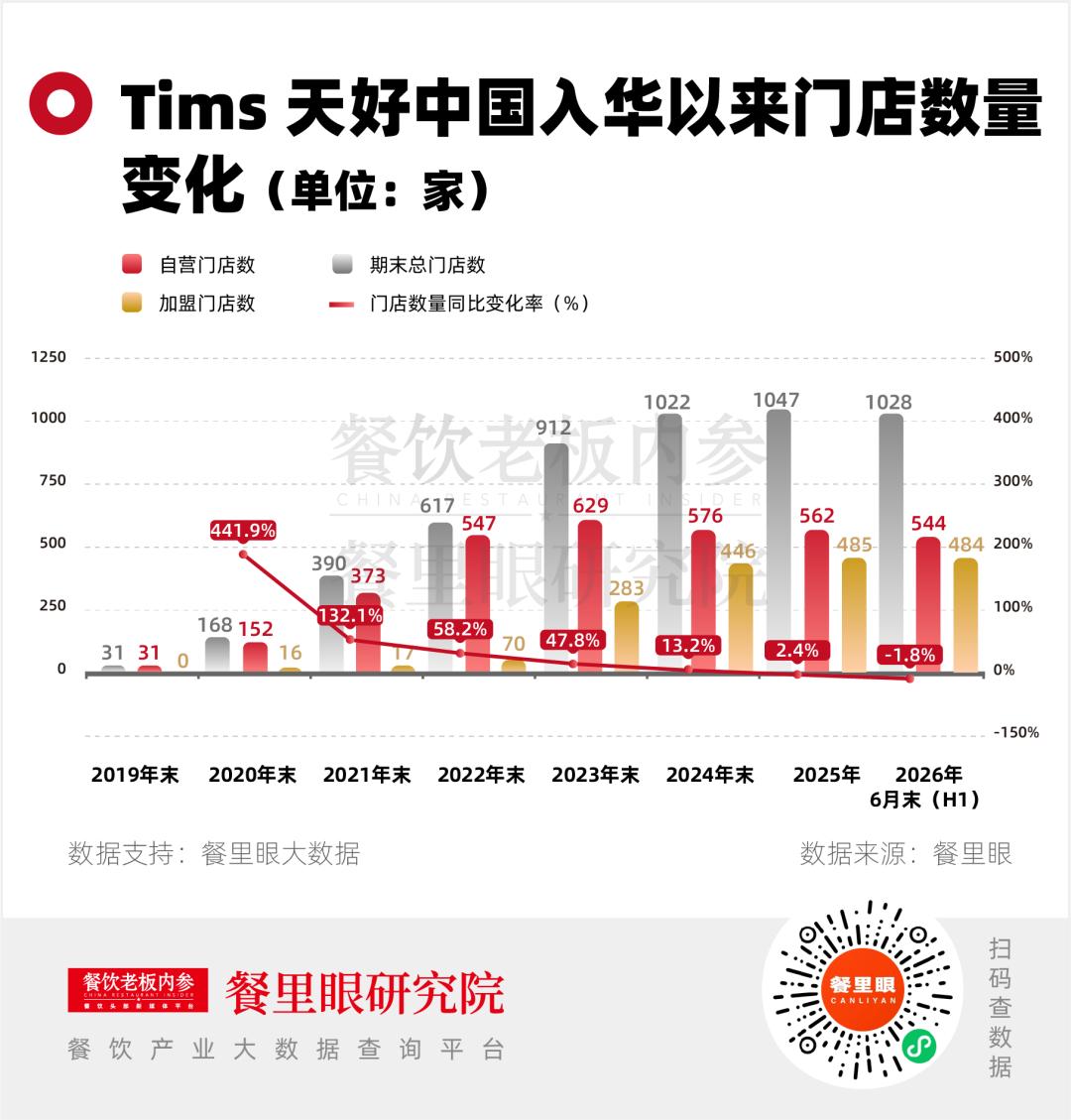
Therefore, since 2023, Tims China has continuously lowered the threshold for joining, trying to quickly seize the market with a parallel model of direct operation and franchising.
2024-2026: The Industry Began to Shift, and Tims China Also Started to Contract
By 2024, the game of the coffee industry has changed again. The era of crazy store opening gradually passed, and the industry shifted from "scrambling for scale" to "striving for profitability", from "charging forward" to "surviving first".
In addition, the takeaway price war further intensified in 2025, and Tims China also tried to grab traffic from this takeaway war.
With larger discounts, Tims China once pushed up the proportion of digital orders, but the orders brought by subsidies also came with bills. In the fourth quarter of 2025, takeaway revenue accounted for 65.6% of the revenue of self-operated stores, and the proportion of distribution costs rose to 13.3%. After the platform subsidies faded, in order to retain orders, Tims China needed to keep giving profits, resulting in pressure on both order volume and customer unit price, and same-store sales also declined accordingly.
As a result, Tims China has gradually eliminated stores with high rent, large area and poor operating performance, completely bidding farewell to the stage of scale expansion.
03
Is Mediocrity a "Sin"?
A Coffee Brand With an Awkward Positioning
It can be seen that Tims China has been constantly changing over the past 7 years.
But after all these changes, it never seems to find a position that consumers can truly remember and that can bring itself stable profits.
This may be the core problem of Tims China today: it is not that it has no characteristics, but that its characteristics are not strong enough; it is not that it has no consumers, but that consumers have no reason to choose it over others.
After all, Starbucks emphasizes coffee, space and brand experience, while Luckin later focuses on high frequency, low price and convenience. If Tims China can make "coffee + warm food" its own unique consumption scenario, it can theoretically find its own market share.
In recent years, warm food products such as bagels, sandwiches and wraps have indeed become an important label that distinguishes Tims China from other coffee brands.
This is actually a good differentiated path. Lu Yongchen, the former CEO, once told the media last year: "If all the bagels we sold are stacked together, they can reach a height equivalent to 3,700 Oriental Pearl Towers."
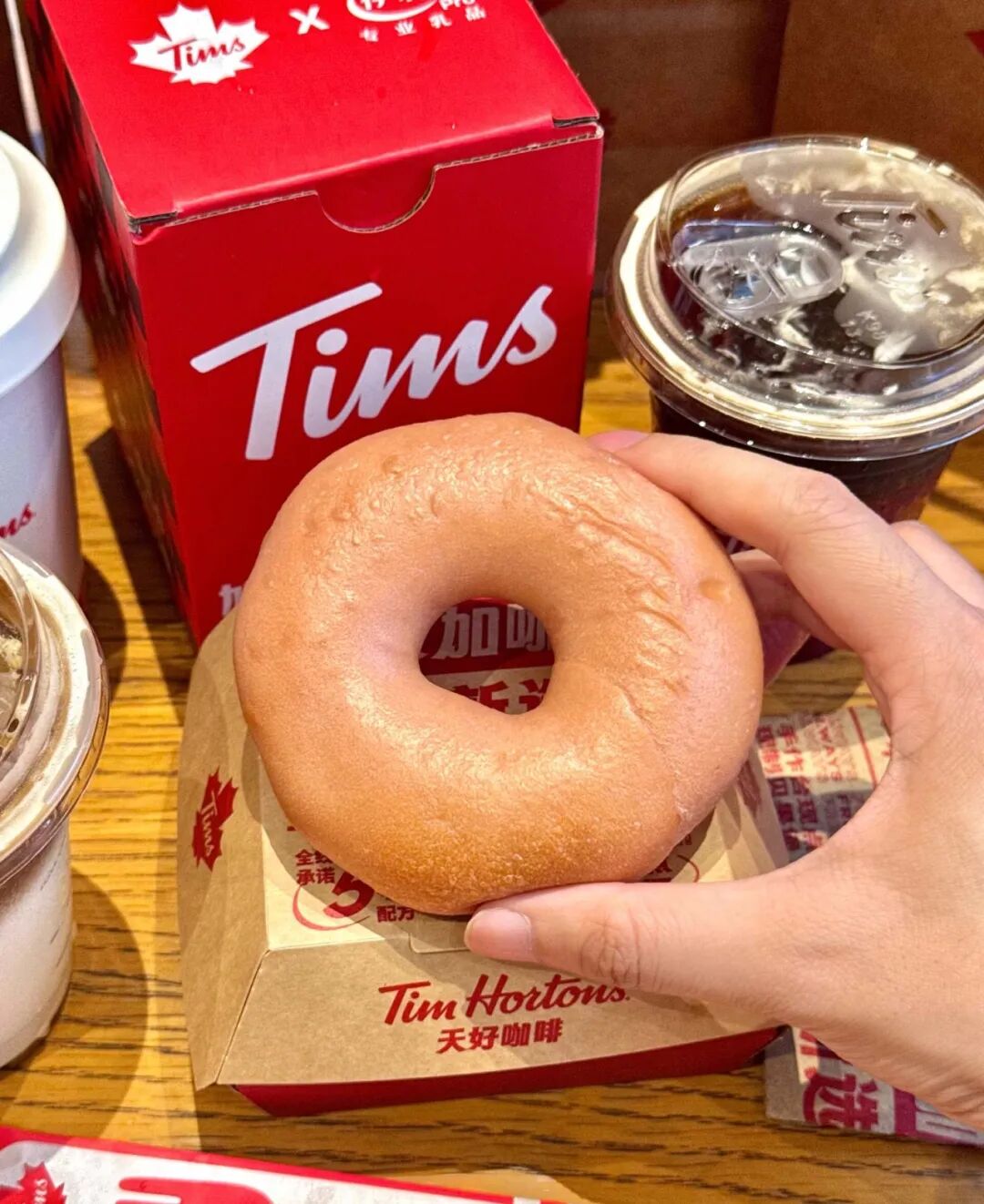
But the problem is that warm food is a much more complicated business than coffee. The core coffee products are relatively standardized, while bagels and sandwiches involve more ingredients, processing, cold chain, loss and in-store operation, which put higher requirements on supply chain and operation capabilities.
Worse still, this differentiation has not been maintained all the time. A deeper change is taking place in China's ready-to-drink beverage industry: the originally clear category boundaries between coffee, milk tea and fruit tea are rapidly blurring.
In the past, consumers' consumption mindset was relatively simple - if you wanted coffee, you went to a coffee shop, and if you wanted milk tea, you went to a milk tea shop. But now, brands are no longer competing for a single category, but for consumers' daily beverage needs and more consumption time slots.
Expanding the menu has become an increasingly common competitive strategy. Coffee brands have started to sell tea drinks, fruit drinks, baked goods and light meals, while tea brands are also expanding their coffee, breakfast and light food offerings. The boundaries between categories are blurring, and brands are competing for different consumption scenarios of the same consumer at breakfast, afternoon tea, work breaks and even at night.
As a result, Tims China's original differentiation has been gradually diluted. It has not built a strong enough brand mindset in the coffee category, nor has it formed a deep enough consumption barrier in food service.
From the consumer side, Tims China lacks a distinct enough advantage that can form a stable cognitive mindset, no matter in terms of products, services, prices or consumption experience. In other words, consumers know Tims China, but they may not be able to answer "why must I choose Tims China".
04
The Collective Downturn of Overseas Coffee Brands
In fact, Tims China entered the Chinese market at a relatively late time.
Starbucks entered China in 1999, and by 2018 it had about 3,600 stores, and had built a very strong brand awareness and "third space" mindset in the Chinese market. Starbucks basically took up all the dividends that the earliest batch of overseas brands could enjoy - brand education, consumption habit education and coffee culture education.
After 2018, the Chinese coffee market began to enter a completely different competitive stage. Local brands such as Luckin and Cotti rose rapidly, and coffee began to become a more high-frequency, immediate and convenient daily consumption. The focus of market competition has shifted to who has faster product iteration, more scenario coverage, more attractive prices and higher store efficiency.
Not only Tims China, but overseas coffee brands that entered China in the past few years have generally failed to meet expectations. Costa and Lavazza are very typical examples.
Costa was once one of the overseas brands that had the best chance to challenge Starbucks in the Chinese market, but now it has also entered a contraction period. Store closures first started in third- and fourth-tier cities, and then gradually spread to first- and second-tier cities. It has withdrawn from cities such as Nanchang, Xiamen and Tianjin one after another, and currently its operating stores across the country have been reduced to about 256.
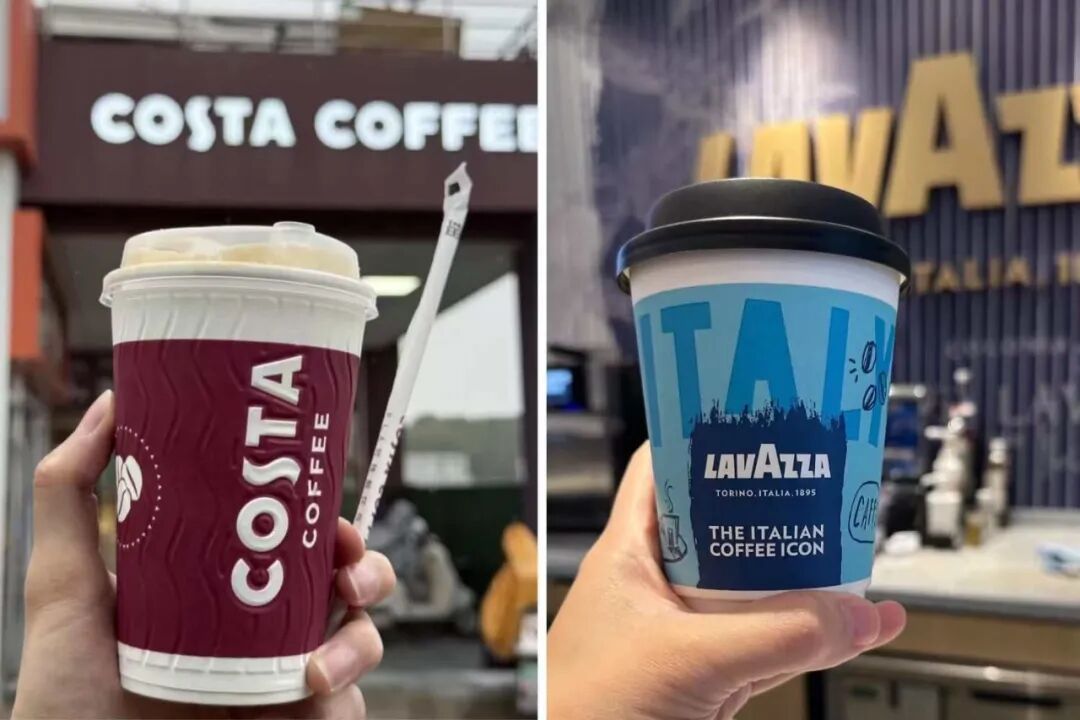
Lavazza's story is very similar. In 2020, Lavazza entered the Chinese market and once set a target of opening 1,000 stores by 2025. But by the end of 2025, there were about 150 stores in mainland China. Recently, it has successively withdrawn from markets such as Changsha and Ningbo, entering the adjustment stage of contraction and focusing on core cities.
This means that it is difficult for brands to achieve growth in the Chinese market just by relying on the aura of an overseas brand. What overseas coffee brands are facing is not the problem of "how to expand in China", but how to prove that they are still worth choosing for Chinese consumers.
Therefore, for a number of overseas coffee brands at present, the priority is "to stay alive as long as possible".
Hold on to core cities, maintain brand mindset, and find their own niche consumer groups. The Chinese market is large enough, and consumption trends are constantly changing. No one can be sure what will happen in the next cycle.
Maybe one day, when the Chinese coffee market changes again, overseas brands can see their own opportunities again.
05
Tims China Is Not Ready to Admit Defeat
With two consecutive quarters of declining performance and a cumulative loss of over 3.1 billion yuan in 7 years, Tims China obviously does not intend to give up easily.
In fact, the "leadership reshuffle + capital injection" two months ago already shows that the brand is still making efforts.
In June this year, former CEO Lu Yongchen was promoted to Group Chairman, and Zhang Guohua, who once worked at Nestle, Coca-Cola and Procter & Gamble, took over as CEO. At the same time, Tims China continues to receive financial support from its parent company, and announced that it plans to issue up to 55 million US dollars of convertible bonds to supplement working capital and optimize its store network.
On the other hand, Tims China's financial reports are not completely without good news.
As of June 30, 2026, the total number of members in its registered membership club reached