The Pricing Power of Traffic Platforms: The Real Issue Avoided in This Round of Discussions
Recently, a statement has sparked heated online debate: real enterprises work hard on production, and offline merchants bear rent and labor costs, yet most of the profits are taken away by e-commerce platforms in the middle of the transaction chain.
This virtually sets e-commerce against brick-and-mortar entities. In fact, e-commerce is an integral part of the real economy, and it is connected to manufacturing, warehousing, logistics and employment behind the scene. More importantly, no matter e-commerce platforms, brand merchants, or offline entities such as restaurants and hotels, all need to purchase access to reach consumers from upstream traffic platforms.
In this round of discussions on merchant profits, what is truly bypassed is precisely the pricing power of traffic platforms.
01
Merchants have to buy the chance to "be seen" even before they start selling goods
According to QuestMobile data, as of December 2025, the scale of monthly active users of mobile Internet has reached 1.276 billion. Meanwhile, the average daily usage duration and times per user across the whole network are 7.96 hours and 112.9 times respectively, up 6% and 2.1% year on year. Short videos, online videos and instant messaging dominate the growth of user duration.
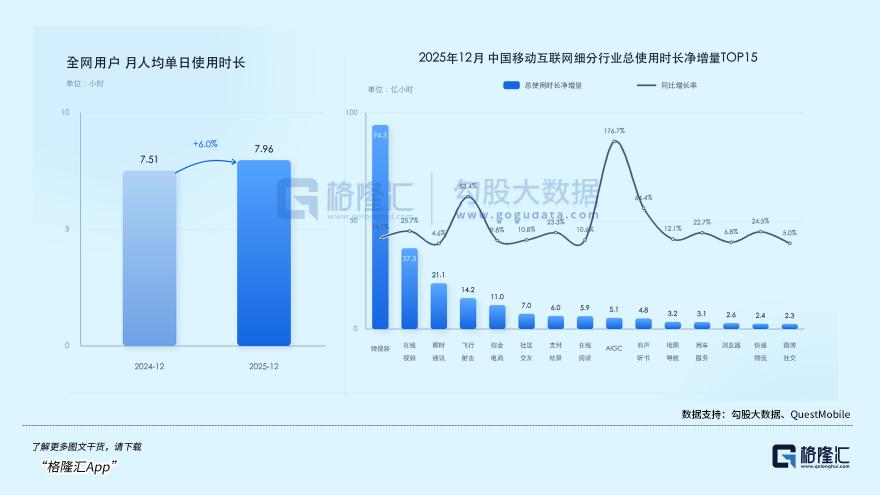
Such concentrated usage duration means that the entry of consumption decision-making is controlled by traffic platforms. And where consumers are, business must go there.
Traffic itself is not a bad thing. It lowers the threshold of communication, giving new brands, small stores and products from remote areas the chance to be discovered by more people. The real problem is that when consumers' time is highly concentrated in a few entrances, traffic gradually changes from an optional marketing tool to an almost unavoidable business cost.
The pricing power of traffic platforms is not only reflected in the unit price of advertisements. Who can be seen, how much needs to be paid to be seen, whether exposure can continue after stopping payment, and whether traffic can finally be precipitated into the enterprise's own customers, are all part of this pricing power.
What it determines is no longer just the price of a single advertisement, but the cost for a business to approach consumers.
Both e-commerce and offline brick-and-mortar entities have become buyers of the same attention system. No matter online or offline, no matter what type of consumer goods industry, as long as enterprises need to find consumers, they may have to buy the chance to "be seen" from the traffic entrance first.
02
Traffic is becoming the "second land rent" of business
In the past, merchants were willing to pay high rent for good storefronts, because good locations controlled stable pedestrian flow.
Today, the positions on mobile phone screens are equally scarce. An offline store not only has to pay rent in the real world, but also compete for positions in the digital world. Traffic thus becomes the "second land rent" of business.
Even if a restaurant has great taste, if it does not enter the content and recommendation systems that consumers frequently use, it may be submerged in the selection process; even if a hotel has excellent services, without continuous exposure, good reputation may not be converted into stable customer sources.
The financial data of listed consumer enterprises also confirms this trend.
These listed enterprises come from all walks of life, operate across the whole domain, and run both offline channels and e-commerce. Their situation can better reflect that: the influence of traffic on brand operation is all-round, not limited to any specific platform or channel.
The sales expense ratio of Proya has risen from 42.98% in 2021 to 49.63% in 2025, exceeding 40% for five consecutive years and increasing year by year.
The change of Marubi Bio-tech is also obvious, whose sales expense ratio has exceeded 50% in the past three years. In 2024 and 2025, sales expenses increased by 36.38% and 25.80% respectively, both exceeding the operating revenue growth rates of 33.44% and 16.48% in the same period.
Similar pressure does not only exist in the beauty industry.
The sales expense ratio of Breo from 2023 to 2025 is about 54.0%, 50.1% and 53.0% respectively. Almost half of the operating revenue is converted into sales expenses.
Roborock's sales expenses increased by 73.20% and 64.95% in 2024 and 2025 respectively, both faster than the operating revenue growth rates of about 38% and 56.51% in the same period.
Even for well-known brands with solid offline operation foundation among the public, traffic cost is changing from "operation cost" to "survival cost". Without traffic investment, they may be quickly marginalized.
Listed companies already have strong brand foundation, operation scale and professional marketing teams, yet they still can not get rid of the high cost of consumer reach. If listed companies are in such a situation, the vast number of small and medium-sized enterprises and store merchants with more limited funds, weaker brand awareness and lower bargaining power will probably face even more difficult situations.
Although not every sum of sales expense flows to traffic platforms, these data collectively reveal a structural phenomenon: for more and more consumer enterprises and stores, producing goods and providing good services is only the first half of the cost, while gaining consumers' attention is becoming the second half with higher cost and weaker bargaining power.
03
A good traffic ecosystem should not trap everyone in traffic
The impact brought by traffic pricing power will not stay on financial statements. It will also change how enterprises allocate resources and what enterprises compete for in essence.
The more expensive the traffic is, the smaller the profit margin will be; when profits are squeezed, it is more difficult for enterprises to continuously invest in R&D, quality and services; when products and brands can hardly form stable organic growth, they can only rely on promotions and investment to maintain sales volume; the deeper the dependence on investment, the harder it is to get rid of traffic costs.
The reason why this cycle is hard to break is also related to the algorithm allocation mechanism of traffic.
Clicks, stay, interactions and immediate transactions can be quickly identified and fed back, while whether the product is durable, the service is reliable, and the R&D is effective takes a much longer time to verify. When traffic is more tilted towards short-term, quantifiable results, enterprises will naturally allocate resources to links that can generate data faster.
This does not mean that enterprises are unwilling to make good products, but when "no investment means no sales" becomes a realistic pressure, investing in R&D that will pay off in three years often cannot compete with purchasing exposure for tomorrow.
Traffic is supposed to help good products find consumers. But when the ability to acquire traffic gradually replaces the ability to create value, the tool begins to shape business in turn. Enterprises may raise prices, or cut down investment in products and services. Eventually, the traffic cost will be transmitted along the industrial chain, and borne by consumers and the whole society together.
To solve the problem, we do not need to go back to the era without traffic platforms, nor deny the value of digital marketing, but return traffic to the position of a tool.
Traffic platforms need to transform from sellers of exposure to co-builders of the ecosystem. With more transparent and stable rules and more reasonable customer acquisition costs, they can make quality, reputation, repurchase and services gain long-term returns. Enterprises also need to reduce their dependence on short-term explosive growth, and re-invest more resources in products, services and customer relationships.
Traffic can buy a single click, but it cannot buy long-term trust; it can buy temporary sales volume, but it cannot automatically precipitate into a brand. Truly sustainable growth ultimately comes from products, services and customer relationships.
The value of traffic should be to help good products be seen faster, rather than making all businesses can only be seen by purchasing traffic.
This article is from WeChat Official Account "Gelong", written by Belon Industry Research, and released with authorization from 36Kr.