NetEase Cloud Music does not want to let Qishui Music snatch away its last note.
In 2013, when NetEase Cloud Music first broke into the sky of China's digital music market, Tencent Music had already built a solid moat with its huge copyright empire. On the frontal battlefield of the copyright war, NetEase Cloud Music barely had any chance of winning.
However, NetEase Cloud Music opened up a differentiated path: community and algorithm. The organic integration of the three major functions — playlists, comment sections, and private FM — allowed NetEase Cloud Music to bypass copyright barriers and directly tap into the younger generation's demand for "music roaming" in their spiritual world.
This set of strategies was all the rage in the mid-to-late 2010s. The unique "Cloud Village" culture built extremely high user stickiness among young people, and the term "NetEase Depression Cloud" once evolved from a joke to a cultural symbol. The story sharing and emotional resonance in the late-night comment sections constituted the most unique brand spiritual asset of NetEase Cloud Music.
However, the tide of the era has finally crossed the inflection point. This barrier built on textual sentiment and static recommendation is being diluted by ByteDance's Qishui Music, and NetEase Cloud Music is obviously unwilling to surrender.
On August 20, NetEase Cloud Music released its financial report for the first half of 2026. The financial report shows that total revenue in the first half of 2026 was 3.959 billion yuan, a year-on-year increase of 3.40%; net profit was 809 million yuan, a year-on-year decrease of 57%; gross profit was 1.474 billion yuan, a year-on-year increase of 5.9%.
(The one-page infographic of NetEase Cloud Music's financial report is as follows, unit: 100 million yuan, all data is from Wind, sorted by Financial Chronicle)
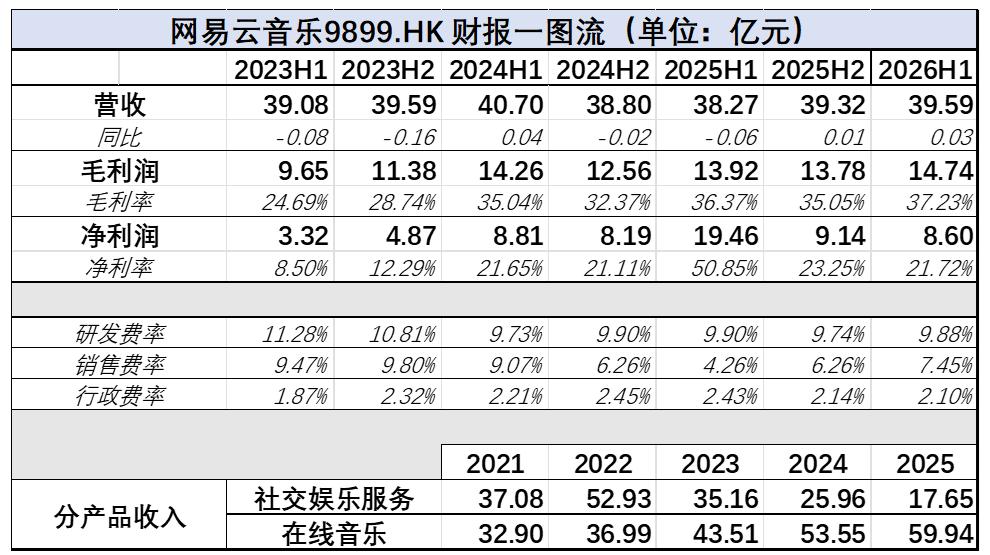
From the perspective of the financial report, on the revenue side, NetEase Cloud Music has maintained relatively stable growth. However, the performance on the cost side is not satisfactory. Against the general background of cost reduction and efficiency improvement, NetEase Cloud Music has chosen to increase investment against the trend. In our view, NetEase Cloud Music does have a good investment window at present, but focusing only on online music services and returning to a narrow track may not be a choice with a higher return on capital.
01
Return to the narrow track, barely maintain the growth rate
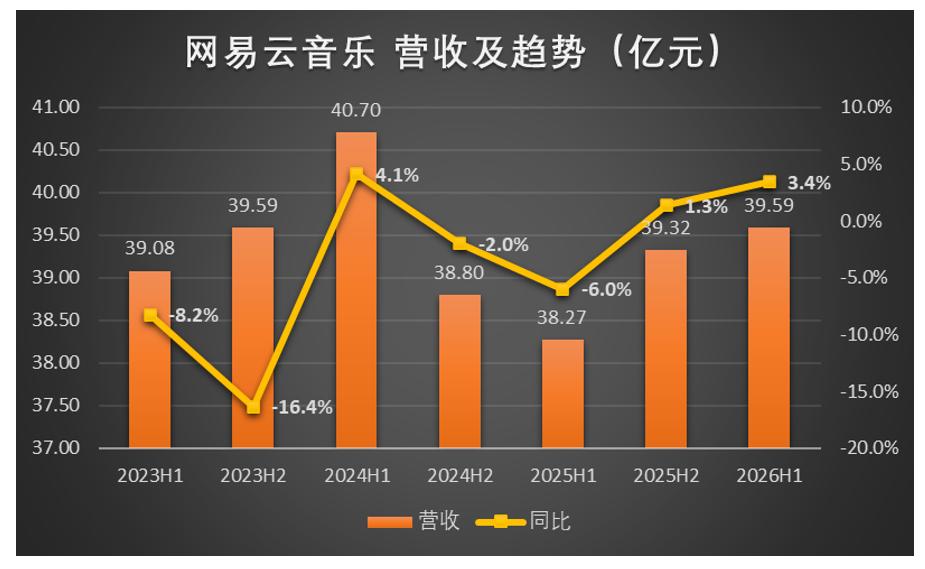
NetEase Cloud Music's revenue has been in a tepid state in recent years.
The 2025 interim report disclosed that the revenue was 3.959 billion yuan, a year-on-year increase of 3.40%, which is already the best performance of NetEase Cloud Music on the revenue side in the past two years.
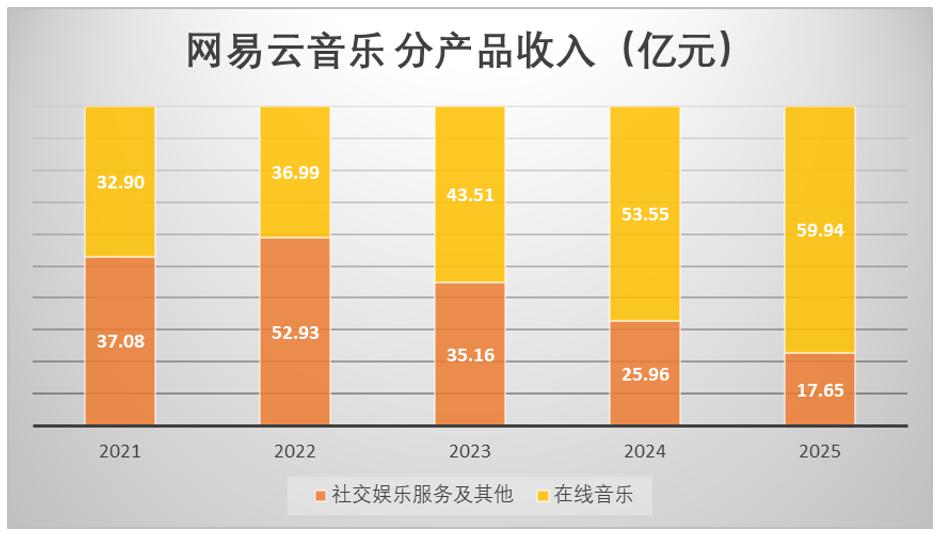
Let's first clarify the composition of NetEase Cloud Music's two businesses: social entertainment services include live streaming services, social entertainment applications (Soundwave, Music Street, Xinyu) and other music derivative services, and the rest are online music services.
Looking at the split of the revenue structure, the revenue of social entertainment services has shown a very obvious downward trend in the past two years, mainly because NetEase Cloud Music significantly reduced the entry of social entertainment in 2024 and cut off the high-stimulus live streaming revenue.
The official answer to this move is that it is caused by focusing on the core music business. From the perspective of the capital market and finance, the real purpose of NetEase Cloud Music can be summarized as two points:
First, reduce compliance risks. A lot of high revenue in the social entertainment sector actually relies on "gameplay mechanisms" with stimulating consumption or even edge of gambling. After the tightening of supervision, the compliance cost and legal risk of such businesses have risen exponentially.
Second, the user ecosystem has been backfired. The most core moat of NetEase Cloud Music is the community atmosphere and emotional stickiness. However, forcing a large number of show live streams into the home page and secondary entrances of the music app has seriously damaged the product experience of users who listen to music, and undermined the foundation of the product.
In the first half of this year, NetEase Cloud Music did not disclose specific business revenue, but attributed the growth of revenue and gross profit in the financial report to the increase in revenue from online music services. Obviously, the core of NetEase Cloud Music's business this year is still online music services, which has not changed.
After the home page and interface are purified of redundant content, users' attention refocuses on "listening to music" itself, which directly drives the penetration rate and willingness to pay for SVIP/VIP members. NetEase Cloud Music is gradually returning to the narrow track.
02
To maintain the growth rate, the cost NetEase Cloud Music paid is a bit too high
Against the background of the overall growth of the revenue market, NetEase Cloud Music's adjusted profit in the first half of this year was only 860 million yuan. The substantial growth of profit in 2025 came from a one-time gain, with a deferred tax credit of 747 million yuan recognized. If viewed on a month-on-month basis, the net profit did not increase but decrease compared with the second half of last year, and the adjusted net profit margin was only 21.72%.
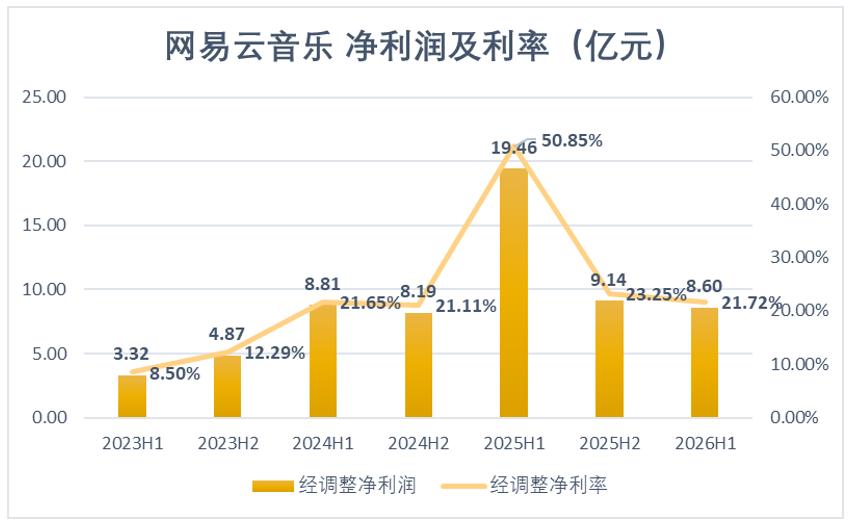
By splitting it down, the performance of the main business is not bad. The overall gross profit margin in the first half of this year reached 37.23%, an increase of 86bp over the same period last year, and a month-on-month increase of 218bp over the second half of last year.
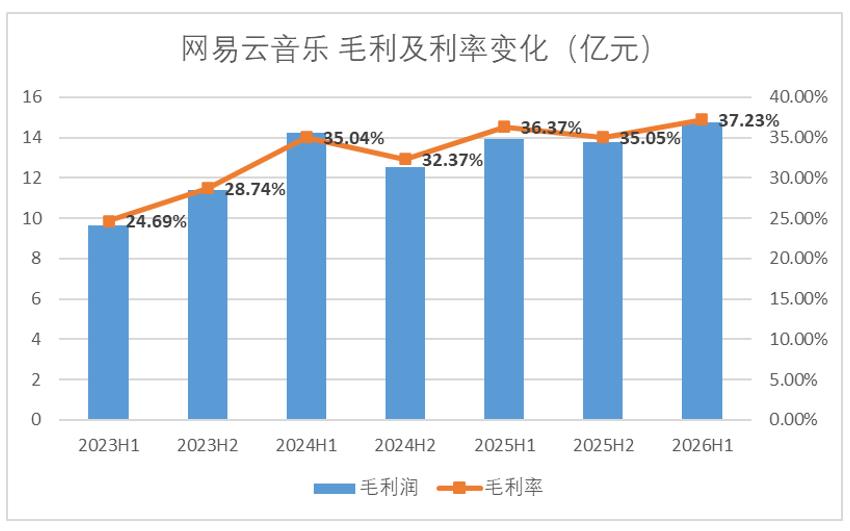
Consistent with the logic of the second half of last year, the recovery of gross profit margin mainly benefits from online music revenue, which has a relatively high gross profit margin in itself.
The problem lies in the cost control side. The sales expense in the first half of the year was 295 million yuan, 50 million yuan more than that in the second half of last year, and 130 million yuan more than that in the same period last year. This is still under the premise of the shrinking of social entertainment business — in order to maintain the market share of the music market, NetEase Cloud Music's investment in sales expenses has increased instead of decreasing.
Music platforms generally have extremely high stickiness in their regular subscription revenue (TME's DAU/MAU is also relatively stable), and NetEase Cloud Music's DAU/MAU also remains above 30%. The renewal of old users hardly consumes additional sales expenses. It is obvious that the acceleration of sales expenses means NetEase Cloud Music is focusing on acquiring new users.
03
Take the initiative, do not want ByteDance to take away the last note
In the past two years, the main theme of the Internet industry has been cost reduction and efficiency improvement. Cutting businesses, reducing marketing, and ensuring profits — this subtraction logic has almost become the standard action of all Chinese concept stocks.
NetEase Cloud Music took the initiative to break the previous comfort zone of "lying down to win". The reason is very simple: if it does not take the initiative to attack, even its last hole card will be taken away by ByteDance.
The March 2026 online music APP industry report released by the third-party data agency QuestMobile reveals the changes in the online music market. NetEase Cloud Music, which has long ranked among the top three in the industry (monthly active users of 147 million), was overtaken by Qishui Music (monthly active users of 156 million) in just half a year, and officially fell out of the top three in the industry.
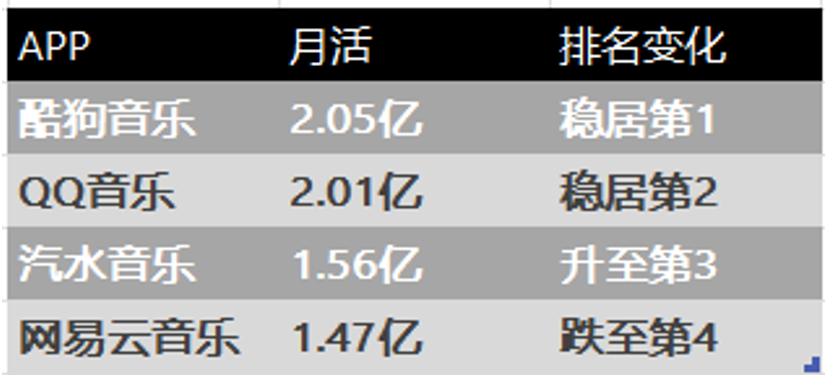
Data is from third-party data agency QuestMobile, sorted by Financial Chronicle
In the evolution history of China's digital music, there are two parallel paths: one is the copyright hegemony represented by Tencent Music; the other is the "niche community" built by NetEase Cloud Music relying on independent musicians and refined algorithms.
Nowadays, the user portraits of Qishui Music and NetEase Cloud Music are highly overlapping, and their paths also overlap.
In the dimension of algorithm, NetEase Cloud Music's "static collaboration" has encountered ByteDance's "real-time feedback". NetEase Cloud Music's traditional recommendation mechanism is built on "user historical behavior + playlist collaborative filtering", which uses "user taste" to recommend songs to users. Backed by ByteDance's real-time feedback engine, Qishui Music directly introduces the "completion rate, song switching rate in the first few seconds, and repeat playback rate" of short videos into the music listening scenario.
In addition, there is a gap in the supply of classic works in the Chinese music industry, and NetEase Cloud Music's daily recommendation based on taste matching is increasingly unable to meet the emotional hunger of the young public.
In the community dimension, NetEase Cloud Music's "text sentiment" has been deconstructed by the "visual atmosphere" of the short video era. The golden age of NetEase Cloud Music's community is built on text expression and the emotional resonance of literary youth, but the subsequent filling of redundant functions for monetization and the proliferation of homogeneous copywriting have greatly diluted the sense of reality in the comment section.
The deeper change is that the emotional expression and perception media of the younger generation have completely shifted from "text and image comments" to "the combination of vision and audio". The community logic of NetEase Cloud Music is that users listen to songs and then read other people's text stories, while Qishui Music directly integrates visual pictures and emotions into the music.
The most fatal threat to NetEase Cloud Music lies in the transfer of the "right to create hit songs" in the upstream. In the past, independent musicians and niche hit songs relied on NetEase Cloud Music as a fermentation position; but now, Douyin has become the absolute origin of music hits and publicity infrastructure. Qishui Music naturally inherits Douyin's music traffic pool and achieves a seamless closed loop.
Just as Tomato Reading is to China Literature, Qishui Music is to NetEase Cloud Music, which is essentially the disintegration and reconstruction of traditional elite aesthetics by grassroots creative forces. ByteDance's products have long provided everyone with low-threshold opportunities for creation and publication, stimulating the underestimated grassroots creativity.
This control over the source of music publicity, the absorption of grassroots content dividends, and the extreme pursuit of frictionless music listening experience are the fundamental reasons why Qishui Music poses a substantial threat to NetEase Cloud Music.
This also explains why in 2026, when cost reduction and efficiency improvement have become the collective creed of the Internet industry, NetEase Cloud Music chose to increase sales expenses against the trend and take the initiative to break the "lying down to win" pattern it had finally established.
NetEase Cloud Music is very clear that it does not have many cards left in its hand. It can't compete with Tencent for copyright, and can't compete with ByteDance for traffic. The only thing it can hold on to is the "small but beautiful" position built by the community and algorithms. The capital market can applaud a subscription story with high gross profit and high net profit margin, but users will not stay for a beautiful financial report.
From Kugou to Xiami, the history of China's digital music has never lacked protagonists in the stories of falling behind. NetEase Cloud Music takes action now to hold on to its qualification to compete.
04
NetEase Cloud Music can do more in this window period
The two opponents NetEase Cloud Music faces are not in the same volume level.
Tencent Music's total revenue in the second quarter of 2026 was 8.93 billion yuan, and its adjusted net profit was 2.78 billion yuan — the profit of a single quarter is more than three times the adjusted profit of NetEase Cloud Music in the first half of the year (860 million yuan). Backed by ByteDance and Douyin, Qishui Music's strength goes without saying.
But we can also understand that for NetEase Cloud Music at this stage, it is indeed a good counter-cyclical investment window:
First, the narrative of anti-monopoly is strengthening, and the copyright structure of the music industry has shown some loosening at present.
Second, large manufacturers are collectively obsessed with the AI narrative and have no time for other things.
This is also why in 2026, when cost reduction and efficiency improvement have become the collective creed of the Internet industry, NetEase Cloud Music chose to increase sales expenses against the trend.
Previously, in order to maintain user reputation, NetEase Cloud Music voluntarily reduced the traffic entry of high-revenue businesses such as show live streaming, and did a set of subtraction operations. This operation was reasonable at that time, and the purity of the community is the only differentiated moat that NetEase Cloud Music can show.
But now the window has appeared. If NetEase Cloud Music continues to take the narrow track and focus on the pure music track, is the return on capital not high enough?
Admittedly, it is difficult to find a winner-takes-all market in China's Internet tracks. Tencent Music takes copyright, Qishui Music takes traffic, and NetEase Cloud Music takes emotion — three dimensions, three logics, three sets of strategies. As long as there are still people writing stories late at night in the comment section of Cloud Village, and as long as independent musicians still regard NetEase Cloud Music as their first release position, it will not die.
But between "not dying" and "living well", there is a multiple-choice question. Now there are two gold bars in front of you, tell me which one is noble and which one is despicable?
This article is from WeChat official account "Financial Chronicle", author: Xing He, authorized for release by 36Kr.