Those people who use brain-computer interfaces
Wang Yihe, a neurosurgeon at Xuanwu Hospital, found that many patients believe that undergoing a brain-computer interface (BCI) procedure will allow them to fully recover to normal health. "This is almost impossible. In addition, not all patients will see therapeutic effects." He compared the current state and future of BCI technology to the "brick phone" and the smartphone in the communications field. Patients can choose to accept a "brick phone" today, or wait for future iterations of the technology.
In early August 2026, paraplegic Wang Zhiming walked step by step out of his doorstep, propping himself up with braces, and talking to his twin daughters as he moved.
Recently, he occasionally posted videos of himself walking online. Many fellow patients reached out to ask how he managed to stand on his feet again.
Six years ago, Wang Zhiming's lower limbs were paralyzed in a car accident, after which he was bedridden for a long time and suffered from fecal and urinary incontinence. In May 2025, he participated in the "North Brain No.1" epidural BCI clinical trial jointly carried out by Xuanwu Hospital, Capital Medical University (hereinafter referred to as "Xuanwu Hospital") and the Beijing Institute for Brain Disorders. After the surgery, his spinal cord injury rating improved from the most severe AISA-A grade to C grade. He is now able to stand and walk with the assistance of a walker, and has regained self-care ability for urination and defecation.
BCI not only helps some paralyzed people stand again, but also attempts to restore vision for blind people to see the world.
In May 2026, Chen Yiqi, an ophthalmologist at Zhejiang Provincial People's Hospital, performed a retinal BCI implantation surgery on Lingling. After nearly 3 months of rehabilitation training, Lingling, who was almost completely blind and only had slight light perception under strong light, has been able to recognize some Chinese characters and objects.
At the end of July, Lingling met Chen Yiqi again and said to him, "I can see things now, and I'm really happy about it."
Today, a technology that once only existed in science fiction is being widely applied to real human bodies. Different technical routes are trying to bypass damaged neural pathways, re-establish connections between humans and the outside world, and treat diseases including spinal cord injury, stroke, blindness, and coma.
However, the results of clinical trials are not always as expected: some patients have achieved significant improvement, while others have only seen limited effects.
Wang Yihe, a neurosurgeon at Xuanwu Hospital, found that many patients believe that undergoing a brain-computer interface (BCI) procedure will allow them to fully recover to normal health. "This is almost impossible. In addition, not all patients will see therapeutic effects."
He compared the current state and future of BCI technology to the "brick phone" and the smartphone in the communications field. Patients can choose to accept a "brick phone" today, or wait for future iterations of the technology.
01
Standing Up Again, Seeing the World Again
Wang Zhiming was only 24 years old when the car accident happened. A tipping semi-trailer crushed him under the vehicle, leaving him with no sensation below his navel. He received two years of traditional rehabilitation treatments including acupuncture, electrotherapy, and tuina massage at a local hospital, but saw no obvious improvement. Doctors told him that he had a complete spinal cord injury and would have to rely on a wheelchair for the rest of his life.
But he was unwilling to give up. He asked friends to inquire about more advanced medical technologies and also looked up information online. In 2025, he came across a video on Douyin from Huashan Hospital Affiliated to Fudan University, which showed that a paraplegic patient who had a BCI implanted for half a year was already able to grab bricks and dumbbells with his hands. He thought that maybe he could stand up again too.
He asked his brother to bring his medical scans and diagnosis certificate to Xuanwu Hospital for consultation. After evaluation, he met the eligibility criteria for the clinical trial. His hometown was 1,500 kilometers away from Beijing. The doctor called him at 10 a.m., and one hour later, his wife drove off with him to the capital.
To this day, Wang Zhiming still clearly remembers that the first question he asked his wife when he woke up from the BCI implantation surgery was: "Check for me, can my legs move now?"
More than ten days after the surgery, Wang Zhiming began a six-month rehabilitation training program. The sensation brought by electrical stimulation felt like electric current passing through his body, "just like the nerves were reconnected", which was the first time he felt his legs after the injury.
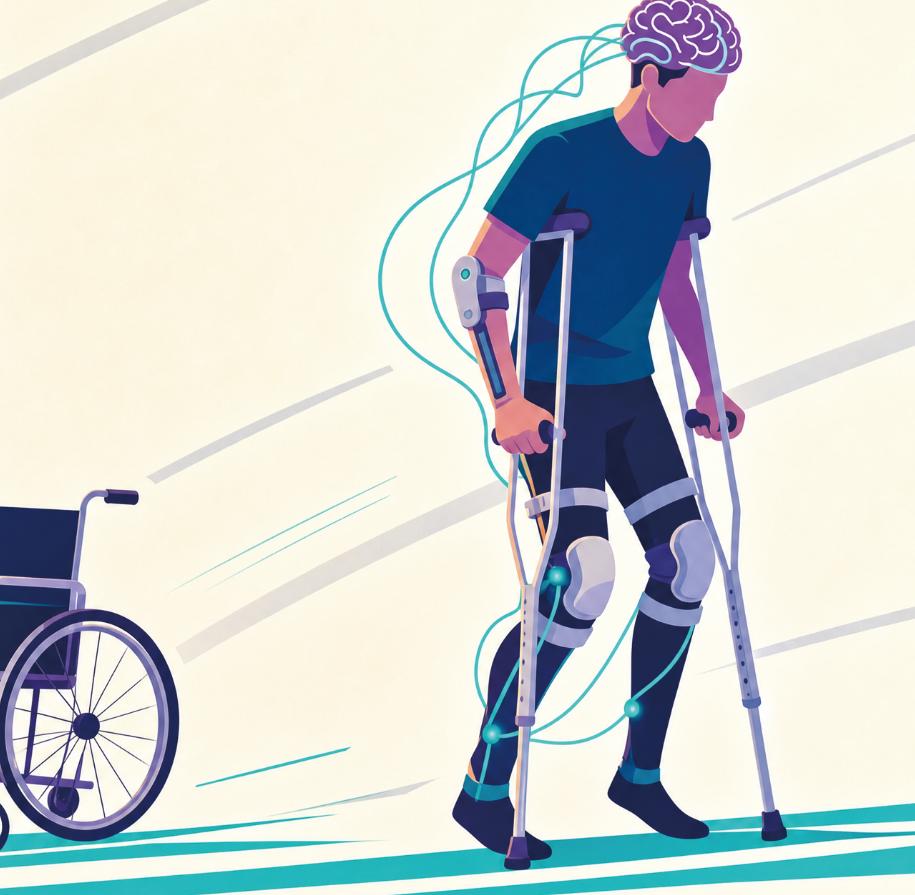
Wang Zhiming is the world's first patient to receive combined treatment with epidural BCI, spinal cord electrical stimulation and exoskeleton robot. During training, he needs to send movement intentions through the BCI. For example, when he imagines lifting his left leg in his brain and the thought is transmitted successfully, a flash of electric current will pass through his left leg, and the exoskeleton will drive his left leg to take a step forward.
During training, he must stay highly focused and free of distracting thoughts, otherwise he may not be able to take a step. At the beginning, he thought about lifting his leg but it did not move, and he had to repeat the thought many times to take a single step. As the number of training sessions increased, he gradually got familiar with the control method. By the third month, he was able to take three steps at a time.
Lingling, 40 years old this year, is a patient with retinitis pigmentosa and has been blind for nearly 20 years. Many people asked her who the first person she wanted to see after the surgery was. Her answer was her son, as she had never seen what her son looked like.
Being relatively young and having an optimistic personality was one of the reasons why the doctors selected her. BCI does not allow patients to regain their original vision, but requires them to abandon the visual experiences they have accumulated in the past and rebuild a new set of visual cognition, which requires continuous learning and training.
Half a month after the surgery, Lingling started her training, going to the hospital 3 to 4 days a week for at least half a day each time. At first, she could see bright light, and gradually she could see shaped, persistent graphics. Now, she can see some Chinese characters and distinguish some objects.
But there is still a long way to go before this can truly change her life. Chen Yiqi said that Lingling is still easily disturbed in complex scenes. According to the team's plan, if she continues training for another half a year or longer, she may further gain the ability to walk, pick up objects and pour water in complex environments.
"To be honest, I didn't have very high expectations for her vision recovery. I only hope she can take care of herself, walk without bumping into people, and eat without being fed," Chen Yiqi said. "For many patients, BCI may be the last resort."
02
Full Recovery to Normal Health Is Unlikely
Not everyone is as lucky as Wang Zhiming and Lingling.
On August 18, a neurologist received a video from a rehabilitation hospital: a hemiplegic patient was holding the corridor handrail with his right hand, clenching his left hand into a fist, and walking step by step, taking about one step every two seconds. More than a year ago, he performed the BCI surgery on this patient. Before the surgery, the patient had grade 3 hemiplegia, needed assistance to walk, could not grasp a spoon, and was unable to take care of himself in daily life.
After that surgery, dozens of paralyzed patients approached this doctor hoping to receive BCI surgery, but he did not agree to operate on them.
"Because the signal collection (for last year's patient) was not ideal enough, we did not perform more surgeries of the kind," the doctor said. The medical team originally hoped that the patient would regain basic self-care ability through 3 months of training. Now, he can walk independently with the help of handrails, but the improvement of his hand grip is limited, and he can only grasp relatively thick objects. "The patient has shown significant improvement, but the effect is still slightly worse than we expected, and he cannot fully take care of himself yet."
Even knowing that the effect may not be ideal, there are still people who are willing to try.
In April 2024, Lin Meng's mother suffered a sudden cerebral hemorrhage. After regaining consciousness, her mother's language ability was impaired, she could only speak short sentences, and her right side limbs were completely unable to move. After rehabilitation treatment, her mother's cognitive function gradually recovered, but the right half of her body never regained mobility.
In September 2025, Lin Meng learned on Xiaohongshu that BCI may allow patients to control external devices through their consciousness, and even restore mobility and play games. She thought it was amazing, so she took her mother to a top tertiary hospital in central China to participate in a clinical trial. She hoped that her mother's right hand and right leg could move again, and even walk again.
This trial did not implant a chip into her mother's intracranial cavity. She only needed to wear a BCI device to collect brain signals, and perform training by imagining movements such as raising her hand and kicking her leg. The original plan was to train for 15 days, but on the 13th day, Lin Meng decided to withdraw from the trial, because her mother's body had not shown any obvious changes.
Lin Meng told The Economic Observer that if she had to choose again, she would still be willing to take her mother to participate in this trial, because non-invasive BCI would not cause harm to the body at least.
In the view of the aforementioned neurologist, these ineffective or sub-optimal results reveal two shortcomings of BCI: first, brain signal collection is still not complete enough, and second, the conversion from brain signals to skeletal muscle movement is not mature enough.
At the end of 2025, Xuanwu Hospital opened a BCI screening clinic. The clinical trial database of Xuanwu Hospital has three to four hundred spinal cord injury patients. After basic data screening, preliminary screening via video conference, detailed outpatient evaluation, and discussion of risks and benefits with patients, only about 10 patients can finally be enrolled in the trial.
Wang Yihe works at the BCI screening clinic every week. In addition to conducting preliminary screening for clinical trials and popularizing science about the technology, he also needs to do one thing: lower the expectations of patients and their family members.
03
Special Surgery
Wang Yihe has been engaged in BCI-related work since 2023, and has participated in nearly 20 surgeries, including Wang Zhiming's surgery.
Wang Zhiming underwent a combined surgery. The doctor first implanted electrodes into the epidural space, then turned the patient over to perform spinal surgery and place the electrical stimulator. The whole process lasted seven or eight hours. After the surgery, the device also needs to be connected to the lower limb exoskeleton to form a closed-loop system of "brain - spinal cord - limb".
The difficulty of the surgery lies not only in the implantation, but also in enabling the devices of three different enterprises to interconnect. Due to different software and ports, the three enterprises repeatedly debugged, opened ports, and tested parameters before the surgery.
In addition to epidural BCI, Xuanwu Hospital is also exploring interventional pathways. In 2022, Ma Yongjie, a neurosurgeon at Xuanwu Hospital, implanted an interventional stent electrode into a sheep and completed the interventional BCI animal experiment. "
At the very beginning, the success rate of animal experiments was not high. About one in every three experimental sheep would die," Ma Yongjie said. After dozens of experiments, the team gradually became familiar with animal anatomy, equipment and surgical pathways. In the first half of 2026, the electrodes in one sheep stably collected EEG signals for 8 consecutive months. Pathological examination after the experiment showed that the electrodes had grown together with the blood vessel wall, but the blood vessel remained unobstructed.
In September 2025, the team began human studies, and has now completed interventional BCI implantation on 4 patients with severe subarachnoid hemorrhage, all of whom were in a coma. The study mainly verified the safety of the device in the human body and the stability of signal collection. No device-related adverse events occurred in all 4 surgeries. The electrodes were implanted in an average of about 7 minutes, and could be removed about 1 minute after the collection was completed.
BCI surgeries do not only take place in the brain. For Chen Yiqi, he is working on another equally precise and fragile organ - the eye.
The surgery Chen Yiqi performed on Lingling was his first BCI human surgery as the lead surgeon. The surgery lasted from 1 p.m. to 6 p.m., which took longer than ordinary retinal surgeries.
A chip with 320 electrodes needs to be implanted in Lingling's eye. The chip is placed close to the retina, and then fixed near the macula with a magnetic fixator. After the camera on the glasses captures the external image, it transmits the signal to the chip, which stimulates the retina to generate vision. The difficulty of the surgery is not to put the chip in, but to place it in the exact correct position. No bleeding should occur when separating the choroid and sclera, and the retina must not be scratched when moving the chip.
For this surgery, the team made a 3D model based on Lingling's eyeball condition before the operation to simulate the chip's fixed position and surgical incision. On the day of the surgery, the assistant even secretly bought a can of Red Bull for Chen Yiqi.
Before performing the surgery on Lingling, Chen Yiqi had completed hundreds of animal experiments over 12 years. He first explored the implantation pathway with pig eyes, then observed signal transmission with rabbits, and last year implanted chips in monkeys, which were removed several months later. No retinal detachment or eyeball atrophy was found in the experimental subjects.
At the end of July, when he met Lingling again, Chen Yiqi gave her a detailed examination. Her cornea and lens were in good condition, and the chip was in the normal position, fitting well with the retina.
Many people are curious: can the implanted BCI device be removed after implantation?
Ma Yongjie introduced that the difficulty of removing devices of different technical routes varies: SEEG (stereotactic electroencephalography) is usually used for a short period of time and can be removed after collection is completed; epidural devices can be left in the body for a long time, and can also be removed if necessary; intravascular stent electrodes may fuse with the blood vessel wall after long-term indwelling, and there are risks associated with removal.
04
"The Moon Landing Project Between Two Ears"
Zhao Guoguang, president of Xuanwu Hospital, regards BCI as "the moon landing project between two ears". It is not enough to just implant the device into the body, we must also ensure that patients can "return safely".
According to technical routes, BCIs can be roughly divided into non-invasive and invasive types. Non-invasive BCIs mainly collect EEG signals through the scalp; invasive BCIs require surgery to implant electrodes into the body, including transvascular interventional implantation, epidural implantation, and direct implantation into the cerebral cortex.
From the scalp to the inside of the brain, the closer the electrodes are to the neurons, the clearer the signals that can be obtained, but at the same time, the risk of invasion also increases. Zhao Guoguang made an analogy: non-invasive BCI is like listening to music through a wall, epidural implantation is like listening to music from the auditorium, and intracortical implantation is like listening to music right next to the instrument.
"We hope to obtain high-quality signal collection with as little trauma as possible," Zhao Guoguang said. Based on this concept, in 2023, the team cooperated with Hong Bo's team from Tsinghua University to carry out exploration of epidural BCI implantation technology.
They jointly completed the first epidural BCI surgery. The subject, Lao Yang, had been high paraplegic for 15 years. After the surgery, Lao Yang's hand functions such as grasping, holding and pinching improved significantly. Now he can hold a small wine cup to drink by himself, and can even pick up his grandson.
"Although the technical routes are not exactly the same, the surgery we performed on Lao Yang was more than two months earlier than the first human implantation performed by Elon Musk's Neuralink company," Zhao Guoguang said.
In Zhao Guoguang's view, the reason to promote BCI into clinical practice is not because the technology is cool enough, but because there are a large number of problems in clinical practice that cannot be solved by traditional treatment methods. Taking spinal cord injury as an example, there are about 3.74 million patients in