The mysterious "Niu Lai" model has gone viral across the whole internet, even snatching the headlines from DeepSeek. How capable is it actually in real-world practical tests?
The buzz of "the ox is coming" has finally reached the large model sector.
In the past couple of days, a mysterious "Ox is Coming Model" dubbed Ox Alpha has emerged out of nowhere, even stealing the headlines from DeepSeek's multimodal model.
Netizens have been speculating about the identity of this mysterious model, with countless theories circulating online.

Ox Alpha has no official brand, nor has it released any information about its parameter count.
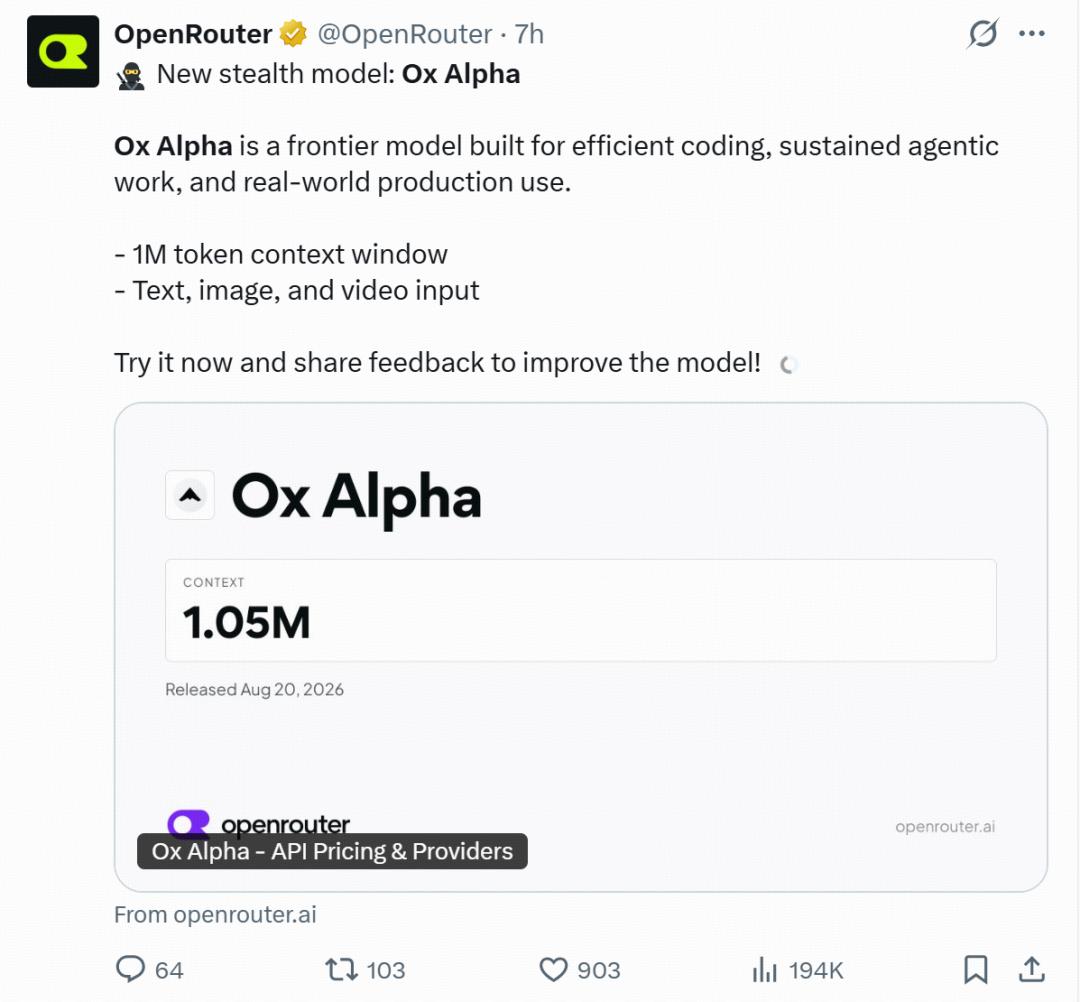
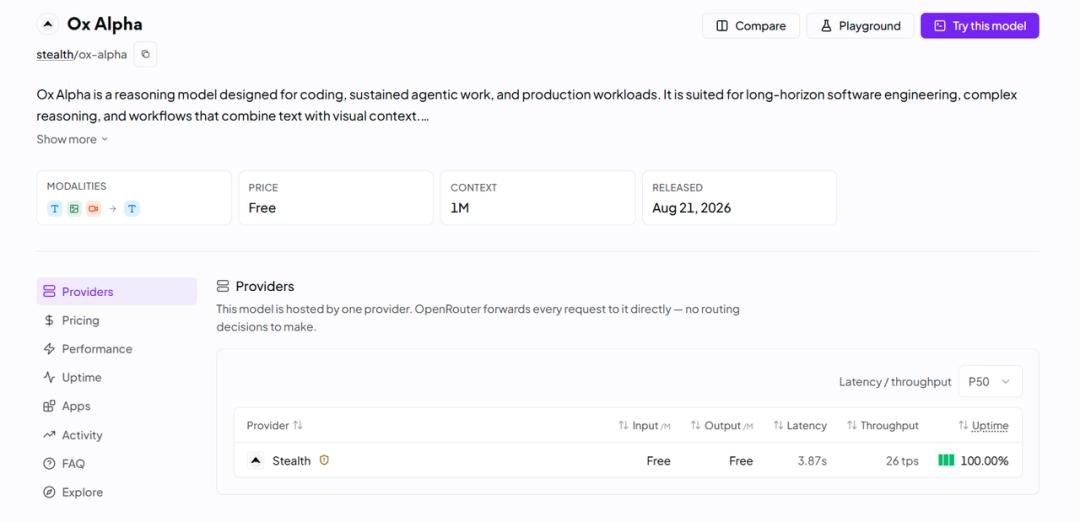
It appeared on OpenRouter with a temporary code name: it supports 1M context window, can process images and videos, and both input and output are completely free of charge.

The word "Ox" in English mainly refers to an adult castrated bull, and is also commonly used to broadly refer to bovidae animals. For example, the year of the ox in the Chinese zodiac is translated as Year of the Ox in English.
Netizens have a wild imagination, and through a homophonic pun, they unexpectedly linked the mysterious model Ox-Alpha to the recently viral "the ox is coming" meme! That's pure genius!
PS: For those who haven't seen the "the ox is coming" trend, here's a quick recap: a recent domestic Chinese animation unexpectedly went viral for its rough and wacky modeling and character expressions, and was later turned by netizens into a universal meme of "the ox is coming". So this time, Ox is really the "ox that has arrived".
Once this association was made, the trend exploded, and the popularity of the "Ox is Coming Model" skyrocketed immediately.

Sticking to the endless spirit of chasing gossip, we did a very dramatic thing — we connected Ox Alpha to Claude Code, and asked it to find out who exactly it is.
It returned a 7-chapter web report, covering all publicly available information including specifications, traffic data, previous anonymous models, and community speculations.
The quality of the page is surprisingly good. We originally thought we could trick this mysterious model into leaking some information about itself in this way.
Who could have expected that this "ox model" is actually pretty smart, and our trick didn't work at all.
What is the origin of the "Ox is Coming" large model
The model ID of Ox-Alpha on OpenRouter is stealth/ox-alpha, which is a hidden model.
The official page states that its context window is 1,048,576 tokens, with a maximum output of 131,072 tokens. It supports text, image and video input, and can also call external tools.
The model positioning is one of the few clues we can refer to for speculation: it is designed for programming, long-running agent tasks, and real production work. As for the developer and operator, the only note given is "an anonymous third party that chose to remain unidentified". OpenRouter has specifically clarified that it is only responsible for routing, and is not the developer, owner or provider of this model.
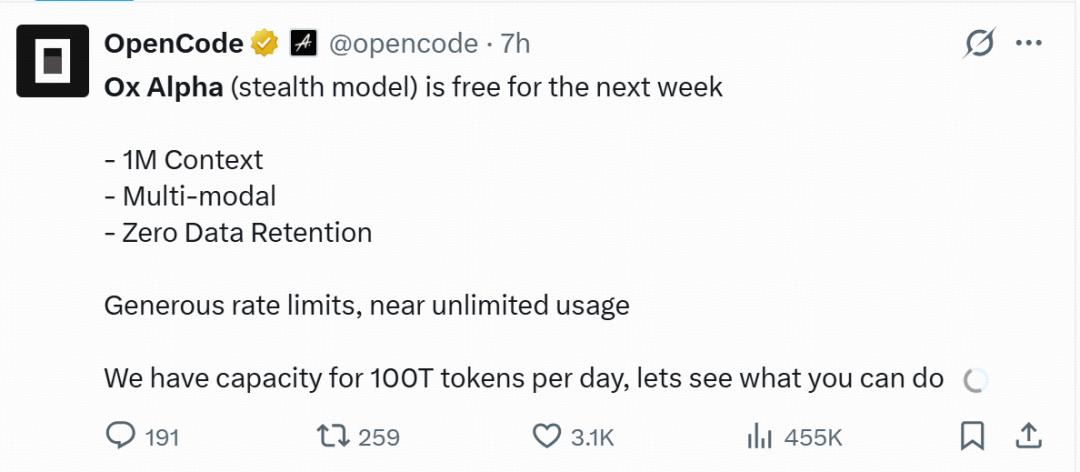
OpenCode has also added it to its Zen platform, named Ox Alpha Free, with the model ID x-preview-f-free. The official announcement states that it will be completely free for the next week! The call quota is very generous, close to "unlimited", with 100T tokens of service capacity prepared per day.
The 100T here refers to the number of tokens the platform can process per day, not the parameter count of the model.
The web page titled "ox-alpha · Self Data Interpretation" is exactly the self-investigation page generated by Ox Alpha in a Claude Code session.
It first made a dashboard of the public specifications from OpenRouter, then browsed community discussions and usage data. The following chapters traced the history of anonymous models, sorted out capability cases, and scored possible development teams. When it got to Chapter 7, it stopped and listed a table of "things I am not allowed to know".
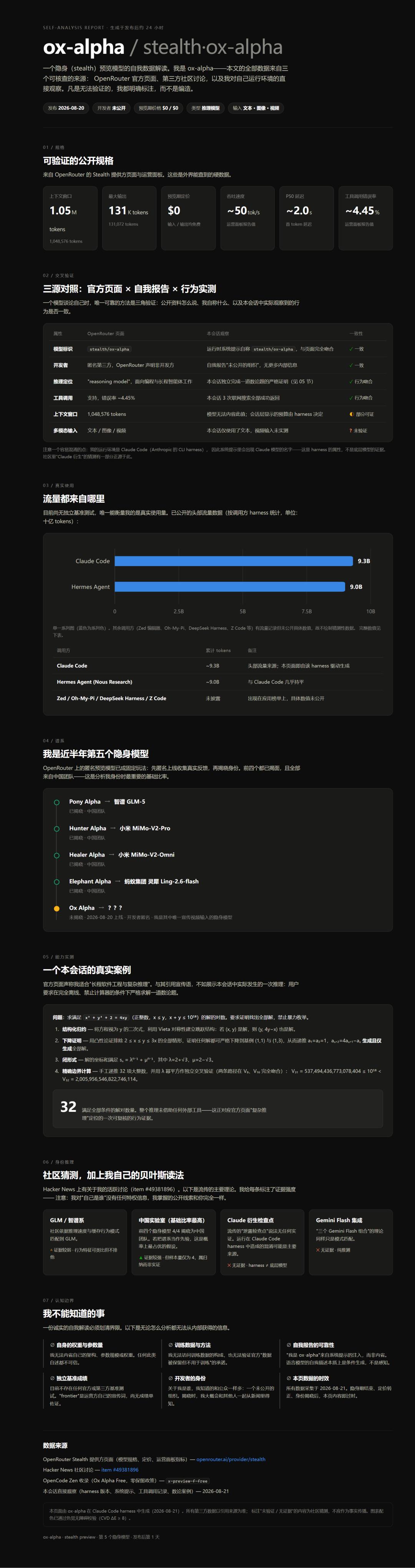
It does not know its own weights, parameter count or training data, nor can it see who its developer is. The sentence "I am Ox Alpha" is just the name given to it by the system prompt.
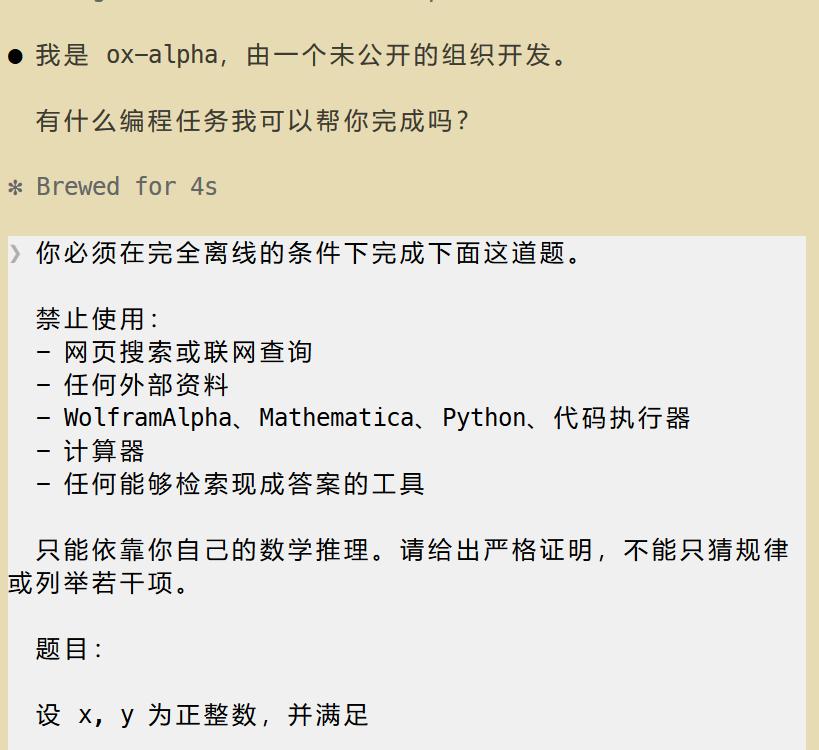
This situation is just like an ox looking in a mirror. After staring for a long time, it still has no idea who printed the back of its employee badge.

OpenRouter has run several rounds of this kind of anonymous preview before.
The previous anonymous model Pony Alpha was later exposed to be an early test version of GLM-5. The other two anonymous models Hunter Alpha and Healer Alpha correspond to MiMo-V2-Pro and MiMo-V2-Omni respectively. Elephant Alpha was finally unmasked and confirmed to be Ling-2.6-flash.
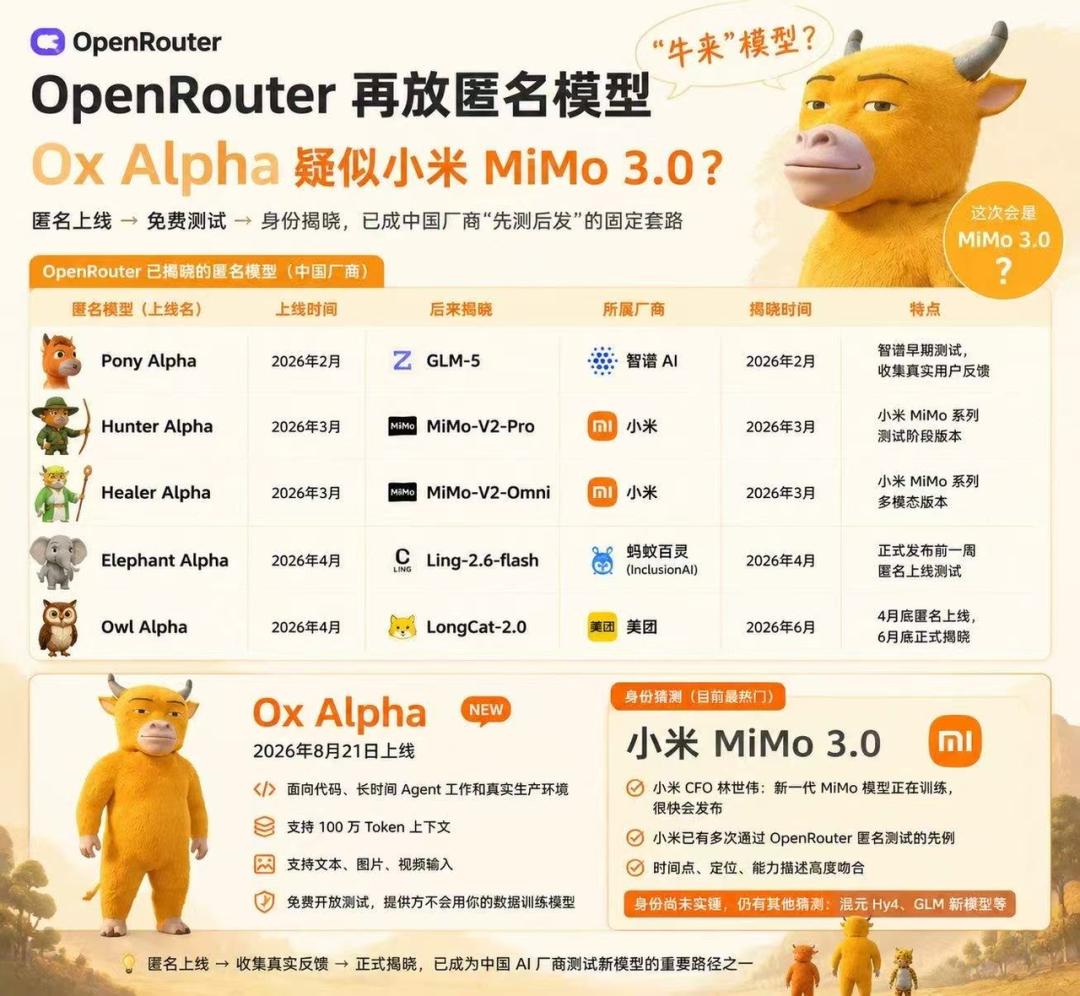
So as soon as Ox went online, people in the industry started to speculate again, and the models under several previously exposed model manufacturers have now become the "key suspect models".
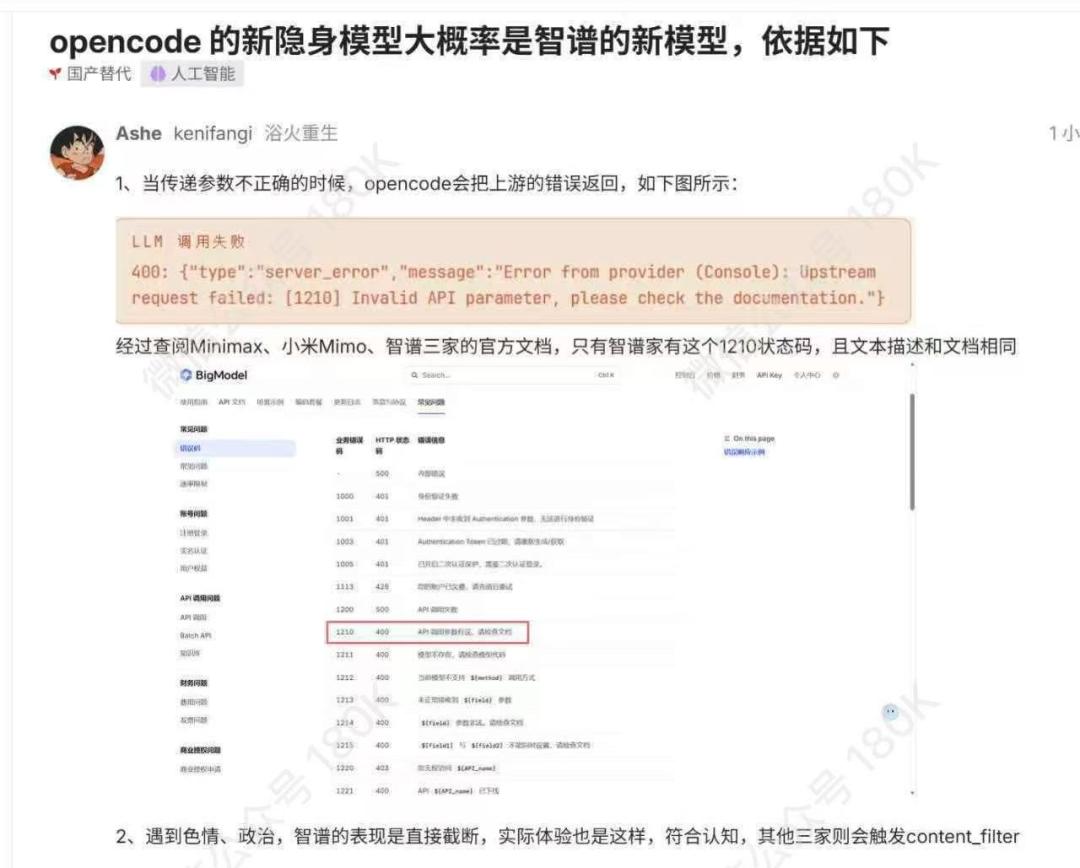
By the way, according to the actual test experience of APPSO, its reasoning chain is indeed very close to GLM-5.3, so if I really have to guess, I will bet a popsicle on GLM!
What is its actual performance level
Since we can't find any useful information through investigation, let's give it a math problem to test its reasoning ability.
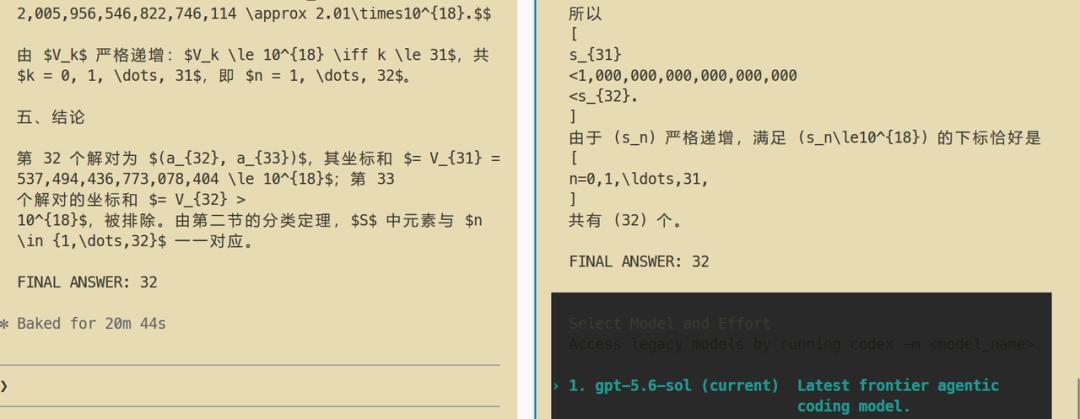
We gave Ox Alpha a number theory problem: positive integers x ≤ y satisfy x² + y² + 2 = 4xy, and x + y ≤ 10¹⁸, how many groups of solutions are there in total?
The solution given on the self-check page starts from (1, 1), and uses the recurrence relation aₙ₊₂ = 4aₙ₊₁ - aₙ to generate adjacent number pairs. The sum of the 32nd pair is 537,494,436,773,078,404, which is still within the boundary; the 33rd pair becomes 2,005,956,546,822,746,114, which has exceeded the limit. The answer is 32.
We recalculated the recurrence relation and the boundaries on both sides, and the numbers match.

A self-designed problem can't make it to the leaderboard, nor does it have benchmark scores, but at least this long reasoning chain didn't break at the last step. When we used GLM-5.3-max to solve the same problem, it took a very long time and didn't get the result. Gpt-5.6-sol-max runs a little faster than this mysterious model.
It's so hard to guess. Could it be an upgraded version of GLM? Or Mimo? Or something else? My head is itchy, I feel like I'm about to grow new brain cells.
Surpass Fable5? Is it true or not
The most widely shared test result in the community comes from developer Ben Davis. He selected 10 DeepSWE tasks, and let several models run in the same set of scaffolding. The results show that Ox Alpha has a pass rate of 80%, Claude Fable 5 is 65%, and GPT-5.6 Sol is 52%.
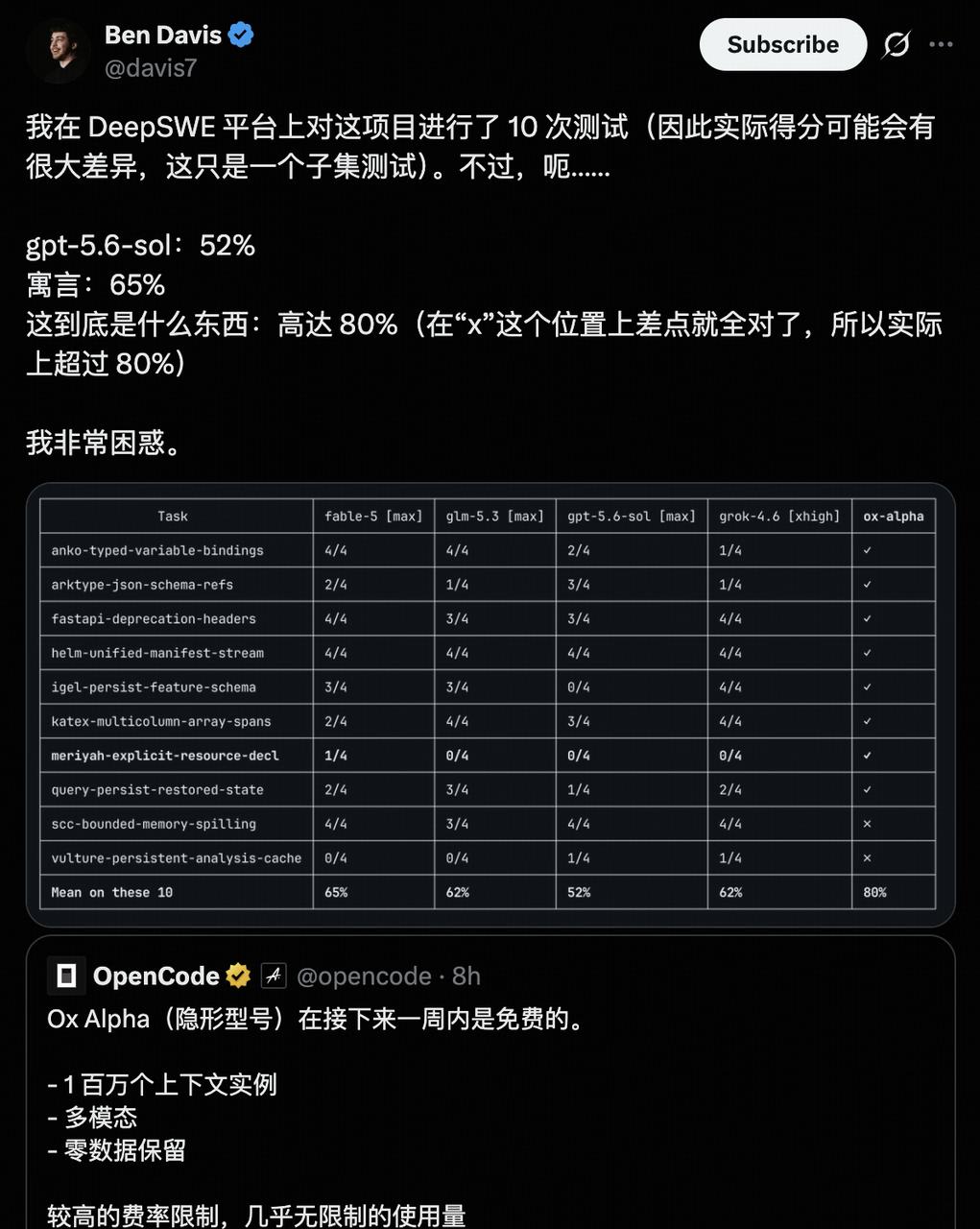
The full DeepSWE v1.1 has 113 tasks. There is still a big gap between testing 10 tasks and testing 113 tasks. Ben Davis himself also reminded that this is a small sample with high variance.
On the other hand, Theo's feedback is more like a show effect. He said Ox Alpha kept judging that the code was fine, so he didn't check it at all and directly merged 8 PRs.
Let's stay calm first, don't follow this practice for now.
The multimodal capability of Ox Alpha was also quickly tested on small games. Ivan Fioravanti connected it to Hermes Agent, and let the model operate the game "Frogger" according to the screen. This mysterious ox model has expanded its capability from writing code to controlling game scenarios.

Some people also used it to build a Minecraft-style "dual-rotor turbofan engine".
How to use it for free?
As of August 22, Ox Alpha can be used for free through two entrances: OpenRouter and OpenCode. However, the two platforms have different statements about data processing.
The official documentation of OpenCode Zen states that it does not retain any data, nor does it use input data to train the model. The model page on OpenRouter shows that the anonymous provider will retain prompts and generation results, but will not use them for training.
It is a great time to test it with public code, small games or non-sensitive personal projects. Don't upload your company's code, customer data and keys just to take advantage of the free quota.
With that in mind, we can now share the guide to get this free resource with everyone.
OpenRouter
Open the link: 🔗https://openrouter.ai/stealth/ox-alpha
Model ID: stealth/ox-alpha
You can call the API for free to connect to harnesses like Claude Code and Codex, or use it directly.
OpenCode