HK$80 billion, Alibaba announces additional financing for AI, which is reportedly oversubscribed
Zhidx reported on August 23 that Alibaba has just announced its plan to place new shares through the Hong Kong market, with a total raised fund of about HK$80 billion (equivalent to around US$10.2 billion, or about RMB 68.6 billion).
Alibaba stated that it plans to use 100% of the net proceeds from this placement to invest in "full-stack AI capabilities". Combined with the full-stack AI strategy previously disclosed by Alibaba, this investment will mainly cover fields including AI chips, infrastructure and AI model development and deployment.
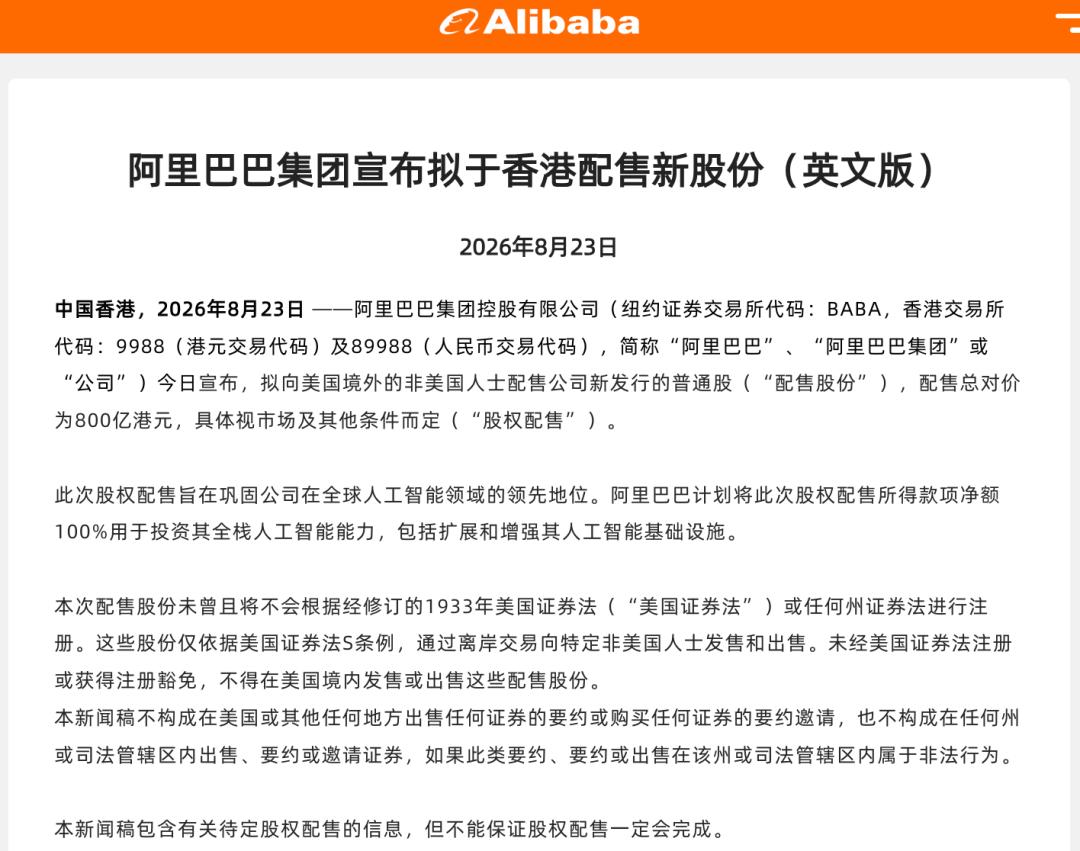
This will become the largest follow-on stock offering in the primary market in the history of listed companies in Hong Kong. According to statistics from Reuters, on a global scale, this transaction will also become the third largest follow-on stock offering in the primary market since 2026, second only to the transactions of Google's parent company Alphabet and Intel.
Foreign media The Information cited a source familiar with the matter as revealing that due to strong interest from sovereign wealth funds and other international investors, this transaction has been oversubscribed.
Just three days ago, Alibaba released its quarterly financial report reshaped by AI. In the first quarter of fiscal year 2027 (from April 1 to June 30, 2026), Alibaba has pushed its capital expenditure to RMB 67.68 billion, a year-on-year increase of 75%.
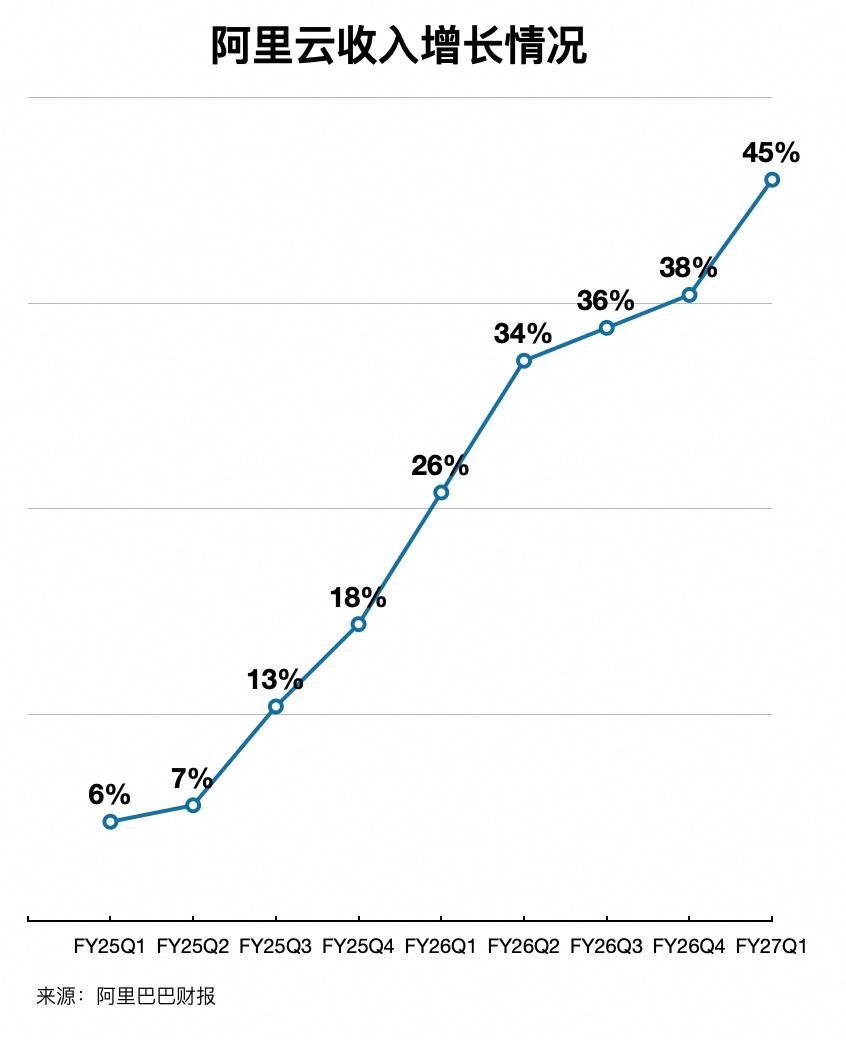
On the other hand, during this period, Alibaba's revenue from AI cloud and computing power services reached RMB 48.437 billion, a year-on-year increase of 45%; the adjusted EBITA reached RMB 5.628 billion, a year-on-year increase of 133%. The growth rate of Alibaba Cloud's external commercial revenue rose to 45%, hitting a new high in 22 quarters. Alibaba bets that its investment will bring returns in the long run.
The global AI arms race is increasingly turning into a capital expenditure race directly.
01.
All HK$80 billion invested in AI
Alibaba injects new capital into AI business
According to the announcement, this share placement is mainly for non-US persons outside the United States to subscribe for the newly issued shares of the company.
A term sheet reviewed by Reuters shows that Alibaba plans to sell 710 million ordinary shares at a price of HK$112.70 per share, which is a 3.6% discount to its latest closing price.
Meanwhile, Reuters cited people familiar with the matter as saying that this transaction has received strong demand from investors including sovereign wealth funds and has been oversubscribed, so Alibaba later expanded the transaction scale. Morgan Stanley, HSBC, UBS and CICC participated in this transaction.
It is worth noting that Alibaba has not arranged other uses for this fund such as e-commerce expansion, mergers and acquisitions or share repurchases, but clearly stated that 100% of the net raised funds will be invested in full-stack AI capabilities.
It can be predicted that the so-called full-stack AI capabilities specifically cover three core links: chips, AI infrastructure, and AI model development and deployment. From underlying chips and data centers to Alibaba Cloud, then to basic models such as Qwen, and finally connected to various AI applications, capital expenditure is sinking along the entire Alibaba AI technology stack.
This is also the latest large-scale capital operation of Alibaba outside the previously announced RMB 380 billion AI infrastructure investment plan.
02.
Single-quarter capital expenditure hits RMB 67.7 billion
Nearly half of the RMB 380 billion plan has been implemented
Alibaba is raising another HK$80 billion at this time, when AI is devouring capital at an unprecedented speed.
On August 20, Alibaba released its financial report for the first quarter of fiscal year 2027. From April to June, its capital expenditure reached RMB 67.68 billion, a year-on-year increase of 75%. Alibaba said that the growth of capital expenditure is mainly related to the investment in AI infrastructure. Earlier this year, Alibaba announced that it would invest at least RMB 380 billion in the construction of cloud and AI infrastructure in the next three years. The latest financial report shows that nearly half of this plan has been implemented cumulatively.
Funds are quickly converted into cloud and AI production capacity. In this quarter, the growth rate of Alibaba Cloud's external commercial revenue reached 45%, and the revenue of AI cloud and computing power services reached RMB 48.44 billion. At the same time, the revenue of AI-related products has maintained a three-digit year-on-year growth for the 12th consecutive quarter.
Wu Yongming, CEO of Alibaba, mentioned on the financial report call that in order to seize future growth opportunities, the company first needs to build necessary computing capabilities through capital expenditure.
Another notable figure is the return on investment cycle. Alibaba said that with the rapid growth of AI demand, the estimated payback period of its AI-related capital investment is shortening from about 3 years to 2.5 years.
This means that the logic of Alibaba continuing to invest heavily is changing. AI infrastructure is still expensive, but the growth of demand begins to bring faster returns for heavy asset investment.
03.
Global tech giants are investing heavily together
AI competition has entered the battle of balance sheets
Behind the battle of AI models, there is already a larger-scale capital battle for infrastructure.
Reuters predicts that the total capital expenditure of the four US hyperscale cloud vendors Microsoft, Amazon, Alphabet and Meta will reach about US$725 billion in 2026, a large part of which will flow to AI data centers, chips and cloud infrastructure.
Chinese tech giants are also accelerating in the same direction.
For Alibaba, the RMB 380 billion plan is already one of the largest AI infrastructure investment plans in China's Internet industry in recent years. Now, by raising about HK$80 billion through the capital market, it means that it is further expanding the capital pool for long-term AI investment.
This kind of investment has also begun to be reflected in the profit side. Alibaba's net profit in the latest quarter fell by 75% year-on-year, and the rapid increase in capital expenditure on AI infrastructure is one of the important backgrounds.
The trade-off between short-term profit pressure and long-term AI investment has become a common problem faced by global tech giants.
The difference is that as the capabilities of models are gradually converging, the price of Token continues to drop, who has more available computing power, lower unit reasoning cost, more complete technology stack from chip to model, and stronger financing capacity, is becoming a new competitive variable.
04.
Conclusion: The AI competition is expanding from model ranking lists to financial statements
In the past two years, the most visible parts of the large model industry are parameters, ranking lists and model release speed. After entering 2026, the competition has gone deeper into chip procurement, power supply, data centers, reasoning efficiency and capital cost.
It can be predicted that the truly irreplicable gap between AI giants in the next stage will less and less reflected in a certain model launch conference. When AI enters the stage of heavy asset expansion, model capabilities determine whether you can participate in the game, while computing power supply, capital efficiency and continuous investment capabilities will determine who can sustain the competition for a longer time.
This article is from the WeChat official account "Zhidx" (ID: zhidxcpm), written by Li Shuiqing, edited by Mo Ying, and published by 36Kr with authorization.