Marvell: Can it poach business from Broadcom by forming an alliance with Google at a loss?
Marvell Technology announced its first issuance of warrants to Google, directly driving a more than 10% surge in Marvell's share price. Meanwhile, Broadcom's share price posted a notable decline, reflecting the market's expectation that Marvell may seize Google's TPU orders.
In this section, Dolphin Research will sort out the terms and impacts of the agreement between the two parties together with you:
I. Terms of the Agreement Between Marvell and Google
First, let's look at the specific terms of the agreement Marvell signed with Google this time: the commercial agreement was signed on July 29, 2026, and the warrant issuance date is August 18, 2026, with the exercise price set at $206.58 per share (the closing price on August 18 was $216, representing a discount of about 4%).
The total number of shares covered by the warrants granted this time is 58.97 million, which can be divided into two parts:
1. Time-based vesting (direct grant): 1.36 million shares. Approximately 340,000 shares will vest respectively on the 3rd, 6th, 9th, and 12th month after this issuance. This part is an unconditional direct grant;
2. Performance-based vesting (performance unlocking): 57.61 million shares, split into 240 tranches. Starting from August 1, 2026 (until January 29, 2033), each tranche (240,000 shares) will be unlocked for every $500 million of eligible sales revenue achieved.
Eligible sales revenue must come from custom-developed products, and purchases made by third parties on behalf of Google are also counted. This means that general-purpose components sold by Marvell to Google (optical DSP, DCI modules and general-purpose SSD controllers) are not included in this part of sales, only Google's custom ASICs are counted, including AI inference accelerators, storage controllers, network interface controllers, memory interface controllers and near-memory computing products.
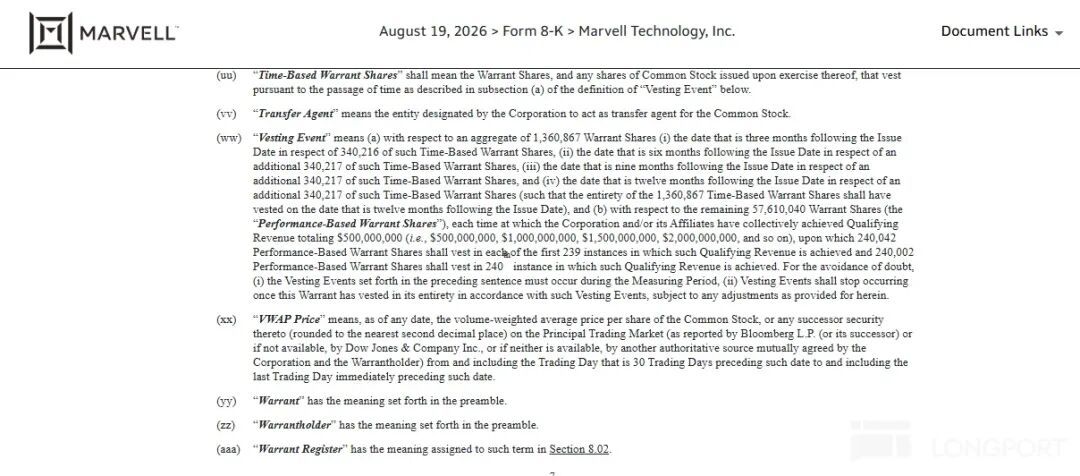
It is worth noting that there is another clause in the agreement: Google can unilaterally choose the method of cash exercise or cashless exercise, and automatic cashless exercise will be triggered if the warrant is in the money at maturity. If Google adopts the net exercise method later, Marvell will not receive any cash at all, and will only issue net shares according to the intrinsic value.
II. Impacts of the New Agreement Terms
Based on the above core terms, Marvell is clearly the disadvantaged party in this arrangement: ① Regardless of subsequent revenue generation, 1.36 million warrants are given away for free first as a gesture of goodwill; ② Google does not need to pay any cash, and can directly choose the net exercise method.
Combined with the company's definition of "eligible revenue limited to the ASIC field", Dolphin Research believes that Marvell's agreement is mainly intended to pry Google's custom ASIC business away from Broadcom.
As for Google, first of all, it gets the good deal of receiving warrants given away for free, which it can accept first; secondly, it already has existing custom ASIC cooperation with Marvell (Axion CPU), and there are subsequent product plans such as MPU (Memory Processing Unit), and this cooperation also enhances its bargaining power against Broadcom.
For Marvell, this is not the first equity-related arrangement of the company. The company has previously signed similar agreements with Amazon and NVIDIA.
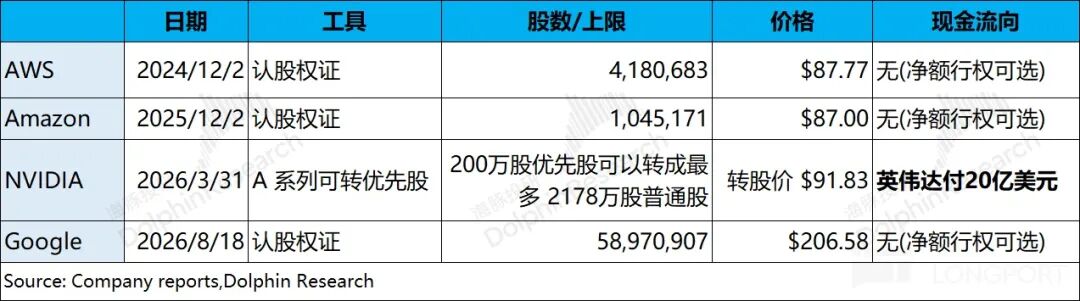
1) Amazon: Two warrant agreements have been signed
The first one was signed on December 2, 2024, covering custom AI products, optical DSP, AEC DSP, PCIe retimer, DCI optical modules, Ethernet switching silicon and other products, with a total of 4.18 million shares.
Vesting conditions: 280,000 shares of which are time-based vested (free grant); 2.7 million shares are tied to revenue from custom AI products, and 1.2 million shares are tied to revenue from other products (including general-purpose products), the revenue calculation period ends on January 5, 2030 (5-year term).
The second one was signed on December 2, 2025, as a customer incentive signed simultaneously with the acquisition. Signed on the same day as the announcement of the acquisition of Celestial AI (Amazon itself is its core customer), the vesting is tied to Amazon's purchase of Photonic Fabric products, totaling 1.045 million shares.
2) NVIDIA: Series A Convertible Preferred Stock
Signed on March 31, 2026, attached to the NVLink Fusion cooperation: Marvell provides custom XPU and NVLink Fusion compatible scale-up network, NVIDIA provides Vera CPU, ConnectX NIC, BlueField DPU, NVLink, Spectrum-X switching and rack-level environment, and the two parties will also carry out silicon photonics cooperation.
NVIDIA is the only one among these arrangements that paid $2 billion in real money, and is a voting strategic shareholder, and NVIDIA can choose to convert the preferred stock into common stock.
Overall, Google's cooperation agreement with Marvell is roughly similar to the template of the previous Amazon version, and the main difference lies in the scale: ① The number of shares has increased significantly from 4.18 million to 58.97 million (more than 10 times); ② The exercise price is close to the par value on the issuance date, where Google's exercise price ($206.58 per share) is much higher than that of Amazon ($87 per share).
The two customers are different for the company: the company itself is Amazon's main supplier, while Google is an entry that Marvell "forced to pry open" from Broadcom (which has a 10-year TPU cooperation history with Google).
On the whole, the cooperation between Marvell and NVIDIA is more like mutually beneficial strategic cooperation; while the agreements between the company and Amazon and Google are more of Marvell's proactive gesture of goodwill to obtain large customer orders.
As for the TPU cooperation, the market may have some misunderstandings about it. Dolphin Research believes that Marvell is more likely to obtain supporting products for TPU, rather than the TPU itself. Google has already found the "backup" MTK (which has co-developed products with it for many years) on the basis of Broadcom, and Marvell is still difficult to "capture" the core TPU orders in the short term.
In this recent arrangement with Google, Marvell has offered quite generous terms, hoping to pry the custom ASIC cooperation between Google and Broadcom open. Google itself already has Axion CPU cooperation with Marvell, and there may be subsequent landing of custom MPU, TPU supporting chips and other products.
From Marvell's perspective, the most important thing at present is to obtain recognition from large customers and large orders. The company is already a competitor, and this move is relatively positive. When the company's cooperation with large customers such as Google gradually deepens, there is a possibility that it may "accidentally" pry the large TPU order.
This article is from the WeChat Official Account "Dolphin Investment Research" (ID: haituntouyan), author: Dolphin Research, authorized to publish by 36Kr.