The cheapest welfare in the world
The recent public discussions about unreserved train tickets have been very heated, which reminds me of my past experiences of traveling on trains with unreserved tickets.
When traveling with an unreserved ticket, you usually become much more observant. You will quietly notice who starts to pack their water cup, who throws away their instant noodle box, who takes their bag down from the luggage rack... Several other people standing nearby will also observe discreetly, competing silently. If you judge correctly, you can sit for a few stops; if you get it wrong, it's no big deal, you just keep standing.
Back then I never thought about whether I was free or not. The reason I bought an unreserved ticket was very simple: all the reserved tickets were sold out, and I had to take that train. If I had a choice, I would actually very much prefer to be "restrained" by a chair. I did exactly that once. Once when I could only get an unreserved ticket again, I spent more than ten yuan buying a small plastic stool and brought it onto the train. That trip became much easier as a result. But I never did that again later, probably because reserved tickets became easier to buy, or maybe because I was told that doing so was against the rules.
So later, when I heard Zhang Dandan, Vice Dean of the National School of Development at Peking University, say that for flexible workers, "flexibility itself is a kind of welfare", the first thing that came to my mind was the unreserved train ticket.
Following this logic, unreserved tickets also have a welfare that reserved tickets do not have: you are not restricted by a seat number, and you can stand wherever you want as long as you do not block the way. The railway department has been selling unreserved tickets for so many years and never thought of promoting them this way, which is a bit of a missed opportunity for good publicity.
This remark appeared in the financial talk show *Chat a Bit*. The host Wang Boming asked what social security the more than 200 million flexible workers have. Zhang Dandan explained that formal employees exchange their time and freedom for the five social insurances and one housing fund; flexible workers have greater autonomy over their time, at the cost of relatively weaker social security benefits.
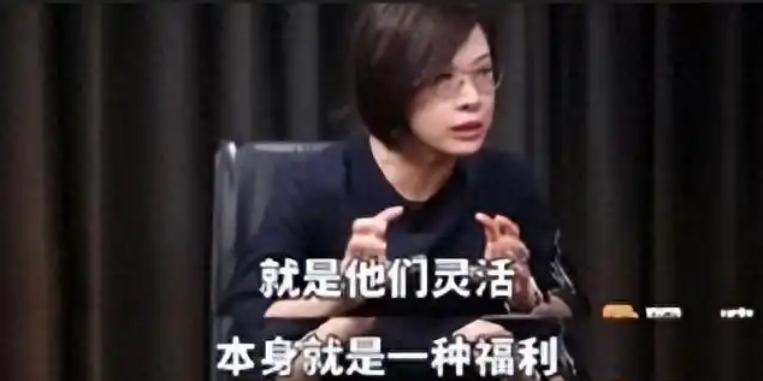
When this passage was posted online, many people suggested that Zhang Dandan go and experience this kind of welfare in person. This suggestion is not very kind, but it conforms to people's simple sense of distributive justice: if it is such a good thing, other people should not be the only ones who get to enjoy it.
It seems that the story ends here. A professor from Peking University who does not understand the lives of the underprivileged said a remark in the style of "why don't they eat meat" and got a lot of criticism. After scolding her, everyone swipes up with their fingers and moves on to the next piece of content.
But after watching the full interview, I found that things are a bit more complicated.
In the subsequent conversation, Wang Boming asked again whether flexible employment was their active choice. Zhang Dandan said that some people choose it voluntarily, while others "have no choice" because they cannot find a stable job with a labor contract and the five social insurances and one housing fund.
She is not unaware that some people are standing simply because there are no seats available.
At the end of 2024, Zhang Dandan's research group surveyed more than 30,000 riders on a leading food delivery platform. The surveyed riders are 34 years old on average, 70% of them hold rural household registration, and their average retention period is only about half a year. 60% of the riders also take other part-time jobs: some take orders on other platforms, some work on assembly lines in manufacturing factories.
When asked what problem they most want to solve, housing subsidies and medical insurance top the list. More than half of them are concerned about pension security, and one third of them care about whether their children can attend school in the cities where they work. Freedom is also on the list: 28.8% of the riders hope to retain as much autonomy as possible in their work on the platform.
There is nothing contradictory about a person wanting to decide when to go online to take orders, and also wanting to be able to afford medical treatment after getting injured. Life never stipulates that people who value freedom must give up their pension security.
The solutions Zhang Dandan proposed in the past also include clarifying the responsibilities of platforms and outsourcing companies, enabling the cross-regional transfer of social security, and providing more subsidies to low-income gig workers. According to her own research, flexibility and security are not mutually exclusive options.
So simply classifying Zhang Dandan as an "expert who does not understand the grassroots" is certainly very easy, but it will also flatten a complex person into a judgment that is convenient to forward.
The problem therefore does not disappear, but becomes more specific: she knows all this, why did she still say that sentence?
In labor economics, the value of a job is never just a payslip. Commute distance, working environment, time flexibility, and the degree of supervision you are subject to all belong to the non-monetary benefits of a job. Some people are willing to earn a little less in exchange for working from home; some people would rather not get a year-end bonus than squeeze the subway every morning. Counting "flexibility" as a kind of welfare is not some unheard-of academic absurdity.
If a person has two roughly equivalent job options, one is stable but has fixed working hours, the other has slightly weaker security but allows him to arrange his own schedule, and he chooses the latter, then freedom does constitute part of his labor remuneration.
This logic is not wrong on paper. The trouble is that the prerequisite that determines the conclusion is gently skipped over: this person must first have the other job to choose from.
When Amartya Sen discussed "capability", he cited the difference between fasting and starving. Two people who do not eat look exactly the same on the surface; the person who is fasting can eat at any time but chooses not to, while the person who is starving does not have that option. The difference is not in their stomachs, but in whether life gives them another possibility.
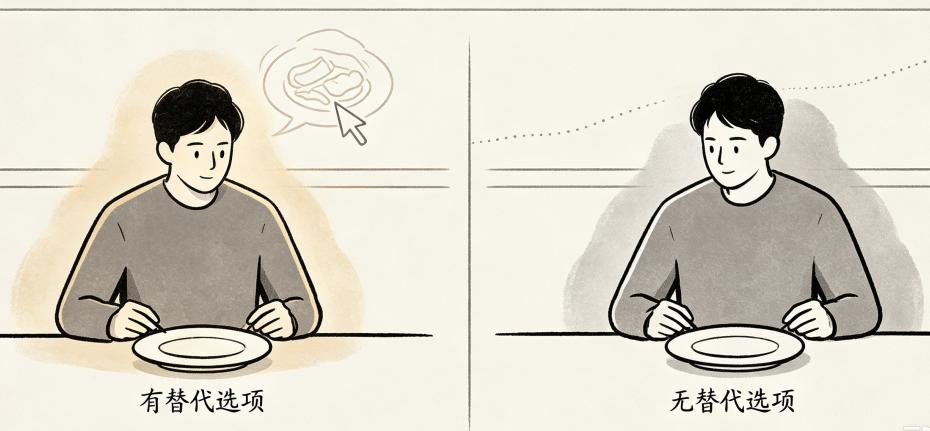
The same is true for flexible employment.
"Being in flexible employment" describes a person's state; "preferring flexible employment" describes his choice. You cannot deduce what a person originally wanted just because he accepted a certain outcome in the end.
A university teacher is not in the office at 2 p.m., and a ride-hailing driver is also not in the office at 2 p.m. Neither of them clocks in, and they seem to enjoy the same kind of freedom. The former might be writing a paper at home, while the latter might have been sitting in his car for eight hours. One person's time is largely arranged by himself, while the other's time is split into individual orders, and the empty driving segments are usually not paid.
Not needing to clock in sometimes means the organization allows you to arrange your own work; sometimes it means there is no organization willing to recognize you as its member at all.
There is indeed a "log off" button on the order-taking app, and riders can press it whenever they want. But after they press it, the rent does not log off, the car loan does not log off, their children's tuition fees and tomorrow's breakfast do not log off either.
The attendance sheet is gone, but the bills will still clock in on time every month.
That button only provides operation permission. A person can be said to have a real choice only if life can still go on normally after he presses that button.
Even if some people do actively choose flexible employment, another issue still remains unexplained: why do they have to pay for this freedom by giving up basic security?
Whether a rider takes an order at 3 p.m. has no necessary logical connection with whether he can get compensation after getting injured; whether a person is willing to be bound by fixed working hours cannot determine whether he deserves a pension when he gets old. Fixed jobs can implement flexible working hours, and mobile labor can also have portable social security that moves with the worker.
Today, security is often tied to formal labor relationships, and flexible workers often have to bear more of the risks related to pension, medical care and work suspension on their own. This is an institutional arrangement, not a natural law. It cannot in turn prove that less security is the price for more freedom.
What actually happens is that flexible employment first makes the platforms more flexible. When there are more orders, they can quickly recruit more workers; when there are fewer orders, they do not need to bear the idle labor costs. Workers also get part of the time flexibility, but at the same time they take over the risks of income fluctuation, equipment investment, occupational injury and aging. The risks do not disappear, they just change recipients.
The reason why the remark "flexibility itself is a kind of welfare" makes people uncomfortable is not just that it sounds lacking in empathy. It also quietly alters the whole narrative.
The original question is: why do some workers not have stable security? After the alteration, the answer becomes: because they chose a welfare called flexibility.
Not having a fixed post is interpreted as liking flexibility; not having a company to pay for your social security is interpreted as self-management; the costs originally borne by workers are, after a series of conceptual rearrangements, turned into extra benefits they get.
The term "flexible employment" was not wrong at the very beginning. Freelancers, small business owners, food delivery riders, ride-hailing drivers, manufacturing gig workers, and people who temporarily cannot find a fixed job all need a collective name. Statistics and policies also need to know exactly who they are talking about.
The problem is that after a name is used for a long time, people tend to forget that it covers very different lives. Gradually, it no longer only describes people's situations, but also starts to explain those situations for them; it no longer only tells us how a person works, but also arbitrarily concludes why he works that way.
Zhang Dandan's original research is very complex. Among more than 30,000 people, some like flexibility, some are forced into it; some earn more than 10,000 yuan a month, some only earn more than 2,000 yuan; some care most about work autonomy, some ask first about medical insurance and their children's schooling. But in the studio, these intertwined lives are sorted into two simple categories: formal employment gets security, flexible employment gets freedom.
More than 30,000 questionnaires are finally reduced to an overly neat generalization.
Flexibility can of course be a kind of welfare. A person who has room to refuse work, has the ability to stop working, has security that prevents him from falling into poverty after a single illness; can leave one platform without losing his medical insurance and pension; can arrange his own time, instead of being allowed by life to freely switch between different kinds of busyness.
Standing can of course also be a choice. Some people only take the train for one stop and do not want to bother getting a seat; some people like walking around in the carriage. Standing is not necessarily worse than sitting, but what we need to figure out is whether a person is standing because he does not want to sit, or because there are no seats available.
You can leave your seat, and you know you can come back to sit when you get tired. That is the kind of life most people long for, and that is what a real choice looks like.
Renaming unreserved tickets is much easier than adding an extra chair for every standing passenger. This kind of welfare is, of course, very cheap.
This article is from the WeChat Official Account "Letter PRO", the author is He Renfei, and it is published with authorization from 36Kr.