AI is now even helping people get rid of single status, and the "cyber matchmaker" has secured 15 million yuan in angel financing.
In the 2026 venture capital circle, there is an unspoken unwritten rule: putting the two letters "AI" in your BP can cut your financing journey in half.
AI runs coffee shops, AI reads feng shui, AI calculates bazi, AI chats with insomniac young people until dawn. Everything can be AI-powered, and everything is waiting for a round of financing. Stick the label on, and the green light turns on.
The latest green light that has been lit points to one of the oldest businesses - matchmaking.

A startup named Liangpei Technology has a team of 18 people, its product was launched 40 days ago, and it has just over 10,000 registered users. Its flagship product is a chatty "AI matchmaker". With this alone, Xu Xin from Capital Today talked to the founder for 3 hours, and immediately closed a 15 million yuan angel round - originally the founder only planned to raise 10 million yuan and give up 15% of the shares, but Xu Xin took the initiative to offer to take 20% and increase the amount to 15 million yuan.
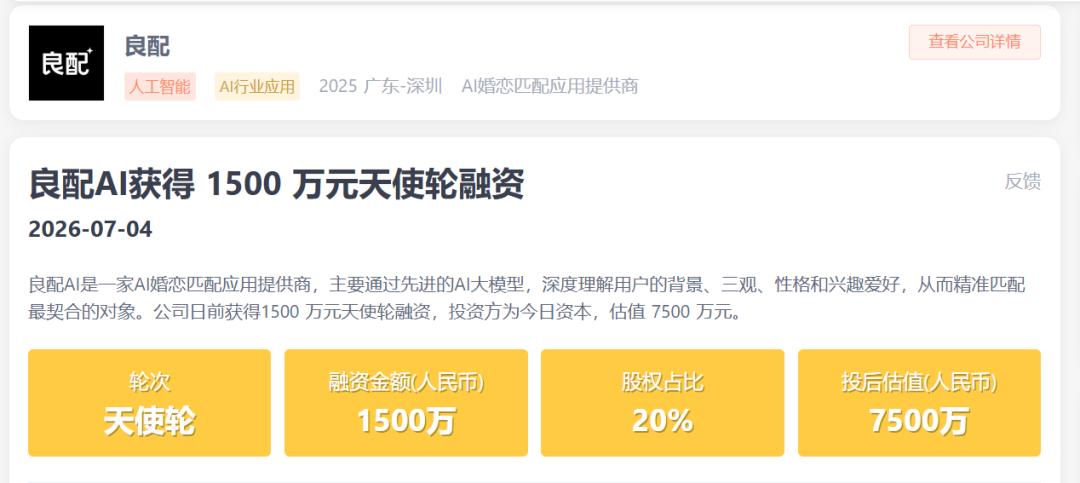
It should be noted that Capital Today is known for being tight-fisted, and only made five investments in the whole of last year.
The founder Zeng Xinxun, born in 1994, is a 2019 graduate of Southern University of Science and Technology. He previously worked on search recommendation at WeChat and TikTok, and was the head of AI search at Kimi before leaving his job. For this startup, he gave up tens of millions of options - in his own words, those options rose 10 times after he left.
A person who used to work on search turned to matchmaking. This combination feels familiar: more than 20 years ago, a group of companies welded "Internet" and "dating" together, namely Jiayuan, Baihe, and Zhenai, which were extremely popular for a time, then collectively fell into decline.
So here comes the question: Is AI matchmaking just a rebrand of those old dating sites, or a brand new business?
01
The Magpie Bridge
Chinese people moved dating and marriage online much earlier than most people remember.
In August 1995, the Shuimu Tsinghua BBS was launched, which was the first large-scale BBS in Chinese mainland. Engineering students discussed operating systems and canteen food prices on it, and quietly did other things too - there was a section on the site called "pie bridge", the Magpie Bridge section, dedicated to making friends.

Posters detailed their own conditions, wrote down their expectations for a partner, spoke in a restrained tone with full sincerity. This was one of the earliest cyber romance stories on the Chinese Internet. There were no algorithms, no membership fees, not even photos, only paragraphs of plain text self-introductions.
Three years later, the novel *The First Intimate Contact* by Pizi Cai made "online dating" a household term. Another year later, OICQ was born, and later it got a better-known name - QQ. Chat rooms and instant messengers turned "making friends online" into the social enlightenment of a generation, and "meeting strangers online" changed from a novelty to a daily routine.
Once the habit is formed, business follows.
In 2003, Gong Haiyan, a second-year postgraduate student at the School of Journalism of Fudan University, founded Jiayuan, for a simple reason: she found that all her highly educated classmates around her had good conditions, but just couldn't find a partner. In 2005, Tian Fanjing, a Tsinghua PhD, and Mu Yan founded Baihe, focusing on "spiritual matching"; in the same year, Li Song, a US-educated PhD and former Morgan Stanley professional manager, acquired the China Dating Center founded in 1998, and reorganized it into Zhenai.
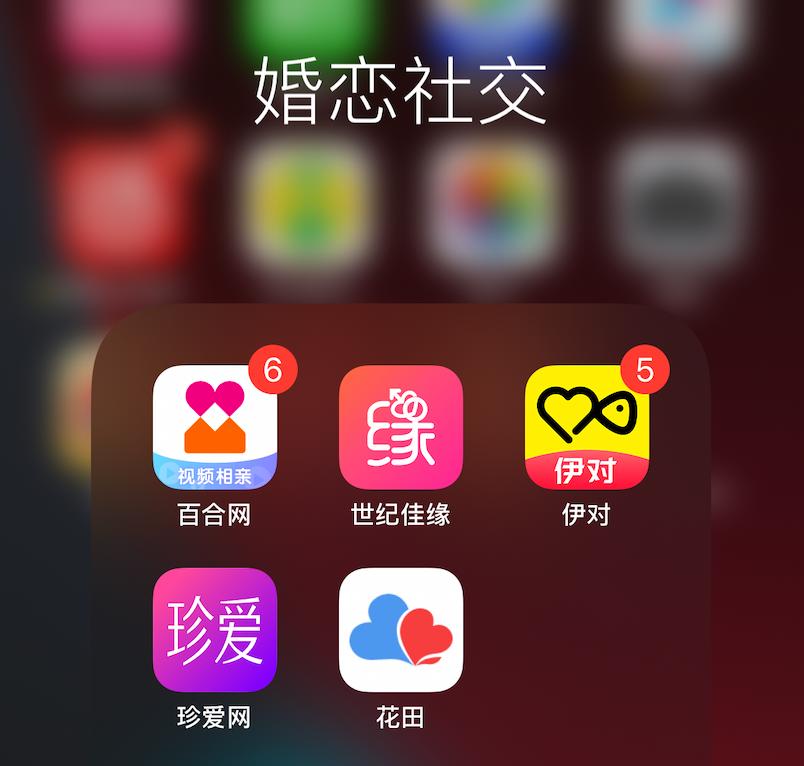
The era of vertical dating platforms thus began. From 2005 to 2007, the publicly disclosed financing amount of domestic dating websites alone exceeded 60 million US dollars - in an era when housing prices had not yet taken off, this was a real hot track.
How to run the business? The answer of the first generation of players was simple and crude: split the process of "meeting people" into paid items. Registration was free, checking profiles was paid, and sending messages was also paid. Jiayuan invented the "stamp system" - sending a message to a member of the opposite sex required a stamp, which cost 2 yuan. Baihe sold memberships, and Zhenai later simply shifted its focus to offline services, with offline stores equipped with in-person matchmakers providing one-on-one services, with a unit price ranging from thousands to tens of thousands of yuan, which later contributed 80% of Zhenai's revenue.
In 2011, Jiayuan was listed on NASDAQ as "China's first dating stock". At that point, it was an almost perfect business: the demand was rigid, everyone wanted to get married; the willingness to pay was extremely high, and the user payment rate once approached 80%, the highest among all Internet sub-sectors; customer acquisition cost was almost zero, single young people came to the platforms on their own.

The Magpie Bridge was built, with people coming and going on it. No one really thought about one question: did the people crossing the bridge want the same thing as the people who built the bridge?
02
The Dilemma
The answer gradually emerged in the next ten years: no, they did not.
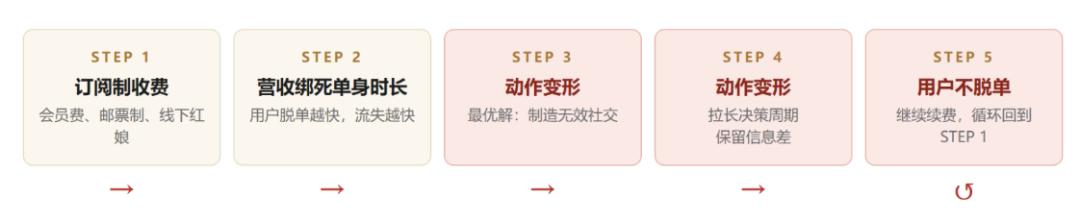
For users, the end point of a dating platform is to find a partner and leave; for the platform, a user finding a partner means losing a paying member. The subscription system ties the platform's revenue firmly to the length of the user's single status - the faster the user finds a partner, the faster the platform loses the user; the longer the user stays single, the longer they will renew their membership.

Under this set of incentives, improving matching efficiency does no good to the platform at all. The optimal solution is to create ineffective social interactions, extend the decision-making cycle, and deliberately retain information asymmetry. Let users always feel that the next person might be better, that they are just a little short of finding a perfect match, and that they are willing to renew their membership for another month.
The success of users is the failure of the platform.
After being twisted for too long, operations will inevitably go wrong. The 2024 CCTV 3·15 Gala named Zhenai, Jiayuan and Baihe: they used high-quality opposite-sex resources, zero-threshold advertisements and success stories as bait to harvest anxious single men and women. In January 2025, Zhenai was fined 1.7 million yuan by the market regulatory authority for falsifying member information and false propaganda. Media investigations went even further: the staff training of dating platforms did not teach dating psychology, but taught how to "figure out the financial status of customers".
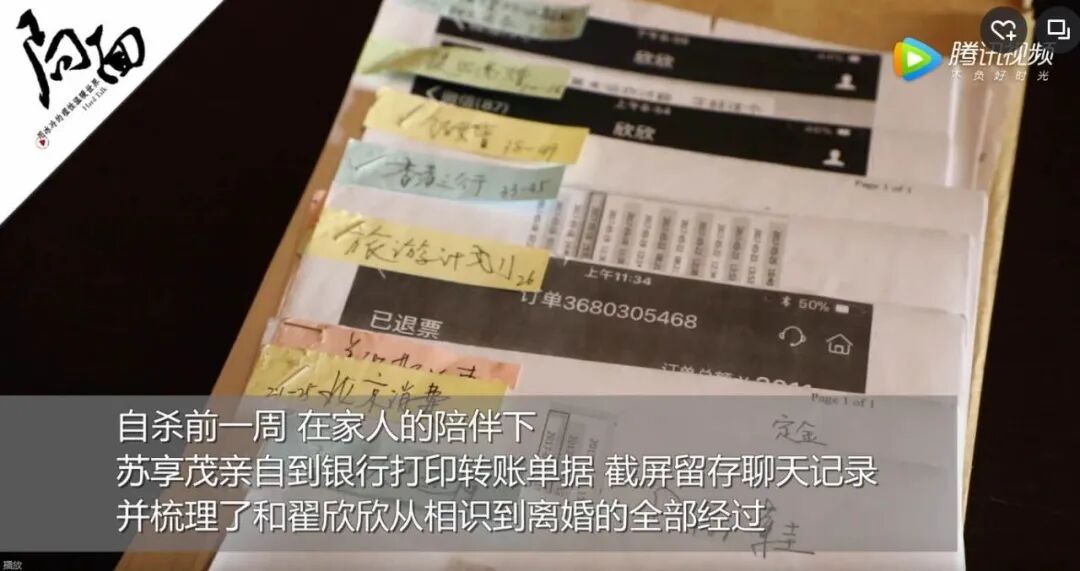
An earlier landmark event took place in 2017. Su Xiangmao, the founder of WePhone, met Zhai Xinxin through the VIP service of Jiayuan. They met on March 30, got married on June 6, spent more than 13 million yuan in total, got divorced quickly, and he fell to his death from a building in September. This tragedy fully exposed the fact that the verification of dating platforms was almost non-existent - a survey by the provincial consumer protection committee showed that platforms such as Jiayuan and Zhenai did not conduct mandatory verification of members' identity and property status.
The downhill path never stopped after that. At the end of 2015, Baihe announced the merger with Jiayuan, and the new company completed privatization the following year, Jiayuan was delisted from NASDAQ, with its stock price permanently fixed at 7.49 US dollars; in 2018, the merged "Baihe Jiayuan" joined Fosun; in 2022, the senior management of Jiayuan was reported to the police by major shareholder Fosun for investigation; in March 2025, offline stores of Zhenai in many cities were closed overnight, and paying members could not get in touch with their matchmakers, with no way to get refunds.
Industry data is equally bleak: the revenue of the online dating industry peaked at 5.593 billion yuan in 2019, and fell directly to 4.547 billion yuan in 2020. The larger background is that marriage itself is on the decline - the number of marriage registrations across the country dropped from 13.469 million pairs in 2013 to 6.106 million pairs in 2024, exactly halved, hitting a 44-year low.
Looking back, this business has hidden flaws from the very first day: what users want is the result of getting out of single status, what the platform wants is active data. There is a steady stream of single people, and members come and go. Those platforms like Jiayuan did not lose to their competitors, but to the unsolvable equation in their own business model.
03
The Prescription
Now it's Zeng Xinxun's turn. His diagnosis is consistent with all reviewers: the root cause lies in the opposition between the business model and user interests. His solution is to reverse this opposition.
The product design of Liangpei is full of anti-Internet characteristics everywhere.
Users have to pass three checks first when entering: real-name authentication, face recognition, then chat with the AI matchmaker via voice for 20 full minutes, the AI will give a profile diagnosis score, and users with a score above 70 will be allowed to enter. In the first week after the product was launched, the system blocked more than 50 married people.

After entering, you can only chat with one person at a time. The AI screens matching objects from users in the same city, starts a 1-on-1 conversation, cancels the match if it's not suitable, then switches to the next one. There is no left swipe or right swipe, no waterfall flow, no push notification saying "38 people liked you today".
The charging standard of Liangpei is 300 yuan for a quarter, 1000 yuan for permanent access, and 2000 yuan for "marriage guarantee" (full refund if you don't get a marriage certificate within three years). The marriage guarantee is not just a promise, it is a system: the money is deposited in a special bank escrow account, and will not be counted as revenue until three years later. Even if the company goes bankrupt, the money will be returned the same way.
In Zeng Xinxun's words, the logic of past dating apps was fundamentally inconsistent: users wanted to succeed, but the platform did not want users to succeed, so operations would inevitably go wrong; what Liangpei wants to do is to tie the user's success in getting out of single status and the company's commercial success to the same line through mechanisms.
As for what AI does in this process, it is not that mysterious.
First, profile collection: 20-minute voice interview, the AI asks questions and you just answer out loud, no need to rack your brains to write a self-introduction; then matching, it mixes four models including Doubao, DeepSeek, Qianwen and Kimi to work in different scenarios, and is training a special matching model with a scale of 7B to 14B at the same time, to screen out 10 people for you from 100,000 people; finally, communication assistance: the AI avatar asks those hard-to-say questions for you anonymously, such as debt, marriage history, and bride price expectations; the AI strategist provides conversation topics when the chat goes cold.
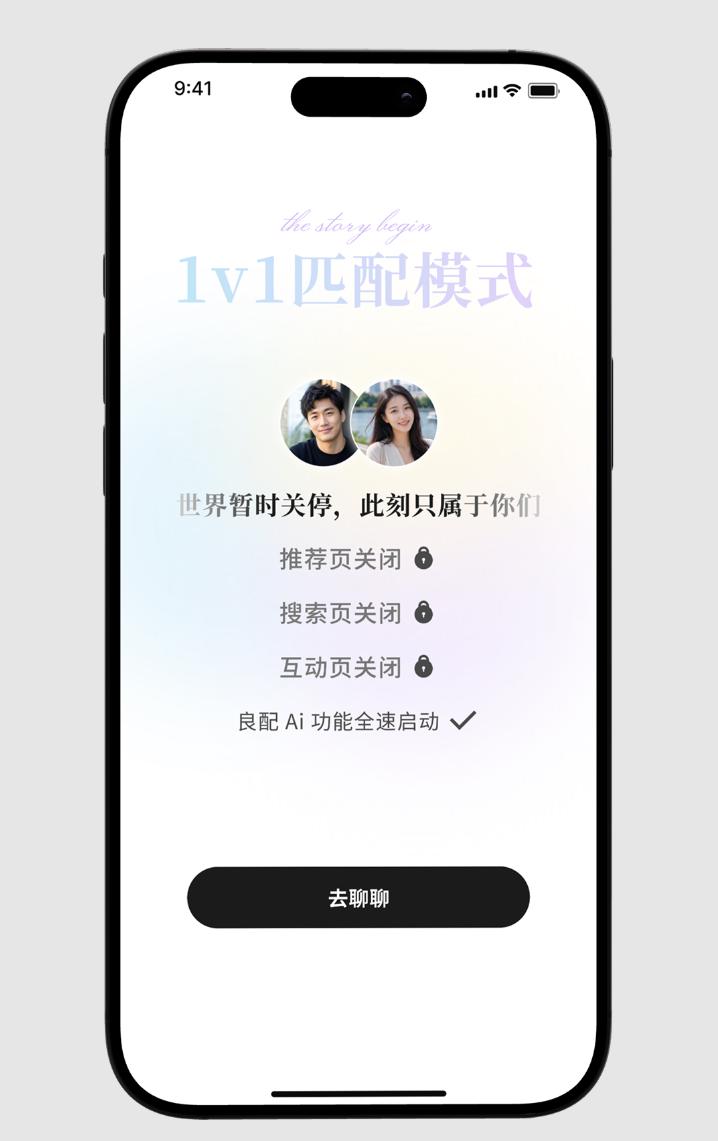
Will this prescription work?
Let's talk about the effective part first. Profile collection is really improved, allowing users to speak for 20 minutes instead of writing 132 words, which reduces the expression threshold by an order of magnitude. With more sufficient data fed