Jensen Huang's daughter: from a chef to an annual salary of 8 million RMB
Jen-Hsun Huang's daughter made a rare public appearance in Beijing.
On the opening day of the 2026 World Robot Conference, Madison Huang came to Yizhuang, Beijing, and visited a number of robotics companies along the way, including DOBOT, LightWheel Intelligence, UBTECH and other robotics firms.
This post-90s "heiress of NVIDIA" now serves as Senior Director of Product and Technical Marketing for NVIDIA's Physical AI Platform, with an annual salary of 1.2 million US dollars, equivalent to more than 8 million RMB. Little known is that she first studied culinary arts, worked as a chef, and also served at LVMH. After many twists and turns, she finally joined NVIDIA, the company founded by her father, as an intern.
This trip to Beijing coincides with the most prosperous moment of China's robotics industry. Unitree Robotics has just gone public, and China's robotics IPO queue is growing. The second half of the robotics industry has already kicked off.
Jen-Hsun Huang's Daughter
Visiting Robotics Enterprises in Beijing
The global robotics industry's attention has once again turned to Beijing.
On August 19, the 2026 World Robot Conference opened in Yizhuang, Beijing. A familiar face appeared in the crowd — Madison Huang, daughter of Jen-Hsun Huang.
She visited multiple robotics booths across the exhibition hall. At the DOBOT booth, Madison Huang watched the demonstration of the "one brain, multiple bodies" embodied intelligence platform and the robot playing table tennis.
At the LightWheel Intelligence booth, Madison Huang focused on learning about the company's progress in human data collection, physical simulation, large-scale evaluation and real deployment feedback. During the visit, the NVIDIA delegation also experienced the physical simulation equipment in person, and exchanged details with the team on simulation scenario generation, parameter calibration and other topics.
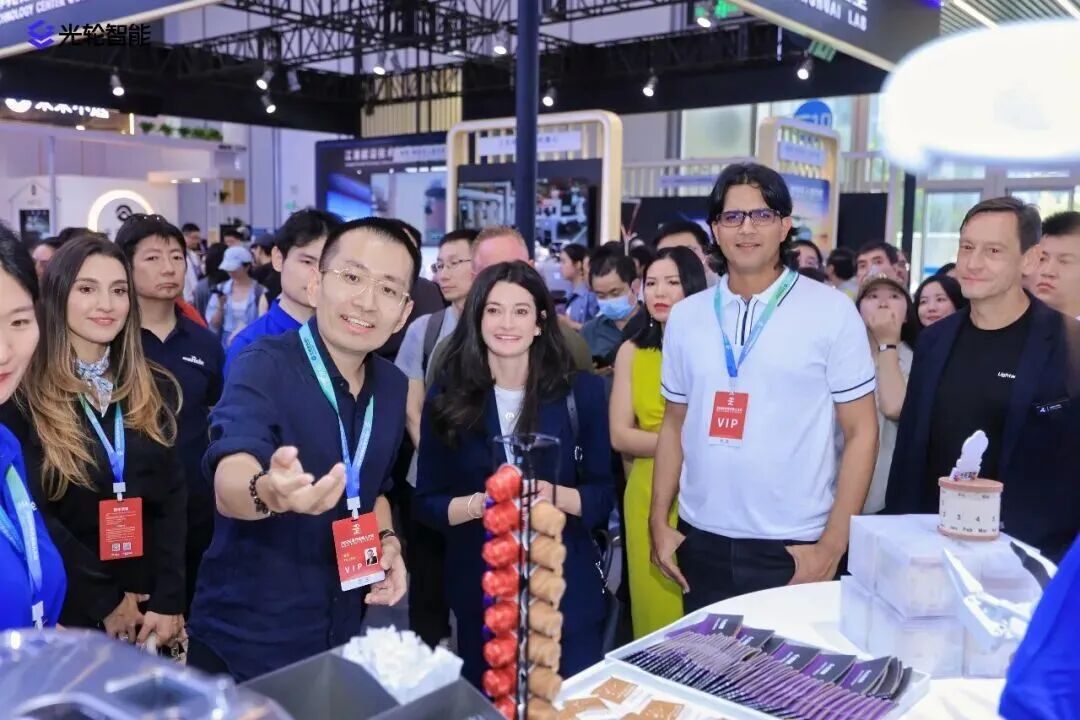
After that, she visited the booths of UBTECH, Huazhijian and other enterprises. UBTECH's commercial service humanoid robot Walker C1 walked up to Madison Huang with a bouquet of flowers, presented the flowers to her and shook hands with her. Then she stopped in front of the ultra-realistic humanoid robot U1 and experienced it for a long time. At the Kepler Robotics booth, Madison Huang experienced the heavy-duty Qilin series quadruped robot; at the JD exhibition area, she continued to learn about the real-scene operation and data training system of robots, watched the demonstration of robots' movements in specific scenarios, and exclaimed "Amazing" several times.
Many people recognized this "heiress of NVIDIA", some took out their mobile phones to take photos, and some came forward to take group photos with her. Compared with her father Jen-Hsun Huang, who frequently appears in China, Madison Huang rarely appeared in the public eye before.
The day before arriving in Beijing, Madison Huang led a team to visit the robot data factory built by LG in Seoul, South Korea. The itinerary has always been centered on robots, which is also related to her current position at NVIDIA.
Madison Huang is currently the Senior Director of Product and Technical Marketing for NVIDIA's Physical AI Platform, covering products including Omniverse, Cosmos, Isaac and GR00T, the foundational model for humanoid robots. In the past few years, these businesses have occupied an increasingly important position in NVIDIA's territory, and are the next wave that Jen-Hsun Huang has repeatedly mentioned in recent years: Physical AI.
Simply put, large language models enable AI to learn to understand and generate text, while Physical AI aims to enable machines to understand the real world and actually operate. Robots are the most important carrier in this process.
Therefore, this trip to Beijing has more implications. What Madison Huang visited along the way is a group of the most active robotics companies in China at the moment, as well as the ecosystem that NVIDIA cannot avoid when betting on Physical AI.
Going back more than ten years ago, her life trajectory was far from chips, AI and robots. At that time, she chose to step into the kitchen.
From Chef to NVIDIA
With an Annual Salary of 8 Million RMB
Madison Huang is a post-90s generation. When NVIDIA was founded, she was only one or two years old. Growing up in an engineer's family, when she graduated from high school, she once thought of following the path of her parents and applying for electrical engineering.
Unexpectedly, it was Jen-Hsun Huang himself who first persuaded her to change her mind. In his opinion, his daughter did not have great enthusiasm for engineering, and what she really liked was cooking. Therefore, Madison Huang withdrew her original application and entered The Culinary Institute of America.
After graduating in 2012, Madison Huang worked in restaurants in New York and San Francisco successively, then went to Paris to study pastry, and later continued to study wine at Le Cordon Bleu London. After leaving the catering industry, Madison Huang joined the LVMH Group and began to engage in marketing and brand management.
These seemingly unrelated experiences are connected by a hidden line. The kitchen pays attention to time, heat and details, and luxury goods also attach great importance to products and experiences. Madison Huang found that what she is really fascinated by is polishing a product over and over until it is good enough — she is almost paranoid about details and enjoys the process of making products to the extreme.
It was 2019 that brought her back to the technology industry. At that time, Madison Huang and her brother Spencer attended an artificial intelligence course at MIT together, and then she went to London Business School to pursue an MBA.
The next year, while still studying, Madison Huang joined NVIDIA as an intern. At first, she was not used to the work, and the technical terms in the meetings often made her confused. She once shared that she created a document at that time to write down every word she could not understand, and then looked up materials and made up lessons one by one after the meeting. Over time, there were fewer and fewer unfamiliar words in the document, and she became handy at work.
After several years, Madison Huang rose from an intern to senior director. Looking back on her own experience, she mentioned in a recent speech that the AI era does not require a straight life path, and the detours you take can eventually become new accumulation.
Interestingly, her brother Spencer also took a quite similar detour. After graduating from university, Spencer opened a cocktail bar with his friends. There was no fixed wine list here. Customers told their tastes, and bartenders created on the spot. The bar was once listed as one of the "50 Best Bars in Asia".
Madison Huang joined NVIDIA first, and Spencer later closed the bar and returned to campus. After completing his MBA, he joined NVIDIA as an intern in 2022. Now, he is mainly responsible for robot software and simulation related products, including robot learning simulation, synthetic data generation and other directions.
According to NVIDIA's disclosure, in fiscal year 2026, Madison Huang's total compensation was about 1.232 million US dollars, equivalent to about 8.3 million RMB; Spencer's total compensation was about 1.32 million US dollars.
This also makes the outside world inevitably talk about a topic: nepotism. At an all-hands meeting of NVIDIA in 2025, Jen-Hsun Huang did not avoid this topic, and confessed that the company did employ many children of employees, but parents usually would not easily recommend children who would make them ashamed. He even joked that the performance of some "second-generation NVIDIA" has surpassed their parents.
After many twists and turns, the brother and sister returned to NVIDIA and gathered in the company's next battlefield — robotics.
The Hottest Track in China
This year's World Robot Conference is still bustling.
Nearly 400 enterprises brought more than 3,000 exhibits, and more than 300 new products were launched collectively. In addition to dancing, boxing and playing table tennis, more and more robots began to transport materials, sort goods and operate equipment, appearing in real scenarios such as automobile manufacturing, logistics and commercial services.
The changes on the booths also reflect the entire industry. In the past few years, China's humanoid robot industry has rapidly completed the development from 0 to 1. Startups have emerged intensively, the iteration of complete machines is getting faster and faster, and the supply chain of core components is gradually taking shape. Capital has poured in accordingly, and financing records and valuations are constantly being refreshed.
Now, the first batch of companies have started to go public.
On the opening day of the World Robot Conference, Unitree Robotics officially landed on the Sci-Tech Innovation Board, and its share price once soared by more than 600% on the first day of trading.
The IPO queue is accelerating. Agibot announced the launch of the listing process in Hong Kong, Deep Robotics' Sci-Tech Innovation Board IPO has been accepted, and companies including Leju Robotics, Zhisquare, Zibianliang Robotics, Exxact Robotics, Qbot, Stardust Intelligence, Galaxy General are also advancing their capitalization processes.
According to incomplete statistics, more than 50 robotics-related enterprises are already queuing up for listing on the Hong Kong Stock Exchange. But the ringing of the listing bell is not the end. The capital market can give valuations, and the final answer will be given by the industry.
In the first half of this year, the shipment volume of humanoid robots in China has exceeded 40,000 units. After the rapid growth in quantity, a more important problem has emerged: whether robots can adapt to more tasks, understand instructions and complete actions even in unfamiliar environments.
The real competition of robots has thus shifted from the "body" to the "brain".
Wang Xingxing mentioned at this World Robot Conference that the real "ChatGPT moment" for robots should be that when entering an environment they have never seen before, they can complete most tasks only through voice or text instructions. He judges that this day may take another 2 to 10 years.
This also pushes the competition to a deeper level.
China already has one of the most complete manufacturing systems in the world. A robot can complete R&D, production and iteration at an extremely fast speed from components to the complete machine. More importantly, huge industrial scenarios such as automobiles, 3C, logistics and retail have provided a rare testing ground for robots.
Robots are manufactured here and then sent to the real world. When global tech giants turn their attention to China's robotics industry, what they see is not just a large number of emerging startups, but a real industrial competition.
The real test is just around the corner.
This article is from the WeChat official account "Pedaily" (ID: pedaily2012), author: Wang Lu, published with authorization from 36Kr.