Hong Kong Professors in Embodied Entrepreneurship
Qiao Buchi, from QbitAI | Official Account QbitAI
When the term "embodied intelligence" became a hit from the lab to the capital market, a group of very special figures emerged from universities in Hong Kong.
They are not only professors who publish papers at top conferences, but also founders or chief scientists of companies valued at hundreds of millions of dollars.
One foot is in the ivory tower, the other is in the upper reaches of the industrial chain, and neither side is neglected.
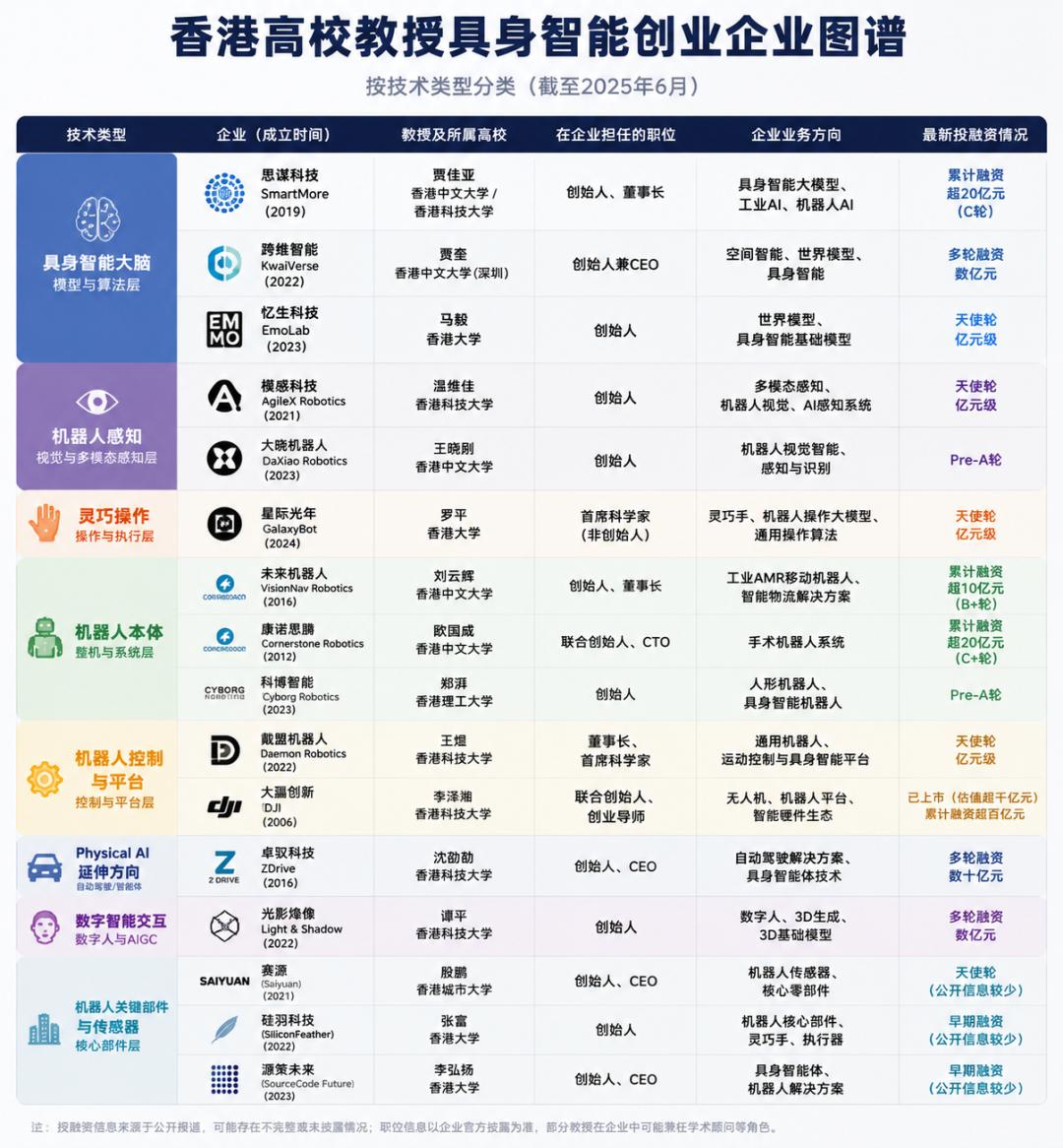
QbitAI has collected and sorted out that at least sixteen professors from Hong Kong universities are personally participating in embodied intelligence entrepreneurship as founders, co-founders, and chief scientists.
Interestingly, the entrepreneurial directions of these professors cover a very wide range. From the "thinking" brain and world model of embodied intelligence, to the "clear-sighted" 3D vision, from the tactile dexterous hand at the fingertips and the fine operation on the operating table, to the autonomous driving on the road and the UAV in the sky — their figures can be basically seen in the whole chain of perception, decision-making, operation and implementation.
Learning about their entrepreneurial stories, what you see may not be the overbearing president story of a prestigious university elite who goes down to start a business and turns clouds and rain with his hands, but that they leave the ivory tower and "toss around" in the real world.
In this process, how did they put down the respected status of professors, "break and reorganize themselves", and truly implement the laboratory technology into products?
The process may be very bumpy, but as Professor Wang Yu, who has been deeply engaged in robot operation for 40 years, said.
Today may be the best era for scientists to start businesses. In the past, mentors and students might only be two names on a paper, but today they have every opportunity to become partners who jointly solve industrial problems and change the world together.
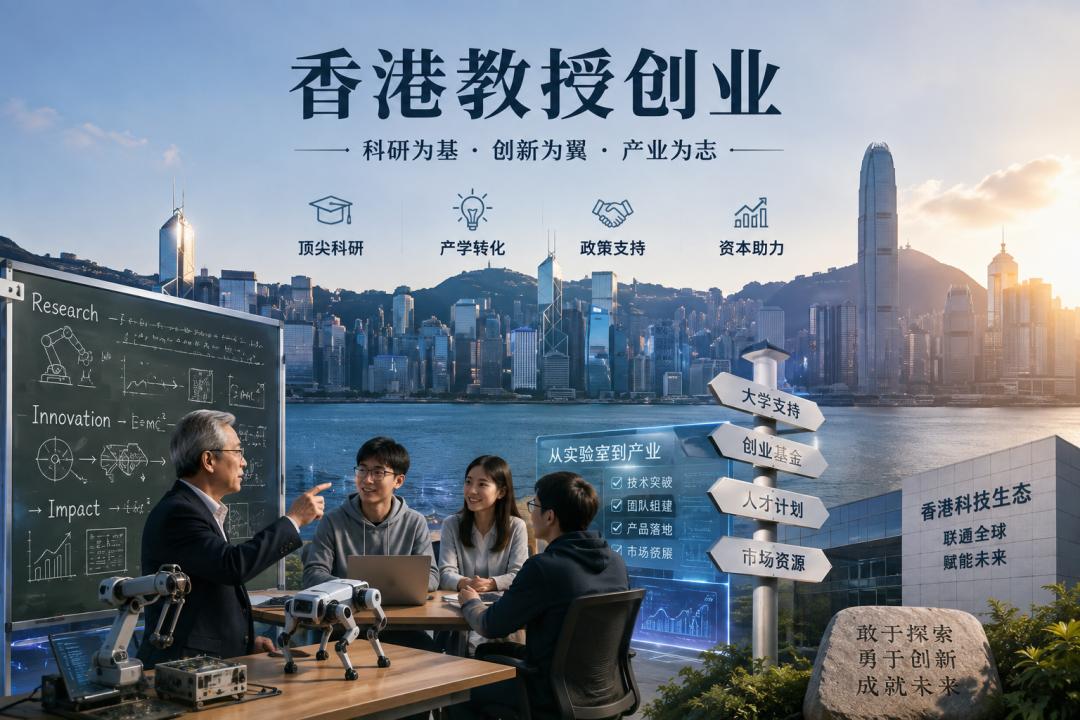
△ Image generated by AI
Hong Kong university professors build "organs" for robots
Let's first see what these people are doing.
Putting their companies together reveals an interesting thing: they almost unanimously avoided "building a complete humanoid robot", but each precisely created a certain "organ" or function of the robot's body.
Some are making the brain of the robot.
△
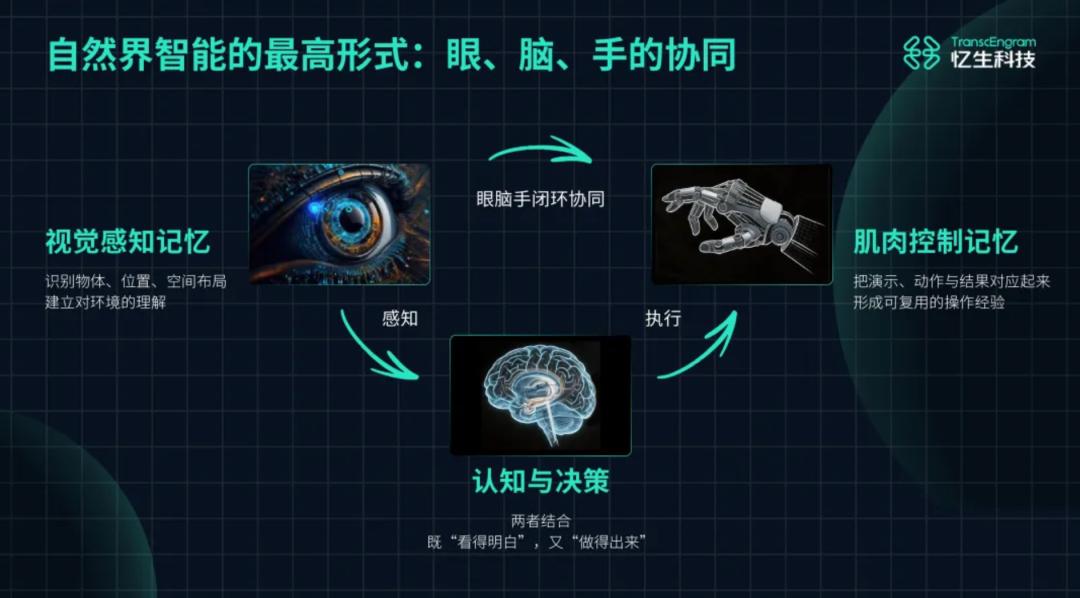
Ma Yi from the University of Hong Kong is the winner of the Marr Prize, the highest paper award in the field of computer vision. He co-founded Memry AI, which develops world models capable of autonomous learning;
Wang Xiaogang from the Chinese University of Hong Kong, co-founder and executive director of SenseTime, founded Daxiao Robotics, which currently provides "embodied brains" for robots, with the long-term goal of developing general embodied robots;
Jia Kui from the Chinese University of Hong Kong (Shenzhen) is developing an embodied intelligence engine to build the "most powerful brain" for robots. The company's valuation has soared to tens of billions of yuan and is sprinting for an IPO;
In addition, "FutureMind", which has just received financing, is developing a "general full-body humanoid base model" and was founded by Li Hongyang from the University of Hong Kong in April 2026.
This is the uppermost layer of technology, which is also closest to general artificial intelligence, and exactly corresponds to the academic background in computer vision of these people.
Some are making the "hands" and "nerves" of robots.
Daimon Robotics, co-founded by Wang Yu from the Hong Kong University of Science and Technology, focuses on the "nerve endings" of hands. Each robotic hand is densely packed with 40,000 sensing units per square centimeter, giving embodied robots a sense of touch.
Even when the robot cannot see, it can rely on the tactile sensation of its fingertips to "feel" in real time what is happening on the contact surface, and then adjust its movements accordingly — similar to the feeling of inserting a key into the lock to open the door even with eyes closed.
Luo Ping from the University of Hong Kong serves as the chief scientist at Starvision, where he is responsible for the "bones and muscles" of the hands: using two technical routes of cable drive and direct drive to make dexterous hands, so that robotic hands can grasp and operate more flexibly and accurately to complete tasks.
△
This layer is a recognized technical bottleneck in the industry, and it is precisely the traditional strength of Hong Kong universities in sensors and precision control.
Wen Weijia from the Hong Kong University of Science and Technology is the chief scientist of MooSense Technology, which installs a "nervous system" similar to human skin for robots, giving robots perceptual capabilities similar to human skin.
Some are making the "fuel" for robots. There is a saying in the embodied intelligence circle: "The model is only the engine, and the data is the oil." Yin Peng from the City University of Hong Kong — a scholar with NASA and NVIDIA resumes — founded Saiyuan, which specially provides training data for robotics companies.
Some are also making complete whole machines for specific scenarios.
ConoMed, founded by Ou Guowei from the Chinese University of Hong Kong, makes endoscopic surgical robots, which has been approved by the National Medical Products Administration and has accumulated financing of over 3 billion yuan; Future Robotics, founded by Liu Yunhui from the Chinese University of Hong Kong, makes unmanned forklifts for logistics and warehousing; SiliconFeather Technology, founded by Zhang Fu from the University of Hong Kong, makes UAVs that can fly autonomously in tunnels and narrow alleys.
There is another team that extends along the definition of "Physical AI" to autonomous driving: Xidi Zhijia founded by Li Zexiang develops commercial vehicles, One Innovation founded by Liu Ming from the Hong Kong University of Science and Technology develops park unmanned vehicles, and Zevo Technology founded by Shen Shaojie (author of the VINS navigation algorithm) develops heavy-duty truck intelligent driving.
From data to the brain, from dexterous hands to complete machines, and then to autonomous driving, these Hong Kong professors have almost built the key technical skeleton of embodied intelligence.
get your hands dirty
Professor entrepreneurship is nothing new.
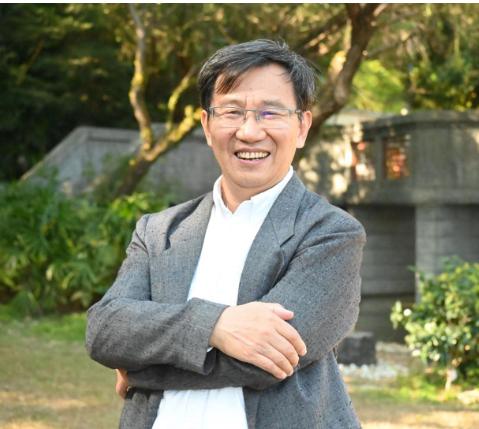
Professor Li Zexiang from the Hong Kong University of Science and Technology can be called a representative figure of Hong Kong university professors starting businesses, and also a master of the "professor + student" entrepreneurial model.
This story can be traced back to the origin between Li Zexiang and DJI.
In 1992, Li Zexiang resigned from his teaching position in the Department of Computer Science at New York University and joined the Hong Kong University of Science and Technology, which had just been established for one year.
Soon after, he insighted into a painful educational dilemma: students trained in traditional engineering often rushed to Silicon Valley and Wall Street, and had no interest in industrial innovation.
△
In Li Zexiang's view, university research must have an impact on industrial development to show the significance of the university.
So he began to look for "new engineering" talents who are innovative and practical — "people who can create new things with technology".
At this time, Wang Tao entered his field of vision. Wang Tao is Li Zexiang's student, and in their interactions, his fanaticism and persistence in technical research left a deep impression on Li Zexiang.
Li Zexiang exceptionally admitted Wang Tao, who only got a C grade in his graduation project, as a postgraduate student.
It can only be said that he has a discerning eye for heroes. Under Li Zexiang's guidance, Wang Tao went to Shenzhen to found DJI in 2006 when he was still a postgraduate student.
In the early stage of entrepreneurship, DJI once had a broken capital chain, and almost all technical personnel left. Wang Tao had no choice but to turn to Li Zexiang. Li Zexiang not only invested his own money, but also introduced the first batch of postgraduate students he trained at the Harbin Institute of Technology Shenzhen Graduate School to DJI.
Eventually, DJI counterattacked and became a UAV giant with annual revenue approaching 80 billion yuan.
The success of DJI became a turning point.
Before that, the first choice for students after graduation was to go to the United States for further study, or to enter Silicon Valley and Wall Street; after the rise of DJI, 90% of the students went to start businesses. At this time, the development opportunities in the Greater Bay Area far exceeded those overseas.
Professors from the Chinese University of Hong Kong were not idle. In 2014, Tang Xiao'ou, a professor in the Department of Information Engineering at the Chinese University of Hong Kong, founded SenseTime with many scholars and postgraduate students. In just a few years, SenseTime developed into the artificial intelligence (AI) company with the largest total financing and highest valuation in the world.
The entrepreneurial stories of these two Hong Kong professors have proved to the entire university circle one thing: university professors can really build global-level enterprises by starting hard technology businesses.
Zhang Fu, tenured associate professor in the Department of Mechanical Engineering at the University of Hong Kong, has a deep connection with Li Zexiang and DJI.
Around 2015, Zhang Fu was invited by Li Zexiang to join the Hong Kong University of Science and Technology, and began to systematically study robots and UAVs.
Recalling this experience ten years ago, he remembers it vividly: "Professor Li Zexiang's influence on me continues to this day."
When he was in the HKUST lab, Li Zexiang taught him that once the goal is determined, he must do everything himself, not just be a scholar or bystander, but go to the front line to do the dirtiest and most tiring work.
"get your hands dirty", a phrase Li Zexiang often says, means "don't be picky, don't just think about sitting in the lab and directing others, go down to the front line."
Zhang Fu took his mentor's advice. When the lab project reached the manufacturing stage, because the number of products required by the lab was small, some mold factories were unwilling to produce, so Zhang Fu would personally go to Dongguan to negotiate prices with the mold factory.
When doing UAV tests on the mountain, he also rushed to the front, climbing the mountain all afternoon and his legs were shaking when he came back. "Looking back, it was really hard, but it allowed you to truly calm down and communicate with the front-line team, users, and supply chain."
Since 2016, Zhang Fu has served as a senior consultant scientist at DJI for 8 years, deeply participating in DJI's core technology R&D and product implementation. This experience also gave him a lot of gains.
In the past, in universities, it was only necessary to publish research results as papers to finish the work.
At DJI, he participated in the whole process of bringing technology to products and then pushing products to the market. He communicated with R&D personnel, went to the factory to watch workers operate, and even operated it several times by himself, so that he could know how many difficulties and challenges a product would encounter from R&D to implementation.

With these two experiences, in August 2018, Zhang Fu joined the Department of Mechanical Engineering at the University of Hong Kong as an assistant professor (now a tenured associate professor) and established the MaRS Lab (HKU Mechatronics and Robotics Systems Lab).
"The goal I set up for my lab is to solve real problems in the industry, not to publish papers."
If you go to solve real problems in the industry, honors will come naturally, and the academic community will recognize you. But if you do research only to publish papers from the beginning, nine times out of ten the research will end with the paper, and it will only add an entry to the annual review KPI in the school.
In February 2026, Zhang Fu industrialized the technology researched by MaRS Lab and founded SiliconFeather Technology, which aims to build brains for UAVs, making them truly aerial intelligents that can perceive, think and act.
Zhang Fu said that this entrepreneurial experience also made him realize "two completely different worlds".
"Universities are like ivory towers. Professors are protected too well, and everyone holds you in high esteem and respects you. After starting a business, with the change of identity, you will inevitably suffer a lot of grievances. For example, the people you want to recruit are unwilling to come, the subsidies you apply for cannot be granted, and the decisions you make are not understood by the company's people, and so on."
In this process, Zhang Fu realized that he needed to put down his status and face the more complex environment of society.
He has to learn to deal with many very complex relationships, including the relationships between people, between people and society, between people and the government, and between people and the law.
△
In his opinion, the identity of a professor is often a burden. To start a business means that you must dare to break yourself and then reorganize.
Li Zexiang has always been his role model. "Professor Li can be said to be a very wealthy professor in the robotics industry, and he is also very successful in academics. He has no shortage of honors and money, and he can completely take an easy path. But he still chooses to do very hard work, incubate a