60 Billion, 500 Billion: The U.S. AI Sector Starts Borrowing Frenetically
No other industry has ever received such large-scale attention and favor from capital as AI does today.
After seeing so many AI-related capital cases, even the old fox starts to feel that the small goal Wang Jianlin mentioned back then is truly just a tiny goal.

Especially in the United States, if an AI company raises less than 1 billion US dollars in financing, it only means that the company and its founder do not have enough influence, and they need to go back to hone their capabilities further.
As for the tech giants, they have mastered capital operations extremely skillfully. In fact, the model here is no longer that AI companies lack money and need financing, but that AI computing power has been turned into a financial tool.
Take Broadcom as an example. On August 20, Bloomberg broke the news that it will take on more than 60 billion US dollars in debt, plus subordinated debt, the total debt size may exceed 100 billion US dollars, which is equivalent to 670 billion yuan, or 670 "small goals".
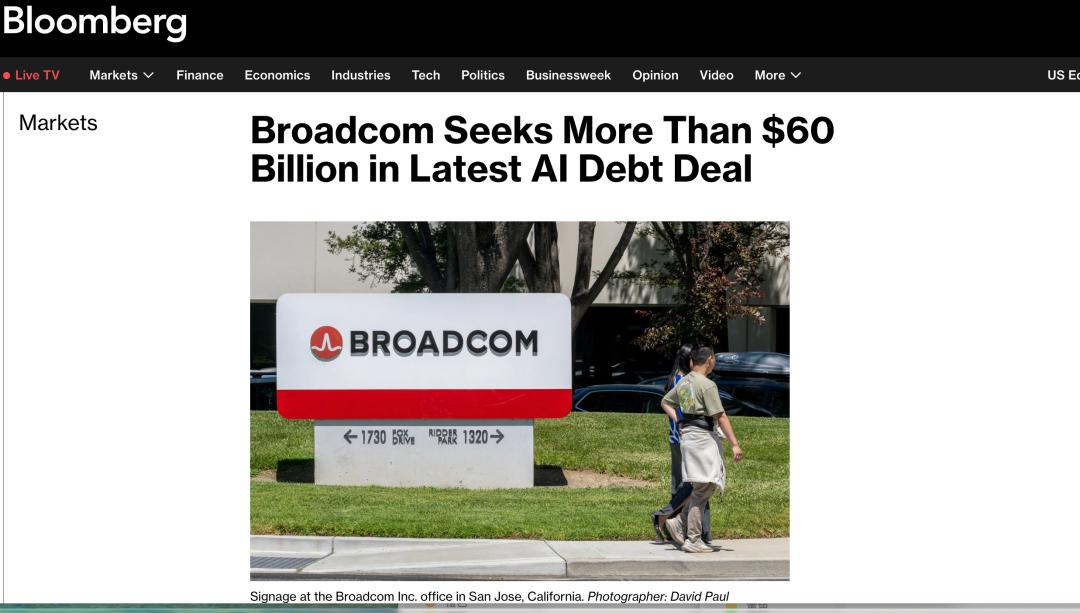
Many people may not be familiar with Broadcom. Just like Nvidia, Intel and Qualcomm, it is also a chip giant. Back in 2018, it once tried to acquire Qualcomm for 117 billion US dollars, but the deal was stopped by Donald Trump later.
Broadcom takes a leading position in the fields of AI custom chips (ASIC) and network communication chips. For example, Google's TPU and Meta's self-developed chips all have cooperation with Broadcom, and Anthropic also intends to commission it to customize its own AI chips.

The reason why Broadcom borrows such a huge amount of money is precisely to fund the infrastructure for artificial intelligence chips. But there is a very interesting point here: it is borrowing money to buy its own products.
The process goes like this: Broadcom has already reached a partnership with private equity giants Blackstone and Apollo Global Management in June, to jointly provide financing support for computing infrastructure.
Therefore, this time they will set up a new company, borrow money in the name of this new company. The capital source will be handled by Blackstone and Apollo, while Broadcom provides guarantee for this sum of money. The borrowed funds will then be used to build AI computing power centers.
After that, this computing power center will become a "landlord" in the AI era, with tenants including companies like Anthropic. It leases computing power to Anthropic for training large models and providing inference services. As long as computing power remains in short supply, the computing power center can generate steady profits, which will be used to pay off the debt.
So you can see, this is a leveraged operation that makes profits with borrowed resources. As long as AI computing power stays tight, Broadcom can sell more computing chips and expand its market share; Blackstone and Apollo can get back rent and interest. Anthropic no longer needs to rack its brains to raise 60 billion US dollars to build data centers, and only needs to pay rent every year to reduce its capital pressure.
Everyone is a total winner here, isn't it?
But the premise is that the demand for AI computing power continues to stay strong. Once the demand weakens and the working capital is insufficient, there will be a risk of a thunder collapse.
As the main player, Broadcom naturally has many commercial considerations. It needs to expand its sales scale to cope with Nvidia's challenges in the high-margin, high-volume AI chip market, and further consolidate its cooperative relationship with Anthropic.
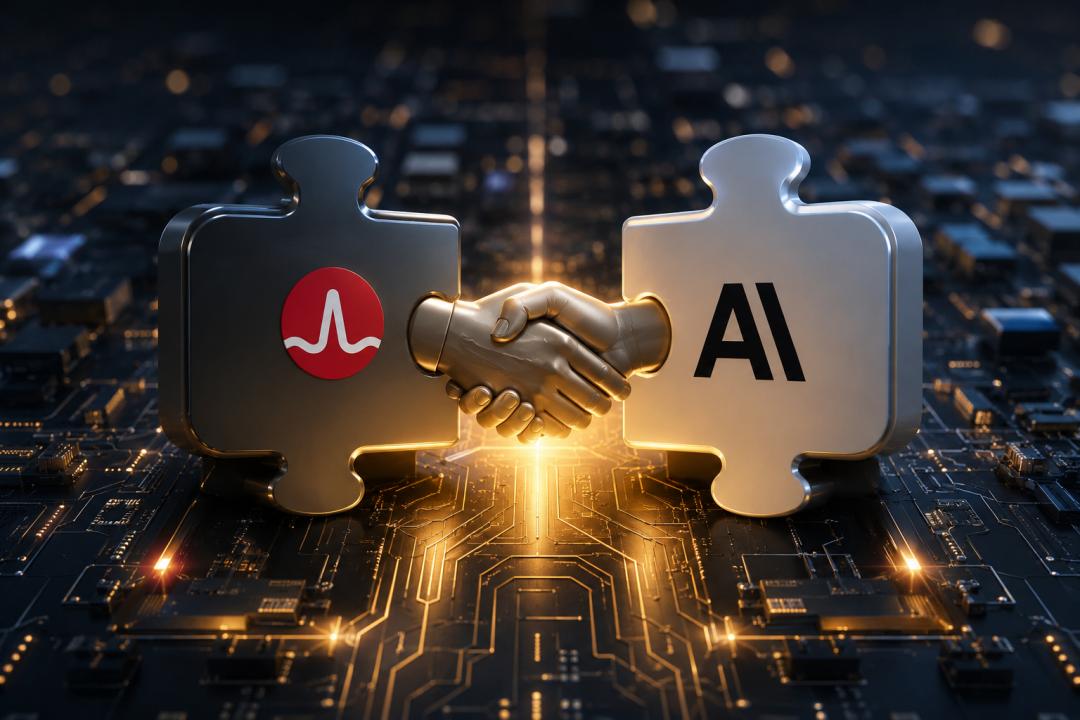
As Broadcom's rival, Nvidia has actually done similar things, but with a different gameplay.
In mid-August, Nvidia joined 6 financial institutions including the aforementioned Blackstone, Apollo, as well as BlackRock, Goldman Sachs, KKR and Brookfield, to form a 500-billion-US-dollar "independent computing power financing platform" for AI computing power construction.
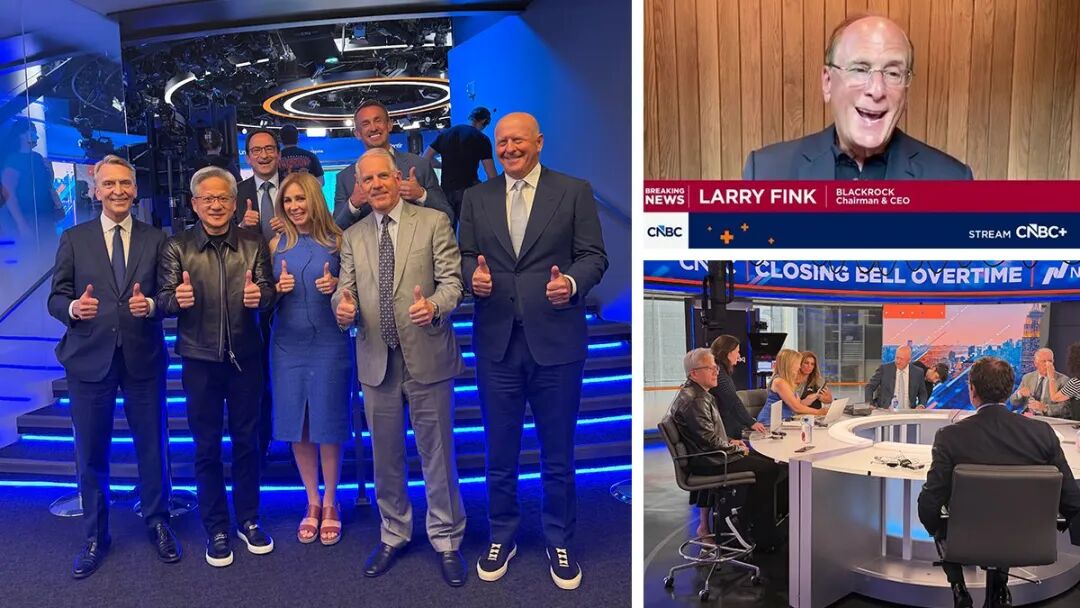
Among the 500 billion US dollars, Nvidia will contribute up to 25%, which is 125 billion US dollars.
It is worth noting that this is a "financing platform".
Different from Broadcom's model of providing guarantee for loans to build computing power centers and lease them to AI companies, Nvidia chooses to cooperate with financial institutions to set up a financing platform, lend money to AI companies to build computing power centers, and then get these companies to buy Nvidia's own GPUs.
We have to admit that in terms of financial tools and capital innovation, the United States is not only highly capable, but its capital market is also extremely active.
Such a self-circulating operation that expands revenue scale can indeed promote industrial development and provide AI companies with access to capital. But the risk is also obvious: it blows the bubble bigger, and ties more stakeholders to its own chariot at the same time.
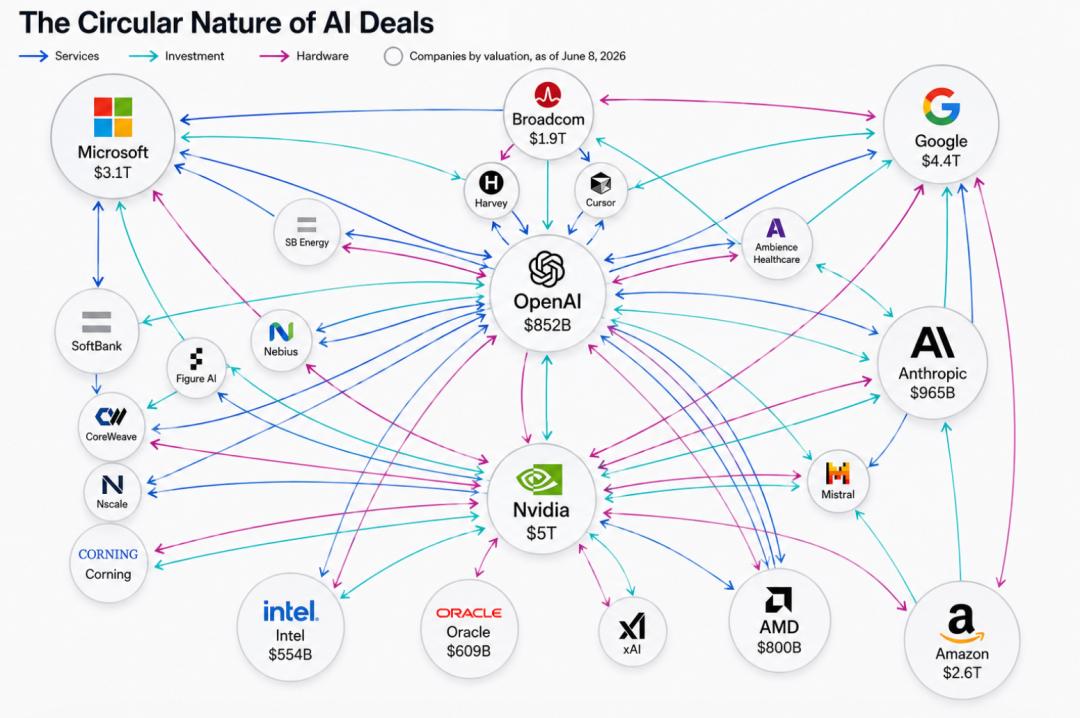
The leading large AI models in the US are OpenAI and Anthropic. After entering 2026, OpenAI obtained the largest private equity financing in commercial history, with the amount reaching 122 billion US dollars. Anthropic is no less impressive, it has also raised 95 billion US dollars through two rounds of financing.
After seeing so many astronomical figures, looking at the balance in my own bank account, ahem...

The companies that have increased their investment in both of the two large model firms include Amazon, Microsoft and Nvidia. The cloud services of Amazon and Microsoft will also provide computing power support for these tech giants.
Therefore, to a certain extent, all these enterprises are actually tied to the same boat.
At this point, we have to compare the AI financing situation in China. In addition to players like Zhipu AI and MiniMax that have already gone public for financing, in June this year, DeepSeek raised 50 billion RMB (about 7.4 billion US dollars), and Kimi also completed a 3.5 billion US dollar financing not long ago.
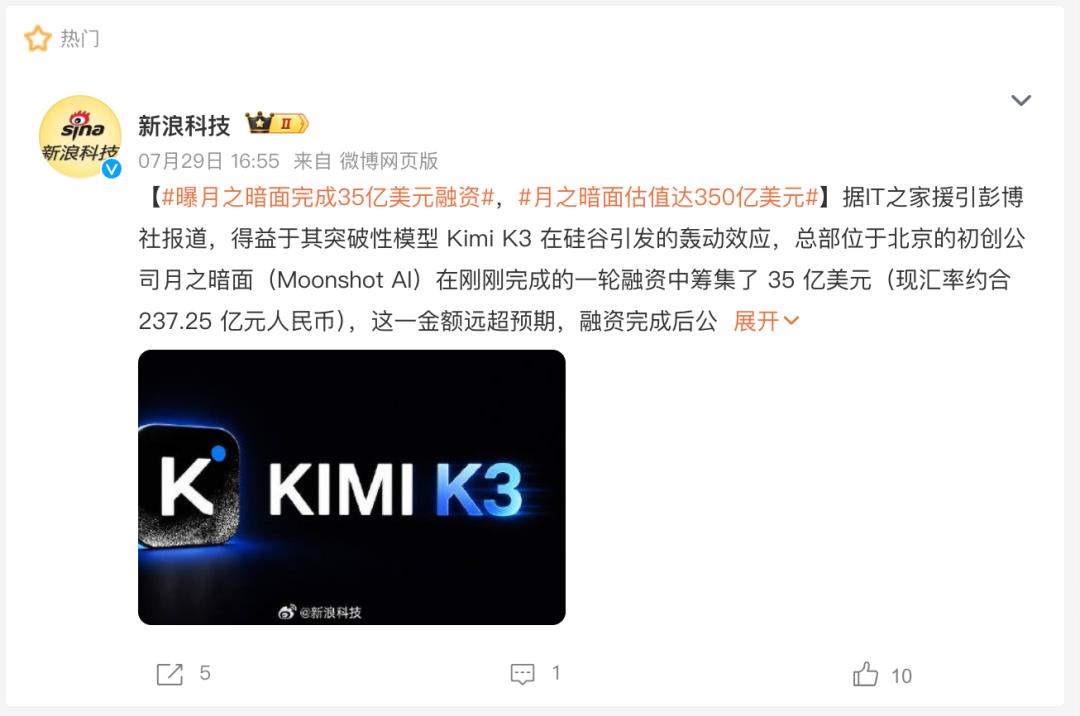
It's not that I'm being arrogant, the financing scale of DeepSeek and Kimi does look a bit "modest" compared to the US counterparts. But this also proves the high capital efficiency in China from the opposite side: with a much smaller amount of capital, they have built products with performance close to GPT and Claude, at much lower usage costs.
Moreover, their investors are mostly government funds, leading internet companies, investment institutions and industrial funds, there is no suspicion of unrealistic over-leveraged operations, so the value of these investments is higher.
The rise of China's open-source large models not only poses a threat to the two closed-source large model players OpenAI and Anthropic, but even to all the stakeholders on that US "chariot".
The scene that the market value of Nvidia plummeted 16.9% in a single day when DeepSeek R1 was released is still fresh in our memory.
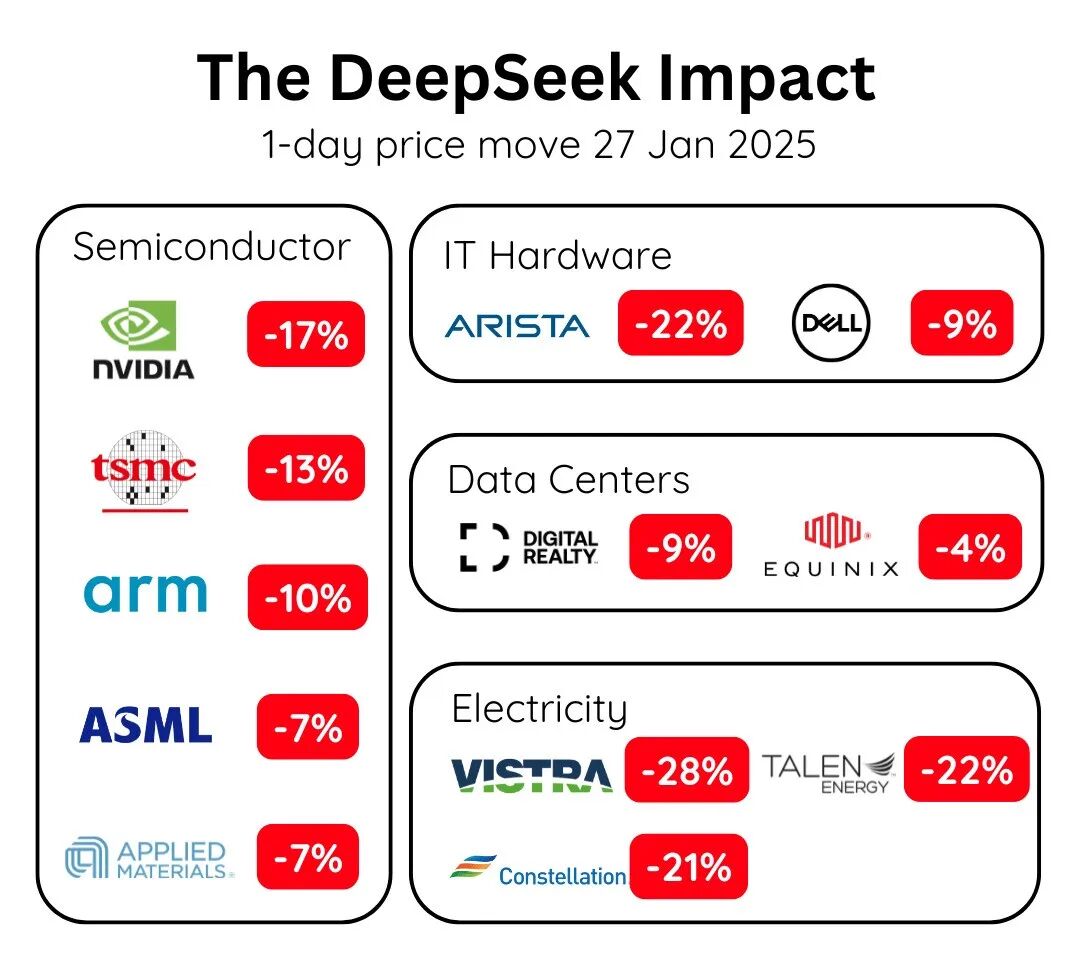
Therefore, in the future, the AI competition between China and the US is not only the competition among leading large model enterprises, but also the competition of capital density and capital efficiency, and even the competition of the entire AI industry chain.
If there is a bubble in the US AI industry, the one that pricks the bubble is very likely to be the Chinese companies like DeepSeek.
Editor: Mu Yi
This article is from the WeChat Official Account "TechFox" (ID: kejihutv), written by Laohu, authorized for release by 36Kr.