Who on earth is buying the robots on WRC!

Written by | LIU Sijie, LIU Ziyan, LIU Chenyi
Edited by | ZHANG Wei
Cover Designed by | QU Mei
When making popcorn or scooping ice cream, robots occasionally make mistakes, but that's okay as staff standing by can offer assistance.
At the site of the World Robot Conference, the humanoid robot from ExRobots shows its full capabilities in a simulated convenience store scenario.
This robot went on sale last September. Sales were sluggish in the early stage, and only after hardware iteration and cost reduction did its sales performance improve, with total shipments exceeding 100 units so far. Buyers include scenic spot convenience stores and government-run data collection centers. These robots are used to collect real-machine operation data, which is then applied to the post-training of models.
Like the robots from ExRobots, most of the robots exhibited at WRC do not yet have a stable, continuous large-scale buyer base, and their main demand does not come from the household and factory sectors that the general public expects. Not just humanoid robots, buyers for robots in the form of robotic dogs are also in the stage of gradual validation.
A wheel-legged robot from Benmo Technology is fitted with a delivery box. At present, this robotic-dog-like product is a result of cooperation with JD, designed to try to complete the "last mile" of express delivery.
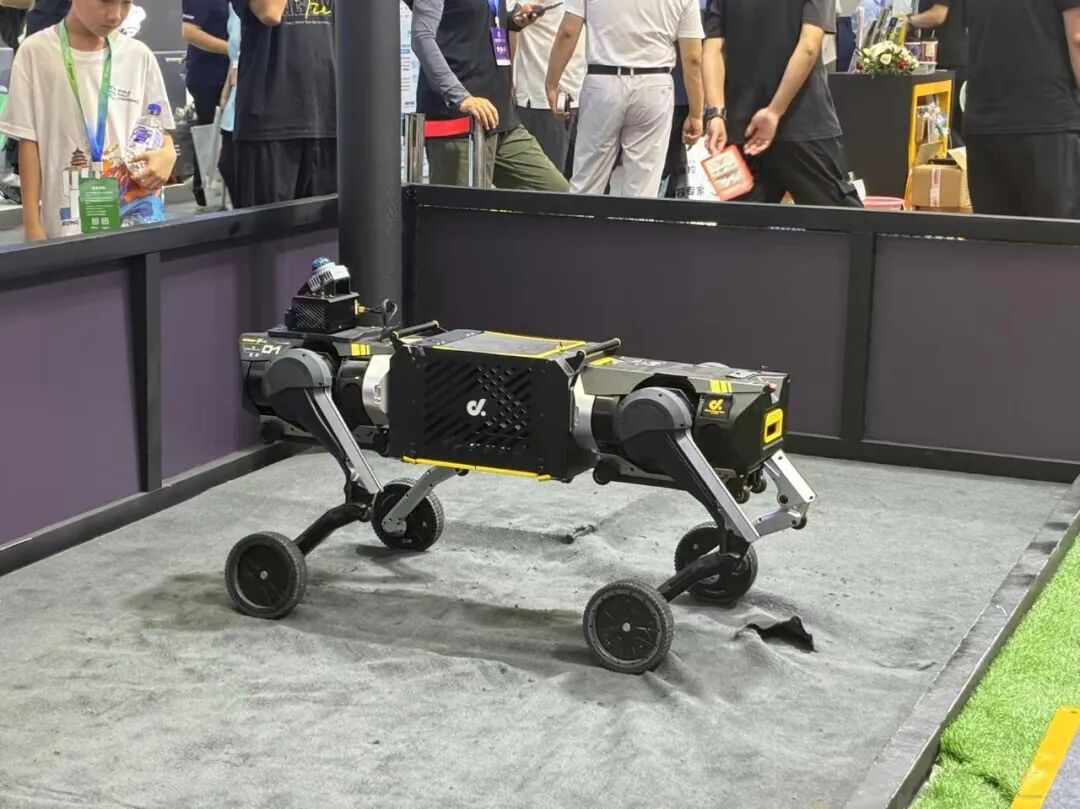
The "robotic dog" from Benmo Technology
Logistics is only one of the application scenarios it is testing. Among the delivered buyers, power companies purchase it to accompany power workers on mountain inspection tours, where it carries heavy loads; tunnel construction parties add sensors to it to detect the gas content inside tunnels. A salesperson from Benmo Technology also traveled to Aksu, Xinjiang, to meet a client who owns thousands of acres of apple orchards and is troubled by a shortage of picking labor when apples ripen. They are attempting secondary development to enable the wheel-legged robot to pick apples. Another high-value client is a military enterprise that purchased 6 units at one time and signed annual reservation contracts for subsequent years.
According to data from Counterpoint Research, global humanoid robot shipments exceeded 22,000 units in the first half of 2026, a year-on-year increase of nearly 300%. Unitree, UBTech, Galbot, Aelos, and Agibot rank top 5, all of which are Chinese manufacturers. In terms of application structure, entertainment performance and data production research together still account for more than 60% of total shipments, service guidance accounts for about 19%, and intelligent manufacturing and warehousing logistics account for about 13% and 5% respectively.
Robots have started to be shipped, but it is still too early to talk about "replacing humans".
They are more like being tested by different buyers for different use cases: training models, replacing partial manual labor, attracting traffic, or simply providing a little sense of novelty.

"Visible Intelligence" in Public Service Places
According to the prospectus of Unitree, from January to September 2025, 73.60% of Unitree's humanoid robot revenue came from scientific research and education, 17.39% from commercial consumption, and only 9.01% from industry applications. What do these data mean? Humanoid robots are not only far from the daily life of ordinary people, but also still a certain distance from large-scale implementation in actual factories.
In fact, the first buyers of robots are people inside the industry.
A staff member at the Unitree booth mentioned a type of intra-industry buyer: algorithm research institutions and companies. "After the algorithm is developed, you need to find a powerful hardware to verify whether it works well. If the verification is successful on Unitree's robot, it can prove that the algorithm itself is indeed feasible."
Within the industry, data collection centers are also a type of real buyer.
According to the staff of Leju Robotics, the company's largest order last year was worth about 80 to 90 million yuan, from a robot training ground that purchased robots for data collection. The staff of ExRobots also mentioned that data collection centers of some local governments will purchase robots to collect real-machine operation data, train models, and then deploy the models to more robots.
Of course, more intra-industry demand comes from secondary development.
The delivery-box-equipped form of Benmo Technology's robot that cooperates with JD is only one of the display solutions for their current products. "It is not a robotic dog specifically designed for logistics scenarios, but a detachable modular robot." In actual delivery, customers will continue to modify it according to their own scenarios. There are downstream companies that specialize in secondary development: after purchasing the robot body, they add modules such as cameras, sensors, and face recognition, and then sell them to end customers in the public security, chemical, and tunnel sectors.
Governments and public sectors constitute one of the most stable buyer groups for various types of robots.
At the booth of Songyan Dynamics, a row of half-body bionic robots with delicate makeup and different hair colors blink at the audience from time to time. This is the bionic humanoid robot X-Head1 launched by Songyan Dynamics, which has been mass-produced and sold 100 to 200 units in the past year. At present, it is mainly oriented to public service scenarios such as museums, science and technology museums, enterprise exhibition halls, government service halls, social security halls, airports, and high-speed railway stations, undertaking work such as tour guidance, explanation, and consultation reception. According to the staff of Songyan Dynamics, a recent large order came from a steel group, whose factory exhibition halls purchased bionic robots to replace manual staff for explanation and reception.
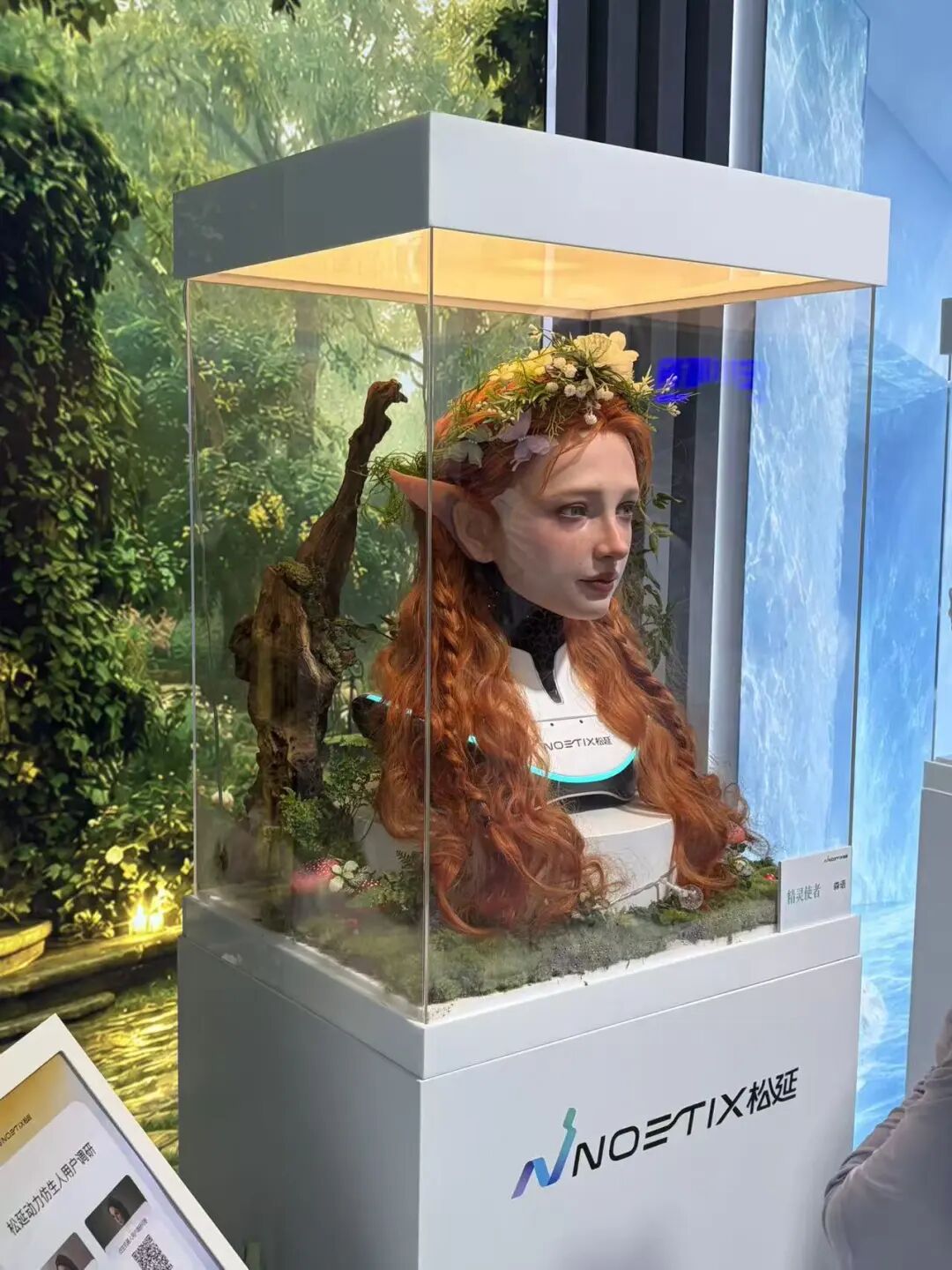
The half-body bionic robot from Songyan Dynamics
Public health cleaning follows a similar logic. Heshang Siwei exhibited a commercial toilet cleaning robot with a unit price of about 200,000 to 250,000 yuan, mainly targeting government customers, as well as enterprises and overseas customers. The staff said that as of June this year, the company's sales had reached 100 million yuan, with about 400 to 500 units sold. This robot adopts a structure of a chassis plus a robotic arm, and is equipped with blowing, water spraying, water absorbing, and scraper devices, as well as a mopping head device with a patent pending, which can clean urinals, toilets, countertops, and floors. In Beijing, the robots have been put into use in Haidian Park and the speed skating stadium of the Olympic Village, and can replace 70% of the work of human cleaners. Of course, work like putting on garbage bags still requires the cooperation of manual workers.
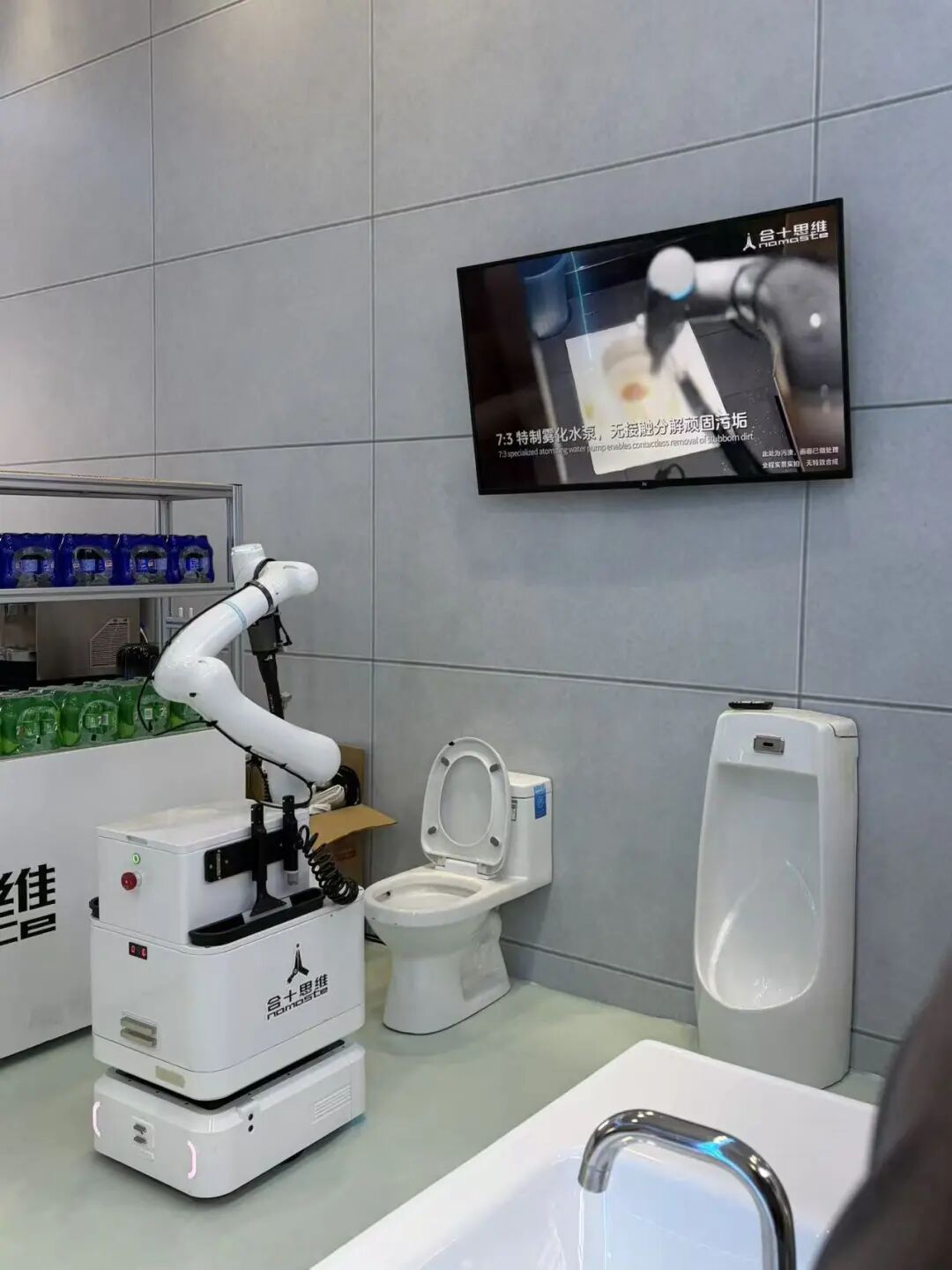
The cleaning robot from Heshang Siwei
More than 30 bionic robots produced by a robot company under Chery Automobile have been placed on roads across the country, wearing the reflective vests of traffic police to direct traffic. Another 3 units are equipped with an automatic registration machine on their chest, providing patient guidance services in several local hospitals in Wuhu.
In public service scenarios, robots do not need to completely replace humans, nor do they have to independently complete complex tasks. As long as they can undertake part of repeated inquiries, tour guidance, cleaning and inspection work, or provide a kind of "visible intelligence" in spaces such as government service halls, hospitals, scenic spots, and exhibition halls, it can become a reasonable purchase.

Humanoid Robots Are Not the Main Workforce in Factories
But when robots enter factories, the evaluation criteria they face become different. What factories care about is whether a robot can stably and continuously complete a clear and repetitive task.
If this is the criterion, then humanoid robots are definitely not the best answer at present.
Factories are actually one of the earliest and most mature application scenarios for robots, but not the "humanoid" ones. In manufacturing production lines such as automobiles, 3C, lithium batteries, and photovoltaics, industrial robotic arms, collaborative robots, AGV/AMR, and visual inspection equipment have long undertaken work such as welding, handling, sorting, palletizing, inspection, and loading/unloading. They do not look "like humans", but work stably, and their input-output ratio is easy to calculate.
At the WRC site, the staff of Rokae Robotics introduced that Rokae's robotic arms sold about 15,000 units in the whole of last year, and 15,000 units in the first half of this year, with prices ranging from 50,000 to 500,000 yuan depending on configuration and scenarios. Their customers cover automobile factories, humanoid robot manufacturing plants, etc. "As long as there are places where people produce things, robotic arms can actually be used."
Franco Robotics also takes robotic arms as its core product. The staff introduced that since 2024, Franco has produced customized robotic arms for various manufacturers, and more than 2000 units have been put into use. At this exhibition, Franco launched a general-purpose robotic arm with a selling price of 23,800 yuan, which is mainly for large model and software/hardware companies and supports secondary development. A recent large order came from Jack Sewing Machine Co., Ltd., which purchased more than 2000 robotic arms to build sewing robots. In addition to industrial scenarios, Franco's robotic arms have also been deployed in commercial scenarios such as coffee and ice cream making, and photography.
These figures form a sharp contrast with the shipment volume of humanoid robots. Counterpoint data shows that in the first half of 2026, the total global shipment of humanoid robots is only 22,000 units. It can be seen that in the mature industrial scenarios, robotic arms and collaborative robots are still the more practical main force.
Factories buy robots to improve efficiency, reduce costs, and ensure safety. If robotic arms or automation equipment can complete the task, there is no need to pay for a humanoid robot that is more complex, expensive, and difficult to maintain.
This is why when many humanoid robot companies talk about "entering factories", they are still mostly in the stage of exploring and verifying specific stations. At present, when humanoid robots enter factories, they are competing with existing automation solutions such as mature robotic arms, collaborative robots, AGV/AMR, and visual inspection systems.

Cultural Tourism Scenarios: Attracting Traffic by Robots
But in cultural tourism scenarios, the fact that robots "look like humans" has become a good means of attracting popularity and traffic.
The tolerance for errors of robots in cultural tourism scenarios is also higher. After all, when a robot makes popcorn or ice cream at a scenic snack stall, even if the movement is a little slow or occasionally makes a mistake, tourists are more likely to regard it as a novel experience.
In front of a booth for a bionic humanoid tour guide robot, the staff repeatedly mentioned to me that the role of their robot is to "attract traffic". It is mainly oriented to science and technology museums, museums, libraries, children's palaces, scenic spots, airports, and convention and exhibition centers. The terminal price per unit is about 150,000 to 180,000 yuan, and the price can be tens of thousands of yuan lower if purchased directly. The robot walks with a tray at the bottom, and there is a camera in its eye that can take the initiative to greet people when it sees them. Customers can upload scenic spot materials in the background, so that it can complete tour guidance and explanation work for tourists.
The staff said that they have already provided services for Overseas Chinese Town and Yuanmingyuan Scenic Area, and have also contacted customers such as Guangxi Cultural Tourism and Xinjiang Cultural Tourism. Some popular hot pot restaurants, string shops, clothing stores, and shoe and hat shops will also rent such robots at a monthly rent of about 10,000 yuan. Its use is not complicated: it stands at the door to attract people, takes photos with tourists, and then the photos are uploaded to WeChat Moments and family groups, so that the scenic landmarks and brand logos in the photos are promoted.
"This thing naturally attracts people to the entrance of your street, and everyone likes to post on Moments." The staff said, "People will ask, where is this? It is a secret to enhance the sense of technology of the scenic spot and increase traffic."
This is also the reason why cultural tourism scenarios are willing to buy robots first.
At the WRC site, the demand for robots from cultural tourism scenic spots appears repeatedly. The staff of ExRobots said that part of their robot buyers come from high-traffic scenic spots. The staff of China Mobile's robotic dog mentioned that the small B-end