The more adept people are at using AI, the faster their learning ability deteriorates.
"Will people gradually become dumber if they use AI too much?"
This is arguably one of the most widely debated myths over the past three years, which has been around ever since ChatGPT rose to fame. After more than three years of arguments, neither side can produce solid, credible evidence:
Those who worry about this only have intuitive feelings, while those who do not only hold their own positions.
On August 18, *The Economist* supplemented the most solid piece of evidence to date for this debate.
The report centers on 27,000 middle school students in China. After using AI, their homework scores increased by an average of 18%, and the time spent on completing one assignment dropped from 64 minutes to 45 minutes. All of this sounds like good news, until the monthly exam papers were handed out: in the closed-book exam, this group of students scored 20% lower than their peers who did not use AI.
Homework scores used to be the most reliable "barometer": the better you performed on homework, the better you did in exams. Among students who used AI, higher homework scores basically meant deeper usage of AI. As a result, the trend became: the more heavily students relied on AI, the worse their exam results dropped.
For the first time, homework scores began to lie.
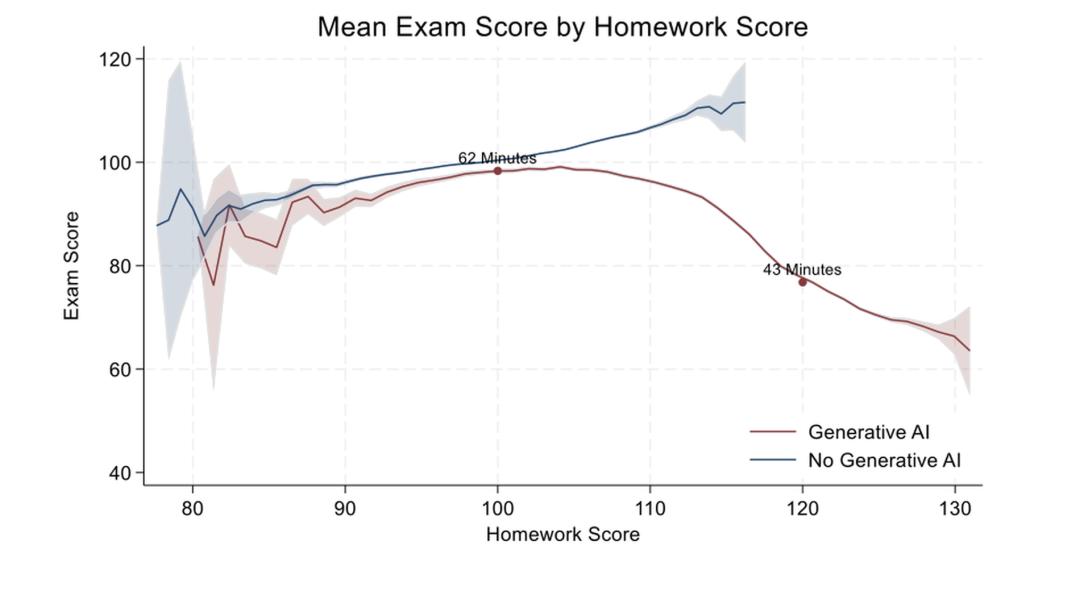
Among people whose homework scores exceeded 100, the scores of those who did not use AI rose to 112, while the scores of those who used AI plummeted all the way to 64. | Image source: *The Economist*
The data draft of *The Economist* is a paper published in June by three economists from Stockholm University and the University of Hong Kong, titled *The Generative AI Learning Penalty*.
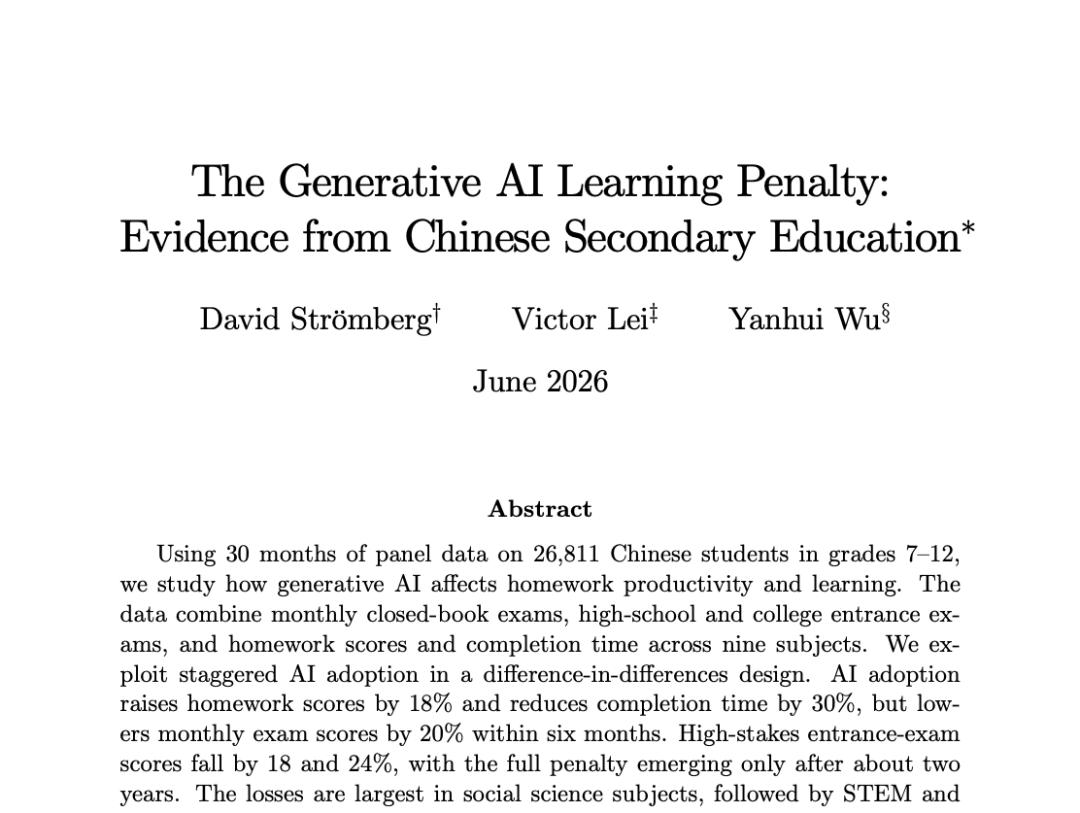
*The Generative AI Learning Penalty* | Image source: SSRN
The sample came from a county in central China with a population of over one million. The paper specifically emphasizes its representativeness: it is similar to most Chinese counties outside the coastal regions. The study tracked 26,811 junior and senior high school students from 5 junior high schools and 4 senior high schools, who accounted for 90% of all local middle school students, for a full 30 months from September 2022 to June 2025.
Homework in this county is submitted online, and the system records the time each student spends; the scores of monthly exams, senior high school entrance exams, and college entrance exams are all stored in the database — how fast they write and how well they perform in exams have for the first time become hard data that can be directly measured. Information on who is using AI comes from full-coverage questionnaires with a recovery rate of over 96%.
In September 2022, almost no students used AI. By June 2025, this figure reached 80%. There were two obvious jumps in this trend, which coincided exactly with the release dates of DeepSeek V2.5 and R1. The tools involved are all familiar ones: Doubao, DeepSeek, Wenxin Yiyan, Tongyi Qianwen.
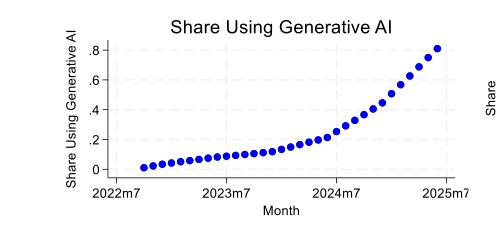
The two jumps in the adoption curve both coincided with DeepSeek's version releases | Image source: CEPR
The conclusion is the set of figures mentioned at the beginning: homework scores +18%, time spent -30%, monthly exam scores -20%, which is equivalent to 1.4 standard deviations. The penalty is not evenly distributed across subjects: it is the most severe for social sciences, with a 27% drop; followed by mathematics at 22%, English at 17%, and Chinese the slightest at 9%. Junior high school students are 40% more affected than senior high school students, and boys are more affected than girls.
It seems that the "becoming dumber" effect does not spare smart people: it is precisely the group of children who used to have the best grades that suffered the most severe drops.
The calculation for entrance exams needs to be more careful. When this study went viral on Chinese internet at the end of June, the most widely spread claim was that "scores plummeted 24% in the senior high school entrance exam and 18% in the college entrance exam". The original statement in the paper is much more restrained: this is the full penalty for students who have used AI for more than two years, while the average effect for all AI users is only around 7%.
But this "restraint" itself is worse news: the penalty takes two full years to reach its maximum. The authors specifically noted that all current short-term studies spanning only a few weeks or months are systematically underestimating the learning cost of AI.
01
The Disappearing Model Students
When this study first came out in June, there was actually a comforting conclusion in English discussions: 20% of students used AI but did not outsource their homework, and their grades were not damaged. Therefore, the problem does not lie with AI, but with how it is used.
The paper does state the first half of this point. It gives a numerical definition of "outsourcing": spending less than 50 minutes on homework counts as "in-house completion", and only spending less than 45 minutes counts as real "outsourcing".
Among students who just started using AI, 58% outsourced their homework. And those children who spent their usual time doing homework and only used AI as a tutor showed almost no difference in exam performance from their peers who did not use AI.
The paper even found that in the overlapping interval of 50 to 65 minutes, the two groups of children spent the same amount of time and got almost the same scores. AI itself is not toxic, all the toxicity lies in the time saved by using it.
If the paper stopped here, it would be a standard paper arguing that "the tool is innocent, and the problem lies in the way it is used".
But the paper goes further to explore this issue: after 5 months of usage, the outsourcing rate rose from 58% to 81%, and the full outsourcing rate rose from 34% to 50%. All those "model users" who spent more than 65 minutes doing homework carefully were new users who had used AI for less than 5 months.
And after 6 months of full adoption, none of the AI-using students spent more than 65 minutes on their homework anymore.
In the sample of 26,811 people, "using AI properly" is not a stable usage pattern, but a transitional state that cannot last for more than half a year. The authors' explanation is very brief: what AI squeezes out is the most intense part of effort.
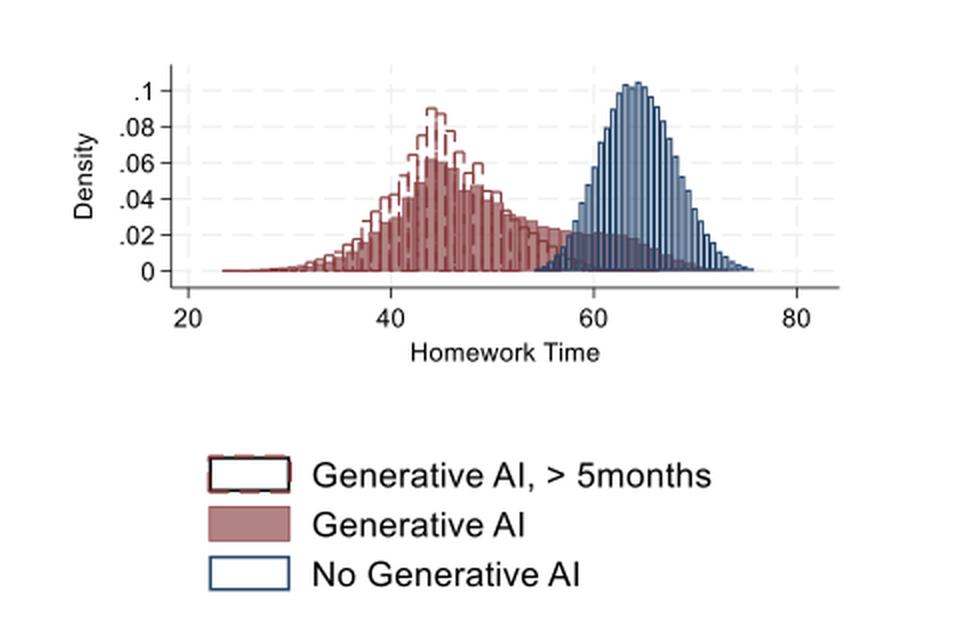
After 6 months of full usage, the interval of more than 65 minutes is empty | Image source: CEPR
This is not just another paper that says "AI makes grades worse", it is tearing off a comforting fig leaf: as long as we teach children to use AI correctly, everything will be fine.
The answer given by the data is that no one can keep using AI correctly forever: after all, homework scores are rising, parents are giving likes in group chats, and the submission records teachers see are becoming more and more uniform. Every feedback is subtly forming a deformed incentive mechanism: you are doing great, it doesn't matter if you go a little faster.
02
The Exam Room for Adults
Seeing this, this study may seem to have little to do with adults whose brains are fully developed as we traditionally understand. But the same trend has appeared four times among adults over the past year or more.
A Polish study published in August last year in *The Lancet Gastroenterology & Hepatology* targeted 19 senior doctors from four endoscopy centers, each of whom had performed more than 2000 colonoscopies. After several months of AI-assisted examinations, when they returned to working without AI, their adenoma detection rate dropped from 28.4% to 22.4%, a relative decrease of 20%.
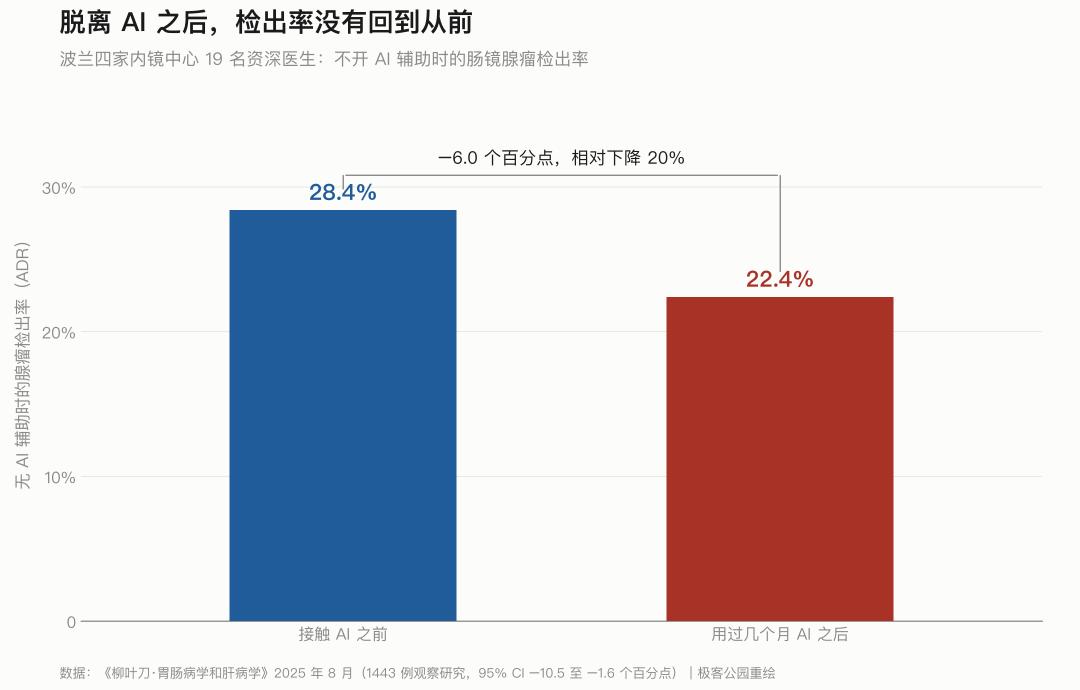
It is the exact same figure as the monthly exam result of middle school students.
This is the first time the medical field has measured in real clinical practice that "people's skills get rusty after using AI", and the subjects are exactly the group of people on this planet whose basic skills are the least supposed to be doubted.
The second time this phenomenon was observed was among writers. In an EEG experiment conducted by the MIT Media Lab last June, 54 students wore electrode caps to write essays. The group that used ChatGPT had the lowest neural connection strength, which was up to 55% lower than the group that wrote entirely on their own; shortly after finishing writing, 83% of them could not even retell a single sentence from their own articles.
The research team named this phenomenon: cognitive debt.
The third time it was observed in offices. Microsoft Research and Carnegie Mellon University surveyed 319 knowledge workers last year, and the conclusion can be summed up in one sentence: the more confident people are in AI outputs, the less effort they put in to verify the content with their own minds.
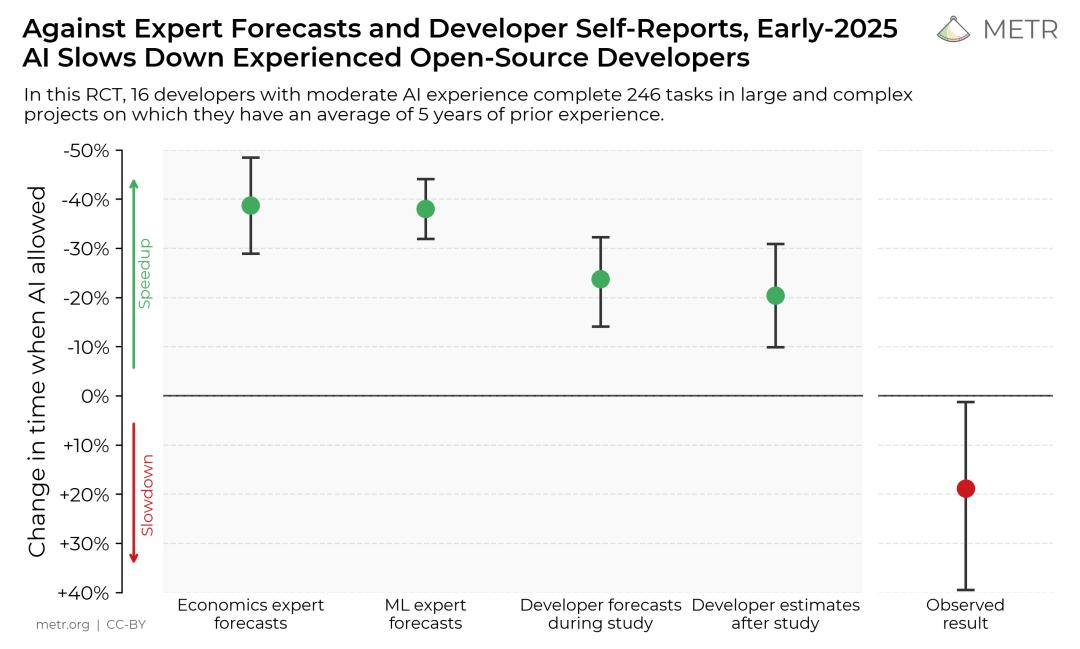
The fourth time it was observed among programmers. In a controlled experiment conducted by research institution METR last year, senior programmers actually became slower when using AI, but they felt that they were 20% faster. In February this year, the team tried to repeat the experiment but failed, and the reason written in the report was: most developers had refused to work without AI.
It is exactly the same as that classroom where no one is willing to spend 65 minutes doing homework anymore.
After detaching from AI, the detection rate did not return to the previous level | Image source: METR
Clinical practice, EEG experiments, questionnaires, and controlled experiments — these four warnings all point to the same thing: when AI is present, outputs get better; when AI is absent, capabilities get worse.
Going back to the question that has been argued for more than three years at the beginning. The answer given by these studies is more uncomfortable than simply saying "people will become dumber": AI does not reduce anyone's IQ, it removes the process that makes people "smarter". Scores still rise, outputs are still submitted, but the ability that should have been developed in those 64 minutes never grows.
Cognitive science calls this "cognitive offloading": transferring the processes that should be run in one's own mind to external tools. Offloading is not a new concept — calculators and navigation systems are both examples of it. What is new here is the position: what AI takes over is not calculation or route memorization, but drafting, trial and error, and deduction, which are exactly the processes where mental models are formed.
When applied to daily work, this change even sounds like an upgrade: from "writing code" to "reviewing code", from an executor to a gatekeeper.
But the premise of being a qualified gatekeeper is that you have your own draft in your mind. For people who have never done the deduction personally, what they are reviewing is essentially a black box. Once the logical chain of AI has a deep error, they do not even know where to start to question it. The version for students is simpler: homework is the draft, and the exam is the debugging process. If you outsource the draft, you will be exposed on the day of the exam.
There is only one difference. Students have a closed-book exam every month, which puts this trend out in the open. But most adults do not have monthly exams at work.
The paper leaves some leeway at the end. Looking at it over a longer period of time, the generative AI learning penalty is narrowing: after 5 months of usage, students in early 2023 had an average loss of 25%, while the figure dropped to only 16% in June 2025.
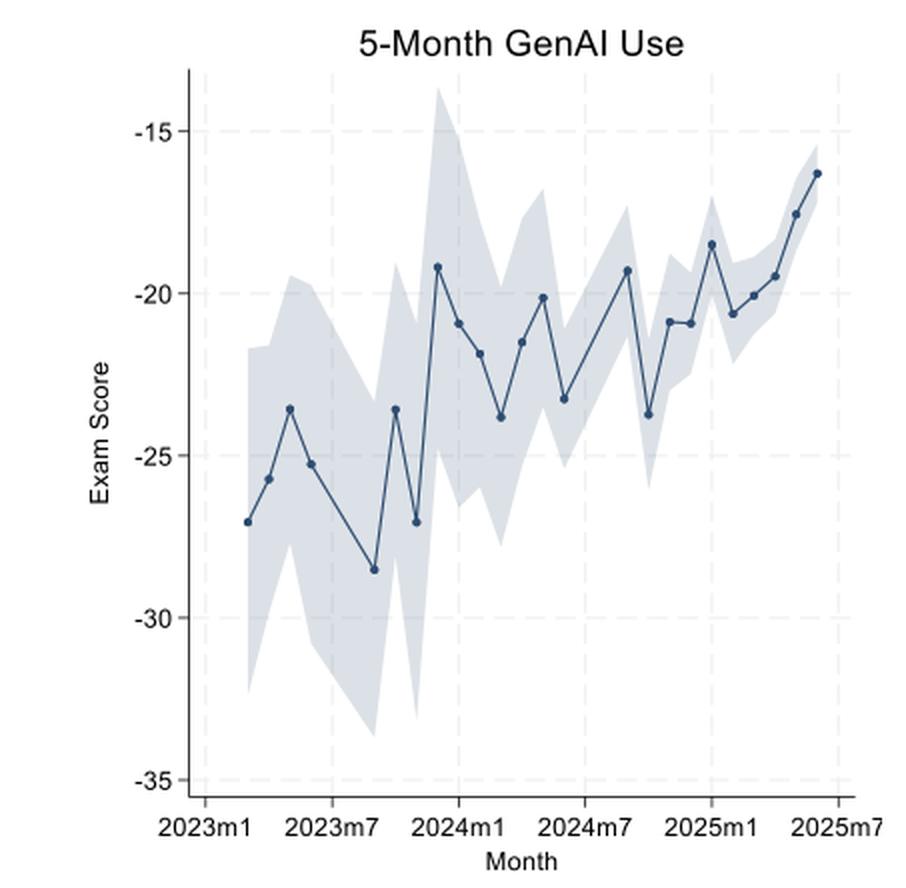
After the same 5 months of usage, the penalty narrowed from 25% to 16% | Image source: CEPR
Teachers and students are adapting, and there are also people on the tool side trying to find solutions, for example, forcing AI to show its deduction process synchronously when giving answers. But according to the authors' judgment, although the loss is getting smaller, there is no sign that it will drop to zero.
The new semester starts on September 1. In classrooms across the country, this experiment involving 26,811 people will be rerun with a larger sample.
In the future, when you see your child getting 100 points on homework every day, you may want to ask first: is this 100 points earned by the child, or by Doubao.
Next time before you submit the proposal to your boss, you might as well ask yourself this same question first.
*Cover image source: The Internet
This is an original article from GeekPark. For reprint requests, please contact the official WeChat account of GeekPark via geekparkGO.
One Question from GeekPark
When was the last time you completed a piece of work entirely without using AI?