There are no new stories for the current wave of robots, only real problems.
Just one month after the closing of WAIC (2026 World Artificial Intelligence Conference), robots have "moved on" from Shanghai to Beijing, and are now showing their full capabilities at WRC (2026 World Robot Conference).
What distinguishes WRC from WAIC is that at WRC, casual visitors and industry insiders with professional expertise have gathered together.
Some elderly people came to the exhibition with their grandchildren on summer vacation. After an on-site robot finished making a pizza, an elderly man asked the staff for the pizza on behalf of his granddaughter. When the staff handed it over, they specifically reminded: "It might not taste good."
The booth of Galaxy Universal was crowded with people. An elderly couple started chatting in a Northeast Chinese accent. The old man asked: "Which organization does Galaxy belong to?" His wife standing beside him replied crisply: "No idea." The question and answer, with the characteristic straightforwardness of the Northeast dialect, made people unable to hold back their laughter. But this did not stop the two of them from continuing to watch with great interest.
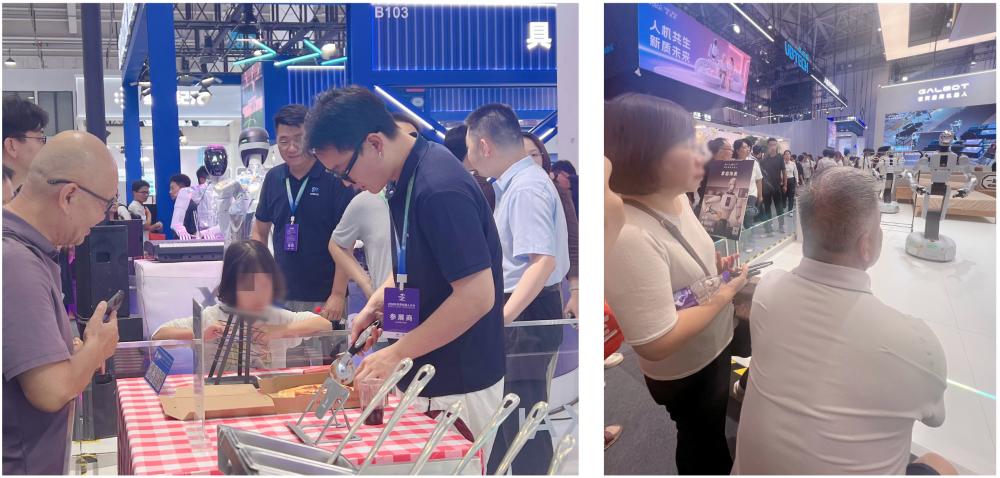
On the contrary, another group of people hurried past with clear goals, exchanging technical details and robot solutions.
Therefore, at the WRC site, I also heard two completely different voices. Casual onlookers saw: Why are robots still folding clothes and grabbing express parcels? Compared with 2025, there seems to be no change. Those who truly understand the industry are focusing on a different set of issues. They stepped forward to communicate with bright eyes, asking about the implementation behind the robots: what model is used, how much data has been accumulated, whether long-horizon tasks can be completed, and whether the accuracy has reached the centimeter level or the millimeter level.
A statement from Gao Jiyang, founder and CEO of Starseas, provided an explanation for this seemingly fragmented phenomenon. He believes that the embodied intelligence industry has entered a boom period, but the so-called "GPT moment" of embodied intelligence requires two conditions to be met at the same time: first, the technology has truly reached a critical point, and second, everyone realizes at a certain moment that this moment has arrived.
In other words, technological changes may have already occurred, but these changes have not yet been perceived by all people at the same time.
Wang Qian, founder and CEO of Independent Variable, believes that embodied models are "following the path that language models took five years ago". From the exchanges between Tencent Tech and a number of industry insiders, a fairly clear consensus has formed among practitioners: everyone is actively trying to solve specific problems, and believes that that moment will eventually come. At the same time, more C-oriented audiences are still measuring the current development level of embodied intelligence with the imagination from sci-fi movies.
At the WRC site, Tencent Tech communicated with the founders of many leading enterprises such as Starseas, Mochi Intelligence, and Qwant Robotics, trying to find the changes happening in the humanoid robot industry, and the "Delta" belonging to this industry. (Note: Delta (Δ) is a mathematical concept that represents the amount of change or difference.)
01 Scenarios, or more scenarios
Just like the WAIC in Shanghai, the robots at this year's WRC are all "working". Compared with 2025, this was originally a very significant change. But with the foreshadowing of WAIC a month ago, by the time of WRC, demonstrating application scenarios seems to have become a must-have option for robot exhibitions.
What kinds of work are they doing? Tencent Tech saw on site that they can be roughly divided into the following categories.
The first is folding clothes. The robot of Galaxy Universal is folding white shirts on site; in the double-layer booth of Starseas, a bright and open space is specially reserved on the first floor to demonstrate clothes folding. Two grippers jointly pick up a T-shirt and cooperate to complete the subsequent operations.
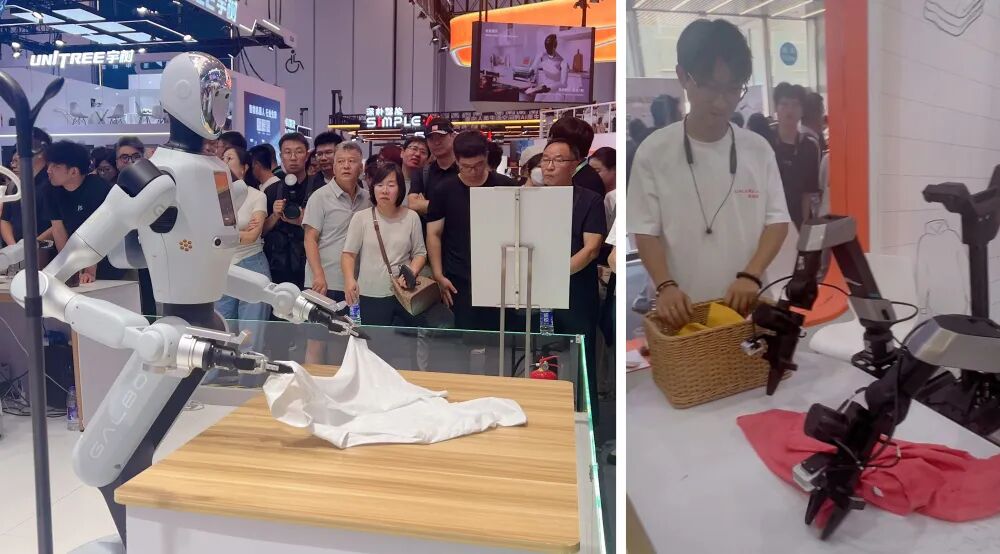
The scene in front of people makes them trance back to 2024. That year, Tesla released a video of Optimus folding a T-shirt, but Musk later admitted that there was remote control operation in the demonstration. For this reason, "folding clothes" is no longer considered new to many people, but it is still a classic scene that WRC repeatedly demonstrates almost every year.
Why is everyone focusing on folding clothes? The staff at the Starseas booth told Tencent Tech that clothes are flexible objects whose shape keeps changing during operation. For robots, folding clothes seems daily, but it is actually a quite complex task. Huang Qingqiu, co-founder and CTO of Mochi Intelligence, said: "Only by choosing a sufficiently complex scenario can we obtain sufficiently rich and diverse data, and then train a more capable foundation model."
Another common task is item picking. In terms of object grasping, Leju and Independent Variable focus on logistics scenarios, while Mochi Intelligence puts robots in daily environments to handle scattered sundries.
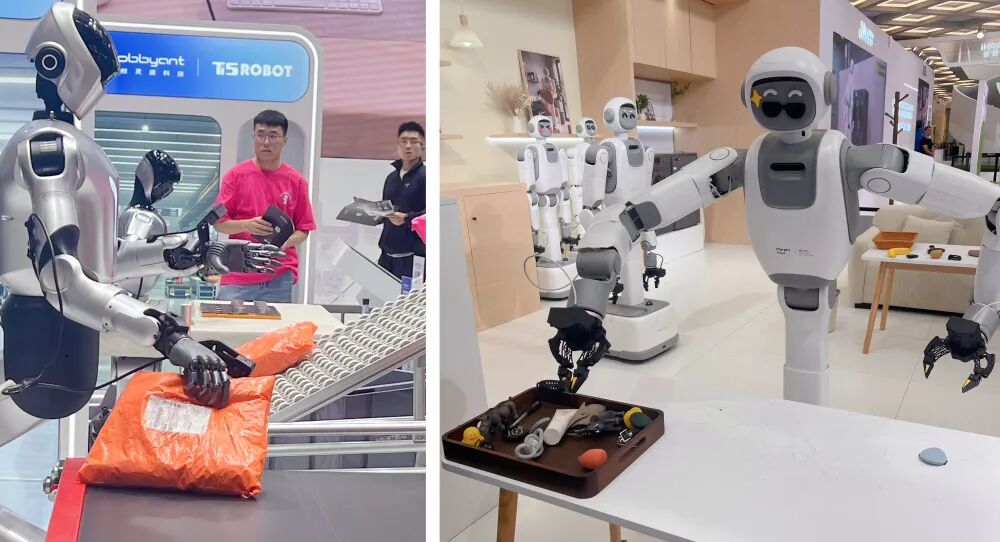
(Left: Leju Robot, Right: Mochi Intelligence)
In addition, there are some scenarios closer to consumers. For example, Galaxy Universal's Galbot G1 enters a convenience store to pick up items, and some robots try to make coffee and pizza on site.
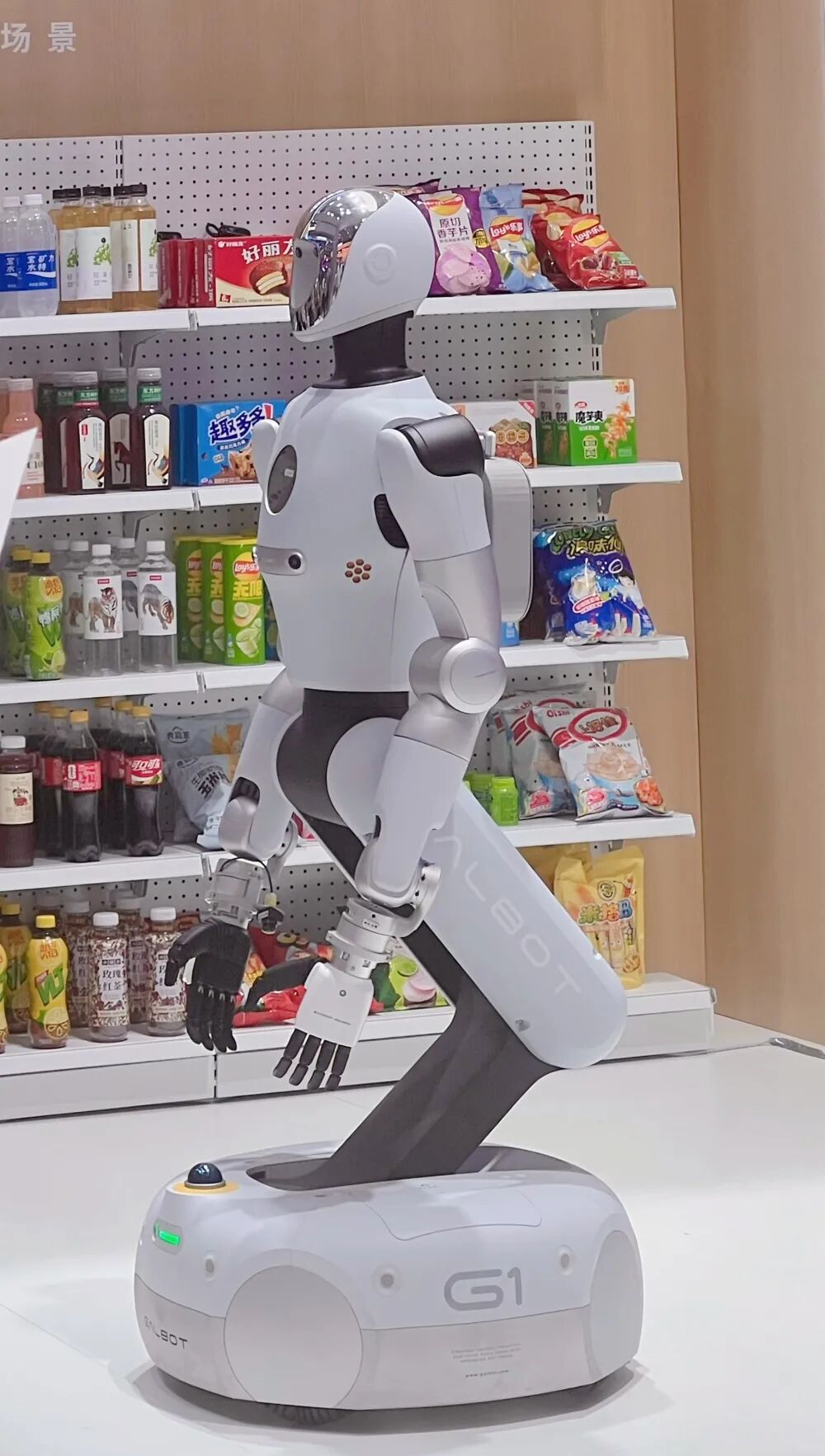
Judging from the performance of robots in these scenarios, compared with the past, two changes in this year's robot demonstrations are particularly obvious.
First, robots seem to start to "think". More accurately, they can make judgments based on the execution results of tasks and perform autonomous error correction.
For example, in the clothes folding demonstration of Starseas, if one of the grippers fails to clamp the clothes, the robot will not stay in place, but will re-judge and try repeatedly until it successfully clamps it. The same is true for logistics picking. When the Independent Variable robot finds that the object has not been successfully moved to the target position, it will actively adjust its actions and re-execute until the task is completed.
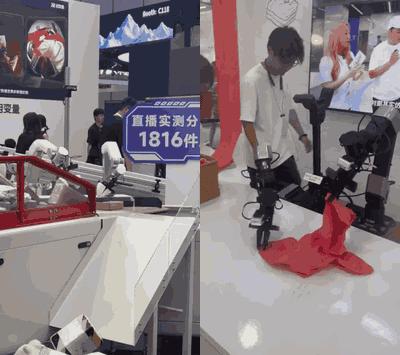
(Left: Independent Variable robot demonstrates logistics picking, Right: Starseas demonstrates the clothes folding scenario)
Second, the task chain that robots can complete has become longer. For example, UniX AI tries to let robots make Gongfu tea. The whole process includes scooping tea, putting tea into the pot, pouring water, steeping, pouring out the tea soup and filtering, and the robot needs to complete multiple interconnected steps continuously. However, during the exhibition tour, we did not see its real full demonstration.
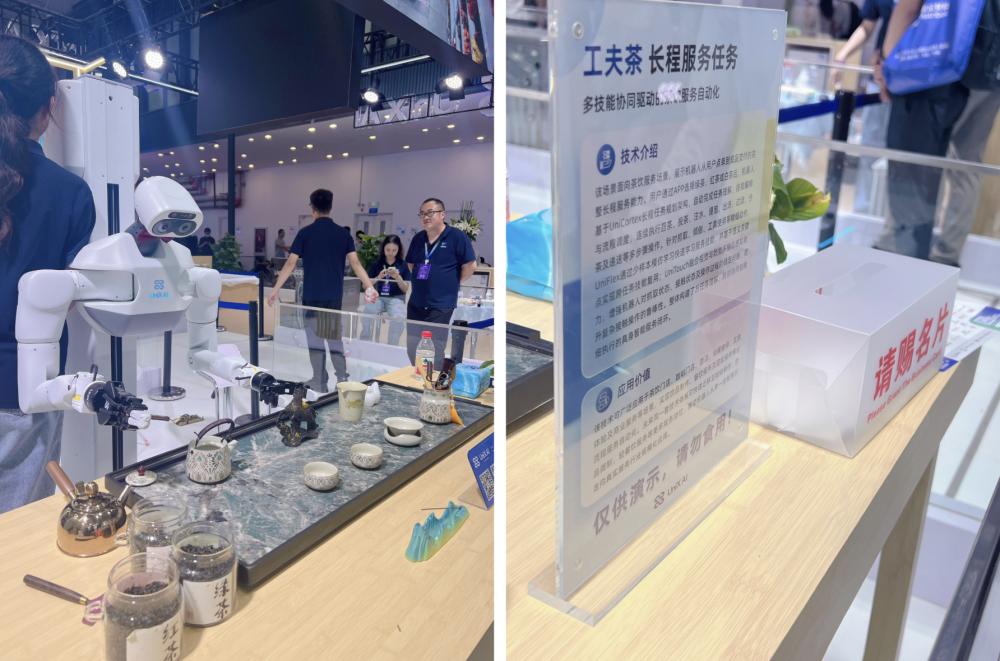
Although, from this WRC, robots are starting to enter more scenarios and can complete longer task chains, there is still the hardest threshold to cross before they can truly "do the job well": the last few centimeters, or even a few millimeters.
Wang Xingxing said at WRC that if a robot is brought into any unfamiliar environment, or even into a home, and can complete about 80% of the tasks, embodied intelligence will be close to the real critical point, and the industry will also usher in a boom. But it is still difficult to achieve at this stage. "At present, the alignment between the input and output of AI models and real robots is not enough. If you ask it to move, assemble things together, or move an object to a certain position, the general direction is fine and it can basically execute; but at the last few centimeters and the last few millimeters, the success rate and deviation cannot be well matched with the real world."
02 Hardware is no longer a difficulty
An important prerequisite for application scenarios to become the focus of this year's WRC is that robot bodies and motion control have crossed the early technical threshold. For many manufacturers, making robots walk, run and jump stably is no longer the most difficult problem.
This change is mainly reflected in two aspects: first, the technical threshold is being lowered, and second, the hardware cost continues to decline.
First, the motion control technology of the robot body has converged.
At this year's WRC, Unitree G1 danced group dances again. Accelerate Evolution brought a robot to the stage to perform lion dance, and also made it imitate Michael Jackson; on the other side, the Qwant robot took very natural steps to walk over, then turned around and started boxing.
Robots turned the exhibition booths into stages, and the onlookers raised their phones and skillfully took videos one after another. Although such scenes have been very common in the past few years, what is uncommon is that compared with a few years ago, the exclamations from the crowd seem to be a little less.
Two years ago, as long as a robot could stand steadily and walk a distance smoothly, it was enough to attract everyone's attention. Now, with the gradual maturity of motion control capabilities, walking, running, jumping and completing a set of preset actions are becoming the basic skills of humanoid robots.
This also explains why manufacturers are vying to demonstrate clothes folding, express parcel picking and Gongfu tea making.
But Zhao Tongyang, founder and CEO of Qwant Robotics, said, "There is no end to motion control."
Although motion control has made rapid progress in recent years, for example, Qwant Robotics can already participate in boxing matches; at robot sports meetings, some robots run at high speed, even faster than humans. But measured against the level we really want to achieve, the current level may only be 60 points.
Second, the cost of manufacturing robots is also decreasing.
Zhao Tongyang told Tencent Tech that in the past few years, the core components of humanoid robots have been greatly reduced in price: the price of ball screws has dropped by about ten times in three years, and the price of reducers has dropped by half. With the expansion of supply chain volume, the cost of complete machines will continue to decline.
A practitioner in the embodied intelligence industry took the integrated joint module as an example. In 2025, leading domestic suppliers began to reach an annual shipment level of 100,000 units. Among them, E Technology delivered about 95,000 units for the whole year, and Quan Zhibo and Inx both disclosed shipments exceeding 100,000 units.
As of the first half of 2026, the cumulative shipment of Quan Zhibo's integrated joint modules has exceeded 120,000 units, and the shipment in June alone has exceeded 60,000 units. While the shipment scale is expanding, the price of joint modules is also decreasing. According to public information, the average price of Quan Zhibo's industrial-grade joint modules disclosed in 2025 is about 1500 yuan per unit, and it is expected that the joint cost will maintain a decline of about 10% per year.
An investor focusing on the robot track also told Tencent Tech that a joint module manufacturer he contacted has products whose prices are almost falling every year.
Of course, hardware still has a threshold, but with the gradual maturity of the supply chain and the large-scale shipment of core components, it is no longer the only bottleneck restricting the development of embodied intelligence.
The listing of Unitree marks that robot bodies are becoming cheaper and cheaper relying on supply chains, large-scale production and component reuse. This will also drive the maturity of the entire hardware upstream and downstream industrial chain, and in the future, the manufacturing cost of hardware will become lower and lower. However, Zhou Wei, founding managing partner of Creation Ventures, said that cost reduction is only the first step. Only by quickly running through the business closed loop and generating real cash flow can upstream and downstream suppliers build together, thereby supporting the development of the downstream.
Just like 15 years ago, Xiaomi made Android phones quickly accessible to the public at a price of 1999 yuan, robots are also going through their own price reduction cycle.
At the WRC site, the lowest selling price of the vbot robot dog has reached 11988 yuan, which is close to the price of a high-end Apple mobile phone. Robots have not really entered thousands of households, but at least in terms of price, they have moved from the distant laboratory to a range that ordinary consumers can seriously consider.
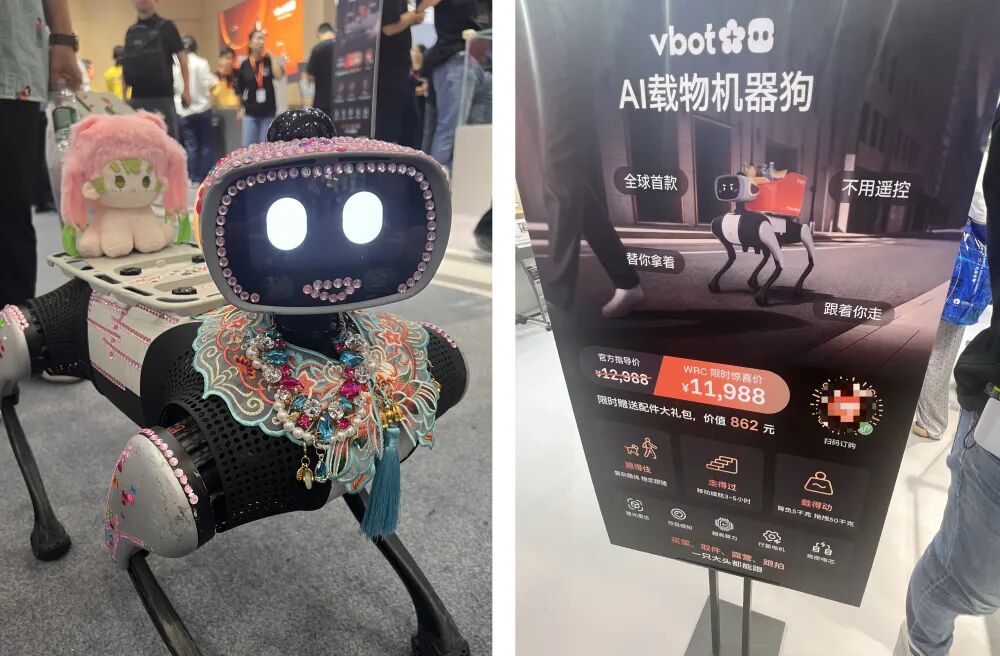
But to make robots really integrate into daily life, it is difficult for a single company to achieve this alone. Therefore, we also see the phenomenon of "huddling for warmth" in the robot industry.
03 Robots, investing in robots
The most direct way of this "huddling" is investment.
Robot companies are carefully controlling advertising and marketing expenses, while investing their limited funds in peers in the industrial chain, and even co-investing in a company with potential competitors. According to statistics from IT Juzi, from January 1 to August 19, 2026, 18 robot-related enterprises have made external investments, involving a total of 36 investment events.
In other words, robot companies are no longer only focused on developing their own products, but have also begun to act as VCs, investing in foundation models, scenario data, robot joints, tactile solutions and operating equipment. Zhou Wei believes that this is a positive signal, indicating that enterprises and technologies are distributed in different links of the industrial chain, and gradually form a synergy, which helps to build a healthier industrial ecosystem and business model.
The unusual part of this phenomenon is that robot companies are generally not "rich" and are not generous in their investments. Embodied intelligence is an extremely capital-intensive industry. Body R&D, model training, data collection and production line construction all require continuous investment. For enterprises with a financing scale of only tens of millions of yuan, the money they get is often only enough to get an admission ticket.
Therefore, many robot companies are very restrained in advertising and marketing investment. Even Unitree, which has achieved large-scale revenue, has not "burned money on advertising" on a large scale. In 2025, Unitree Technology achieved an operating income of 1.69