From Game Overseas Expansion to Global Growth: What Have We Seen Behind Twitch?
A subtle change is taking place in the exhibition halls of ChinaJoy 2026.
The most crowded areas are no longer limited to the BTOC pavilions for players. The BTOB pavilions for the industry are also packed with industry practitioners who come to seek solutions. Official data shows that this year's ChinaJoy BTOC has more than 350 exhibitors, and BTOB has over 500 exhibitors, with foreign-funded enterprises accounting for 46.6% from 39 countries and regions. Advertising platforms, payment companies, data analytics institutions and local service providers are flocking to the exhibition halls, all aiming to secure a larger share of Chinese game companies' overseas budgets.
This is a completely different scene from what we saw three years ago.
At the same time, however, the game industry is also facing a new inflection point.
Data from the China Audio-Video and Digital Publishing Association shows that in the first half of 2026, the overseas revenue of self-developed games reached 12.372 billion US dollars, a year-on-year increase of 30.22%. The figure is still impressive, but data from Sensor Tower shows that the global mobile game downloads declined by 7% year-on-year, the increase in user duration was only 0.01%, and in-app purchase revenue grew by 1.4%, which is almost stagnant. On the supply side, expansion is accelerating: AI tools continue to lower the development threshold, while the number of opportunities that can achieve effective monetization is decreasing.
Overseas expansion is still growing, but the way of growth has changed. After the era of extensive market expansion ended, the real proposition for game manufacturers has shifted from "how to reach more players" to "how to understand local players, integrate into communities, and build long-term connections".
The stock game in the mobile game market is no longer full of suspense, and a noteworthy change is underway.
PC and Console Become New Opportunity Tracks, While New Challenges Are Also Brewing
If you shift your focus away from mobile games, you will see a completely different growth curve.
Sensor Tower's *2026 Game Market Report* shows that in 2025, PC and console games contributed half of the revenue of Chinese games going global. The global revenue of Steam increased from 7.8 billion US dollars in 2022 to about 11 billion US dollars in 2025, with a cumulative increase of 41% in three years. Although the growth rate slowed to 6.8% in 2025, entering a high plateau period, compared with the negative growth of mobile game downloads and stagnant user duration, PC and console have shown new growth potential.
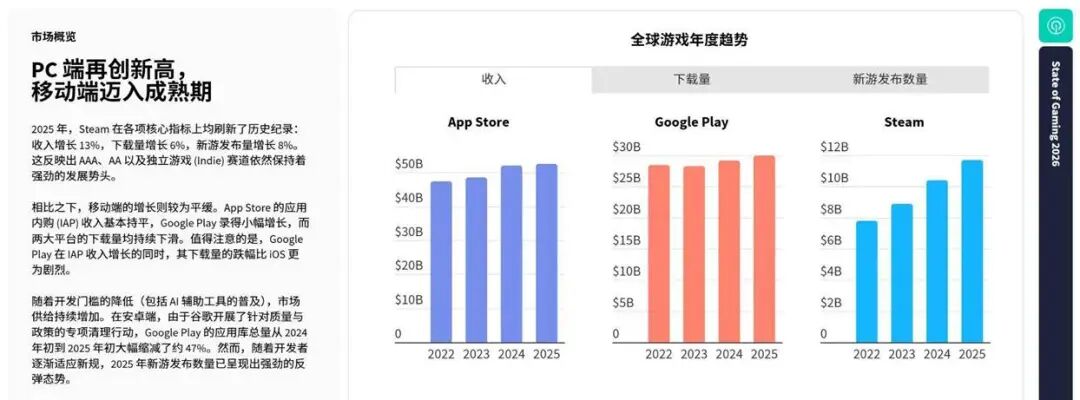
Source: Sensor Tower
But opportunities do not necessarily translate into commercial performance. Chinese publishers account for about one-third of the total number of games worldwide, but only 4.6% of global revenue. The huge gap between quantity and revenue not only indicates the lack of brand premium, but also means there is still considerable room for improvement.
Especially when entering the PC and console market, Chinese manufacturers face far more challenges than just product R&D and distribution.
In the mobile game era, user acquisition was the absolute main theme, with the core logic of buying traffic, conversion and retention, competing for users in app stores and feed advertisements. The logic of PC and console is completely different: players have a longer decision-making cycle, and rely more on community word-of-mouth, streamer recommendations and media reviews. After the game's launch, long-term operation requires continuous content updates and community maintenance to maintain player activity and DLC sales.
This means that Chinese manufacturers need to think about a new proposition: when the product itself is no longer the only decisive factor, and the marginal effect of traffic purchasing continues to decline, how to build a real presence in places where overseas players gather?
What Can a Player-Trusted Game Community Do?
It is impossible to make a console game player feel a sense of belonging to a game only by relying on banner ads.
But Twitch provides the possibility to truly step into the player community.
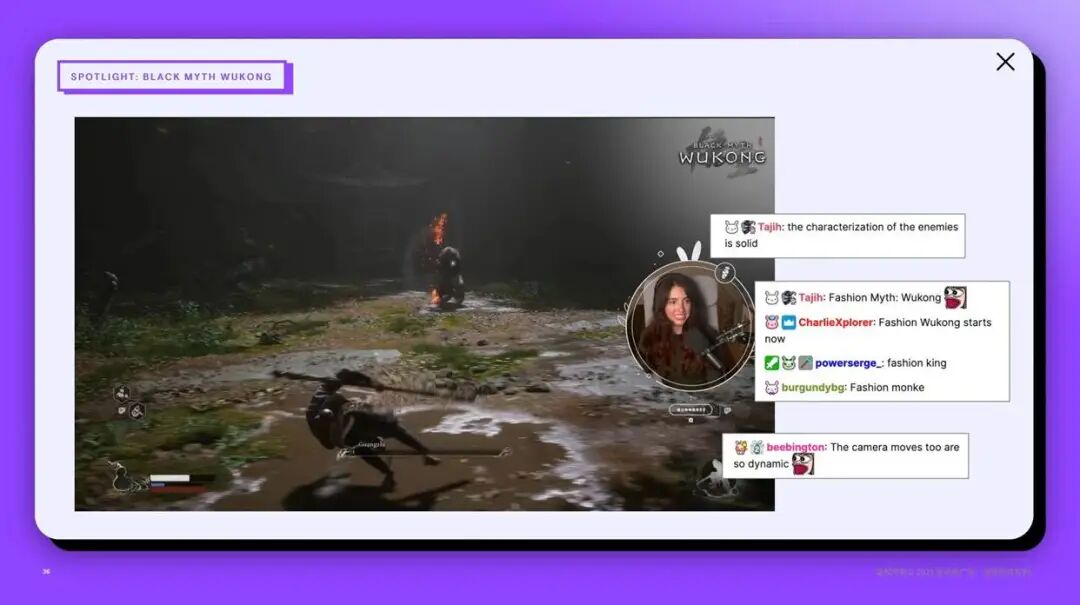
Twitch is the default entry point for global players to access game content. If you want to improve your skills, there are diverse operation demonstrations here; if you want to have fun, there are personalized streamers who bring games to life; if you want to find a sense of belonging, there are active communities built around every game. Interactive features such as Chat turn viewers from onlookers into participants, who not only watch, but also connect and co-create.
This is the first-mover advantage of community products. The audience of Twitch itself is a core player group with high activity and high engagement. Different from pan-entertainment platforms, game content consumption on Twitch is active and focused, and the average continuous viewing time of viewers is calculated in hours. This means that brand information has enough time to be received and discussed, instead of being swiped away.
This point has been verified in multiple cases.
When Gryphline, the publishing brand under Hypergryph, launched *Arknights: Endfield* to the global market, it chose to launch a "public beta blitz" on Twitch. The public beta is the most critical inflection point in the game release cycle. For the first large-scale reach to players, brand voice must reach its peak at this moment, while the window is extremely narrow and player attention is highly fragmented.
The brand cooperated with Twitch to create an immersive interactive experience. The hostile entity "Aggeloi" in the game began to "invade" Twitch live streams, integrating into the streamers' content and bringing unexpected interactive challenges to the audience. As the event escalated, Twitch invited streamers and the community to join "Endfield Industries" to participate in global interactive tasks, with game managers played by streamers guiding the community to advance the plot in the live room.
In just a few days, the Twitch community became an important driving force for this game release. In the end, the event accumulated 2.7 million minutes of total viewing time, nearly 4,000 Bosses were defeated by the community jointly, and a unique interactive emoji that sparked heated discussions in the global Twitch community was created. Game release is no longer a one-way broadcast from the brand to players, but a collective event completed by the community.

If *Arknights: Endfield* verifies that the community acts as a distribution channel, then the "Rogue Shadow Ops" of *Call of Duty: Black Ops 6* redefines the community as content itself.
*Call of Duty* is a legendary IP with a 20-year history, with millions of daily active players. Every new release is a major event in the game industry. Maintaining this level of market popularity requires breaking through conventional marketing methods. The creative team deeply integrated Call of Duty's high-stakes action experience with Twitch's interactive culture, creating a "game within a game" that is both a live show, an interactive suspense drama, and even a social experiment.
Before the launch, the team built two original 3D interactive rooms containing puzzles, codes and mechanisms, requiring viewers to cooperate with streamers through the chat room to decrypt. The first global Twitch-exclusive emoji for Call of Duty was introduced, and viewers could collectively send the emoji to unlock doors and crack safes. The first ever brand Raid in Twitch history seamlessly transferred thousands of viewers to the next creator's live stream, allowing the mission to continue across multiple streamers. The climax was the first offline interrogation room in Twitch history, where two creators were "kidnapped" to the scene for interrogation, and the chat room viewers acted as the jury to dominate the direction of the interrogation in unpredictable ways.
After the launch, teams from the UK and Germany faced off in the new game, and the chat room continued to act as the "mission command center" to unlock in-game challenges and designate combat targets.
According to disclosures, the event finally reached a total viewing duration of 2.7 million minutes, 5.5 times the baseline value; the global exclusive emoji was used more than 550,000 times; the total number of unique viewers exceeded 423,000, a 48% increase over the baseline; there were more than 105,000 chat messages, 28 times the baseline value. Brand improvement was also significant: brand awareness increased by 2.2 percentage points, favorability increased by 9.0 percentage points, purchase intention increased by 10.1 percentage points, and recommendation intention increased by 10.4 percentage points. This case also won the Gold Award in the Content Entertainment and Collaboration category at The Drum Awards.
It is worth noting that this marketing method centered on creator trust and community participation is not only applicable to the game industry.
A Chinese new energy vehicle brand also chose Twitch as the entry point when entering the Saudi Arabian market. Saudi Arabia is one of the largest automotive markets in the Middle East, with a high proportion of young population, and game culture deeply influences local entertainment and technology trends. The brand wanted to reach tech-savvy young audiences, but traditional car advertising is difficult to build real connections among this group.
The brand cooperated with three local Saudi Twitch streamers to turn the vehicle's Vehicle-to-Load (V2L) function into a real game experience in the live broadcast. Instead of interrupting the viewing with traditional advertising, the streamers introduced the brand through natural conversations during the game, making the placement seamlessly integrated with the Twitch environment. Channel package ads paired with custom visual elements kept the brand continuously visible throughout each live stream without being intrusive.
The results exceeded expectations. The three creators generated more than 3.38 million impressions, reached more than 16,000 unique viewers, and the brand content was viewed for more than 4900 hours, with one streamer's audience having an average viewing duration of more than 49 minutes. Viewers spontaneously discussed the product in the chat, showed great interest in the product features, and were guided to offline showrooms for experience. Digital interaction was finally converted into purchase intention in the real world.
From games to automobiles, these cases all illustrate that on Twitch, brands are not "buying exposure", but "participating in culture". As Generation Z is deeply trapped in a content trust crisis, nearly 80% believe that social media content is fake, 68% are overwhelmed by low-quality AI-generated content, and even call this kind of content "slop (digital garbage)", the value of real creators, real interactions and real communities is being re-evaluated. What the audience wants is unexpected surprises, unfiltered immersion, and the appeal brought by real people. These are exactly what banner ads and programmatic delivery cannot provide.
And Twitch is just one piece of Amazon's media resources.
Behind Twitch is Amazon Ads' Continuously Upgraded Marketing Capabilities
From Twitch, we catch a glimpse of a larger territory that Amazon Ads is opening up.
In the past, the industry's perception of Amazon Ads has long been limited to "e-commerce in-site advertising" — search result positions, product detail pages, with the core logic of the final nudge when "people are looking for goods". This perception seriously lags behind the expansion of Amazon Ads in the past few years.
According to a research report released by JPMorgan in July 2026, Amazon Ads has firmly secured its position as the world's third-largest digital advertising solution, with estimated revenue of 83 billion US dollars in 2026, a year-on-year increase of 21%; its operating profit margin is as high as 46%, contributing about 38 billion US dollars in operating profit, accounting for 36% of Amazon's total operating profit. Amazon's Q2 2026 financial report shows that advertising revenue in a single quarter reached 19.8 billion US dollars, a year-on-year increase of 26%, and the growth rate has led the world's top digital advertising platforms for several consecutive quarters. Advertising has become Amazon's third growth pole in addition to AWS and e-commerce, and is also one of the businesses with the highest profit margins.
What supports this growth is no longer just in-site search ads.
From Amazon Marketplace to Twitch, Prime Video, Fire TV, Alexa, Kindle, and then to high-quality global streaming resources such as Netflix, Disney+, Spotify, Amazon Ads is constantly expanding its ad inventory and streaming reach capabilities, covering more scenarios of consumers' viewing, listening, entertainment and interaction.
Source: Twitch
Over the past year, a series of strategic partnerships have outlined the expansion speed of this network: Spotify Ad Exchange is directly integrated with Amazon DSP, allowing advertisers to programmatically purchase Spotify's music and podcast ad resources to connect with audiences in different listening scenarios; Netflix opens ad inventory to Amazon DSP, allowing US advertisers to use Amazon Audiences to deliver Netflix ads based on signals such as lifestyle, interests and active shopping intentions, so that streaming ads not only serve coverage and awareness, but also support a more complete audience strategy combined with shopping signals; Disney cooperates with BrightLine to allow advertisers to deliver enhanced ads such as remote control interaction, content carousel and QR codes in Disney streaming resources; Amazon Ads cooperates with LinkedIn to introduce professional audience signals such as job titles, industries and job levels into the CTV scenario, reaching B2B audiences in the streaming TV environment; partnerships with Roku and Samsung TV Plus further expand the coverage of connected TV, extending interactive video ads from content viewing to direct actions such as "Add to Cart" and "Send to Mobile".
These collaborations collectively point to an emerging infrastructure: an advertising network spanning e-commerce, game live streaming, long and short videos, music and podcasts, living room big screens and professional social platforms, with Amazon Ads at the center, scheduling through a unified DSP and audience system.
However, the scale of inventory itself does not constitute a moat, and the digital advertising industry never lacks media resources. The real barrier lies in audience signals.
The key to future advertising competition is not just "who owns more inventory", but who has more real consumer signals, and the ability to convert signals into large-scale precise reach. The digital advertising industry is undergoing a paradigm shift: the demise of third-party cookies, restrictions on IDFA, and the trust crisis caused by the proliferation of AI content have jointly shaken the foundation of the traditional advertising ecosystem. Probabilistic matching is becoming less and less accurate, interest tags are becoming more and more generalized, and users' tolerance for advertising is getting lower and lower. While advertisers are dispersing budgets across more channels, it is increasingly difficult for them to answer a basic question: who exactly saw my ad, and are they really interested?
This precisely constitutes a unique competitive advantage of Amazon Ads today.
Different from building audiences mainly relying on search keywords, interest tags or third-party data, Amazon has first-party signals from real shopping, browsing and content consumption behaviors. These signals are real events that happened. Through the Authenticated Graph, these signals can be combined with deterministic identity connections, covering more than 90% of households in the United States in an encrypted, pseudonymized way, supporting cross-channel audience targeting, de-duplicated reach, frequency management and effect measurement, without exposing personal identity information to advertisers.
The conversion efficiency of search ads in the "people looking for goods" link is irreplaceable, and social media as a traffic entry forms a synergy with Amazon's subsequent marketing, which also allows Amazon Ads to fill a long-standing gap: in the complete journey from awareness to conversion, use deterministic signals to replace probabilistic guesses, and use cross-screen and cross-scenario frequency management to replace the waste of repeated exposure.
For Chinese brands going global, this means that there is one more noteworthy answer for global marketing.
In the past ten years, the marketing path for Chinese brands to go global has been relatively single: buy traffic on channels, optimize rankings in app stores, and win by price and efficiency. However, with the intensification of stock competition in mobile games, the rising demand for branding in PC and console markets, and the accelerated overseas expansion of high-unit-price categories such as consumer electronics and automobiles, marketing goals are shifting from short-term conversion to equal emphasis on brand building and long-term growth. What brands need is not just a delivery channel, but a set of infrastructure that can understand local consumers, integrate into local culture, and measure the full-link effect.
Amazon Ads no longer only helps brands sell to the world, but also helps brands connect with global consumers and build global brands. From community co-creation on Twitch, to brand stories on Prime Video or other sports events and entertainment content, to