Exclusive Interview with Ren Lifeng: The Man Who Once Built Douyin Is Now Working on AI in Factories
Text by Wen Lihong
Edited by Zhang Yuxin
In the Internet Finance Center located in Haidian, Beijing, "Shumei Wanwu" founded by Ren Lifeng has 3 office locations. One of them is not an office but a laboratory, where they purchase the mainstream 3D printers on the market and arrange them in sequence on the laboratory desktop, printing objects generated by their self-developed generative 3D model every day. Whether the physical objects printed from the drawings generated by the self-developed Hi3D model have broken surfaces or other defects, and how to improve and repair them, all get verified in this room.
In mid-August, the self-developed Hi3D V3.0 model of "Shumei Wanwu" entered the final stage before public release. With the team's daily debugging and discussion, test printing tasks surged, and the generated resin waste had not been completely cleaned up, part of which was stacked in cartons and temporarily stored in the corner of the laboratory.
In early 2024, Ren Lifeng founded Shumei Wanwu, which became a new starting point in his career after he left ByteDance. It was the hottest time for domestic large model entrepreneurship, and Ren Lifeng chose a path that few people were queuing up for: AI 3D generation + manufacturing. In the following two years, they built their own factories in the Pearl River Delta, and the generative AI 3D large model they developed aims to help people turn creativity and design drawings into manufacturable crafts.
Funds soon came to the door. The company was established in early 2024, and the angel round soon got in sight, with HSG and IDG Capital quickly extending an olive branch for the angel round.
It is not difficult to understand the capital's enthusiasm for Ren Lifeng. He is a star entrepreneur qualified to rely on his past "capital", and his resume is almost embedded in the chronicle of all hit products of the Byte ecosystem.
In the autumn of 2016, as a core member, he incubated the short video product A.me. Three months later, this product was renamed "Douyin". He experienced the whole process of Douyin from 0 to 1, and was praised by many people as an important contributor to the rise of Douyin. In the following seven years, he served as the head of Xigua Video, then transferred to Vice President of PICO, in charge of content ecosystem business. In the second half of 2023, he successively stepped down from multiple positions under the Douyin Group, until he officially left his job to start a business in early 2024.
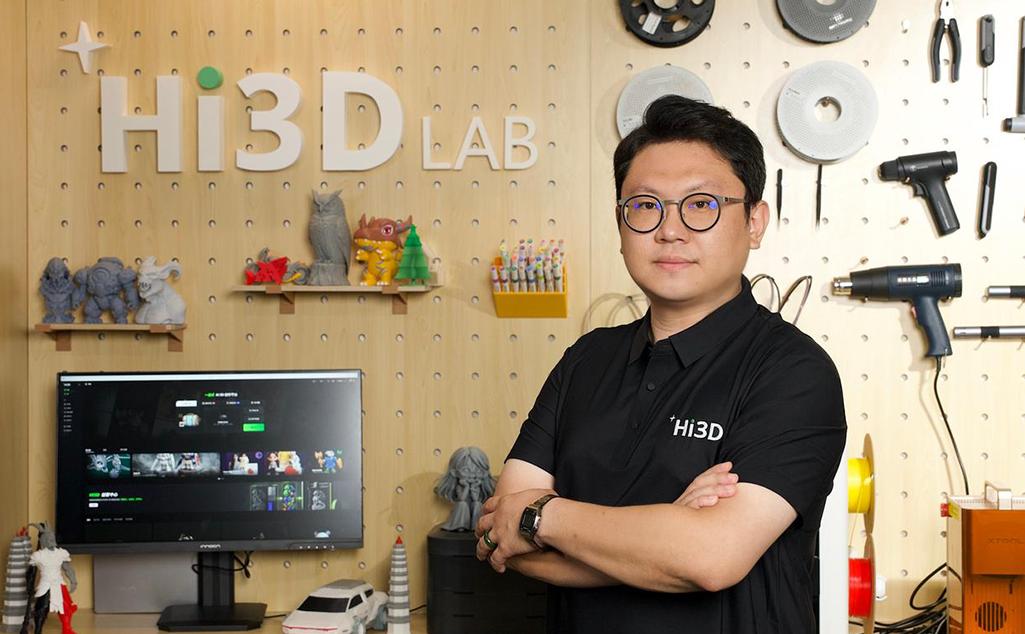
"Juanjuan" Ren Lifeng
The nickname "Juanjuan" is the mark he left within ByteDance. Even today, more people in the industry call him "Juanjuan" than "Ren Lifeng".
But when the funds came to the door, the first thing Ren Lifeng did was to "hold back" the two investment institutions HSG and IDG. He asked the investors to put aside the terms and BP first, and go with him to visit the factories in the industrial belts of the Pearl River Delta for two days. The two institutions went with him to Panyu, Guangzhou, and dived into the factory assembly lines of the jewelry industrial belt.
This was the first important thing Ren Lifeng did at the beginning of financing: try his best to "separate" himself from the project valuation, so that investors can see and rationally assess the real potential behind the company.
This detail is an entry point to understand Ren Lifeng. He knows that the signboard of "star entrepreneur" can make funds arrive faster, but he actively chose a slower but more stable path — what he wants is not the enthusiasm that comes just for "Juanjuan", but fellow travelers who place bets after seeing the situation clearly.
On August 20, Shumei Wanwu officially released the new generation model Hi3D V3.0, with a precision of 2048³ voxel-level resolution, and announced the completion of nearly 50 million US dollars in Series A+ financing. In the past six months, this company has successively obtained two rounds of financing, which were continuously led by BAI Capital and Huaye Tiancheng Capital, followed by Yunhui Capital and old shareholders HSG, IDG Capital, Meituan Longzhu, Qingliu Capital and Jinqiu Fund.
Today, this company, which has been established for two and a half years, has built its factories in the Pearl River Delta, and has reached the intersection from models to the manufacturing industry. The man who once named Douyin and stood at the center of China's business world turned around, dived into the manufacturing industrial belt.
Walking on the new path, what on earth does he want, and what kind of future has he seen?
The following "Intelligent Emergence" is an edited conversation with Ren Lifeng.
Separate "Juanjuan" from the valuation
Intelligent Emergence: When you decided to leave Byte to start a business, the outside world was guessing what you were going to do. What were you thinking at that time?
Ren Lifeng: Frankly speaking, I had no plan to start a business at that time. The last period before I left Byte, I was on vacation. Out of personal interest, I went to visit the industrial belts, and then I had an idea vaguely. After verifying some pre-thoughts and thinking that there was an opportunity, I decided to start my own business.
At that time, I knew that what I was about to do would involve two things: one was the supply chain, I had to get deeply involved in the supply chain. The other was 3D. In Byte's business system, images and videos are the core themes, but what I want to do is 3D, especially the combination of 3D and manufacturing, so I think this direction should be done independently.
Intelligent Emergence: So what kind of company is Shumei Wanwu?
Ren Lifeng: It aims to combine AI generative 3D models with the manufacturing industry.
What I did at Douyin was to provide carving tools in the dimension of time. Today, I use AI generative 3D to provide carving tools in the dimension of space. Humans have eyes and mouths to express. In addition, there are hands to participate in the transformation of the world. What I am doing now is to migrate the past vision of helping users carve time to helping users carve the three-dimensional world.
Intelligent Emergence: Why did you think about the AI 3D large model? What was the opportunity?
Ren Lifeng: This idea actually came up more than a year before the company was founded. At the end of 2022, when I first took charge of PICO, AI-generated images became popular. My first reaction was: generating images is possible, generating texts is also possible, audio and videos can probably be generated too, so when will AI-generated 3D come?
At that time, I seriously looked for algorithm scientists from AILab to talk about this issue extensively. Because 3D production is a very painful point for VR and AR.
At that time, to make a 3D interactive audio-visual content, the production cycle was at least two months, and 50 people had to work on the art pipeline for two months, which was already very fast. For traditional 3A game masterpieces, the development period is at least two years, and most of the two years are spent on the art pipeline. If the content system is not perfect and rich enough, the user's immersive experience with wearable devices cannot be supported. If 3D assets cannot be produced with low threshold and high efficiency, this scenario cannot be realized.
Intelligent Emergence: Why did you enter the actual manufacturing link? This is a very heavy choice for people with an Internet background.
Ren Lifeng: I have visited a large number of industrial belts. After seeing a lot, I was thinking, is it possible to learn data from factories to make a 3D large model combined with the manufacturing industry.
Making models involves two things: one is data, the other is parameterized models. The most core thing is to have large-scale learning corpora, and data to some extent determines the upper limit of its effect. A large amount of data generated by factories in the manufacturing industry, is there any way to obtain them in the links? I went to find out, and it really is possible.
Intelligent Emergence: Which industrial belts have you visited?
Ren Lifeng: The first one I showed to the investors was the jewelry industrial belt in Panyu. From the first day there, we visited factories, and I showed them every link on the production line, what kind of work it was, what tools they used, and what value they created. In the whole production process, which link has technical opportunities.
The manufacturing chain involved in jewelry is very complete, and the materials processed are very diverse. Hard materials include metals, resins, and gemstones. Its shapes are extremely rich, and the processing difficulty is large enough. In addition, it mainly processes hard materials, and the digitalization degree of hard material equipment is high, and more collaborative digital processing techniques are needed. Therefore, by studying this industry, we can see the whole picture, and investigate many related problems in the industrial chain at one time.
Intelligent Emergence: Why did you choose to develop the model independently? At that time, some teams were already researching AI generative 3D models, and taking the cooperation route would be faster.
Ren Lifeng: At that time, we actually looked at the models that everyone in the industry was developing.
First of all, everyone's research was very early at that time. You know, in 2023 and 2024, 3D, as an independent modality, is the latest to develop compared with images, texts, audios and videos. At that time, there were very few models with good effects.
Secondly, we really didn't see any model that can be well combined with manufacturing. The problem we studied has a certain degree of verticality. The 3D large model is general, but among its general applications, the application value in the manufacturing field will be greater. We also have game customers and film customers using our models, but they only use them in some links. Manufacturing is different, our application will be more in-depth, and we provide a series of pipeline models and pipeline services.
So at that time, we chose independent research and development, because what we need to solve is the production problem.
Intelligent Emergence: Who was the first investor to find you? How fast did they make the decision?
Ren Lifeng: The first ones to express support should be HSG and IDG. When I finally decided to start a business, HSG and IDG clearly stated that they wanted to invest.
But I held them back. I said don't be in a hurry, and then I pulled the people from HSG and IDG to visit factories in the Pearl River Delta industrial belt for two days. After visiting the factories on the second day, we had a meeting in the afternoon, and I went through the BP. I told them, look at this BP, it is based on the fact that we have walked through the industrial belt and seen all these information, do you think it is worth investing?
Intelligent Emergence: You don't want investors to invest in you just because you are "Juanjuan"?
Ren Lifeng: I don't deny that everyone pays more attention to me, but I don't enjoy the so-called aura.
When I interview talents, I am especially afraid of the last link, when we start to talk to each other, he says "Juanjuan, to be honest, I'm here for you, I believe you can lead everyone to solve these problems." I can understand that, but I am especially afraid of that.
I told everyone a lot of seemingly beautiful stories with vision, but behind them, what I want to do has great uncertainty, a very long cycle, heavy investment, and great risks, which cannot be covered by aura.
So you ask me how I view the identity of a star entrepreneur. Although I know it can attract resources and talents, the best motivation for them to finally take action is that they believe more in the thing itself.
From pursuing precision to entering the industrial chain
Intelligent Emergence: You just announced the completion of a new round of financing. Where will the funds be spent?
Ren Lifeng: The majority will definitely be spent on the research of the base model, which is our foundation. Our company is first and foremost a technology company, and the majority of R&D investment will be put into AI models and related technologies.
The second part is the investment in coordination with the industrial belts. This involves heavy investment, including materials, equipment, techniques, and the connection of pipeline services with partners. We will also make clear investment in this part.
The third part is to go global. To do things well, we need to allocate as many success factors as possible to get a good result. China has two biggest advantage factors: one is the dividend of engineering talents, the other is the advantage of manufacturing. Combining the advantage of the best engineering talents and the advantage of the best manufacturing, we should do a global business.
Intelligent Emergence: On the same day, your Hi3D business also released the new model version V3.0, which is said to have a precision of 2048³. Why do you spare no effort to pursue precision?
Ren Lifeng: Because in the industrial field, precision represents quality. There is a concept called processing technology precision in production. Equipment types are divided by precision: ordinary 3D printers are about 50 microns, laser ones are about 20 to 30 microns, and CNC precision lathes are 10 microns. If you want to adapt to these equipment in the manufacturing field to reflect product value, precision is an unavoidable issue.
Digital assets do not need to be physically realized, but production is to let users operate in practice and solve practical problems. If the precision is not enough, the sense of value cannot be reflected.
In this version of the model, we have greatly increased from 1536³ to 2048³. We can responsibly say that after evaluation by internal and externally hired senior modeling experts, it has reached the limit of human modeling precision, and even the processing precision of many equipment is not as high as the model precision.
But we don't pursue precision infinitely, and we also need to consider applicability. In the future development, precision will not necessarily be the rigid thing we need to pursue next.
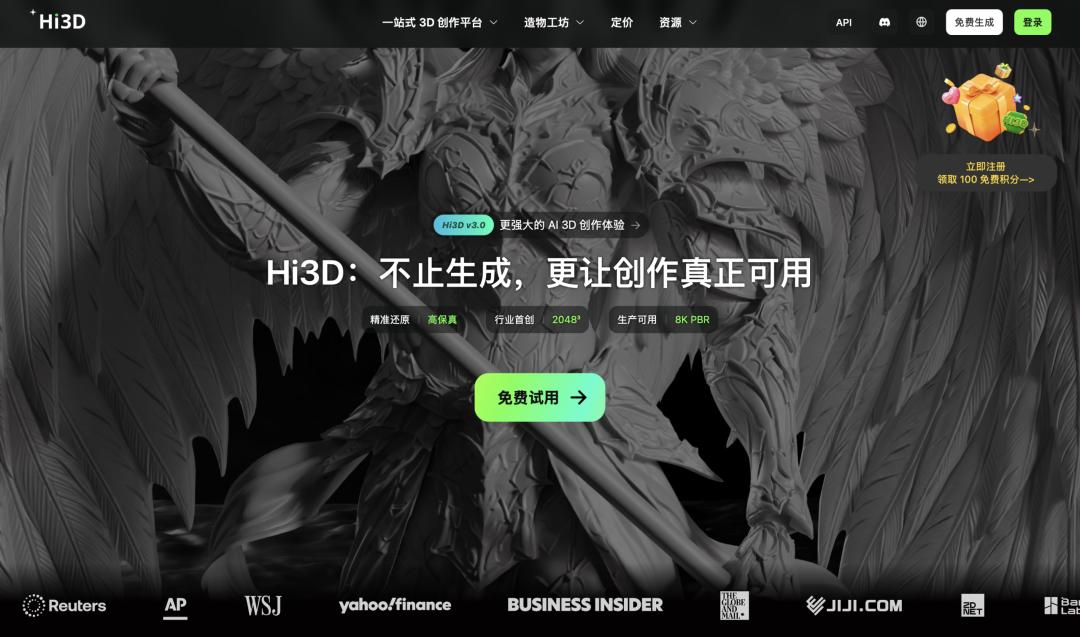
Hi3D official website
Intelligent Emergence: Why?
Ren Lifeng: In the next stage, if you want to improve a little bit more, the resources you need to invest will be huge, and the corresponding return is relatively small.
Intelligent Emergence: You will no longer focus on precision, where are you going in the next stage?
Ren Lifeng: There are three clear routes for the next step. The first is to evolve from integration to structuring, split the whole into parts, and move to the internal structure. The second is from meshing to parameterization. Meshing has low editing freedom, while parameterization is highly editable and controllable. The third is to shift from processing rigid bodies and hard materials to researching flexible materials and flexible processes. We are very clear about these three routes now.
Intelligent Emergence: How many more players can the AI 3D model track accommodate in the future?
Ren Lifeng: I think the industry is now in a stage of rapid development in the initial period, and the incremental space is very large. 3D is an independent modality, which develops the latest compared with images, texts, audios and videos. There is one thing that I think is really worth being proud of: Among so many modalities of AI model fields, 3D should be the only field where Chinese teams have always taken the lead since the