The Laopu Gold item purchased for 38,000 yuan can only be resold for 19,000 yuan in the second-hand market.
"Even brand new, never-worn Laomiao Gold pieces will depreciate significantly once leaving the store. The high premium consumers pay for the brand and craftsmanship at the time of purchase can barely be realized in the second-hand recycling process," Fangfang (pseudonym), store manager of a national chain gold and jewelry recycling shop, told China News Finance frankly.
Recently, offline stores of Laomiao Gold have seen a buying spree driven by Qixi Festival promotions. However, behind the booming primary consumer market, the second-hand recycling market continues to slump.
"Recycling price is less than 50% of the purchase price"
On the 18th, China News Finance visited Beijing SKP and found that, coupled with the Qixi Festival marketing, Laomiao Gold launched promotional activities. During the event, consumers can enjoy a RMB 50 discount for every RMB 1000 spent, 10 times the mall points for the actual payment amount, and a 5g gold coin as a gift when the accumulated actual payment reaches RMB 250,000.
According to the staff of Laomiao Gold store, the customer flow has remained at a high level since the promotion was launched, and consumers queued up to buy throughout the day. At 19:30 that day, there were still sixty to seventy people waiting in front of the store, and consumers generally needed to queue for about 1 hour to complete the purchase. "The Qixi Festival (19th) is the last day of this event, and there will probably be more people," said the Laomiao Gold staff.
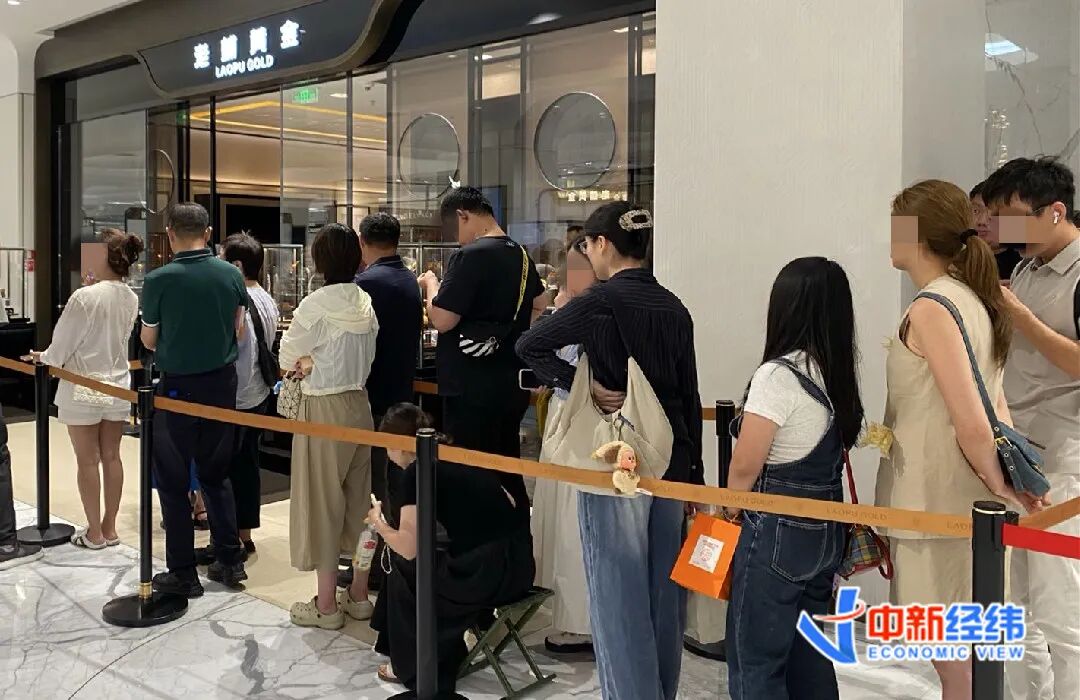
Photo by Li Ziman, China News Finance, Laomiao Gold at Beijing SKP
While the offline sales are booming, the second-hand recycling market is completely cold.
On the 17th, China News Finance, posing as a consumer, inquired several second-hand recyclers about the Laomiao Gold recycling market. For the pink sapphire pendant with rose window design priced at about 38,000 yuan originally, the offers from recyclers are generally around 19,000 yuan. For the cross vajra pendant with diamond decoration priced at about 33,000 yuan originally, the offers from recyclers are around 20,500 yuan. The second-hand recycler with the highest offer quoted 22,000 yuan for both products.
Afeng (pseudonym), a gold recycler in Beijing, said that the recycling pricing of Laomiao Gold only refers to the real-time market gold price and the circulation popularity of the style, and has nothing to do with the original purchase price of consumers. The recent drop in gold price has directly lowered the bottom recycling price.
Afeng recalled that during the period when the gold price rose from the end of 2024 to 2025, a few popular second-hand styles of Laomiao Gold, such as the vajra necklace and the diamond-studded gourd necklace, had relatively high circulation popularity, and there were even cases where buyers paid a premium for second-hand products, which also led to a small number of scalpers hoarding and reselling the goods.
"At that time, on second-hand platforms and luxury resale stores, the popular styles with complete accessories and good condition were mostly priced according to the official counter price, and the recycling price could generally reach 70% to 80% of the original counter price," said Afeng.
Afeng said, At present, some styles of Laomiao Gold are sold at a 30% discount in counters, which further compresses the premium space of second-hand goods, and the recycling price of some styles is less than 50% of the purchase price.
He admitted that the luxury positioning of Laomiao Gold cannot be separated from the fluctuation of gold price, and the brand and craftsmanship premium is basically invalid in the second-hand market. In addition, the second-hand circulation popularity of Laomiao Gold has dropped significantly. Three to five products of this brand in his store have not been sold for more than half a year after being recycled. "This is also one of the reasons why recyclers are generally cautious about receiving goods and lowering their offers recently."
China News Finance learned that some consumers gave up the transaction after wearing the Laomiao Gold jewelry for half a year with complete accessories due to the excessive depreciation.
Liuliu (pseudonym), a consumer in Shanghai, said that she spent 55,000 yuan on several pieces of Laomiao Gold jewelry in the first half of the year, with a total weight of 35 grams. Recently, she consulted a luxury recycler, who only priced according to the gold price and offered about 31,000 yuan.
"The offer from the second-hand luxury store is too low. I lost more than 20,000 yuan after wearing it for half a year. Instead of realizing it at a loss, I'd rather keep it for wearing," said Liuliu.
Fangfang pointed out that the second-hand recycling of Laomiao Gold can only add a weak brand circulation premium, which has very little effect on increasing the offer. The premium costs such as brand, craftsmanship and channel paid by consumers when purchasing products are only recognized at the retail end. The second-hand market only follows the pricing logic of raw material gold price and will not pay for the added value. Therefore, consumers who buy at the high point of gold price generally suffer large losses when they realize their Laomiao Gold jewelry.
"The second-hand market has lost confidence in its value retention capability"
The contrasting market of booming sales on the primary market and slump on the secondary market is essentially the outbreak of the contradiction between the two pricing systems of Laomiao Gold, which also puts its positioning as an Oriental luxury brand to the practical test.
Zhou Ting, Dean of the Top Institute of Luxury, told China News Finance, The hard currency attribute of gold is originally the advantage of Chinese high-end jewelry, but Laomiao Gold binds the commodity attribute, normalizes discount and price adjustment, continuously strengthens the material pricing logic, and weakens the luxury tonality. At the same time, there is no market consensus on the brand's craftsmanship and cultural premium, which cannot form a value barrier. The loosening of the terminal price system directly leads to the second-hand market losing confidence in its value retention capability.
She said that this value separation is a common problem in the industry. The retail end adopts comprehensive pricing that integrates materials, craftsmanship, brand and emotion, including consumption premium; the second-hand recycling only recognizes the residual value of gold as a hard currency. Compared with international luxury brands that can retain part of the second-hand premium, Laomiao Gold has a weak premium foundation, and can only return to the raw material gold price in the end. The difference between the demands of buyers and sellers further amplifies the market separation.
Wu Zewei, a special researcher at Shangshang Bank, told China News Finance that the particularity of gold material is a natural shortcoming. The core value of ordinary luxury goods lies in design and scarcity, while gold recycling only depends on weight, purity and real-time gold price, and the added value of craftsmanship and brand cannot be realized. The comprehensive cost at the retail end is completely zero after the gold is remelted and remade, so the price difference contradiction of high-premium fixed-price gold jewelry is further amplified.
Many consumers mistakenly regard high-end craft gold jewelry as investment products, confusing the attributes of consumption and investment, which leads to a huge psychological gap when they realize the products.
Zhou Ting pointed out that gold jewelry is essentially a consumer product, not an investment product. The gold products that truly have the attribute of value preservation and appreciation are investment gold bars and gold beans with low premium and high liquidity. When consumers buy Laomiao Gold, they pay for the craftsmanship, aesthetics and wearing value, not asset appreciation.
Wu Zewei believes that consumers should also correct their cognition, clarify the consumption attribute of high-end craft gold, and never treat it as a financial management tool.
The views in this article are for reference only and do not constitute investment advice. Investment is risky, so be cautious when entering the market.
This article is from WeChat Official Account "China News Finance" (ID: jwview), written by Li Ziman, edited by Dong Wenbo, proofread by Luo Kun and Chang Tao, released by 36Kr with authorization.