From "Shanghai Seven Measures" to "Shanghai Eight Measures", a differentiated and precise targeted policy implementation.
On August 20, 2026, six departments including the Shanghai Municipal Commission of Housing and Urban-Rural Development and Management jointly issued the Notice on Optimizing the City's Real Estate Policies and Measures (hereinafter referred to as the Notice), which came into formal effect on August 21.
This round of policies covers 8 measures in 5 aspects, with all core incremental support tilted to areas outside the Outer Ring Road, aiming to activate replacement demand and release the consumption potential of new houses outside the Outer Ring Road.
1. On the credit side, the minimum down payment ratio for commercial loans for second homes outside the Outer Ring Road is reduced from 20% to 15%, the ratio for first homes remains 15%, and the ratio for second homes inside the Outer Ring Road remains 25%, with the differentiated regulation framework unchanged.
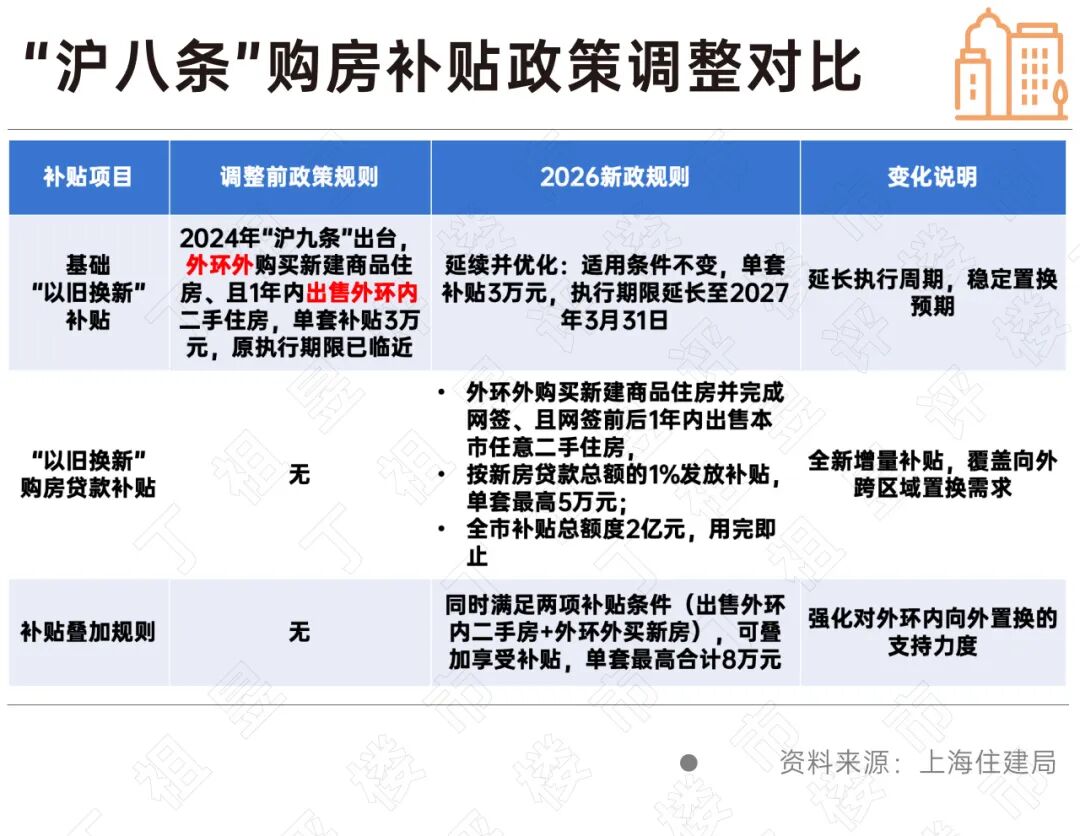
2. On the subsidy side, a new home purchase loan subsidy for trade-in programs is added, which is issued at 1% of the total new home loan amount, with a maximum of 50,000 yuan per unit. After superimposing the original trade-in subsidy, the maximum subsidy per unit can reach 80,000 yuan.
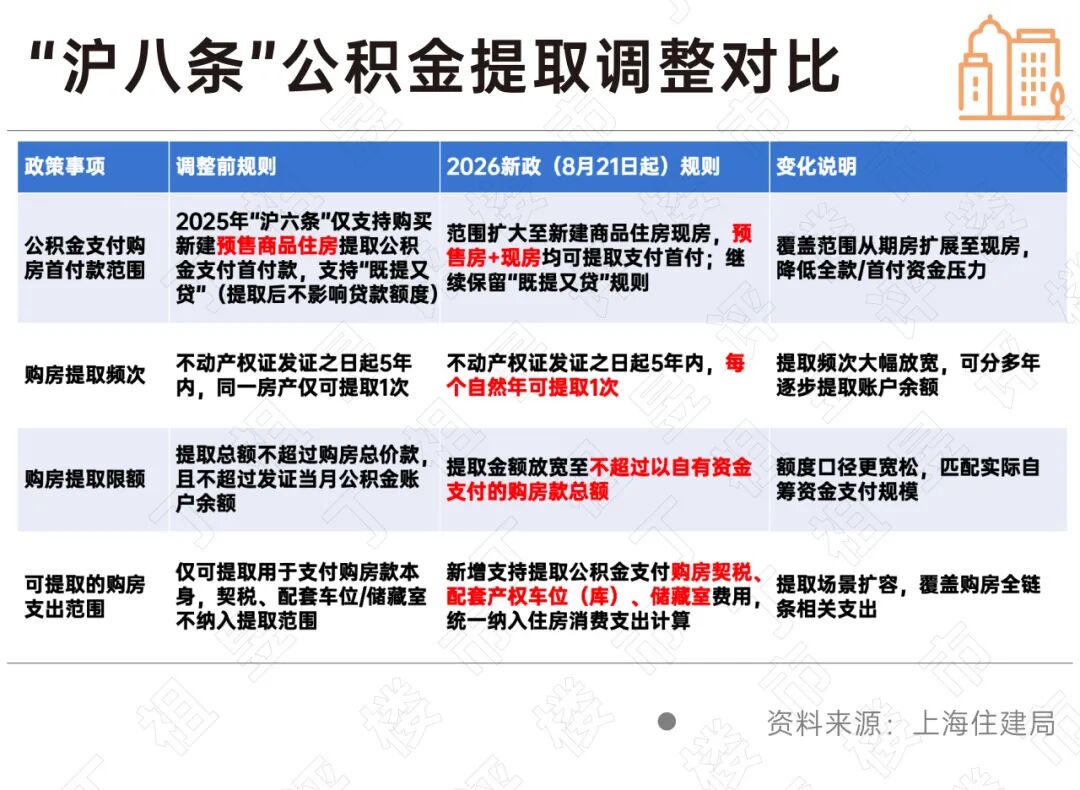
3. On the provident fund side, the withdrawal scope is expanded to cover the down payment of existing houses, the withdrawal frequency is relaxed to once a year, and the applicable scenarios are extended to deed tax, supporting parking spaces and storage rooms.
4. On the resettlement side, house ticket resettlement is promoted in expropriation and demolition, focusing on urban village renovation and old city reconstruction projects.
5. On the security side, the central urban area will accelerate the purchase of second-hand houses to be used as indemnificatory rental housing, further smoothing the replacement chain.
Overall, this round of "Shanghai Eight Policies" is a structurally optimized measure with clear positioning and targeted goals. It continues the consistent idea of differentiated regulation in Shanghai. After the "Shanghai Seven Policies" activated the core areas, it precisely makes up for the demand shortfall outside the Outer Ring Road, and coordinates with Beijing's policies to jointly support the "Golden September and Silver October" sales window.
From the "Shanghai Seven Policies" driving the "small spring peak" from March to April, to the "Shanghai Eight Policies" seizing the "Golden September and Silver October" window, Shanghai's policies have clearly outlined a precise regulation relay path, activated the market replacement chain, and set an example for the whole country.
01
From the perspective of Shanghai's new policy itself, it mainly includes 8 policy measures in 5 aspects: optimizing housing provident fund withdrawal, optimizing personal housing credit, implementing trade-in home purchase subsidies, promoting house ticket resettlement, and advancing the purchase of second-hand houses.
The first and most concerned part is the "down payment reduction". The Notice clearly optimizes the down payment ratio for second home loans. For those purchasing houses outside the Outer Ring Road (including the original areas with differentiated policies), the minimum down payment ratio for commercial personal housing loans for second homes is adjusted from "no less than 20%" to "no less than 15%".
In accordance with the provisions of the optimized policy, the minimum down payment ratio for commercial personal housing loans for first homes in the city is uniformly no less than 15%; the second home credit policy maintains regional differentiation, with the minimum down payment ratio no less than 25% inside the Outer Ring Road and no less than 15% outside the Outer Ring Road (including the entire Baoshan and Jiading districts).
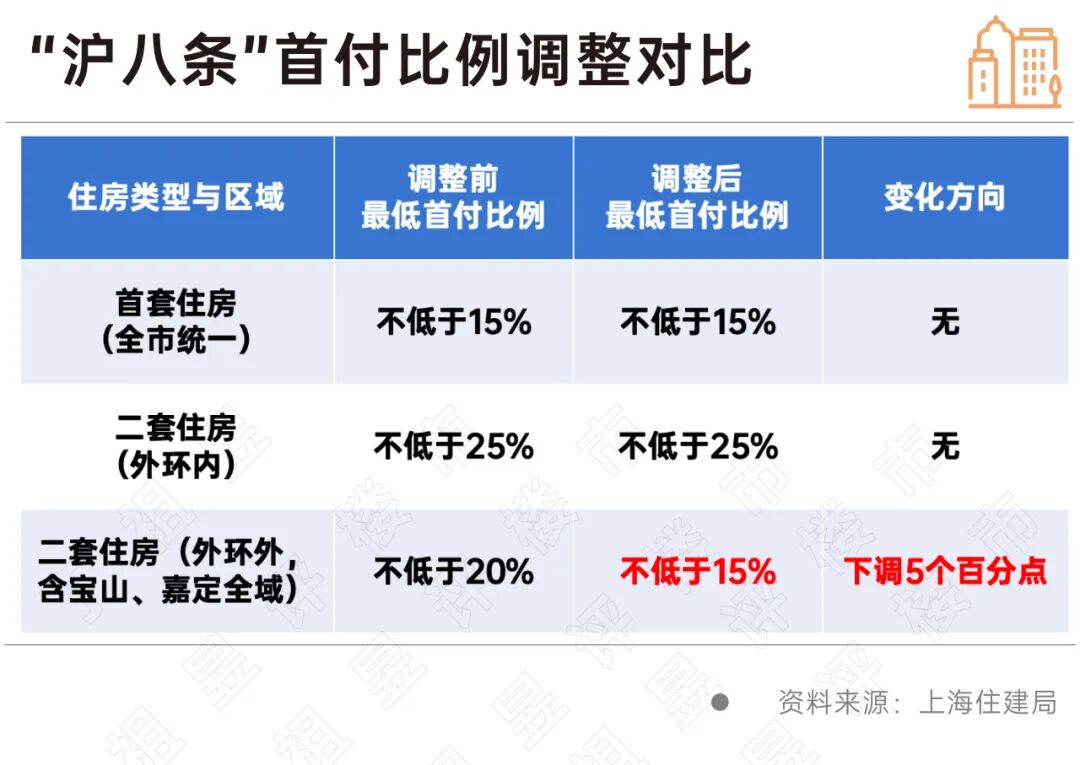
It is worth noting that this credit adjustment only targets second homes outside the Outer Ring Road (including the entire Baoshan and Jiading districts), which mainly reduces the down payment pressure for improved-type families to replace houses outside the Outer Ring Road, especially for second-home customers who sell old houses to buy new ones, guiding purchasing power to tilt to the new housing market outside the Outer Ring Road.
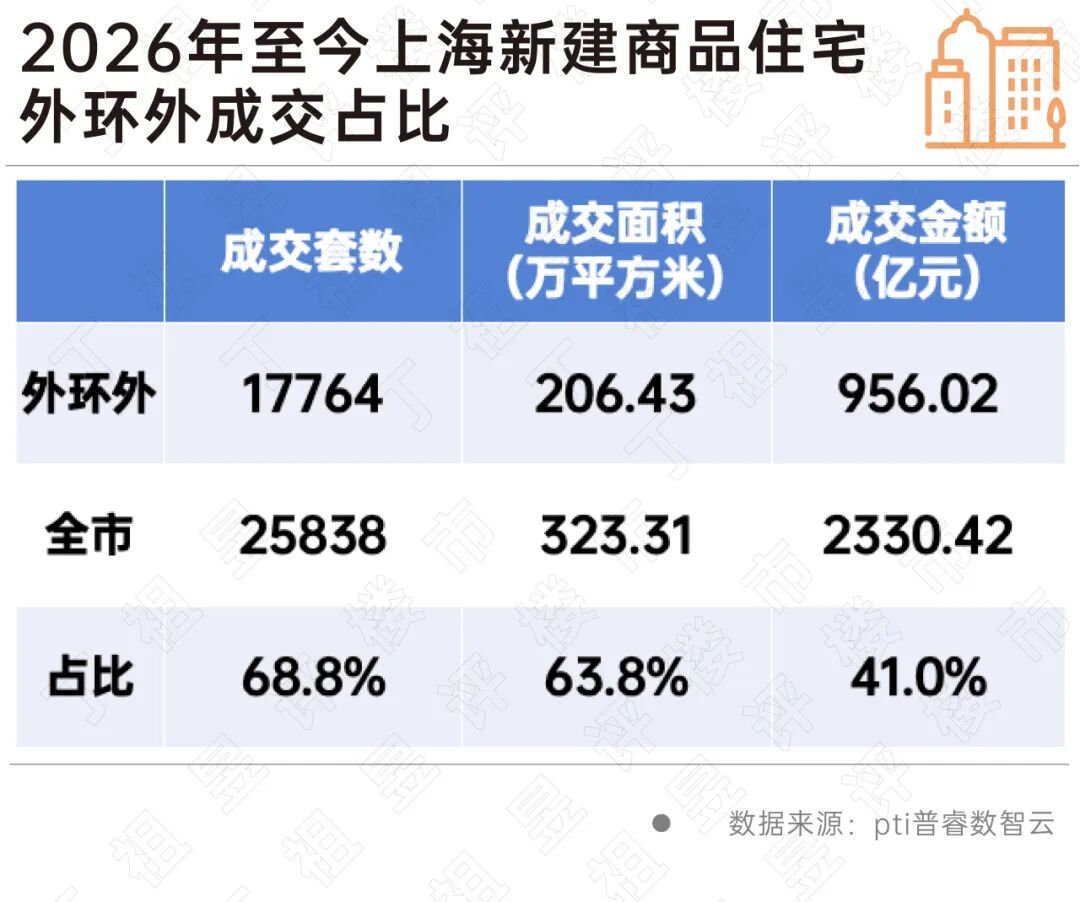
Data from Pury Digital Cloud shows that the transaction volume of new commercial residential buildings outside the Outer Ring Road in Shanghai accounts for about 68.8% of the total since 2026. That means nearly 70% of home buyers will benefit from this new policy.
The second part is subsidy. This new policy upgrades the home purchase subsidy policy. On the one hand, it continues and optimizes the trade-in subsidy of the "Shanghai Nine Policies" issued in 2024, on the other hand, it adds a new home purchase loan subsidy, which can be enjoyed in superposition if the conditions are met, with a maximum subsidy of 80,000 yuan per unit.
Both subsidies are strictly limited to "purchasing new commercial residential buildings outside the Outer Ring Road", which is the most targeted tool in this round of policies.
The next part is provident fund. This round of provident fund withdrawal policy is a city-wide optimization, including three adjustments: expanding the scope of down payment withdrawal, relaxing the limit of withdrawal frequency, and broadening the applicable scenarios of withdrawal, which greatly improves the flexibility of provident fund usage on the whole.
On the one hand, this is a response to the Decision of the State Council on Revising the Regulations on the Administration of Housing Provident Funds. On the other hand, it is also a real benefit for home buyers outside the Outer Ring Road. This is mainly because the total price of houses outside the Outer Ring Road is relatively lower, and the balance of provident fund accounts covers a higher proportion of down payment, taxes and supporting expenses. The relaxation of withdrawal policies can more effectively revitalize the stock provident fund of employees, reduce the cash flow pressure in the early stage of home purchase, and further strengthen the support for rigid demand and improved demand outside the Outer Ring Road.
Finally, the new policy also includes two long-term supply-side measures: promoting house ticket resettlement, and purchasing second-hand houses to be used as indemnificatory rental housing.
Since the work of purchasing second-hand houses as indemnificatory rental housing in Shanghai was substantially launched on February 2, 2026, it has obviously produced a "bottom-supporting" effect on Shanghai's second-hand housing market. Since March, the prices of old and small second-hand houses in Shanghai have begun to stabilize at the bottom.
Now, superimposing the house ticket resettlement work on the basis of purchasing second-hand houses as indemnificatory rental housing will further improve the market supply and demand regulation mechanism.
02
From the perspective of the timing of policy introduction, the landing of Shanghai's new policy this time is only two weeks away from Beijing's new policy on August 7 (for details of Beijing's new policy, please refer to "Beijing's Purchase Restriction is Further Loosened, The Vane of Real Estate Has Moved!").
The two first-tier cities have successively optimized their real estate policies, and the timing is highly consistent with the traditional marketing cycle of "Golden September and Silver October". This is not only a response to market expectations, but also an active grasp of the annual sales window.
Judging from the effect of past policies, after the landing of Shanghai's "Shanghai Seven Policies" in February 2026, the market showed the characteristics of "peaking in 1 month and maintaining a high platform for 3-4 months". This new policy will come into effect on August 21, and the release rhythm of policy effect will exactly coincide with the traditional peak sales season from September to October. Referring to historical experience, the policy pulse peak will most likely fall in September-October, and the high-level platform is expected to continue until the end of the year, providing support for the stable operation of the market throughout the year.
It is worth noting that before the landing of this new policy, there were rumors in the market that Shanghai would optimize the implementation rules for replacement home purchase. Although the official responded on August 15 that no new policy had been issued, it also reflected from the side that the market had clear expectations for policy loosening. Although this new policy does not adjust the purchase restriction rules, it accurately responds to the core demand of the market to "activate replacement demand" by reducing the down payment via credit policies and increasing replacement subsidies, which belongs to the policy landing within market expectations.
03
The significance of this "Shanghai Eight Policies" goes far beyond that. In essence, this round of "Shanghai Eight Policies" is a precise policy relay after the "Shanghai Seven Policies".
To understand its targeting, we need to first see what the "Shanghai Seven Policies" have done and what changes have taken place in the market as a result.
On February 25, 2026, five departments in Shanghai jointly issued the "Shanghai Seven Policies", firing the first shot of post-holiday purchase restriction loosening. It has three core points:
First, the home purchase threshold for non-Shanghai registered residents has been relaxed significantly. The social security payment requirement for buying houses inside the Outer Ring Road is reduced from 3 years to 1 year. Those who have paid social security for 3 years inside the Outer Ring Road can buy a second house. Those who have held Shanghai residence permits for 5 years can buy 1 house without providing social security or individual tax payment records.
Second, the maximum loan amount of the provident fund has been greatly increased. The maximum amount for first homes is raised from 1.6 million yuan to 2.4 million yuan, and the maximum amount can reach 3.24 million yuan when superimposing the preferential policies for multi-child families and green buildings, leading the whole country. The recognition of the number of provident fund loan units is optimized to "recognize the house but not the loan", and the scope of support for multi-child families is extended to second homes.
Third, the real estate tax is adjusted. If the family of an adult child of a Shanghai registered resident family has only one house after replacement, the real estate tax will be temporarily exempted.
The core of these three points is to activate the home purchase demand of non-Shanghai registered families. Superimposed on the substantial launch of Shanghai's work of purchasing second-hand houses as indemnificatory rental housing on February 2, shortly before the release of the "Shanghai Seven Policies".
With "official bottom support" on the one hand and "demand release" on the other, the second-hand housing market in Shanghai's core areas has been booming ever since.
Data from Pury Digital Cloud shows that in March 2026, the transaction volume of second-hand houses in Shanghai directly rushed to 31,200 units, and then hit a new high for the same period in every subsequent month. In total, the total transaction volume of second-hand houses in Shanghai in the first half of 2026 hit a new semi-annual high since the second half of 2021.
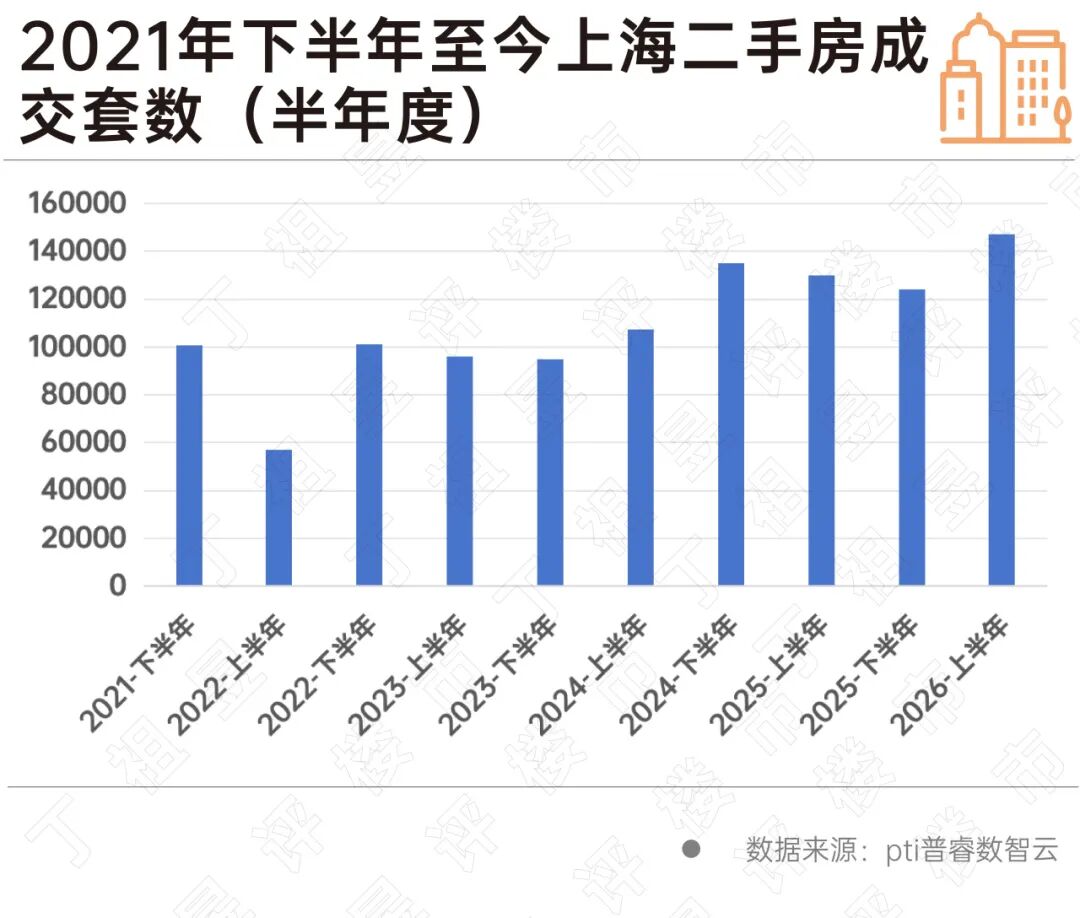
Driven by the second-hand housing market, the overall market heat of Shanghai has led the whole country since March 2026. But from a structural perspective, the boom is concentrated at two ends. One end is the old and small residential buildings in the urban area, and the other end is the luxury houses in the core area.
As the core bearing area of rigid demand and first-time improved demand, as well as the basic disk of the city's new housing market, the transaction volume in areas outside the Outer Ring Road, especially outside the Suburban Ring Road, has not kept pace with the heat of the old and small houses and luxury houses in the core areas.
Data from Pury Digital Cloud shows that the inventory in the area between the Outer Ring Road and the Suburban Ring Road accounts for about 40%, and the inventory outside the Suburban Ring Road accounts for about 30%. The overall transaction flow rate outside the Outer Ring Road, especially the flow rate outside the Suburban Ring Road, is lower than the inventory proportion, and the average price of new houses is far lower than the average level of Shanghai, indicating that the home purchase demand in this area has not been fully activated, and there is still incremental space for demand release.
After understanding this, looking at the policy adjustments of this "Shanghai Eight Policies", we can find that it precisely fills this regulation gap: the down payment for second homes outside the Outer Ring Road is further reduced, replacement subsidies are targeted at areas outside the Outer Ring Road, provident fund withdrawal is revitalized across the city, and the city-wide promotion of purchasing second-hand houses for indemnificatory rental housing extends policy dividends from the core areas to areas outside the Outer Ring Road.
With the coordination of areas inside and outside the Outer Ring Road, and the simultaneous advancement of four dimensions: qualification side, leverage side, cost side and security side, there is a clear and coherent logic behind this round of regulation in Shanghai.
Its essence is to tap potential demand according to the trend: in the outer suburban ring sections with good transaction foundation, further expand replacement demand by reducing down payment and relaxing provident fund withdrawal restrictions to consolidate the transaction scale; in the areas outside the Suburban Ring Road with greater potential, reduce the comprehensive cost of home purchase through home purchase subsidies to attract more rigid demand and overflow demand to enter the market, and continuously consolidate the growth momentum of the new housing market outside the Outer Ring Road.
The "Shanghai Eight Policies" itself extends the policy dividends from the core areas to the areas outside the Outer Ring Road precisely with 5 measures and 8 specific contents.
From the perspective of timing, the "Shanghai Seven Policies" took the lead in loosening the core areas in February, superimposed the official purchase of second-hand houses to support the prices of old and small houses, which promoted the second-hand housing market to stabilize and recover from March to April, thus driving the recovery of the whole city. In August, Shanghai took action in sync with Beijing to seize the "Golden September and Silver October" window. From the "Shanghai Seven Policies" to the "Shanghai Eight Policies", we can see that this is not an impromptu market rescue, but a well-prepared, rhythmical and methodical policy relay.
From a broader perspective, Shanghai's approach is writing a sample of the new development model of the real estate industry. As the industry shifts from high-speed growth to stable operation, policies no longer pursue the pulse-like rebound brought by one-time stimulus, but turn to expectation management, stock revitalization and supply-demand rebalancing.
From the "Shanghai Seven Policies" to the "Shanghai Eight Policies", Shanghai has taken half a year to embark on a clear, coherent and predictable path, which has certain reference significance for the national market.
This article is from WeChat official account "Ding Zuyi Reviews Real Estate", written by the Editorial Department and Pury Research, and authorized to be released by 36Kr.