"Hermès-style financing" has created a 3-trillion-yuan behemoth.
In recent days, a new term has gone viral on my social media feed, which is called "Hermès-style Financing".
The "Hermès" here does not refer to the luxury brand itself participating in investment, but its "sales model": unlike other brands, only part of Hermès' products are available for retail. If you want to buy popular categories such as bags, especially some best-selling styles, you need to reach a certain total consumption amount to get the purchase qualification, which is commonly known as "bundled purchase". The higher the popularity and the newer the style, the more bundled products you need to buy. It is said that some globally limited special styles are only open to VICs whose past consumption has reached a certain astronomical figure.
Many investors believe that today's venture capital market is becoming more and more "Hermès-like". For example, my friend Xingge, who tracks market trends, has summarized at least three types of "Hermès-style" phenomena:
1. To get investment qualifications, you must "bundle purchase" corresponding "orders". This phenomenon is said to be highly prevalent in the humanoid robot and chip industries, under the euphemistic name of "priority for industrial investment institutions".
2. To get the cornerstone investor qualification, you must "bundle purchase" corresponding "anchor investment". The bundled ratio for cornerstone and anchor investment is 2:1 or 1:1, the cornerstone share is locked for 6 months, and the anchor share is a more rigid long-term lock-up.
3. To get a lower valuation for Series A round, you must take a portion of shares at a higher valuation B. Companies in some popular tracks will launch multiple rounds of financing with different valuations at the same time, matching low valuation with high valuation, new shares with old shares, and equity with convertible bonds.
Generally speaking, people regard this as a very bubble-like phenomenon. It implies that the market consensus is overly concentrated, and the right to speak is seriously tilted towards star unicorns and top-tier investors. A netizen also confirmed the authenticity of this anecdote in the comment area, saying that he had just encountered "Hermès-style Financing": the other party demanded either a "1:4 bundled purchase" or "capital contribution within 2 weeks", which was extremely overbearing.
What I want to share today is exactly such a story of "Hermès-style Financing", but the main purpose is to make investor friends feel a little better: The protagonist wanted to invest in the hot unicorn A, but was required to invest in the seemingly very marginal startup B at the same time — after repeated trade-offs, the protagonist reluctantly accepted this request. Unexpectedly, more than ten years later, the former unicorn A has become unremarkable, while the marginal startup B has grown into a giant with a valuation of 3 trillion, bringing the protagonist a huge return.
This marginal company is called Palantir, and the "villain" of this story is the famous legendary investor Peter Thiel.
"Want to invest in Airbnb? Invest in Palantir first"
Let's go back to 2012. In that year, almost all venture capitalists were discussing the "Internet Plus" trend, for a very simple reason: one year earlier, 4G networks were gradually put into commercial use, with a speed 25 times that of the previous ADSL broadband and 20 times that of 3G networks; also one year earlier, Apple released the milestone iPhone 4S, which completely broke the mobile phone out of the positioning of "communication equipment", making people realize that mobile phones can participate in work, life and entertainment in all directions just like computers. The combination of the two created an unprecedented market gap.
For Ajay Royan, this meant more of a chance for redemption.
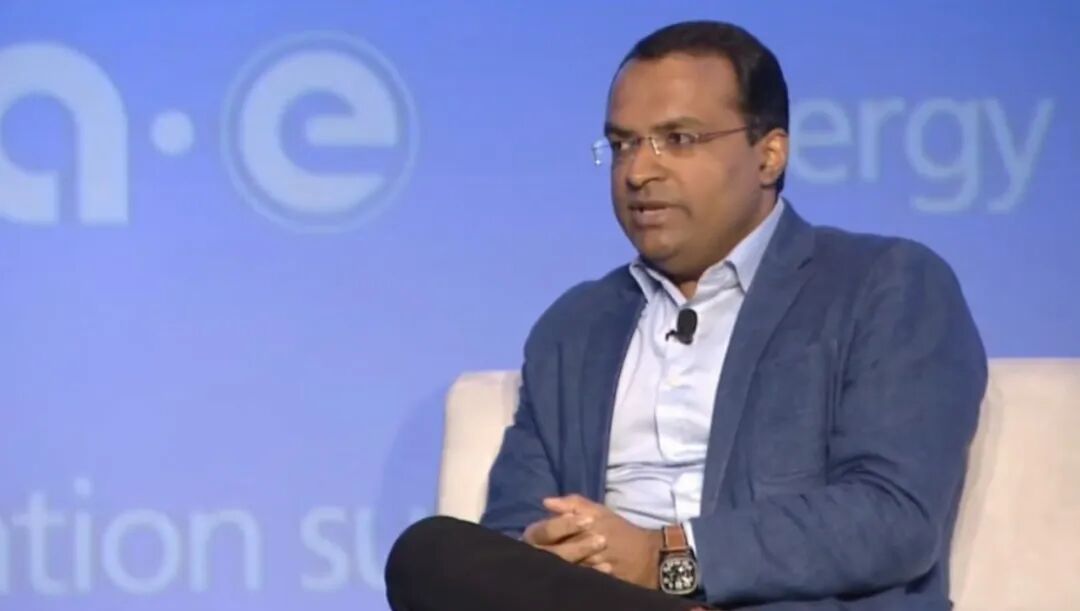
(Ajay Royan, Source: Official website of Mithril Capital)
Ajay Royan is a very typical "Indian-origin elite": quick-thinking, clear-headed, he showed outstanding talent in science and engineering from an early age, then got the opportunity to study in the United States with excellent grades, and successfully joined Clarium Capital, a hedge fund founded by Peter Thiel, starting his Wall Street career. Unfortunately, this story line came to an abrupt end in 2008. In 2008, the subprime mortgage crisis swept the world, and Wall Street suffered heavy losses, so did Clarium Capital. In just four years from 2008 to 2012, Clarium Capital lost more than 6 billion US dollars, which directly led to its bankruptcy announcement the following year.
Fortunately, this was the fate of a whole generation, not anyone's personal fault, and Peter Thiel knew it very well. So in 2012, Peter Thiel funded the establishment of a brand new venture capital fund Mithril Capital, retaining Ajay Royan and his old colleagues from Clarium Capital. What is more valuable is that Peter Thiel directly solved the capital problem of Mithril Capital: he personally invested 100 million US dollars, and quickly attracted more than a dozen LPs with his personal influence, rapidly expanding the fund size to 402 million US dollars. But he did not interfere in the operation of Mithril Capital at all, and Ajay Royan had full say in investment decision-making and team building.
What level of "grace of recognizing talent" is this?
Therefore, since the establishment of Mithril Capital, Ajay Royan has been in full working state, searching all over the world for the startup that can generate phenomenal returns. A few months later, he locked his target: Airbnb.
In Ajay Royan's view, Airbnb gave full play to all the advantages of entrepreneurship in the "social network era": for example, it is essentially a platform, so it can achieve growth and expand business with relatively low capital investment without owning any real estate; for another example, it endows the product with strong social attributes, which enhances user trust, and the more users there are, the more housing resources there are, forming a structural advantage that is intertwined. Ajay Royan tried every means to get in touch with the Airbnb team, win their trust, and fight for the lead investor right of Airbnb's Series C round.
Facts later proved that Ajay Royan's judgment was very accurate. In 2012, Airbnb's valuation was just over 2 billion US dollars, and by 2020, its valuation had exceeded 30 billion US dollars. Ajay Royan did successfully get the lead investor right of Airbnb's Series C round.
But the problem is, Peter Thiel has more than just Mithril Capital as his venture capital fund. Although these funds share the same boss, they are operated by different management teams, thus forming a delicate competitive relationship that is extremely similar to office politics. And Airbnb completely became the trigger:
After finalizing the lead investor right of Series C round, the excited Ajay Royan went public, publicizing everywhere that he was the main investor of Airbnb, and telling LPs that he had secured enough Airbnb investment shares. This move greatly angered Founders Fund, the direct line fund of Peter Thiel. They believed that Peter Thiel was the early angel investor of Airbnb, and Founders Fund was the venture capital fund directly operated by Peter Thiel, which should have the priority lead investor right, so they decided to compete for the lead investor right of Airbnb.
The competition for the "lead investor right" eventually led to the famous "Hermès-style Financing" mentioned at the beginning: With the mediation of Peter Thiel, the lead investor right was taken away by Founders Fund. At the same time, in order to ease the relationship between the two funds, Peter Thiel promoted Mithril Capital to invest in Palantir.
Compared with Airbnb in 2012, Palantir in 2012 was far less impressive: its business was only limited to counter-terrorism and anti-smuggling, and it had not made profits for more than ten years before that, basically relying on the blood transfusion from Peter Thiel personally and Founders Fund to maintain operation. There is also a very intriguing detail: in July 2015, Palantir launched a new round of financing with a valuation of 20.3 billion US dollars, becoming the third largest unicorn in the United States at that time. But according to a document exposed by the media in 2016, Founders Fund, as the incubator, valued Palantir at only 12.7 billion US dollars, 38% lower than the valuation of this round of financing. Some large hedge funds in the old stock trading market even quoted Palantir's valuation at around 10.5 billion US dollars.
In this context, few people at that time thought Peter Thiel was easing the relationship between the two funds under his banner. To most onlookers, Peter Thiel was more like forcing Ajay Royan to show loyalty and accept the non-performing assets in the hands of Founders Fund. The inside of Mithril Capital was even more dejected, saying "This is a complete disgrace to us". The media also tried to restore the negotiation process between the two funds, but no one from Mithril Capital was willing to talk about it, because they were "afraid of retaliation".
It is precisely this kind of "grievance" that eventually makes the whole story full of drama. After Palantir went public in 2020, its market value soared all the way. Especially after the intensification of geopolitical conflicts in 2022, defense technology was selected by the times as the most politically correct track, Palantir's market value once exceeded 4.9 trillion US dollars (about 3.3 trillion RMB) at its peak. According to regulatory documents, Mithril Capital held a total of 1.3% of the equity at the time of listing.
For comparison, Airbnb, which Ajay Royan was extremely optimistic about back then, had a market value of about 47 billion US dollars when it went public. Although its market value once exceeded 120 billion US dollars after listing, it fell back to around 54 billion US dollars due to the impact of the epidemic, and did not return to the 100 billion US dollar mark until 2026.
"The Legacy of the Dot-com Bubble Era"
So back to reality, how should we view the "Hermès-style Financing" that is increasingly giving investors a headache now?
First of all, it must be made clear that Ajay Royan's story is obviously unreplicable. We can hardly draw any referable methodology from his "bundled purchase" experience. After all, Palantir, Peter Thiel, the year 2012, and Ajay Royan's gratitude to Peter Thiel are all unique. You cannot rationally explain why Ajay Royan accepted such a plan, and why Ajay Royan actively increased his holdings of Palantir's old shares in 2013, which allowed them to own as high as 1.3% of the shares at the time of listing.
In fact, even he himself felt that everything was too "unrealistic". In an exclusive interview with Fortune magazine in 2019, Ajay Royan once said, "If I were to design a cultural T-shirt for Mithril Capital, I would print 'Investing is hard' on the front and 'Investing is really hard' on the back".
In addition, Ajay Royan's legendary experience is more suitable to be interpreted as a fable about "patient capital", because from many signs, everything is under the control of Peter Thiel's pace, but Peter Thiel's pace is so different from ours. For example, as early as in a public speech in 1999, Peter Thiel said that "a great enterprise generates 75% of its revenue 12 years after its establishment". For another example, in a conversation in 2019, Peter Thiel said, "We always say that we should have a long-term vision, but usually the so-called long-term is not as long as it should be".
However, it is precisely this kind of "unreplicable" that confirms a more important fact: only in the bubble period will "bundled purchase" become the norm in the venture capital market.
I tried to use Ajay Royan's experience as a template for retrieval, and found that most similar cases were concentrated in the dot-com bubble period, and had distinct characteristics driven by the secondary market. From the beginning of 1996 to the early 2000, with the hot capital market and the shortage of high-quality targets, large investment banks such as Credit Suisse First Boston (CSFB), Goldman Sachs, and Morgan Stanley gradually tried to set up some "additional rules" to revitalize assets. One of the most controversial rules is "bundled purchase", requiring investors who want to get shares of popular IPO (Asset A) to buy shares of unpopular IPO (Asset B) at the same time to get the quota.
None of these bundled assets became dark horses like Palantir, and most of them became cannon fodder after the burst of the dot-com bubble in 2000. Therefore, looking through the reports at that time, you can always see William Donaldson, then chairman of the U.S. Securities and Exchange Commission (SEC), furious, believing that this is an intolerable chaos: "The issuance price and secondary market trading price should be determined by investor demand, and should not be subject to manipulative influence or improper behavior by those who push the issuance to the market and profit the most from it."
The U.S. regulatory authorities also introduced a number of policies since 1996 to curb the occurrence of similar phenomena, and filed charges against relevant investment banking institutions. Well-known institutions including CSFB, Goldman Sachs, Morgan Stanley, JPMorgan Chase, and Robertson Stephens under FleetBoston Financial were all on the list. The most tragic one was CSFB: in 2002, they decided to reach a settlement with the regulatory authorities and paid a fine of up to 100 million US dollars.
In addition, there is also a certain "placement" situation in "mutual funds". When the scale of a single transaction is too large for a single fund to bear independently, or may lead to excessive concentration of the fund, the GP (the fund itself) will provide LPs with co-investment opportunities to balance returns and risks. However, since the mutual fund is set up to balance risks, no carry bonus is set. Therefore, GPs usually launch mutual funds in cases that deviate from their core expertise or where they are not very confident, and leave the cases with higher certainty and more accurate judgment to themselves.
In this case, some GPs subtly set the contribution to the "mutual fund" as a "placement indicator", suggesting that LPs who want to participate in the GP's best investment project (Asset A) in the future may need to accept co-investment in some underperforming projects (Asset B) to maintain a good relationship with the GP.
So when I was writing this article, I often thought of the abstract golden sentence Peter Thiel said when he was a guest on the tech podcast All-in Podcast in 2024: "At a certain point, attention will become the worst thing in the world", and the classic sentence written in Zero to One: "If you put short-term growth above everything else, you will miss the most important problem".
It seems that we have reached this point. It seems that we have also created this point with our own hands.
This article is from the WeChat official account "East 40th Capital" (ID: DsstCapital), Author: Pu Fan, published by 36Kr with authorization.