Wang Zhenhui returns to JD.com, first taking on the sunk cost of the food delivery war.
On August 13, Wang Zhenhui, as CEO of JD Logistics, released his first interim performance report after returning to the company. Revenue in the second quarter reached 64.102 billion yuan, up 24.3% year on year. Revenue from external customers stood at 44.227 billion yuan, representing a 30.8% year-on-year increase and accounting for 69% of total revenue.
Profit did not accelerate in tandem. Adjusted net profit in the second quarter was 2.644 billion yuan, with a mere growth of 2.2%; the adjusted net profit margin dropped from 5.0% to 4.1%, and the gross profit margin fell from 10.6% to 9.7%. On the first trading day after the financial report was released, the share price of JD Logistics closed down 13.69%; on August 17, the company spent another HK$69.898 million to repurchase 5.7308 million shares.
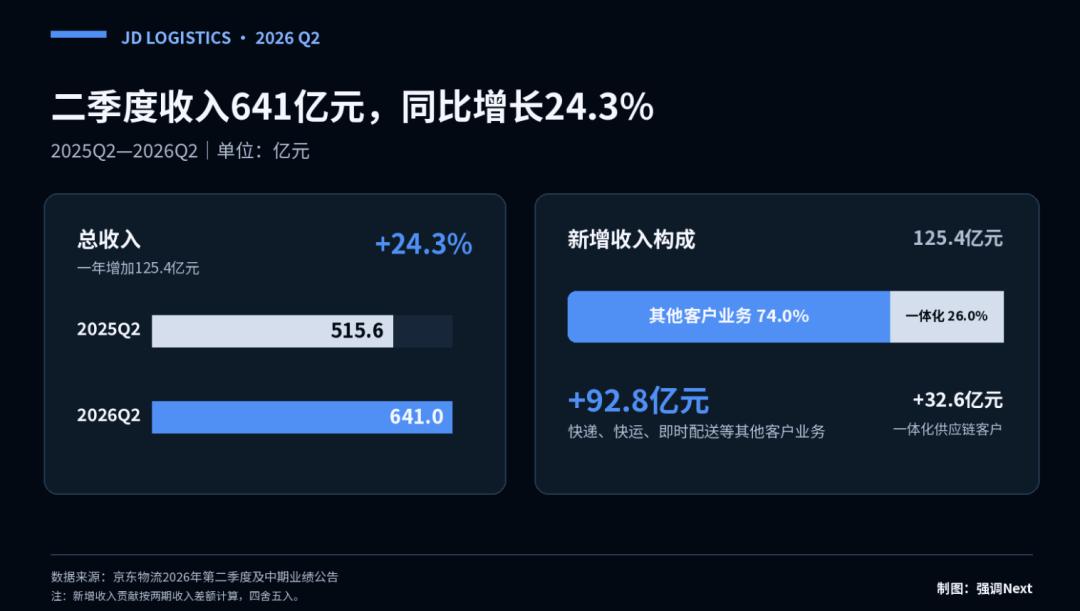
The market is wondering what makes up this 24.3% growth. After breaking down the customer and business calibers, it can be seen that the fastest-growing part is not the integrated supply chain that JD Logistics has repeatedly emphasized, but the newly incorporated instant delivery, as well as standardized businesses such as express and freight transportation. These businesses have rapidly expanded revenue, but also brought more outsourcing costs into the income statement.
This financial report is therefore more like the starting point of Wang Zhenhui's second tenure at the helm of JD Logistics. During his first tenure, he transformed JD's cost department into a logistics company operating externally; this time, he has to tackle a more difficult problem: how JD Logistics can continue to prove itself as an independent and open supply chain company while taking over orders from JD's food delivery business, sinking retail markets and European e-commerce platforms again.
69% "External Revenue" Does Not Equal Independence
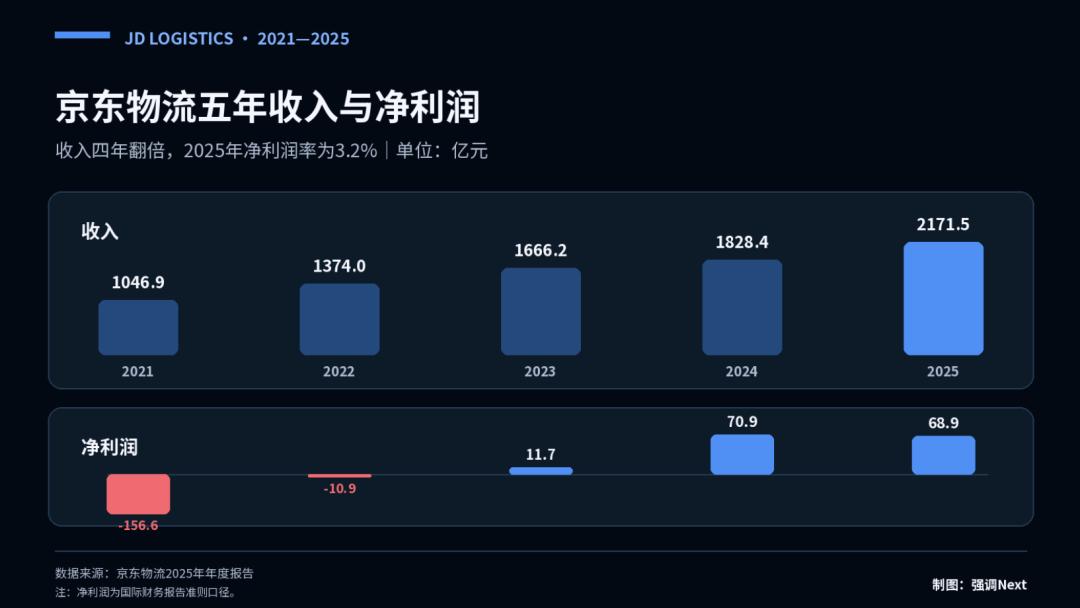
In 2017, when JD Logistics was split from the group to become a sub-group, Wang Zhenhui proposed to achieve 100 billion yuan in revenue within five years. In 2019, he announced that the proportion of external revenue of JD Logistics was close to 40%, claiming that the company had basically completed the transformation from an in-house logistics department to a third-party logistics enterprise. In 2021, JD Logistics' revenue reached 104.7 billion yuan, meeting the 100-billion-yuan target as scheduled, and the proportion of revenue from external customers exceeded 50% for the first time.
When Wang Zhenhui returned to the position of CEO in November 2025, he took over a listed company with an annual revenue of more than 200 billion yuan and an external revenue proportion of over 60%. Judging solely from the 69% external revenue proportion in the second quarter of 2026, the open operation goal established during his first tenure seems to have been achieved.
But this proportion is losing its explanatory power.
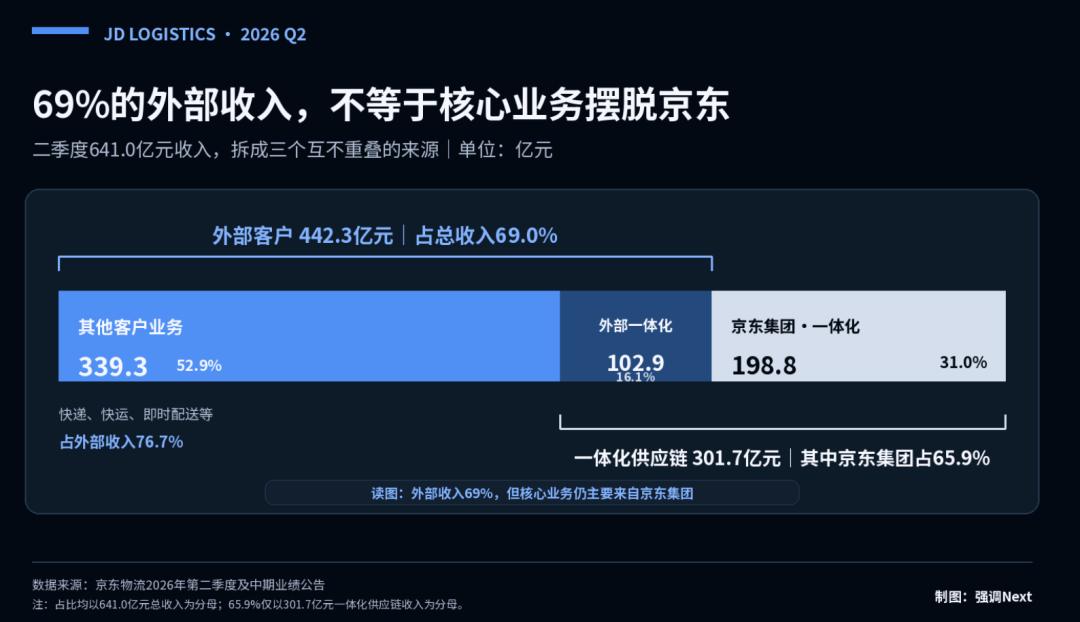
JD Logistics divides its revenue into revenue from integrated supply chain customers and revenue from other customers such as express, freight transportation, and instant delivery. In the second quarter, the revenue of integrated supply chain reached 30.168 billion yuan, of which JD Group contributed 19.875 billion yuan and external customers contributed 10.293 billion yuan. That is to say, in the core business recognized by the company, revenue from JD Group still accounts for 65.9%.
Of the 44.227 billion yuan in external revenue in the same period, 33.934 billion yuan came from other customer businesses, accounting for 76.7%. The main part of external revenue is no longer the integrated supply chain that is deeply involved in inventory management, warehousing and fulfillment, but more standardized express, freight transportation and instant delivery services.
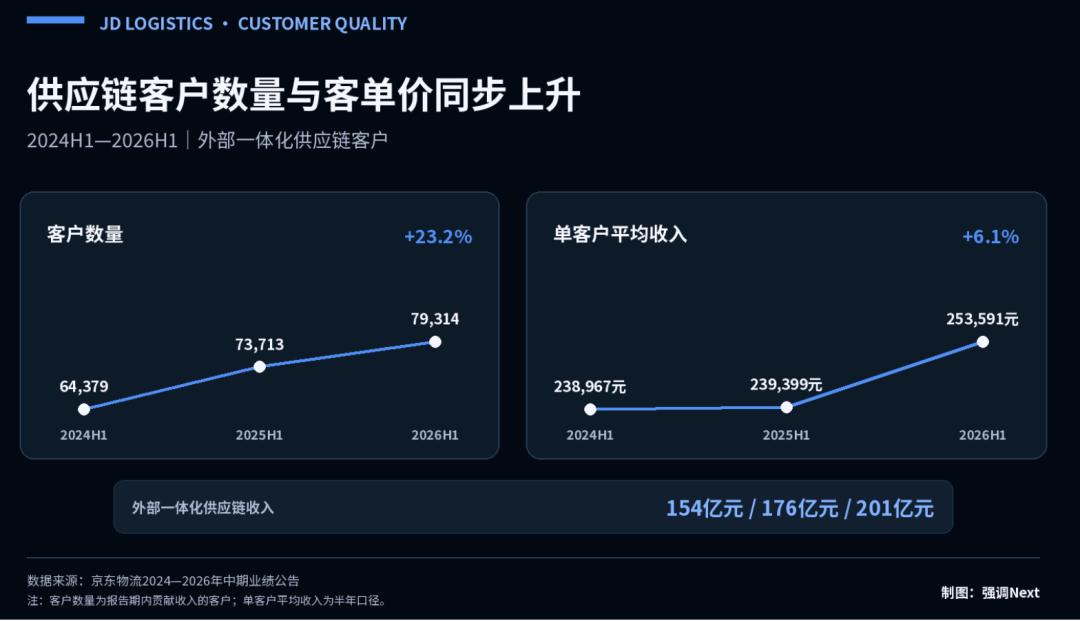
This does not mean that the quality of external business has deteriorated. In the second quarter, both the number of external integrated supply chain customers and the revenue per customer increased, with the relevant revenue rising by 12.5% year on year; the number of customers in the first half of the year reached 79,300, up 7.6% year on year, and the average revenue per customer increased from 239,000 yuan to 254,000 yuan.
The problem is that the 69% external revenue proportion puts two business models under the same label: one type tests industry solutions, inventory turnover and customer stickiness, while the other relies more on order volume, timeliness and transportation capacity cost.
For today's JD Logistics, the increase in the proportion of external revenue can no longer directly prove that its dependence on JD has decreased. What is more important is the proportion of external integrated supply chain in the core business, and whether these customers can continuously purchase more services.
Food Delivery Brings Revenue and Rewrites Cost Structure
The biggest caliber change this quarter comes from instant delivery.
In October 2025, JD Logistics acquired the local instant delivery business of the original Dada system from JD Group for about 270 million US dollars, and the transaction was completed on October 31. JD Logistics' 2025 annual report shows that this business contributed 8.002 billion yuan in revenue and 345 million yuan in profit only in the two months after the consolidation. As it is a business combination under the same control, the company did not restate the comparative period data before the acquisition.
Since January 2026, the transaction relationship has changed once again. Previously, JD Logistics provided delivery services for internal group businesses such as JD Food Delivery, and the relevant revenue was recorded as revenue from JD Group. After that, JD Logistics changed to directly provide instant delivery services to third-party merchants on the JD platform, and the revenue was recorded as external customer revenue.
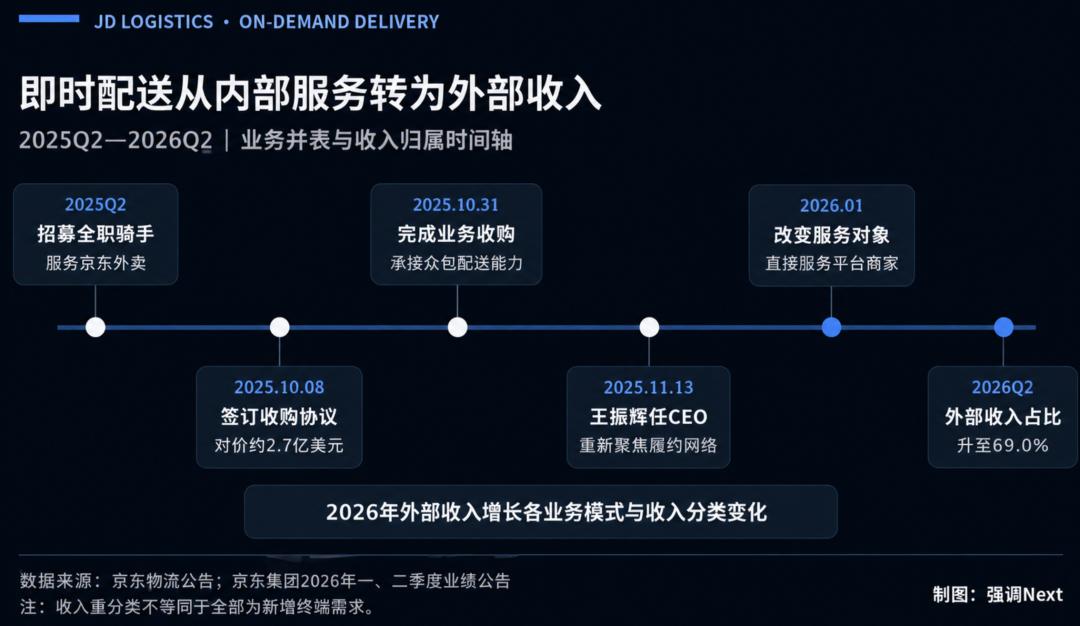
The same set of JD platform orders and delivery networks have thus been converted from internal revenue to external revenue. There are commercial changes in this process, but it cannot be simply understood that JD Logistics has obtained more customers independent of JD's ecosystem.
This adjustment has a great impact on growth. JD Logistics' revenue in the second quarter increased by 12.538 billion yuan year on year, of which the revenue from other customers such as express, freight transportation and instant delivery increased by 9.276 billion yuan, contributing about 74% of the increment. The revenue of integrated supply chain increased by 3.262 billion yuan. The company did not disclose the caliber growth rate excluding the consolidation of instant delivery and revenue reclassification, so the 24.3% growth cannot be fully regarded as organic growth.
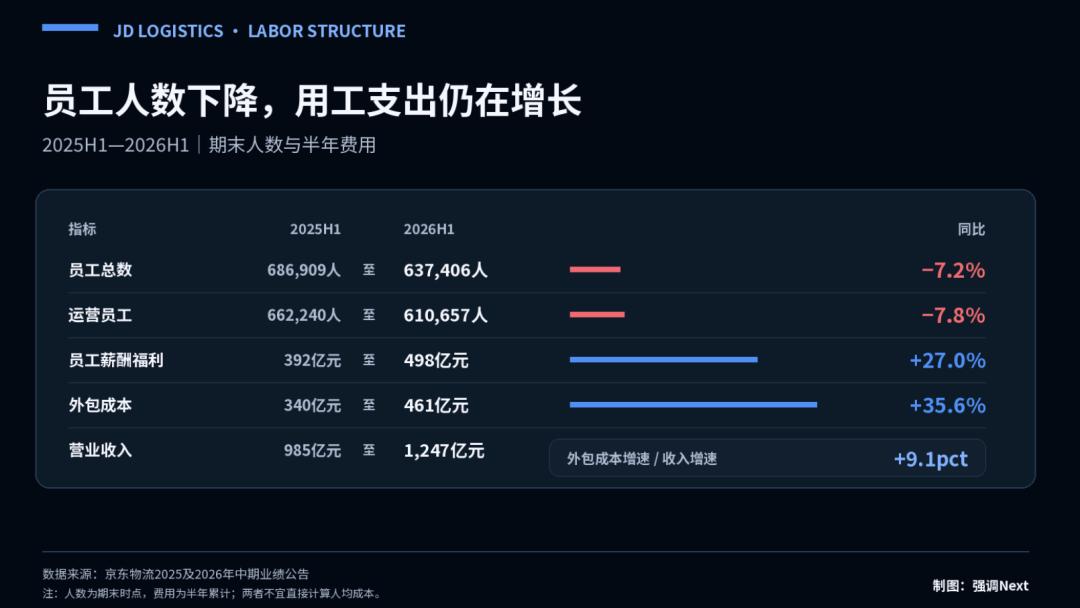
The cost side can better illustrate the problem. In the second quarter, employee compensation and welfare expenses reached 21.94 billion yuan, accounting for 34.2% of revenue, down 1 percentage point; however, outsourcing costs increased by 40.5% to 23.7 billion yuan, accounting for 37% of revenue, up 4.3 percentage points. The two items together account for 71.2% of revenue, up 3.3 percentage points year on year. The management clearly stated that the rise in outsourcing costs is mainly due to the consolidation of the crowdsourced instant delivery business.
JD Logistics puts full-time riders and crowdsourced transportation capacity into the same network, which has brought order scale and coverage density in the short term, at the cost of a simultaneous decline in gross profit margin and adjusted net profit margin.
Deppon is still in the business adjustment period, which also dragged down the overall gross profit margin. In the first half of the year, free cash flow turned from a net inflow of about 300 million yuan in the same period of the previous year to a net outflow of about 600 million yuan. Although operating cash flow reached 6.4 billion yuan, capital expenditure and lease payments totaled about 7 billion yuan.
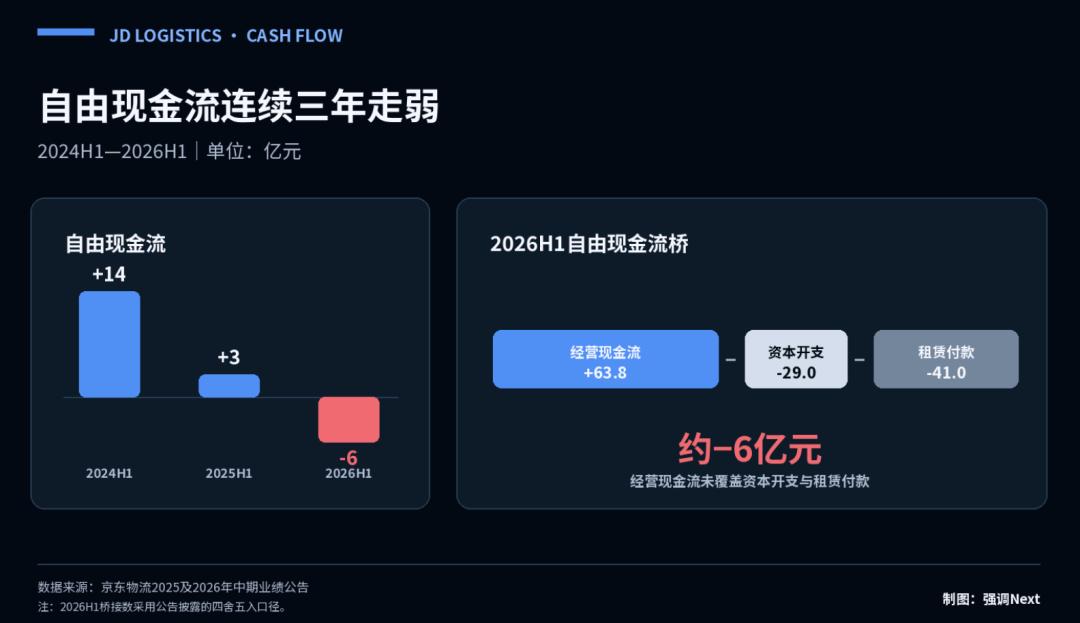
The positive side is that the free cash flow in the second quarter has recovered to a net inflow of 2.15 billion yuan, and the management said that the gross profit margin of the original core business is still improving. The real value of instant delivery to profits will not be seen until the order density increases and the proportion of outsourcing costs can fall.
Serve JD First, Then Expand Beyond JD
During his first tenure at the helm, Wang Zhenhui once asked the team to actively reach out to Alibaba and Pinduoduo. He said publicly that logistics is always the service provider, and JD Logistics, as an infrastructure, should be open to all customers. One of the purposes of establishing an independent sub-group is to ensure that the finance, organization and business decisions are not completely restricted by JD Retail.
Nine years later, Wang Zhenhui is still talking about openness, but the path has changed. JD Logistics is re-becoming the infrastructure for JD to expand new businesses: organizing full-time riders and crowdsourced capacity for JD Food Delivery, providing warehousing and distribution services for JD Retail to sink into lower-tier markets, and following JD's newly launched Joybuy in Europe to operate JoyExpress and densify the local warehousing and distribution network.
This is not a denial of the open strategy. JD's self-operated retail once provided the initial order density for the warehousing and distribution network, and then it had the ability to open up to external brand owners. Now, JD Food Delivery and Joybuy are also playing a similar role as launch customers.
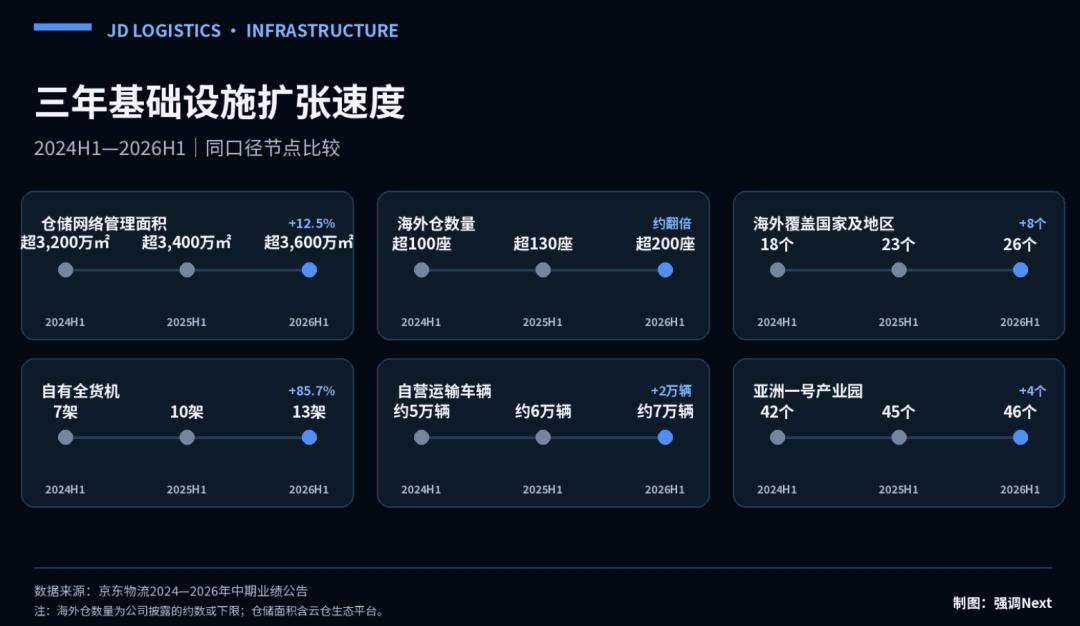
In the second quarter, the revenue of JD Group's integrated supply chain increased by 11.9%, and the management said that one of the main driving forces is the fulfillment demand of Joybuy; as of the end of June, JD Logistics has operated more than 200 overseas warehouses in 26 countries and regions, with an overseas warehouse management area of more than 2 million square meters.
The real dividing line is when these networks can change from "following JD's footsteps" to "retaining external customers". At the performance meeting, Wang Zhenhui said that the cooperation scale of some leading consumer electronics customers in Europe has more than doubled, and the automation of overseas warehouses and order density have also begun to improve unit economics. However, the company did not disclose overseas revenue, external customer proportion and profit margin, so the outside world cannot judge whether Joybuy is helping JD Logistics spread costs or pushing it into a new round of heavy asset investment.
Wang Zhenhui's second round of opening up is therefore not to separate JD from the logistics business more thoroughly, but to repeat a more complicated path: first fill the network with JD's retail, food delivery and overseas expansion businesses, and then sell the network to customers outside JD. The first step has been completed, while the second step still lacks verification from financial data.
Technology Output Is the Touchstone of the Third Stage
Before leaving office in 2020, Wang Zhenhui once divided the development of JD Logistics into three stages: transforming from an in-house logistics department to a logistics enterprise, becoming a leading domestic supply chain logistics enterprise, and finally becoming a leading global supply chain logistics enterprise relying on technology.
When he returned, the scale conditions of the first two stages were already met, while there was still only partial evidence for the third stage.
JD Logistics' R&D investment in the second quarter was 1.207 billion yuan, up 20.1% year on year. The company has deployed the "Smart Wolf" goods-to-person system in more than 30 warehouses in China, and put it into use in the UK and Germany; the "Heterogeneous Wolf" robotic arm has realized 24-hour normal operation, and AI scheduling has been applied to warehousing, transportation, distribution and customer service. In the first half of the year, the company also deployed a smart warehouse system for a leading consumer electronics customer in the Middle East, and mentioned at the performance meeting that it had signed an automation solution contract with Japanese pharmaceutical and medical aesthetic customers.
These cases prove that the technology can operate outside JD's own warehouses, but it has not yet proved that technology itself has become an independent business. The company has not separately disclosed the order value, revenue and gross profit margin of logistics technology, nor has it given the absolute cost saved by AI scheduling. The results that can be seen in the income statement at present are the decrease in vehicle and rental cost ratio and the decrease in employee cost ratio, but the rise in outsourcing cost ratio has offset these efficiency improvements.
Therefore, to judge JD Logistics after Wang Zhenhui's return, there is no need to wait for a higher proportion of external revenue. What is more important next are four sets of figures: the same-caliber growth rate excluding the consolidation of instant delivery, the proportion of external integrated supply chain in the core business, overseas external revenue and warehouse network utilization rate,